CRS Points Guide · Updated September 2026
Canadian Education Points CRS: 15 or 30? The Rules and Real Cases
When you get 15 points, when you get 30, the rules that can wipe them out, and the profile answers that cost real applicants their points.
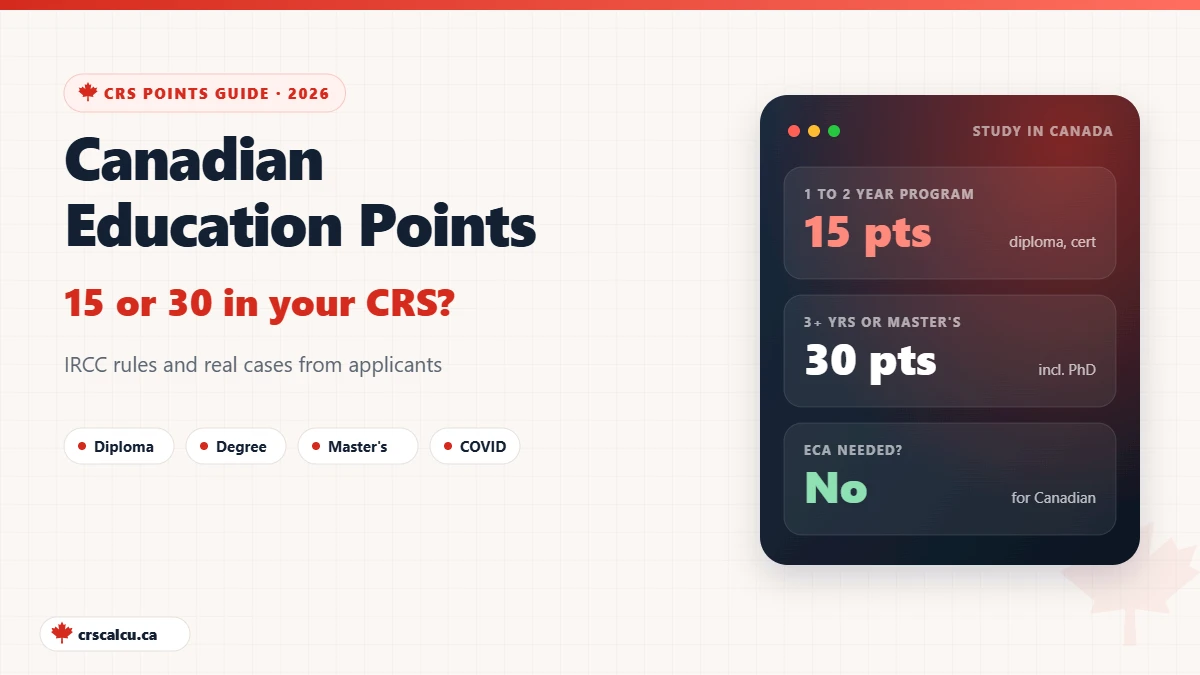
If you studied in Canada, Express Entry gives you extra points on top of your normal education score. The Canadian education points CRS awards are either 15 or 30. That gap alone can decide whether you get an invitation or keep waiting.
The rules look simple on IRCC’s grid, but the forums tell another story. We read more than 20 threads on a large Canadian immigration forum, posted between 2016 and 2026. Most people who saw 0 points did not have a bad credential. They had ticked the wrong box in their profile.
This guide covers the official Canadian education points CRS rules, the COVID online study exception, and the exact answers that fixed real profiles.
Quick answer: how many Canadian education points CRS gives
You get 15 points for a Canadian credential from a one- or two-year post-secondary program, and 30 points for a program of three years or more, a master’s or a PhD. You must have studied at a school in Canada, full-time for at least 8 months, while physically in Canada. No ECA is needed for Canadian credentials.
Key takeaways
How Many Canadian Education Points CRS Gives: 15 vs 30
The points sit in the “additional points” part of the CRS, next to French skills, siblings in Canada and a provincial nomination. IRCC’s CRS criteria page lists two levels. A credential of one or two years gets 15 points. A credential of three years or longer gets 30.
The legal text in the Ministerial Instructions adds one detail the grid hides. Section 30(1) gives 30 points for a program of three years or more, “or a master’s degree, or a doctoral degree.” So the length rule does not apply to master’s and PhD degrees.
Canadian credential | Points | Why |
|---|---|---|
8-month certificate (full-time) | 15 | Counts as a 1-year credential |
1-year post-graduate certificate | 15 | One-year program |
2-year college diploma | 15 | Still in the 1 to 2 year tier |
Two 1-year diplomas | 15 (most likely) | Neither program is 3+ years |
3-year advanced diploma | 30 | Program of 3 years or more |
4-year bachelor’s degree | 30 | Program of 3 years or more |
1-year or 2-year master’s | 30 | Master’s gets 30 at any length |
PhD | 30 | Doctoral degree |
Professional designation (e.g., CPA) | 0 | Not a post-secondary credential |
Source: IRCC CRS criteria and Ministerial Instructions s.30. The two-diploma row is our reading of the rules, not an official IRCC statement.
Why a 1-year master’s gets 30
In October 2020, an applicant with a master’s shorter than two years saw the CRS tool add 30 points and got confused, because the grid says “three years or longer.” A reply quoted the official wording: master’s and doctoral degrees get 30 even at one year. Earlier that year, members discussing 1-year master’s programs agreed that “a master is a master.” One poster projected a jump from 397 to 507 with a Canadian master’s plus one year of Canadian work.
Why a 2-year diploma gets only 15
Real case: 2-year PG diploma, 15 points, not 30
In January 2026, an applicant with a 3-year foreign bachelor’s and a 2-year Canadian post-graduate diploma saw only 15 points, while an online calculator suggested 30. The reply in August 2026 was clear. A Canadian credential of one or two years gets 15. Only three years or more, a master’s or a PhD gets 30. The reply also suggested getting an ECA for the foreign degree to check the “two or more” core points instead.
The 8-month vs 12-month question comes up a lot too. In January 2017, someone planning a 1-year post-grad program asked which was better for points. The answer: both count as 1-year credentials and both give 15. The choice matters more for the length of your post-graduation work permit.
The Conditions Your Canadian Credential Must Meet
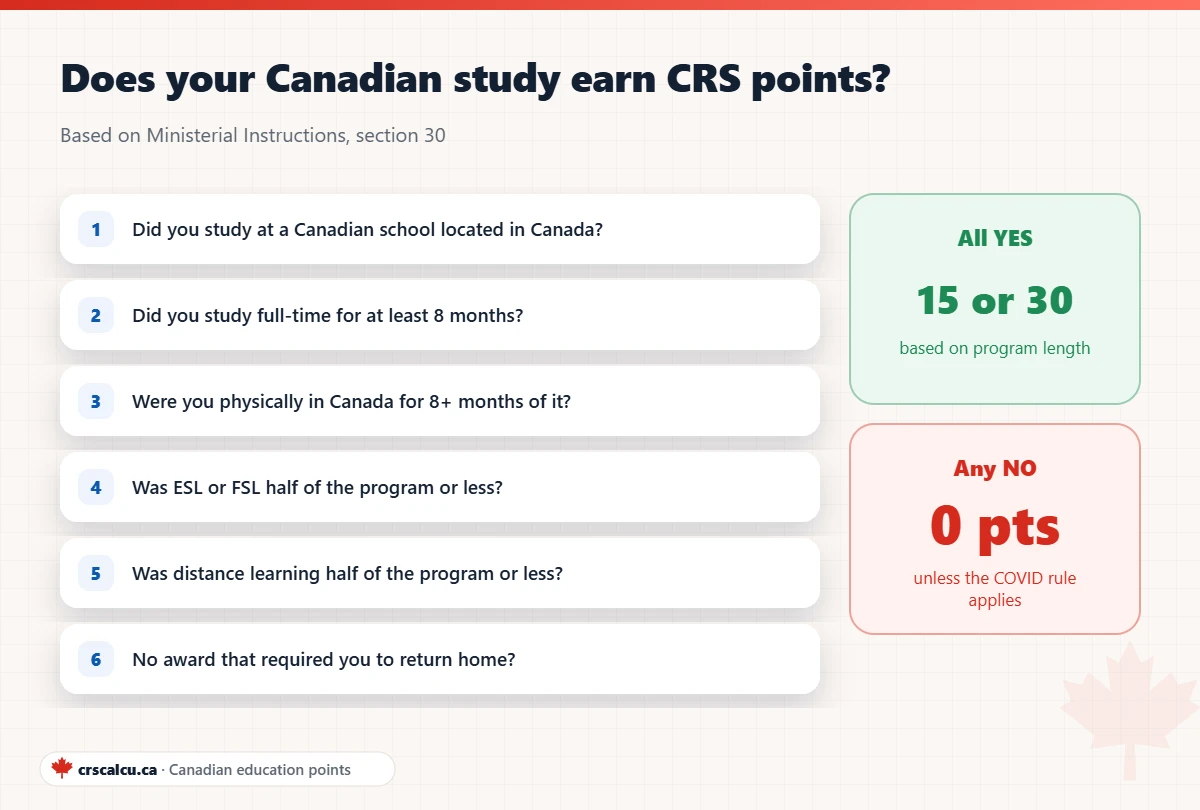
The length of your program only decides whether the Canadian education points CRS gives you are 15 or 30. First, your credential has to qualify at all. Section 30(3) of the Ministerial Instructions says points are only given if you:
The 3 study conditions in MI section 30(3)
On top of that, the same section removes points in three cases. Your credential earns nothing if English or French as a second language courses were more than half the program. It earns nothing if distance learning was more than half. And it earns nothing if you had a scholarship or fellowship that required you to go back to your home country to use what you learned.
8 months full-time and physically in Canada
Part-time study can still count, but only if at least 8 months of the program were full-time and you were in Canada for those months. A part-time evening certificate on its own will usually not qualify. The same goes for a program you took from abroad, outside the COVID window.
ESL/FSL, distance learning and return-home awards
The ESL/FSL rule is about courses that teach English or French, not courses taught in English. A college program taught in English is fine. A program that was mostly language classes is not.
The return-home rule catches sponsored students. In January 2022, a member had a Canadian bachelor’s funded by a home-country employer, with a contract to work for that employer afterwards. They felt the obligation was over because they had repaid the tuition. Nobody replied, and IRCC has no public guidance on that exact case. If this is you, ask IRCC before you claim the points.
Which schools count
The credential must come from a Canadian public post-secondary school, or a private school that runs under the same rules as public ones. Quebec DEP/ASP diplomas of 900 hours or more also count, and so do bachelor’s, master’s and doctoral degrees from authorized private institutions. Professional designations do not. In June 2020, a member with a CPA designation earned part-time in BC was told it does not give Canadian education points.
COVID Online Study: The March 2020 to August 2022 Exception
COVID pushed thousands of students online, and the rules took two years to catch up. In 2020, members reported that IRCC said, through social media, that studying more than 50% online would not earn points. Forum threads on this ran for pages, with no clear answer.
Then IRCC changed the rule. Its program delivery update, effective July 26, 2022, says you can still get the Canadian education points CRS offers if you did any part of your program between March 1, 2020 and August 31, 2022. That holds even if you studied fully online from outside Canada, or part-time.
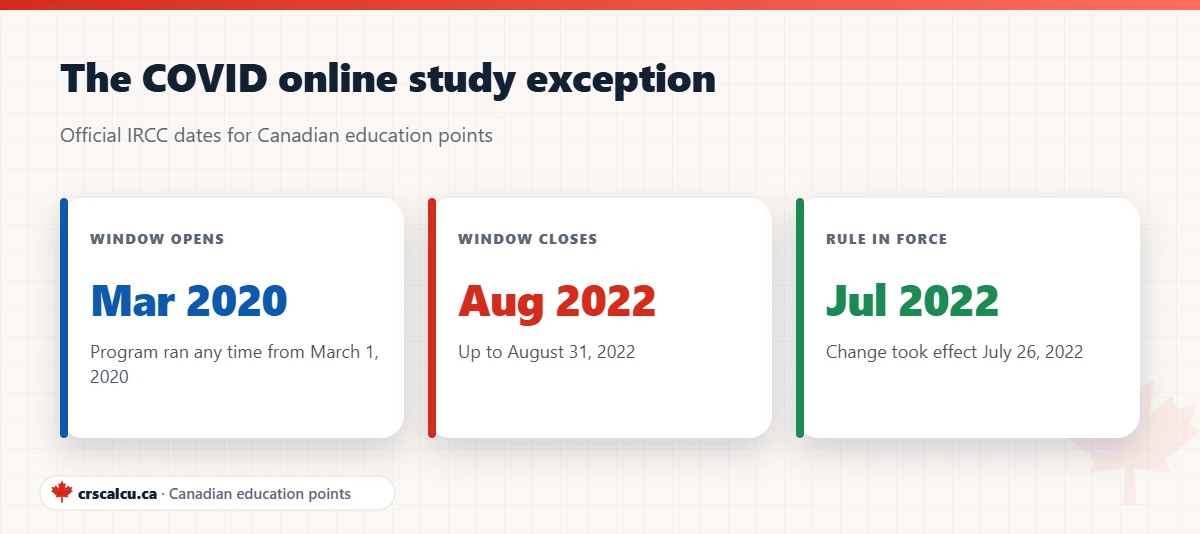
Date | What happened |
|---|---|
March 1, 2020 | Start of the COVID window in the Ministerial Instructions |
June to Nov 2020 | Students switched online; members reported conflicting answers from IRCC |
July 26, 2022 | Ministerial Instructions change takes effect |
August 31, 2022 | End of the window. Programs after this date follow the normal rules |
Source: IRCC program delivery update (2022) and MI s.30(3.1).
Real case: remote master’s went from 0 to 30
In August 2022, a member finished a 2-year master’s (September 2020 to April 2022) fully online because of COVID. Their profile showed 0. They answered NO to the questions about studying in person and spending 8 months in Canada, and YES to the full-time duration question. They reported that the points then appeared. Several people with the same problem posted in 2023 and February 2024 without a documented answer, so check your own answers carefully.
What about programs that started after August 2022?
The COVID exception does not cover them. In February 2026, a member finished a 2-year SAIT diploma, January 2023 to September 2024, taken 100% online while living in Canada. Their 3-year PGWP was approved, but their profile showed 0 Canadian education points. Replies said the fully online delivery was the problem. The PGWP online study rules are separate from the CRS rules, so a PGWP approval does not prove you qualify for points.
Two 1-Year Diplomas: 15 or 30 Points?
This is one of the most common questions. Many students take two 1-year post-graduate programs back to back. They hope two programs will add up to the 30-point tier.
It most likely does not. The bonus is given per credential, and neither 1-year program is three years long. So the most Canadian education points CRS will give you is 15. The Canadian bonus also caps at 30, and it does not stack credential by credential. IRCC has no page that says “two 1-year diplomas = 15” in plain words, so treat this as our reading of the rules.
The same logic affects your core points. “Two or more” credentials (128 points for a single applicant) needs at least one program of three years or more. Two 1-year diplomas do not meet that. In December 2018, a holder of two 1-year Canadian post-grad diplomas answered NO to all three profile questions and got 0. The thread was never resolved, but the pattern matches the public-school answer mistake below. For details, see our two or more credentials guide.
How to Answer the Profile Questions (Most 0-Point Problems)
There is no separate “Canadian education” field in your profile. You add your Canadian credential in the education history, then answer a few yes/no questions. Get one wrong and your Canadian education points CRS total drops to 0, with no warning.
Question (short version) | Answer for most applicants | Common mistake |
|---|---|---|
Was it from a public post-secondary school (or qualifying private school)? | YES | Answering NO, thinking it only applies to Quebec |
Was more than half the program ESL or FSL courses? | NO | Answering YES because classes were taught in English |
Did you study under an award requiring you to return home? | NO | Answering YES by mistake |
Did you study full-time for 8+ months, in Canada? | Answer truthfully | See the COVID case above if you studied online |
Based on member reports from 2016 to 2025. Question wording in your profile may differ slightly.
Real case: one wrong answer, then an ITA the next day
In January 2017, a profile showed 441 instead of the expected 471. In the same thread, a UBC graduate found they had answered NO to the public-institution question, thinking it only applied to Quebec. They switched it to YES and added UBC’s DLI number. The points appeared, and they reported getting an ITA the next day.
Real case: University of Toronto master’s, 380 instead of 410
In June 2017, a U of T master’s graduate saw 0 instead of 30. They had answered NO to all three questions. After changing the public-school question to YES, the 30 points showed up within 24 hours. In December 2017 and May 2018, others in the same thread found the opposite mistake: a YES on the ESL/FSL question.
The ESL mistake is the costliest. In July 2018, a CEC applicant with an ITA at 452 realized a wrong YES on the ESL question had cost them 30 points. Their real score would have been 482. They asked whether to decline the ITA and start over. Check these answers before the draw, not after. If you are in the Canadian Experience Class, those 15 or 30 points can matter a lot against recent cutoffs.
Tip: dates and program length must match
In one 2023 to 2025 thread, a profile showed 435 while a calculator showed 450. A moderator said the points should appear right away, and if not, an answer is wrong. One member fixed it by changing the program dates from 16 months to 2 years, matching the actual credential.
Do You Need an ECA for a Canadian Credential?
No. IRCC’s education assessment page says: “You don’t need an assessment for a Canadian degree, diploma or certificate.” To claim the Canadian education points CRS awards, your Canadian transcript and diploma do the job.
You still need an ECA for any foreign credential you want counted. That matters when you combine a foreign bachelor’s with a Canadian certificate to claim “two or more.” Each foreign credential needs its own ECA. For online or unusual foreign degrees, see our online degree ECA guide.
How Canadian Education Points CRS Adds to Your Base Education Points
The Canadian bonus is separate from your core education score. Your core score is based on your highest level of education (up to 150 for a single applicant). The bonus of 15 or 30 is added on top. A foreign bachelor’s does not cancel your Canadian points. They are two different factors.
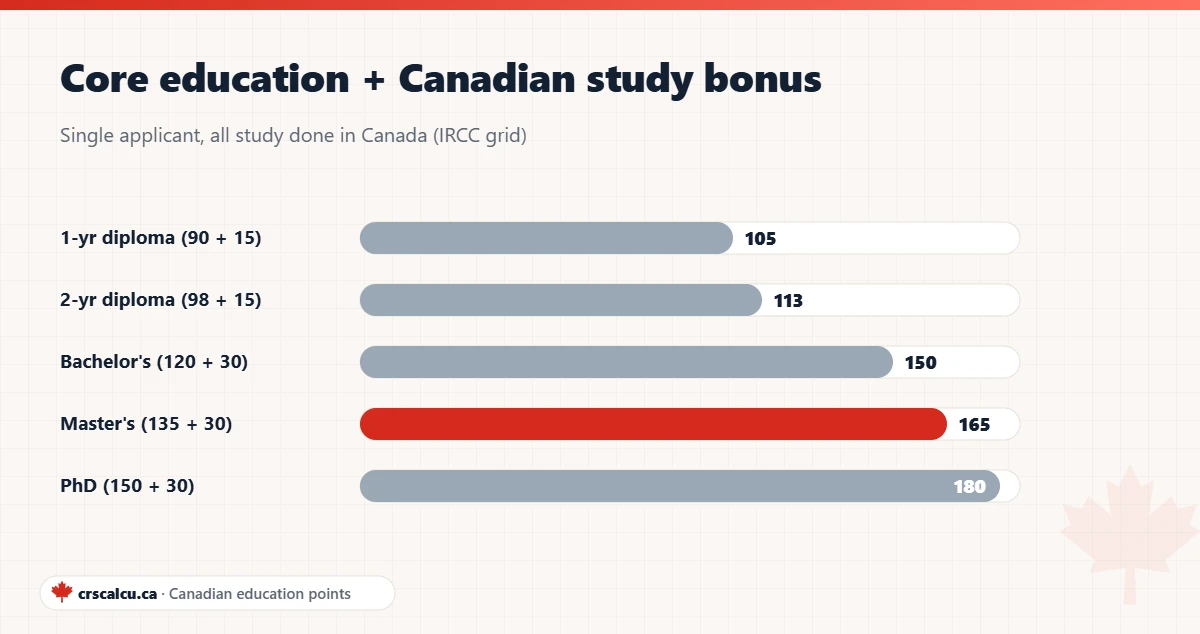
Your education | Core education | Canadian bonus | Total |
|---|---|---|---|
Canadian 1-year diploma only | 90 | 15 | 105 |
Canadian 2-year diploma only | 98 | 15 | 113 |
Foreign bachelor’s (with ECA) only | 120 | 0 | 120 |
Foreign bachelor’s + Canadian 1-year PG cert | 128 (two or more) | 15 | 143 |
Canadian 1-year master’s | 135 | 30 | 165 |
Canadian PhD | 150 | 30 | 180 |
Core values from the IRCC CRS grid for applicants without a spouse. Skill transferability points are extra and not shown.
Example 1: foreign bachelor’s + 1-year post-grad certificate
This is the most common path. Your core score goes from 120 to 128 as “two or more,” the Canadian education points CRS adds are another 15, and your skill transferability points may rise too. That is at least 23 points, but only if you enter both credentials correctly.
Real case: the missing “two or more” selection
In August 2016, an applicant with a 3-year Indian bachelor’s (WES assessed) and a 1-year Canadian post-grad certificate selected only “Bachelor’s.” Their score was 410 instead of 442. Their education points showed 112 instead of 119, and skill transferability 25 instead of 50. Selecting “Two or more certificates, diplomas or degrees” on each entry fixed it. A second member confirmed the same fix.
Example 2: 1-year master’s vs 2-year diploma
A 1-year master’s gives 135 core points plus 30, for 165. A 2-year diploma gives 98 plus 15, for 113. That is a 52-point gap before language and work are counted. You can test both paths in our CRS calculator, and our CRS score guide explains every section.
Common Mistakes That Cost Canadian Education Points
Mistakes real applicants made
That last one matters. From November 2020 to January 2021, one member’s calculator showed 486 (471 plus 15), but the profile stayed at 471. A moderator relayed that IRCC called it a glitch. Always trust the score in your profile, and check it against the latest draw cutoffs.
Canadian Education Points CRS Troubleshooting Checklist
If your profile shows 0 or 15 when you expected more, go through this list in order. Most members fixed the problem at step 1 or 2.
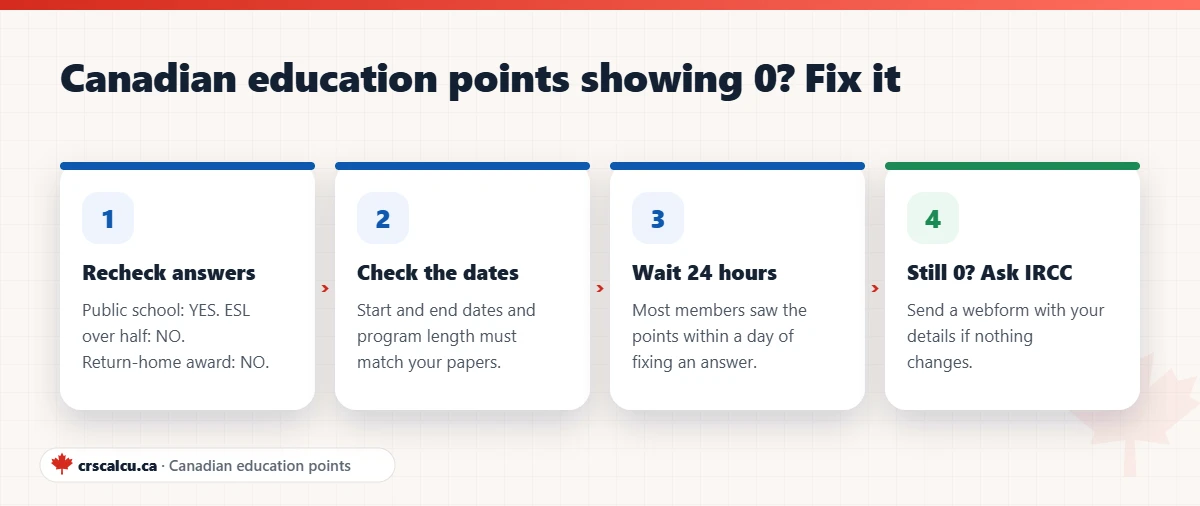
Canadian education points CRS: fix it step by step
Warning: don’t claim points you can’t prove
If you claim Canadian education points and your credential does not meet the rules, you can be refused after the ITA. Be honest in the profile. If your score only reaches the cutoff with points you are unsure about, fix the facts first.
Frequently Asked Questions
Why are my Canadian education points showing 0?
Usually one profile answer is wrong. Members most often answered NO to the public school question or YES to the ESL/FSL question. Fix it and wait about 24 hours.
I have a 2-year Canadian diploma. Why only 15 points?
A credential from a one- or two-year program gets 15. Only programs of three years or more, a master’s or a PhD get 30.
Does a 1-year Canadian master’s get 15 or 30 points?
It gets 30. The Ministerial Instructions give 30 points for a master’s or doctoral degree at any length.
Do two 1-year post-graduate certificates add up to 30 points?
Most likely not. Neither program is three years long, so the best you can expect is 15. IRCC has no explicit statement on this.
Does an 8-month program count?
Yes, if you studied full-time for at least 8 months while physically in Canada. It counts as a 1-year credential and gives 15 points.
I studied online during COVID. Do I still get the points?
Yes, if any part of your program was between March 1, 2020 and August 31, 2022. That applies even if you studied fully online from outside Canada or part-time.
My program was 100% online after 2022. Can I claim Canadian education?
Usually not. Outside the COVID window, you get no points if distance learning was more than half the program.
What does “more than half the program was ESL or FSL” mean?
It means courses that teach English or French as a second language. A program taught in English is not an ESL program.
Do I need an ECA for my Canadian degree or diploma?
No. IRCC says you don’t need an assessment for a Canadian degree, diploma or certificate. You still need one for foreign credentials.
Do professional designations like CPA count?
No. They are not post-secondary credentials, so they do not give Canadian education points.
See what your Canadian study adds to your score
Our free calculator shows your Canadian education points CRS bonus (15 or 30) next to your core education points.
Final Thoughts
The Canadian education points CRS gives are some of the easiest points to lose. Almost every 0-point case we read came down to a yes/no answer, a wrong date or a program that did not meet the 8-month or online rules.
Check your credential against the conditions, answer the profile questions carefully, and confirm the score in your profile. If you did everything right, those 15 or 30 points should be there within a day.