CRS Points Guide · Updated September 2026
Sibling Points in Express Entry: How to Claim 15 CRS Points (Real Cases)
Who counts as a sibling, which documents IRCC actually accepts, and the real cases where applicants lost their 15 points.
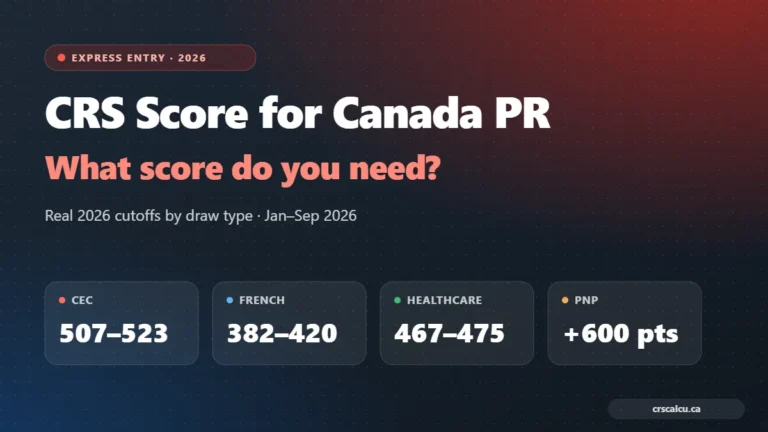
Fifteen points does not sound like much. Then you look at the 2026 CEC cutoffs, which moved between 507 and 523, and you realize 15 points can be the whole difference between waiting and getting invited.
That is why sibling points in Express Entry get so many questions. On one large Canadian immigration forum, two sibling threads have more than 100,000 views, and new questions appeared almost every week in 2025 and 2026. We read them all.
Below you will find the official rules, the documents that worked, and the real cases where people lost their points, sometimes after they had already applied.
Quick answer: who can claim sibling points in Express Entry?
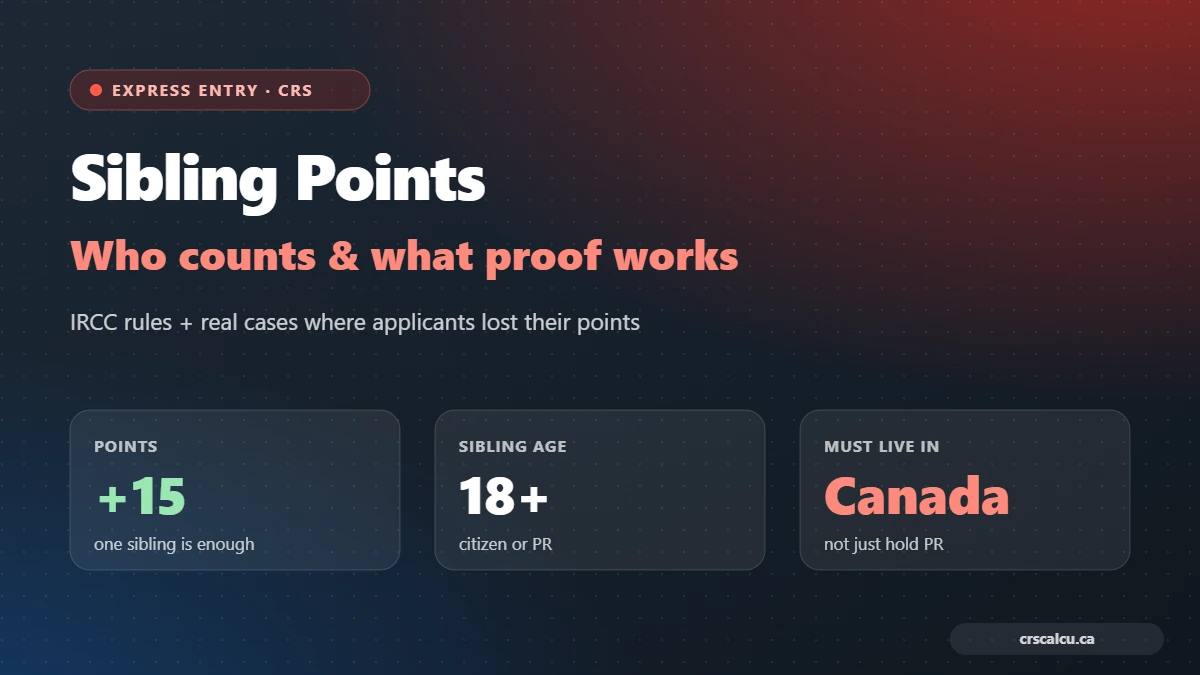
You get 15 CRS points if you or your accompanying spouse have a brother or sister who is 18 or older, a Canadian citizen or permanent resident, and living in Canada. You must share at least one parent by blood, adoption, marriage or common-law partnership. You must prove the relationship, their status and that they currently live in Canada.
Key takeaways
What Are Sibling Points in Express Entry?
Since 2017, Express Entry gives extra points to people who have a brother or sister in Canada. IRCC added them because family support helps newcomers settle. These points sit in the “additional points” part of your CRS score, next to French skills, Canadian study and a provincial nomination.
You can only get these points once. Having three siblings in Canada still gives 15 points, not 45. A 2022 member with two siblings in Canada was told to provide full proof for the one they claimed and list the other in the family information forms.
Rule | What it means |
|---|---|
Points | 15 CRS points (additional points section) |
Age | Sibling must be 18 or older |
Status | Canadian citizen or permanent resident |
Where they live | Currently living in Canada |
Relationship | Share a mother or father (blood, adoption, marriage or common-law) |
Whose sibling | Yours, or your spouse’s if your spouse comes with you |
How many count | Only one sibling is needed; points do not add up |
Source: IRCC Express Entry improvements (2017) and the Express Entry completeness check guidance.
Who Counts as a Sibling for Express Entry?
IRCC’s 2017 announcement says the sibling must “share a mother or father” with you or your spouse. The relationship can be through blood, marriage, common-law partnership or adoption.
In 2025, a member quoted IRCC’s own help text: a sibling can be a biological brother or sister, a half-brother or half-sister, an adopted brother or sister, or a step-brother or step-sister when your parents are married or in a common-law relationship. It must be true on the day you submit your profile and on the day you apply for PR.
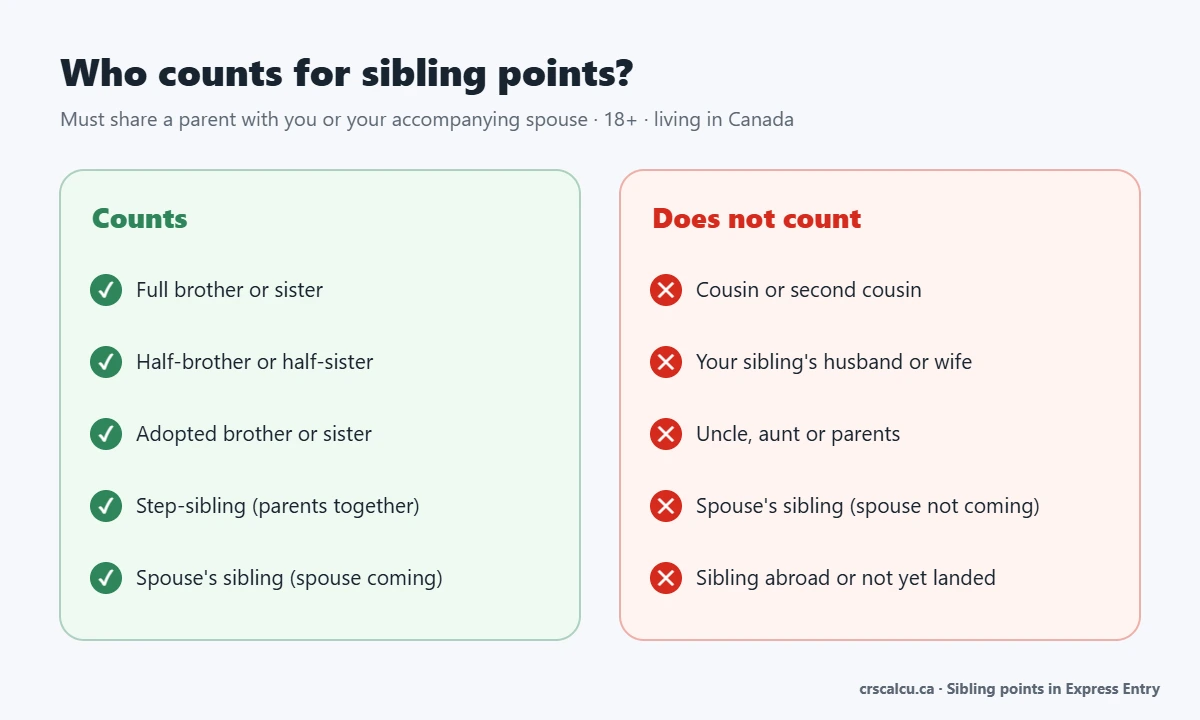
Relative | Counts? | Why |
|---|---|---|
Full brother or sister | Yes | Same parents |
Half-brother or half-sister | Yes | Share one parent |
Adopted brother or sister | Yes | Legal adoption papers needed |
Step-brother or step-sister | Yes, with conditions | Parents must still be married or common-law |
Spouse’s brother or sister | Yes, if spouse is accompanying | Spouse must come with you |
Brother-in-law via your sibling’s marriage | No | Not your or your spouse’s sibling |
Cousin or second cousin | No | No shared parent |
Uncle, aunt, parents, grandparents | No | Not siblings (may matter for FSW, not CRS) |
Based on IRCC rules and answers members received on the forum.
Step-siblings: a real case
In 2025, a CEC applicant claimed 15 points for a step-sister. Their father was in a common-law relationship with her mother, but they never married. Then they learned the step-sister’s mother had passed away. IRCC’s completeness guidance says there should be no sign that the parents’ relationship “has broken down.” A reply said that if she was still alive when they applied, it should be okay, but advised telling IRCC about the death to stay fully honest.
Your spouse’s sibling
Your spouse’s brother or sister counts only if your spouse is coming with you to Canada. In 2019, a principal applicant whose wife was not accompanying asked about her Canadian brother. The answer was a clear no. A 2021 reply in another thread repeated the same rule.
Your Sibling Must Actually Live in Canada
This is where most people lose their points. Being a citizen or PR is not enough. Your sibling must be living in Canada, and you must prove it with recent documents.
Real case: points removed after the brother went abroad
In 2025, an applicant read their GCMS notes and found the officer did not give them 15 sibling points. That dropped them below the cutoff. Their brother, a PR who owns a business in Canada, had been out of the country for about four months to get married, and he was abroad when they submitted the application. Members explained that the officer was right: he was not living in Canada at that time. One warned it could even be seen as misrepresentation. They planned to send a webform with new proof once he returned.
The lesson from that case: short holidays are fine, but if your sibling is away for months when you apply, do not claim the points. PR residency rules (730 days in 5 years) are a different thing. As one reply put it, those rules are about keeping PR status, not about proving family support in Canada.
Real case: “My brother moved back just for my points”
In January 2026, an applicant got an ITA with 529 points, including 15 for a brother who is a Canadian citizen. The cutoff was 511. The brother had lived abroad for two years and moved back only a month before. They then asked if they could drop the sibling points and submit at 514. Some members said you can remove the points if you stay above the cutoff. Others warned that the timing looked like gaming the system and advised speaking to a lawyer first.
What if my sibling only has a COPR?
They must land first. In 2023, someone asked about a brother who had received PR but not landed. The reply: he needs to become a PR before you can claim. In January 2026, a sister got an ITA after claiming her brother’s points before his eCOPR arrived. She was told she should not have claimed them, and that getting selected because of those points could be a problem.
Documents You Need to Claim Sibling Points
IRCC’s completeness check lists three things. Miss one, and your points can be taken away or your file delayed.
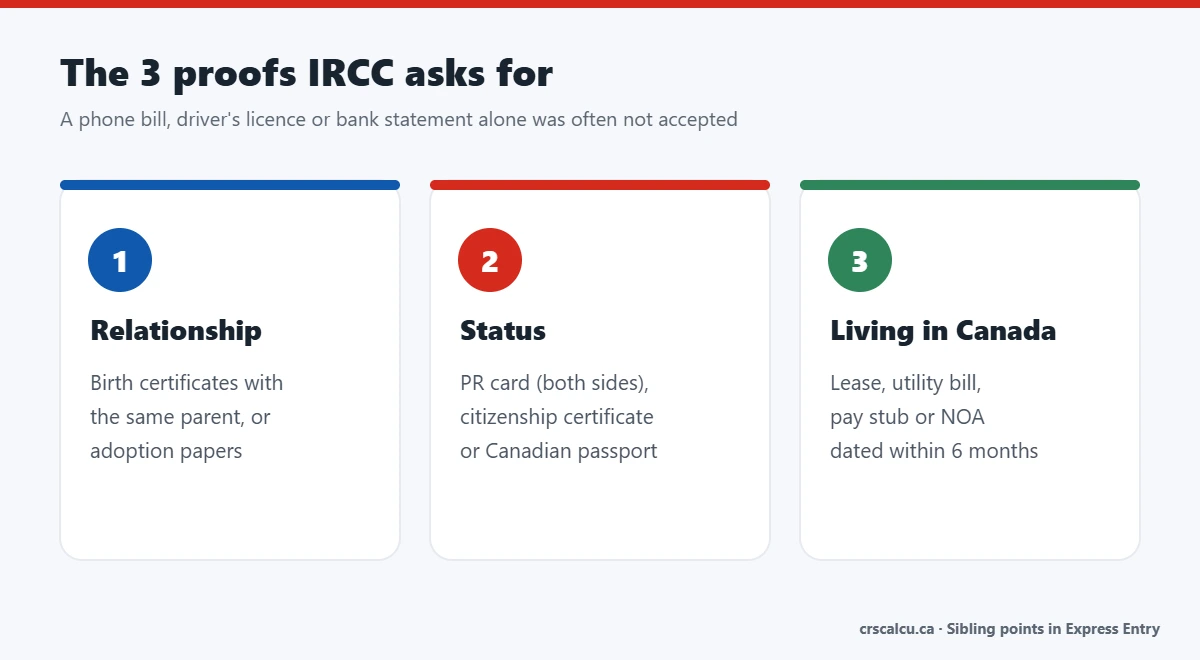
The 3 proofs IRCC asks for
IRCC’s guidance says the residence documents “should be recent (dated within six months prior to submission).” That rule caught many members off guard.
Which residence proof actually worked?
The forum shows a clear pattern. In 2021, IRCC sent one applicant a request saying: provide proof of your sibling’s residence “other than a provincial driver’s license, bank statement, or cell phone bill.” Members suggested a rental agreement, recent pay stubs, an employment letter or a Notice of Assessment (NOA). Another member said their brother’s NOA, pay stubs, employment letter and licence were accepted with no issue.
Document | Result reported by members |
|---|---|
Lease or rental agreement | Strong proof |
Mortgage or property title | Strong proof |
Utility bill (hydro, gas, water) | Good, if in the sibling’s name |
Pay stubs or employment letter | Good, shows they work in Canada |
Notice of Assessment (NOA) or T4 | Good, often accepted |
Bank or credit card statement | Helpful, but weak alone |
Driver’s licence or health card | Weak alone; IRCC asked for more |
Cell phone bill | Not accepted as a utility bill |
Based on forum reports from 2018 to 2025 and one IRCC request letter quoted in 2021.
Real tip: a business phone bill is not proof
In 2025, an applicant planned to use a Bell Mobility business account bill for their sibling. Replies explained that a phone bill, especially a business line, does not prove anyone lives in Canada. A lease, home ownership papers, a hydro bill or proof of current employment are much safer.
What if everything is in someone else’s name?
This is common when a sibling lives with a spouse or rents a room. In 2023, a member’s sister was a homemaker with only a health card and driver’s licence. The reply warned those two may be rejected and pointed to IRCC’s list: lease, mortgage or utility bills. In 2021, a renter was told to upload the rent agreement or rent receipts. If your sibling truly has nothing in their name, pay stubs, an NOA or an employment letter are good backups.
Proof of Relationship: Name Mismatches and Missing Papers
Birth certificates that show the same parent are the easiest proof. Passports that list parents’ names also help. Problems start when names do not match exactly.
Real relationship problems members faced
Family registration certificates also work in some countries. In 2025, a Pakistani applicant planned to use an FRC to prove the relationship. It is an official document that names family members, which is what IRCC asks for.
How to Fill the Sibling Upload Slots in Your Application
After your ITA, the document list shows several sibling slots. One confuses almost everyone: “Family member proof of status.” Members asked about it from 2018 all the way to February 2026.
How members filled the slots
In 2022, a member said they uploaded the sibling’s PR card again for “family member proof of status,” and it worked. In 2018, another member uploaded all the sibling documents again in that slot. One 2018 member explained why the slot exists: it is also used by people claiming FSW points for other relatives, so the system shows it to everyone.
Do I need documents for all my siblings?
No, only for the sibling you claim points for. In 2024 and again in February 2026, members with several siblings in Canada asked this. The answer: give full proof for the one you claim, and list every sibling truthfully in your family information form, including those on work or study permits.
Can You Remove Sibling Points After Your ITA?
Sometimes people get an ITA and then realize they cannot get the documents. In January 2026, a member asked if they could drop the sibling points after the ITA. The reply: if your score still meets the cutoff of the round you were invited in, you can remove them and submit.
But if removing the points drops you below that cutoff, you are no longer eligible for that invitation. In that case, the safer choice is to decline the ITA and fix your profile, rather than submitting points you cannot prove. Check your score both ways with our CRS calculator before you decide.
Real warning: don’t claim points “just in case”
In December 2025, someone claimed sibling points for a PR sister who had been living outside Canada for a year. She had a bank account and a driver’s licence but no lease or bills. Replies were firm: you cannot claim points for a sibling who is not living in Canada, and they should never have added the points to the profile.
Can You Claim Sibling Points? Quick Check
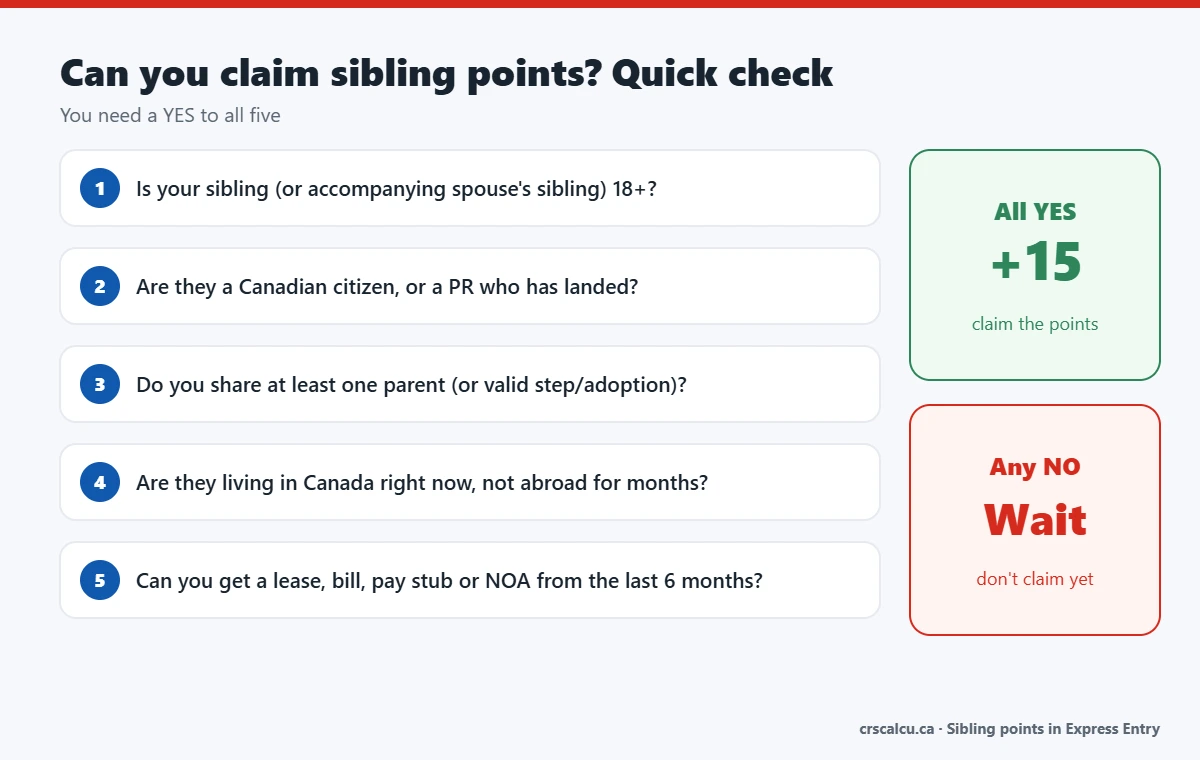
If you answered “yes” to every question in the chart, you can likely claim the 15 points. If any answer is “no” or “not sure,” do not claim them yet. Points you cannot prove can lead to a refusal, and in some cases a finding of misrepresentation.
Undeclared Siblings and Misrepresentation Risk
Sibling points bring your family history into focus. Officers compare your family forms with your sibling’s old immigration files. If a name was left out before, it can surface now.
In 2025, an applicant found that their 2018 visitor visa form did not list their half-siblings. The PR application listed everyone correctly. They did not add an explanation, just made sure the new forms were right. In May 2026, they reported that the PR application was approved.
In June 2026, two siblings who left each other out of their study permit forms asked what to do before applying for PR. Members said this could be treated as misrepresentation and advised speaking to a lawyer. One reply noted that voluntarily disclosing an honest mistake is better than IRCC finding it.
Common Sibling Points Mistakes
Mistakes real applicants made
Every one of these mistakes came from a real post. Most could have been avoided by checking the documents before claiming the points in the profile, not after the ITA. For more ways to raise your score, see our CRS score for Canada PR guide and two or more credentials guide.
Frequently Asked Questions
How many points do you get for a sibling in Canada?
You get 15 CRS points if you or your accompanying spouse have a brother or sister in Canada who is 18 or older and a Canadian citizen or permanent resident living in Canada.
Do half-siblings and step-siblings count for Express Entry?
Yes. Half-siblings count because you share a parent. Step-siblings count if your parents are married or in a common-law relationship, and that relationship has not broken down.
Does my spouse’s sibling count for CRS points?
Yes, but only if your spouse or common-law partner is coming with you to Canada. A non-accompanying spouse’s sibling does not count.
Do I get more points for two siblings in Canada?
No. The maximum is 15 points no matter how many siblings you have in Canada. You only need to prove one.
Can I claim points if my sibling has a COPR but has not landed?
No. Your sibling must be a permanent resident or citizen living in Canada. Someone who has not landed yet is not a PR.
Is a driver’s licence enough to prove my sibling lives in Canada?
Usually not. IRCC asked one applicant for proof other than a driver’s licence, bank statement or cell phone bill. A lease, utility bill, pay stub or Notice of Assessment is safer.
How recent must the residence documents be?
IRCC says they should be dated within six months before you submit your application.
What if my sibling travels outside Canada?
Short trips are fine. But if your sibling is living abroad or away for months when you apply, you should not claim the points.
Can I remove sibling points after getting an ITA?
Yes, if your score without those points still meets the cutoff of the round you were invited in. If it drops below, you should decline the ITA instead.
Do cousins or in-laws count for sibling points?
No. Only brothers and sisters who share a parent with you or your accompanying spouse count. Cousins, uncles and your sibling’s spouse do not.
See your score with and without sibling points
Our free calculator shows exactly what 15 sibling points do to your CRS score.
Final Thoughts
Sibling points in Express Entry are easy points only when your sibling truly lives in Canada and your papers match. The applicants who had trouble were not lying. Most simply claimed the points too early, or trusted a phone bill to do a lease’s job.
Before you tick “yes” in your profile, collect the three proofs. If they are solid, those 15 points may be what gets you invited.