CRS Points Guide · Updated September 2026
Two or More Credentials in Express Entry: How to Get 128 CRS Points
Real ECA results, real mistakes and real point gains from people who asked this exact question. Find out in 5 minutes if your degrees count.
You have a bachelor’s degree. Maybe a diploma before it, or a one-year program after it. Then you see this line in Express Entry: “Two or more certificates, diplomas or degrees.” And you think, wait, does that mean me?
You are not alone. One thread on the CanadaVisa forum about this single question has more than 800 replies and almost 300,000 views. We read all of it, plus newer threads from 2025 and 2026, to find out what actually worked for people and what cost them points.
This guide explains the rule in plain words, shows how many points two or more credentials in Express Entry can add, and walks through real ECA results so you can compare them with yours.
Quick answer: what counts as two or more credentials in Express Entry?
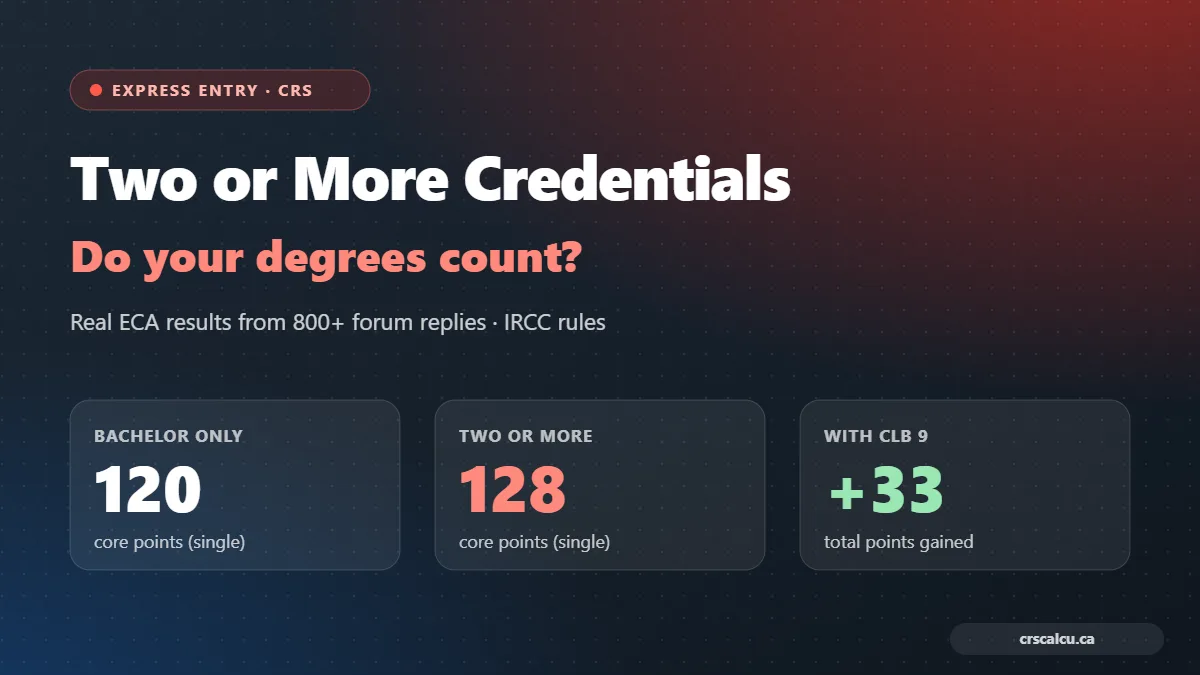
You qualify if you finished two or more post-secondary programs and at least one was three years or longer. Each foreign credential needs its own ECA. High school never counts. It gives 128 points (119 with a spouse) instead of 120 for one bachelor’s degree. With CLB 9 English, the total gain is often +33 points.
Key takeaways
What Does “Two or More Certificates, Diplomas or Degrees” Mean?
IRCC’s official wording is: “Two or more certificates, diplomas, or degrees. One must be for a program of three or more years.” In simple words, you need at least two finished post-secondary programs, and one of them must be a long one.
IRCC’s help centre adds two rules that people often miss. First, you need a valid ECA for each foreign credential. Second, the order you finished them in does not change your points. So a diploma you did after grade 10 and a degree you did later can both count.
Post-secondary means college, university, trade school or technical institute. It does not include high school, even if your country calls it a “diploma.” That one detail trips up a lot of people, as you will see in the real cases below.
Is this the same as a master’s degree?
No. A master’s is its own category and gives more points (135 if single). If your ECA says “Master’s degree,” pick that. As one forum member put it in 2021, two or more credentials is worth “7 points less than Masters” when you have a spouse (119 vs 126).
How Many CRS Points Do Two or More Credentials Give?
Most people only look at the education line and think the gain is small. One user in 2018 asked if it was “really only an additional 8 points” to assess his second degree. It isn’t. The bigger gain hides in skill transferability.
Level of education | Points (single) | Points (with spouse) |
|---|---|---|
Two-year program | 98 | 91 |
Bachelor’s degree or 3+ year program | 120 | 112 |
Two or more credentials (one 3+ years) | 128 | 119 |
Master’s or professional degree | 135 | 126 |
Doctoral degree (PhD) | 150 | 140 |
Source: IRCC Comprehensive Ranking System criteria.
The hidden bonus: skill transferability points
Skill transferability rewards you for combining education with strong language scores or Canadian work. A single post-secondary credential earns 13 or 25 points here. Two or more credentials earn 25 or 50. That is double.
Your situation | One credential (e.g. bachelor’s) | Two or more credentials | Extra points |
|---|---|---|---|
CLB 7 or 8 in English | 13 | 25 | +12 |
CLB 9 or higher in all skills | 25 | 50 | +25 |
1 year of Canadian work | 13 | 25 | +12 |
2+ years of Canadian work | 25 | 50 | +25 |
The education part of skill transferability is capped at 50 points in total.
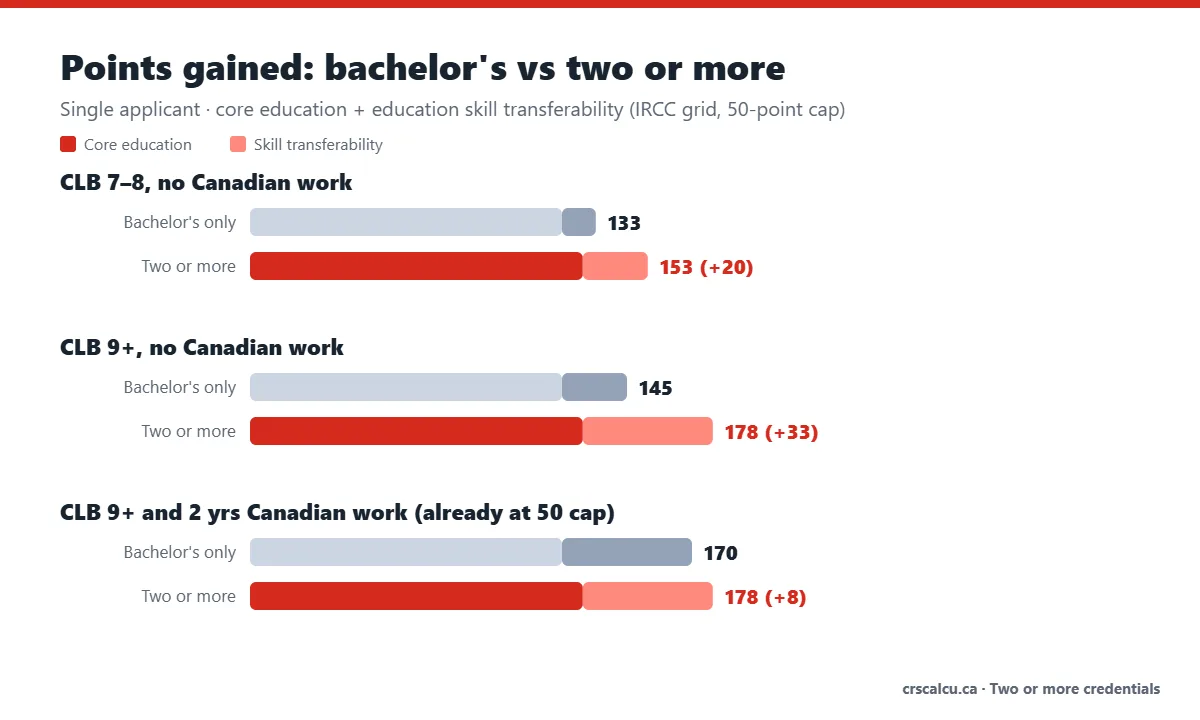
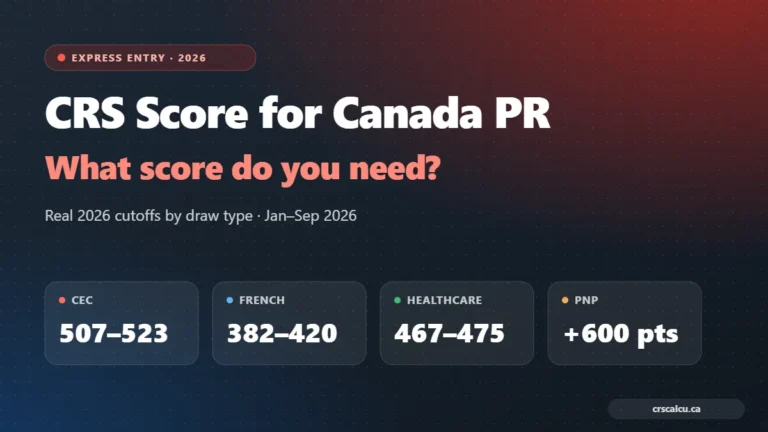
So for a single applicant with CLB 9, moving from “bachelor’s” to “two or more” adds 8 core points plus 25 transferability points. That is 33 points. In 2026, CEC draws moved between 507 and 523, so 33 points can decide whether you get invited. See our CRS score for Canada PR guide for the latest cutoffs.
One catch: the education part of skill transferability stops at 50 points. If you already have CLB 9 and two years of Canadian work, one degree may already reach that cap. In that case, a second credential adds only the 8 core points. Run your own numbers before you pay for anything.
It can also fix your FSW 67 points
The Federal Skilled Worker grid gives 21 points for a bachelor’s and 22 for two or more credentials. In 2021, one engineer wrote that he was stuck at 66 points, one short of the 67 needed to enter the pool. A second credential would give him that missing point. Check yours with our FSW points calculator.
Which Combinations Count? Real ECA Results
Here is where real data helps. We grouped the most common cases from the forum by what people’s ECA reports actually said. Your ECA decides everything, not the name on your certificate. If your case is not in the table, look for the closest match and compare the Canadian equivalency line on your report.
Your education | What the ECA said | Two or more? |
|---|---|---|
3-year diploma after grade 10 + 3-year BE (lateral entry), India | Diploma (2 years) + Bachelor’s (4 years) | Yes, many members got the points |
3-year bachelor’s + 2-year master’s, India | Bachelor’s (3 years) + Bachelor’s (4 years) | Yes |
4-year bachelor’s abroad + 2-year Canadian diploma | Bachelor’s (4 years) + no ECA needed for Canada | Yes |
4-year bachelor’s + 1-year Canadian graduate certificate | Bachelor’s (4 years) + Canadian credential | Yes |
HND (2 years) + UK top-up degree | Diploma (2 years) + Bachelor’s (4 years) | Yes, member got PR |
2-year bachelor’s + 2-year master’s | One Bachelor’s (4 years) only | No, ECA merged them |
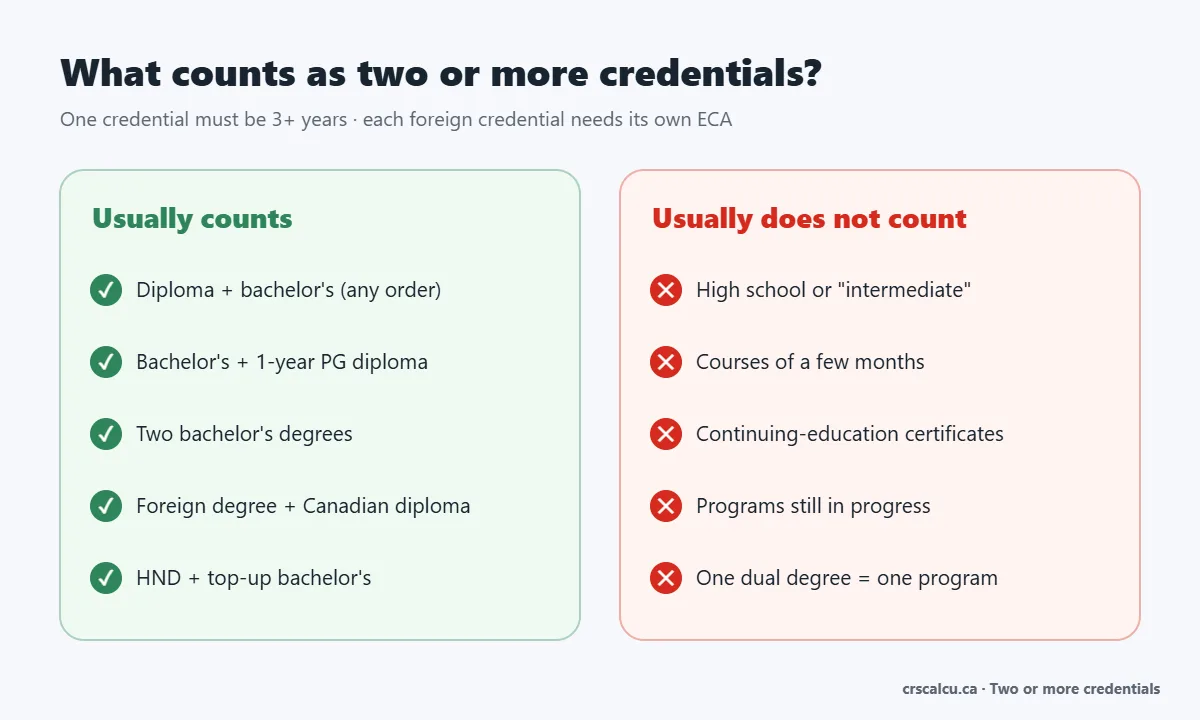
Bachelor’s + Australian Certificate IV courses | Bachelor’s + secondary school | No |
Bachelor’s + 3-month or 6-month certificate | Not assessed as post-secondary | Usually no |
Based on real posts in the CanadaVisa forum, 2018–2026. Your own ECA may differ.
The Indian diploma + lateral entry case
This is the most common question in the thread. Someone finishes a 3-year polytechnic diploma after grade 10, then joins a BE or B.Tech in the second year. WES often reports “Diploma (two years) and Bachelor’s degree (four years).” Members who entered both credentials said they received the points.
A 2025 reply summed it up: if your report shows one credential of 1–3 years and another of 3 years or more, you are eligible. A member in 2023 who had only sent his BE to WES was told to add the diploma to his file, because without that second ECA the system only sees one bachelor’s.
When a master’s is assessed as less
Several people were upset that WES did not rate their master’s as a Canadian master’s. One member with an M.Com and an M.A. saw both assessed as “post-graduate diploma (1 year).” That still gave him two or more credentials, but not the master’s points he hoped for. Others asked about trying a different assessment body instead.
What Does NOT Count as a Second Credential?
The forum has plenty of people who spent money on a course, only to find it didn’t help. Learn from them.
Credentials that usually do not count
Also watch the length. One person took a 4-month graduate diploma part-time over 8 months. Replies explained that the program length on the certificate matters, not how long it took you.
More Real Questions From Applicants, Answered
These are four more situations that came up again and again between 2018 and 2026. The answers come from the replies that members confirmed worked, checked against IRCC’s rules.
“I have a 3-year degree and a 1-year honours year”
Two members had this exact case in 2018. Their ECA listed the first credential as a 3-year bachelor’s and the second as a 4-year bachelor’s. Because the report shows two separate post-secondary credentials and one is 3+ years, the rule is met. The key is that the ECA lists them as two credentials, not one merged degree.
“Can two bachelor’s degrees count?”
Yes. A member asked this in 2018 and pointed to IRCC’s own help centre, which confirms that two degrees can count as long as one is three years or longer. Another member entered “bachelor’s three years and bachelor’s four years” in his profile and saw it recognized as two or more.
“My Canadian diploma credits were transferred into my bachelor’s”
In late 2025 and early 2026, two Canadian graduates asked about this. Each finished a 2-year diploma, received a graduation certificate, then used those credits to finish a bachelor’s in two more years. One said the system picked up “two or more” on its own. If you received two separate credentials with their own transcripts and completion letters, you have two credentials. Keep both documents ready for your application.
“Does ACCA or Chartered Accountancy count with my B.Com?”
This depends on how the ECA body assesses the professional qualification. Members reported mixed results over the years. In 2024, one poster asked if passing only the first ACCA exam levels would be enough, and nobody could confirm it.
In 2018, a Chartered Accountant with a B.Com asked the same thing. The safe move is to send both to your ECA body and wait for the report before you claim anything. If the professional qualification comes back as post-secondary, you can count it.
Do You Need an ECA for Each Credential?
Yes, for every credential earned outside Canada. IRCC says you need a valid ECA for each one. If you only assess your highest degree, the system cannot see the other one, and you lose the points.
Canadian degrees, diplomas and certificates do not need an ECA. In 2021, a member with a foreign 4-year degree and a 2-year Canadian college diploma was told only the foreign degree needed an ECA. That combination qualifies.
ECA checklist before you claim two or more
Plan for time, too. In 2018, one member said his IQAS report took about 12 to 13 weeks. In 2023, another member planning to add his diploma to an existing WES file expected it to take about two months. Start early so your ECA is ready before your profile needs it.
Not sure if WES recognizes your school? Use the free WES degree equivalency tool before paying. At least one member in the thread found a credential listed as “non-recognized institution” only after the report came back.
How to Enter Two or More Credentials in Your Express Entry Profile
This part confuses people because the official CRS tool and the real profile look different. In the tool, you choose “Two or more certificates, diplomas or degrees” from a list. In the real profile, you add each credential separately and the system works out the points.
Step by step
Real mistake: 112 points instead of 119
A member with a spouse had an ECA for a diploma (2 years) and a bachelor’s (4 years). His score showed only 112 points. The reason? For the diploma, he picked “Secondary diploma (high school graduation).” Another member told him to pick “Two-year program at a university, college, trade or technical school” instead. That is the option that unlocks 119 points.
Pick the level that matches your ECA’s Canadian equivalency for each line. If your score looks wrong, read why your calculator score differs from your profile.
Is a Second Credential Worth It If You Don’t Have One Yet?
Many people in the thread asked if they should enrol in a one-year PG diploma just for points. The honest answer: it depends on your language score and your time.
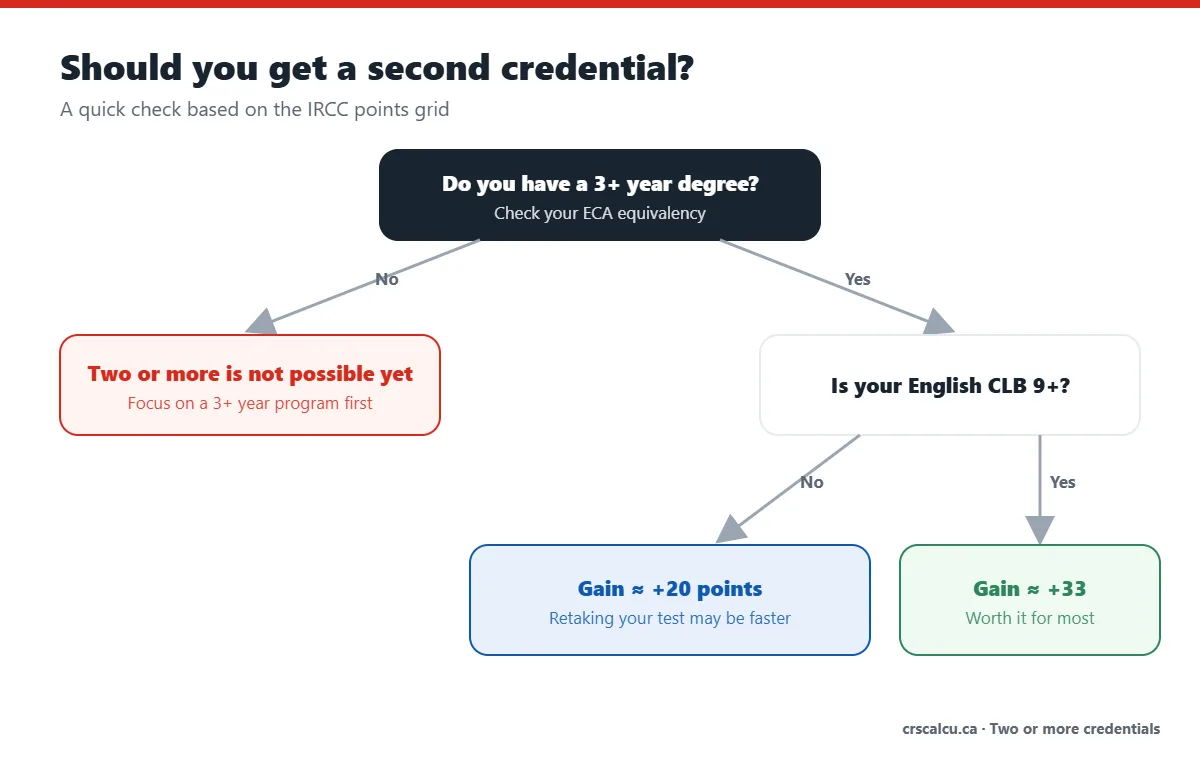
If you have CLB 9 and a 3-year+ degree, a one-year credential adds about 33 points. If you study that year in Canada, you may also get 15 points for Canadian study. But if your English is CLB 7, the gain is closer to 20 points, and improving your test might be faster. Use our CLB calculator to compare.
Be careful with distance or online programs. Members asked about IGNOU, Annamalai and other distance courses for years. Some were assessed, some were not. And a 2018 member working full time asked if studying at the same time was a problem. Officers may question work done during full-time study, so check before you enrol.
Pro tip: check who should be the main applicant
In 2018, a member was told his wife should be the principal applicant. Her B.Com plus MBA could count as a master’s, and she was younger. Always run the calculator both ways with your spouse.
Common Mistakes With Two or More Credentials
Mistakes real applicants made
When in doubt, go by the ECA. A reply from 2018 said it best: you do not “apply for two or more degrees.” Either your reports show them and the points appear, or they do not.
Frequently Asked Questions
What counts as two or more credentials in Express Entry?
Two or more finished post-secondary programs, with at least one being three years or longer based on your ECA. High school does not count. Each foreign credential needs its own ECA.
How many points do two or more credentials give?
Two or more credentials give 128 core points if you are single and 119 with a spouse. They also double your skill transferability points for education, which can add up to 25 more.
Does a 1-year diploma plus a 3-year bachelor’s count?
Yes, if the ECA shows the diploma as a post-secondary credential and the bachelor’s as three years or more. A Canadian one-year graduate certificate also counts and does not need an ECA.
Does the order of my degrees matter?
No. IRCC says the order you finished your credentials does not affect your points. A diploma before your degree counts the same as one after it.
Do I need an ECA for each degree?
Yes, for every credential earned outside Canada. Canadian degrees, diplomas and certificates do not need an ECA.
Why is my profile not showing two or more credentials points?
Usually one credential is missing an ECA, or the wrong level was chosen, like “Secondary diploma.” Fix the level and check again after a day or two.
Is two or more credentials better than a master’s degree?
No. A master’s gives 135 points if single, more than the 128 for two or more. If your ECA says master’s, choose that.
Do short online courses count?
Usually not. Forum members found that courses of a few months are not assessed as post-secondary credentials. A program of at least 8 months is safer.
Can a Canadian continuing studies certificate count?
Usually not. Continuing studies certificates are generally not treated as post-secondary program credentials. A college graduate certificate or diploma is a safer choice.
How long is an ECA valid for Express Entry?
An ECA must be less than 5 years old when you create your Express Entry profile and when you submit your application.
See your new score in 2 minutes
Add both credentials in our free calculator and see exactly how many points two or more credentials in Express Entry add for you.
Final Thoughts
Two or more credentials in Express Entry is one of the most misunderstood options in the CRS. For many people, it is not 8 points. It is 20 to 33 points they already earned and never claimed.
Check your ECA reports tonight. If you have a diploma or second degree that was never assessed, that may be the easiest points you ever get.