Express Entry Guide · Updated October 2026
Primary Occupation in Express Entry: Which NOC to Choose When You Have More Than One Job (Real Cases)
The profile asks for one occupation. Your career has three. Which one you pick decides whether the system finds you eligible, and for which program.
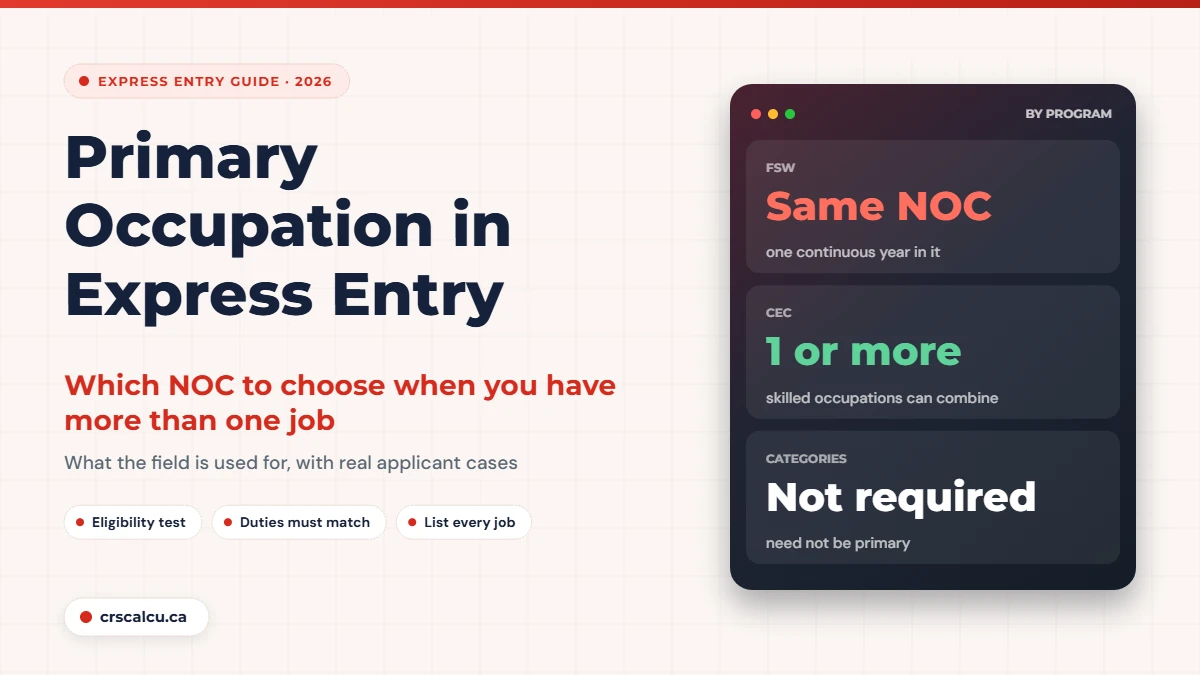
Your primary occupation is one small field in the Express Entry profile that causes a surprising amount of worry. People with a tidy ten-year career in one role never think about it. Everyone else does: the analyst who became a manager, the nurse who now teaches, the graduate with two six-month jobs, the engineer who drove a truck for a year after landing.
The worry usually comes from a misunderstanding. Applicants assume the primary occupation is the only work that counts, so picking it feels like throwing the rest away. It is not. Your whole work history goes into the profile. The primary occupation is the one the system uses for a specific test, and what that test is depends on the program.
We read IRCC’s pages for the Federal Skilled Worker Program, the Canadian Experience Class, the program comparison, the occupation classification guide and category-based selection, along with four public forum threads from 2015 to 2024 in which applicants with more than one occupation asked which to choose.
Quick answer: what is the primary occupation in Express Entry?
It is the occupation, identified by its NOC code, that you use for your immigration application. IRCC’s Federal Skilled Worker Program page (modified September 24, 2026) says your qualifying work experience must have the same NOC as the job you want to use for your application, and must be at least one continuous year. The Canadian Experience Class counts work in one or more skilled occupations. Whichever you pick, your duties have to match that code: check with our NOC TEER finder. All your other jobs still go in the work history.
Key takeaways
What the primary occupation is used for
IRCC’s pages mention the idea in a few places, each time for a specific purpose.
Where | What IRCC says | So the primary occupation… |
|---|---|---|
Federal Skilled Worker minimum | Experience must have the same NOC as the job you want to use for your application; at least 1 year continuous | Must be the occupation of your qualifying year |
Canadian Experience Class minimum | Canadian work in 1 or more of TEER 0, 1, 2 or 3; 1 year in the last 3 | Can be any of your qualifying skilled jobs |
Canadian Experience Class language level | CLB 7 for TEER 0 or 1; CLB 5 for TEER 2 or 3 | Affects which language minimum applies |
Category-based rounds | 12 months in a listed occupation in the past 3 years; it does not need to be your primary occupation | Does not decide category eligibility |
Our summary of IRCC’s Federal Skilled Worker Program page (September 24, 2026), program comparison and category-based selection page (both June 22, 2026). The right-hand column is our reading.

Federal Skilled Worker Program: one occupation, one continuous year
This is where the choice has teeth. The program’s minimum is at least one year of continuous work, or 1,560 hours, in a single skilled occupation within the last ten years, and that occupation is your primary one. Two years split evenly between two different codes may not contain one continuous year in either. See 1,560 hours for Express Entry for how the hours are counted.
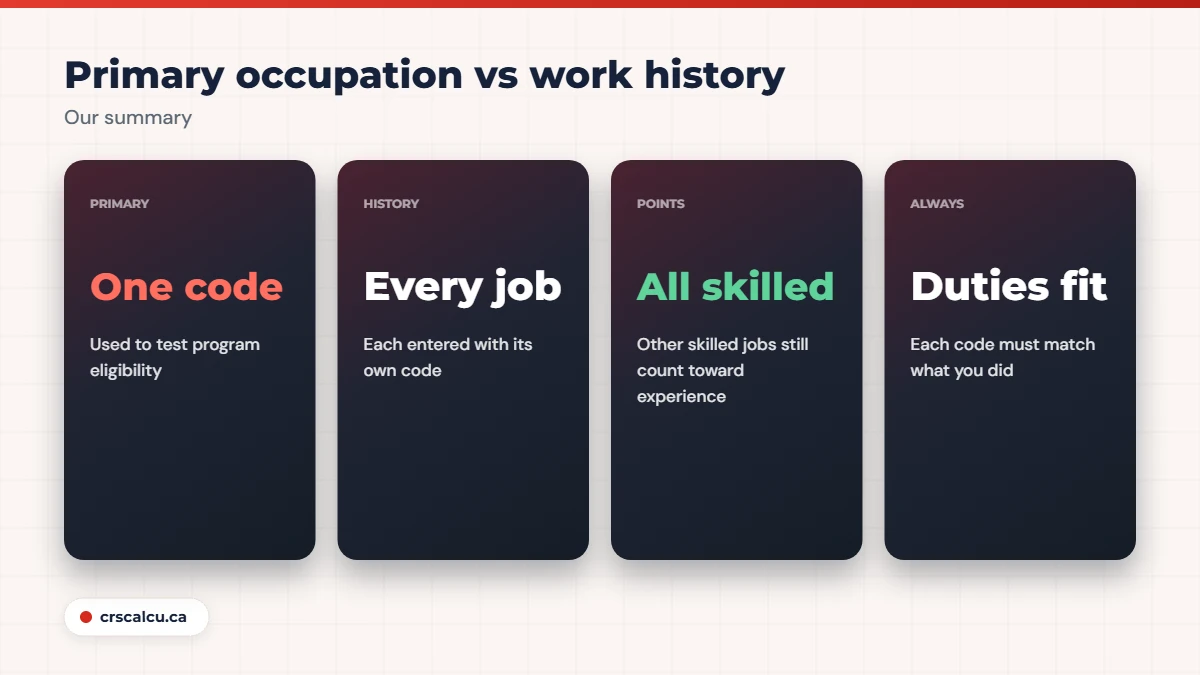
Your other skilled jobs are not wasted. They are part of your work history and count toward your total years of experience for points, both on the program’s own 67-point grid and in the ranking score. Our FSW points calculator shows the grid.
Real case: two codes, and an invitation a week later (September 2015)
An applicant had about two years and four months in a technical support occupation and one year and two months as a contact centre supervisor, and asked whether experience under two codes could be combined for the Federal Skilled Worker Program. An experienced member explained that skilled experience under several codes counts toward the ranking score, but that for the program’s own eligibility the primary occupation is what matters. They advised choosing the occupation with more experience as primary and being ready to document both jobs after an invitation. The poster reported being invited the following week.
The advice in that thread is still the sensible default: for this program, make the primary occupation the one in which you clearly have a continuous year, with the documents to prove it.
Here is our own illustration of why continuity matters. Suppose someone abroad worked ten months as a financial analyst, then fourteen months as an accountant, then eight months as an auditor. That is 32 months of skilled work across three codes. Only the accountant job contains a continuous year in a single occupation, so accountant is the workable primary occupation for the Federal Skilled Worker Program. The analyst and auditor months are still entered, each under its own code, and still add to the total years of skilled experience. If they had chosen analyst as primary, the profile would be testing eligibility against a job with only ten months in it.
Canadian Experience Class: more freedom, one catch
The Canadian Experience Class is looser. IRCC’s comparison says it needs Canadian work experience in one or more of the skilled categories, adding up to one year in the last three. So a year made of two six-month skilled jobs can qualify.
Real case: two six-month jobs and one field to fill (February 2023)
A Canadian Experience Class applicant had worked two different skilled jobs for six months each and was stuck on the primary occupation field. If they chose one, would only six months count? The main reply said no: as long as both codes are in the skilled categories, either can be the primary occupation, and the full history goes into the work history section. A later reply suggested choosing the current job, as the one the applicant intended to continue in. No final outcome was reported.
The catch is language. For this program the minimum depends on the category of the occupation: Canadian Language Benchmark 7 for TEER 0 or 1, and benchmark 5 for TEER 2 or 3. If your year mixes the two, IRCC’s public pages do not explain which applies. The safe approach is to meet benchmark 7. Check your scores with the CLB calculator, and read our Canadian Experience Class guide for the rest.
The code has to fit the duties, not the other way round
It is tempting to treat the primary occupation as a setting you adjust until the system says “eligible”. IRCC’s instructions for finding a code go the other way: make sure the main duties listed match what you did, and if they do not, find a different title whose duties do.
Real case: changing the code to fit a language score (December 2017)
An applicant had entered architect as their primary occupation, but their language test result was below what their route required for that level of occupation, so the profile came back ineligible. They asked whether they could resubmit with a drafting technologist code, one level down, and relabel an earlier job to match. The reply was that it depended on whether their duties were truly consistent with the new code, and that the primary occupation should be where most of their experience lay. The poster decided to keep the architect code, since that was where their experience was.
That was the right instinct. The fix for a language score that is too low is a better language score. A code chosen to get round it has to survive an officer reading your reference letter against the occupation’s main duties, and we cover what happens when it does not in wrong NOC code.
Real case: worried by an “exclusions” line (October 2024)
An applicant with biology degrees worked as a biologist, and wanted that as their primary occupation. Their earlier fourteen months of Canadian experience had been in a different code, whose description listed life science professionals under “exclusions”. They feared this blocked the choice. A member explained that exclusions are only pointers to neighbouring occupations you should check, that several codes can appear in a work history, and that any qualifying one can be primary. What matters is that the duties of each job match the code given to it. The applicant was satisfied and went ahead.
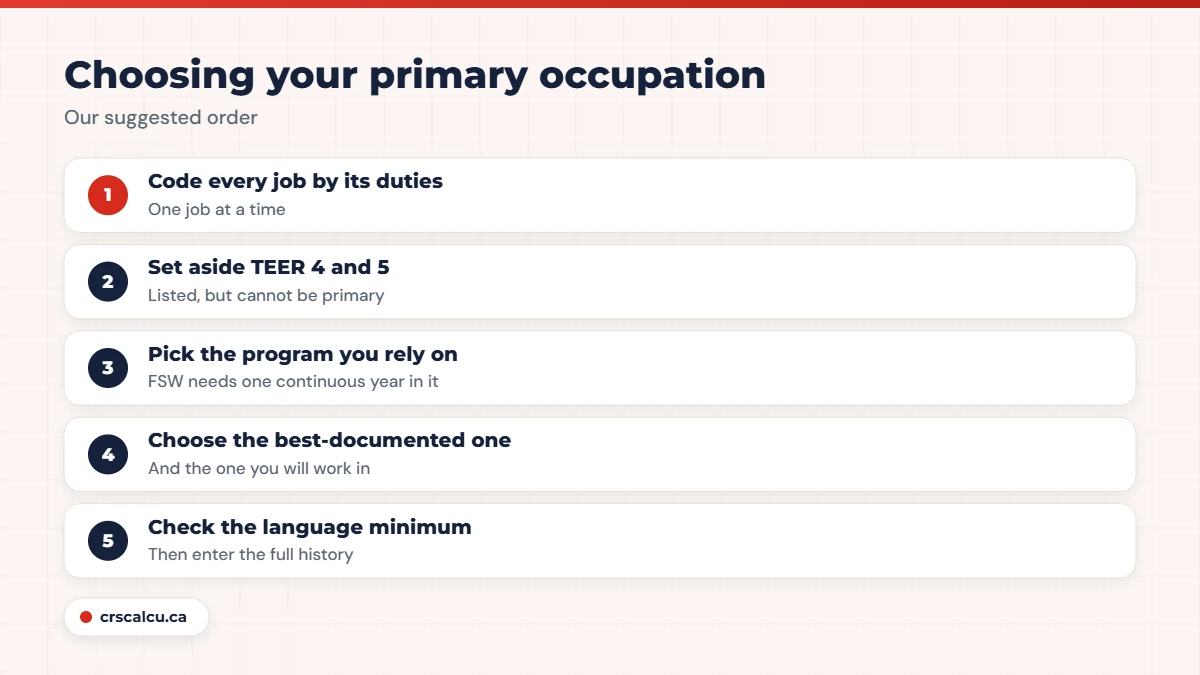
How to choose when you have more than one job
Our suggested order
Primary occupation and category rounds are separate questions
You may see advice to make a healthcare or trades job your primary occupation so that you are picked up in a category round. IRCC’s category page says the qualifying experience does not need to be your primary occupation. What you need is twelve months in a listed occupation within the past three years, shown in your work history. See category-based draws.
Can you change it later?
While your profile is in the pool, you can update it, and you are expected to keep it accurate. If you realize another of your occupations is the better primary one, correct the profile before an invitation, not after. An invitation is issued on the profile as it stood on the day of the round. If the answer changes your eligibility or your score, IRCC’s guidance for invited candidates is to recalculate and, if you no longer qualify, decline: see declining an ITA.
After you submit the application itself, the occupation you declared and the documents you uploaded are what the officer assesses. That is not the moment to discover a better code.
Five mistakes people make choosing a primary occupation
Five mistakes from the rules and the threads
Once the occupation is settled, the rest is arithmetic. Enter your history in the CRS calculator and compare the result with the latest draw cut-offs.
Frequently Asked Questions
What is a primary occupation in Express Entry?
It is the occupation, by NOC code, that you use for your application. For the Federal Skilled Worker Program, IRCC says your qualifying work experience must have the same NOC as that job and be at least one continuous year.
Does only my primary occupation count for points?
No. Your full work history is entered, and skilled experience in other occupations counts toward your years of experience. The primary occupation is used for the eligibility test.
I had two different skilled jobs for six months each in Canada. Which is primary?
For the Canadian Experience Class, the year can come from one or more skilled occupations, and forum advice is that either can be primary. Many applicants choose the current job.
Should my primary occupation be the one with the most experience?
For the Federal Skilled Worker Program it must be one in which you have at least one continuous year. Choosing the occupation with the most well-documented experience is the usual advice.
Do I need a healthcare or trades job as my primary occupation for category-based draws?
No. IRCC’s category-based selection page says the qualifying experience does not need to be your primary occupation. You need 12 months in a listed occupation within the past three years.
Can I change my primary occupation after creating my profile?
You can update a profile while it is in the pool. Do it before an invitation, and make sure the new code matches your duties and that you still meet the program’s requirements.
Occupation settled? Check what your history scores
Enter all your skilled experience and compare your points with recent Express Entry cut-offs.
Final Thoughts
The primary occupation is the occupation Express Entry tests your eligibility against. Under the Federal Skilled Worker Program it has to be one in which you have a continuous year. Under the Canadian Experience Class any qualifying skilled job will do. In both cases the code has to describe what you really did, and everything else you have done still goes in the history and still counts.
If your jobs fall between codes, if your eligibility changes depending on which one is primary, or if you have been invited and now doubt the code you chose, speak to a licensed consultant or lawyer before you submit. The occupation is the part of the application every other document is checked against.