Express Entry Guide · Updated October 2026
IELTS vs CELPIP for Express Entry: Same Points, Different Tests, and How People Who Took Both Scored (Real Cases)
IRCC does not care which one you sit. Your points depend on the CLB level, and the two tests reach each level by different routes. That difference is where the choice lies.
IELTS vs CELPIP for Express Entry is argued about on forums as if one of them were secretly worth more. It is not. IRCC accepts both, converts both to the same Canadian Language Benchmark scale, and awards points by level. A CLB 9 from one is worth exactly what a CLB 9 from the other is worth.
So the real question is narrower and more personal: on which test are you, with your particular strengths, more likely to reach the level you need in all four abilities? The two tests differ in format, in how speaking is examined, and in how raw scores map onto levels. Those differences help some people and hurt others.
We read IRCC’s language test page and its conversion tables, and three public forum threads from 2016 and 2017 written by people who sat both tests, one of them six times in total. Their results do not agree with each other, which is the most useful thing about them.
Quick answer: IELTS vs CELPIP for Express Entry, which should I take?
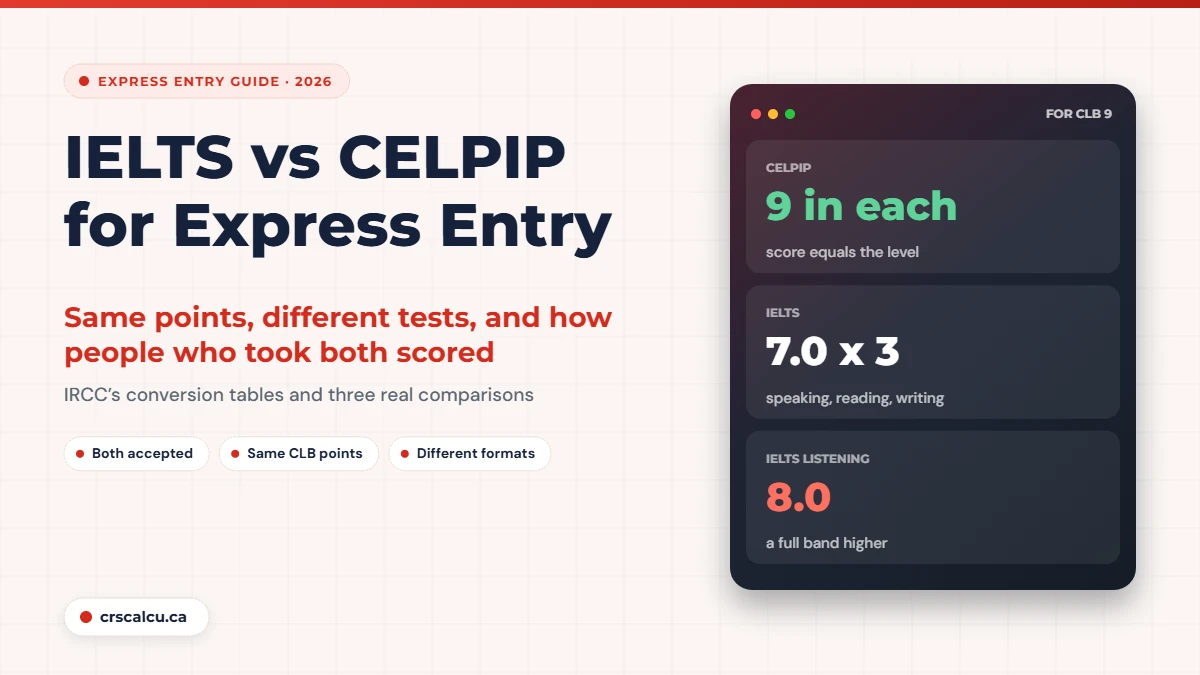
Either. IRCC’s language page (modified June 22, 2026) lists CELPIP-General and IELTS General Training as approved English tests, along with PTE Core, and scores them on the same scale. The differences are practical. On IELTS, CLB 9 needs 8.0 in listening but 7.0 in the other abilities, while on CELPIP the score equals the level in every ability. IELTS speaking is a conversation with an examiner; CELPIP speaking is recorded on a computer. Pick the format that suits your weakest ability, and check the level you need with our CLB calculator.
Key takeaways
IELTS vs CELPIP for Express Entry: what IRCC says
The official position takes three lines. Both tests are approved. You must take the general version of each: IRCC names CELPIP-General and IELTS General Training. And results must be less than two years old when you complete your profile and when you submit your application.
IRCC then publishes a conversion table for each test. This is where they stop being identical.
CLB level | CELPIP (every ability) | IELTS speaking / reading / writing | IELTS listening |
|---|---|---|---|
7 | 7 | 6.0 / 6.0 / 6.0 | 6.0 |
8 | 8 | 6.5 / 6.5 / 6.5 | 7.5 |
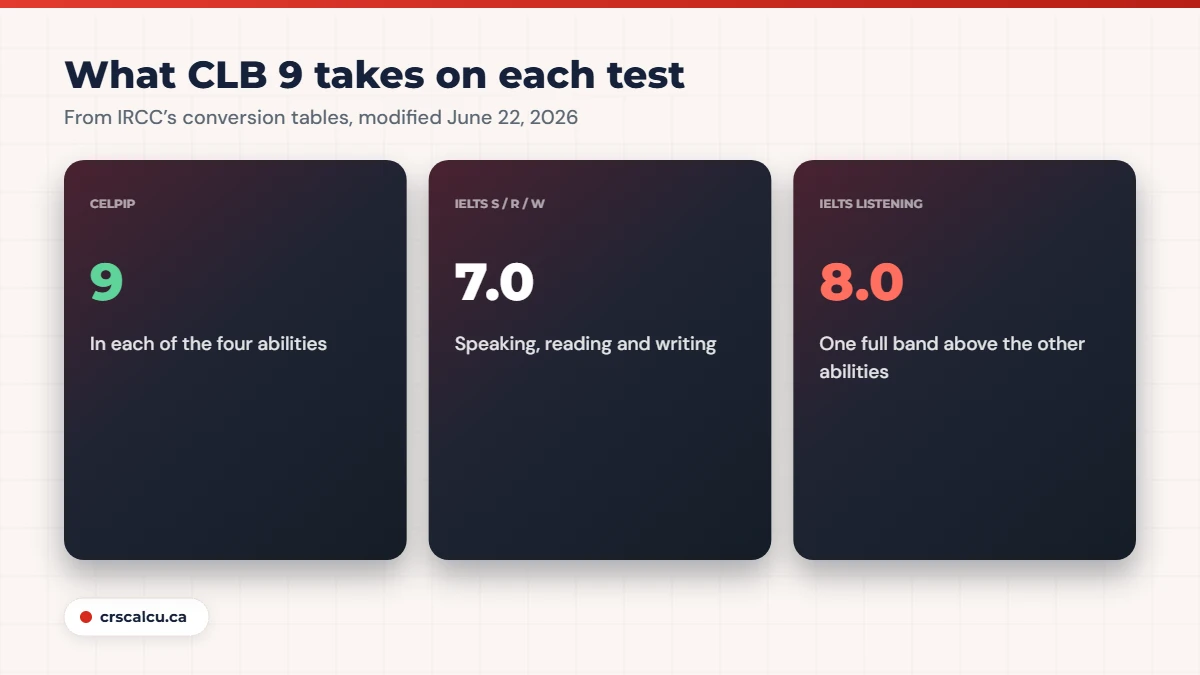
9 | 9 | 7.0 / 7.0 / 7.0 | 8.0 |
10 | 10 or more | 7.5 / 8.0 / 7.5 | 8.5 |
From IRCC’s conversion tables on the “Express Entry: Language test results” page (modified June 22, 2026). IELTS scores shown are the minimum for each level.
Read the IELTS columns carefully. Speaking, reading and writing climb in step until CLB 9. Listening runs a full band ahead from CLB 8 upward: 7.5 for CLB 8, 8.0 for CLB 9, 8.5 for CLB 10. And at CLB 10, reading needs 8.0 while speaking and writing need 7.5. CELPIP has none of these steps. A 9 is CLB 9 in any ability.
Why the conversion matters more than “difficulty”
Points are awarded per ability. On IRCC’s criteria page, a single applicant gets 17 points for an ability at CLB 7, 23 at CLB 8, 31 at CLB 9 and 34 at CLB 10 or more. One ability stuck a level below the others costs you those points, and can cost more in the skill transferability section, where the higher tier needs CLB 9 across the board. We go through the numbers in minimum CLB for Express Entry.
So the practical question for IELTS candidates is often about listening. Someone with 7.5 in listening and 7.0 everywhere else has three abilities at CLB 9 and one at CLB 8. On CELPIP, the question is usually about speaking, for reasons the cases below make clear.
Our example: what the listening step costs
This is our own illustration, using IRCC’s tables for a single applicant. Suppose you score 7.0 in speaking, reading and writing on IELTS and 7.5 in listening. Three abilities are at CLB 9, worth 31 points each. Listening at 7.5 is CLB 8, worth 23. Your language total is 116.
Now lift listening by half a band, to 8.0. All four abilities are at CLB 9 and the total is 124, a gain of 8 points. The larger effect is elsewhere. The skill transferability section gives its higher tier only when every ability is at CLB 9 or above. For someone with a degree and three years of foreign work experience, that tier is worth 25 and 50 points, against 13 and 25 at the lower tier: another 37 points riding on that same half band.
On CELPIP the same person would need a 9 in listening, with no extra step relative to the other abilities. Whether that is easier for you is exactly what a practice test will show.
Where PTE Core fits
Since IRCC added PTE Core to its list, the choice is among three English tests, not two. It is also taken on a computer, and it has its own conversion table: for CLB 9, IRCC’s page lists 84 to 88 in speaking, 82 to 88 in listening, 78 to 87 in reading and 88 to 89 in writing. The same reasoning applies. Points follow the level, so the question is only where your weakest ability lands.
IELTS vs CELPIP for Express Entry: what people who took both reported
Real case: both tests within two months, opposite strengths (November 2016)
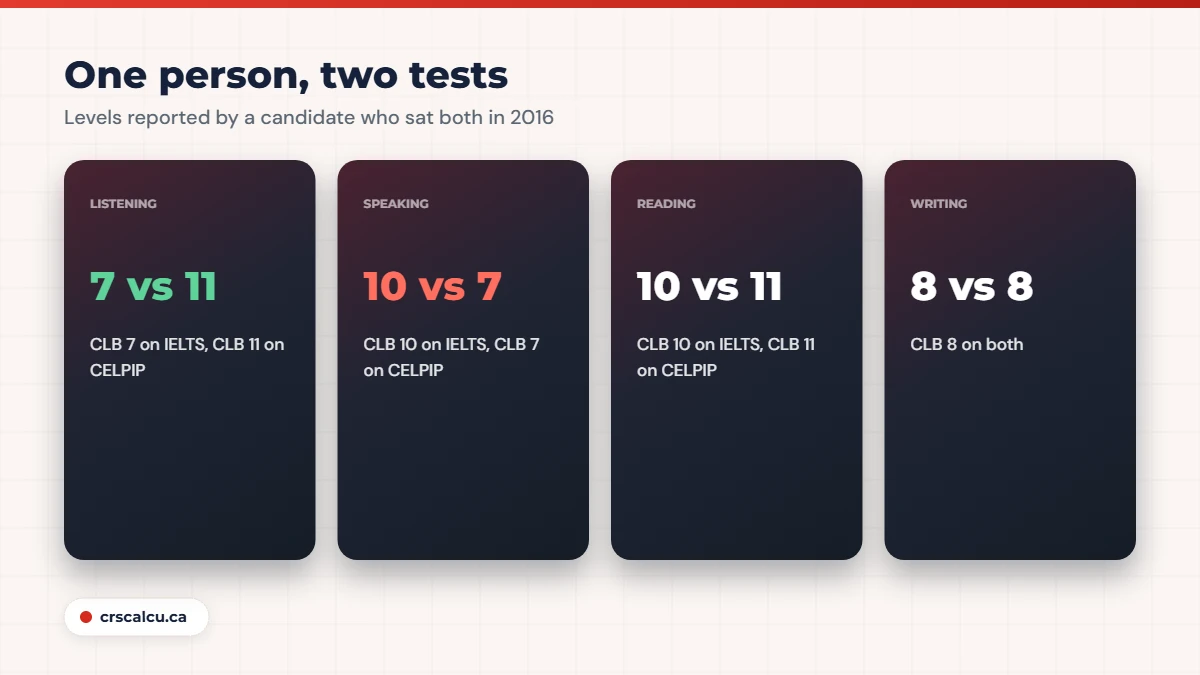
One applicant sat both tests about two months apart and posted the levels. On IELTS: reading and speaking at CLB 10, listening at CLB 7, writing at CLB 8. On CELPIP: reading and listening at CLB 11, writing at CLB 8, speaking at CLB 7. They found IELTS speaking easier because you talk to a person in a quiet room, and CELPIP speaking harder because everyone in the room speaks into a microphone at once. They found CELPIP listening and reading more approachable. Their advice: choose IELTS if speaking is your weak point, otherwise CELPIP.
Look at what happened to that person’s listening: CLB 7 on one test and CLB 11 on the other, weeks apart. Their speaking moved three levels in the other direction. Same person, same English.
Real case: six attempts over a year and a half (March 2017)
Another applicant, working full-time and aiming for CLB 9, sat IELTS three times and CELPIP three times. Their IELTS results improved with each attempt, the third being the strongest. On CELPIP they kept getting good listening and reading scores and falling short in writing and speaking. They concluded that the marking of the written and spoken parts of CELPIP was harsher for them and recommended IELTS. Several replies described the same pattern: strong scores in the multiple-choice sections and a speaking score that would not move.
Real case: weak IELTS writing, stronger on a keyboard (May 2016)
A third applicant took IELTS with little preparation and scored 9 in speaking, 7.5 in reading, 7 in listening and 6 in writing, blaming slow handwriting and spelling. They then took CELPIP, also with little preparation, and preferred typing with a spell-checker available. Their CELPIP results were 10 in listening, 11 in reading, 11 in writing and 8 in speaking, where they missed talking to a person. A re-mark lifted speaking by two levels. Their total was still below the cut-off at the time.
The pattern in those cases
Three people, three different conclusions, and yet the details line up.
What the three accounts have in common
These are three self-selected forum accounts from 2016 and 2017, and both tests have changed in small ways since. Treat them as a guide to what to try, not as evidence about which test is easier.
Sit a timed practice test of each before you pay
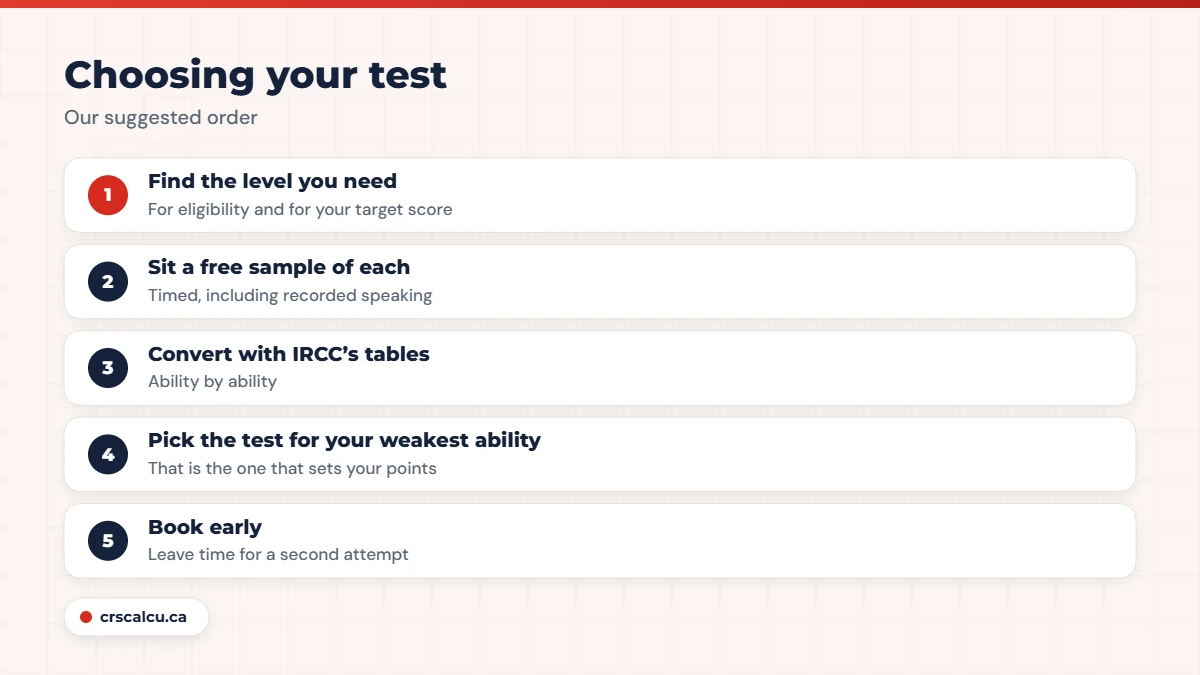
Both providers publish free sample tests. Do one of each under timed conditions, including recording yourself for the speaking tasks, and convert the results with IRCC’s tables. The test where your weakest ability lands highest is your test. That costs an afternoon, not a test fee.
Practical differences to check yourself
We have not listed fees, test lengths or locations, because they change and IRCC does not publish them. Check the providers’ own websites for these before you book.
What to compare
Can you take both, or switch?
Yes. There is no rule against sitting more than one test, and IRCC’s page simply asks for valid results from an approved test. You enter one test’s results for your first official language. You cannot mix abilities from two different sittings: the four scores come from one test report. If you already have a result that is about to expire, see IELTS expired after ITA.
If you update your profile with a new, better result while you are in the pool, your score changes from that point. Updating does not move your place in line for tie-breaking, according to IRCC’s profile page.
Five mistakes people make choosing between the tests
Five mistakes from the rules and the threads
Whichever you choose, convert the result and enter it in the CRS calculator, then compare your total with the latest draw cut-offs. Our guide to the CRS score for Canada PR shows where language sits among the other factors.
Frequently Asked Questions
Is IELTS or CELPIP better for Express Entry?
Neither is better in points. IRCC accepts both and awards points by CLB level. The better test is the one on which you reach a higher level in your weakest ability.
Does IRCC prefer CELPIP because it is Canadian?
No. IRCC’s language page lists CELPIP-General, IELTS General Training and PTE Core as approved English tests and treats their results the same way once converted to CLB.
What do I need on each test for CLB 9?
On CELPIP, 9 in each ability. On IELTS General Training, 7.0 in speaking, reading and writing and 8.0 in listening.
Is CELPIP speaking harder than IELTS speaking?
Two of the three forum candidates who took both found it harder, because you speak to a computer in a room with other candidates. One of them scored CLB 10 in IELTS speaking and CLB 7 in CELPIP speaking. Your experience may differ.
Can I combine my best scores from both tests?
No. You enter the four results from one test report for your first official language.
How long are IELTS and CELPIP results valid?
IRCC says results must be less than two years old when you complete your profile and when you submit your application for permanent residence.
Got your scores? See what they are worth
Convert IELTS or CELPIP results to CLB and compare your total with recent Express Entry cut-offs.
Final Thoughts
IELTS vs CELPIP for Express Entry is a choice of route, not of destination. Both lead to the same CLB levels and the same points. IELTS asks more of your listening at the top levels and gives you a human examiner for speaking. CELPIP scores every ability on one scale and is done entirely on a computer. The people who took both scored very differently on each, in ways that tracked their own strengths.
If your profile depends on reaching a specific level by a specific date, for example before an invitation expires or a current result runs out, plan the booking early and leave time for a second attempt. A licensed consultant can help with timing, but only practice tests can tell you which exam suits you.