Express Entry Guide · Updated October 2026
Tie-Breaking Rule in Express Entry: Who It Affects and How to Read It (Real Cases)
You had the cut-off score and no invitation came. The reason is usually a timestamp. Here is how to read it, and what you can and cannot do about it.
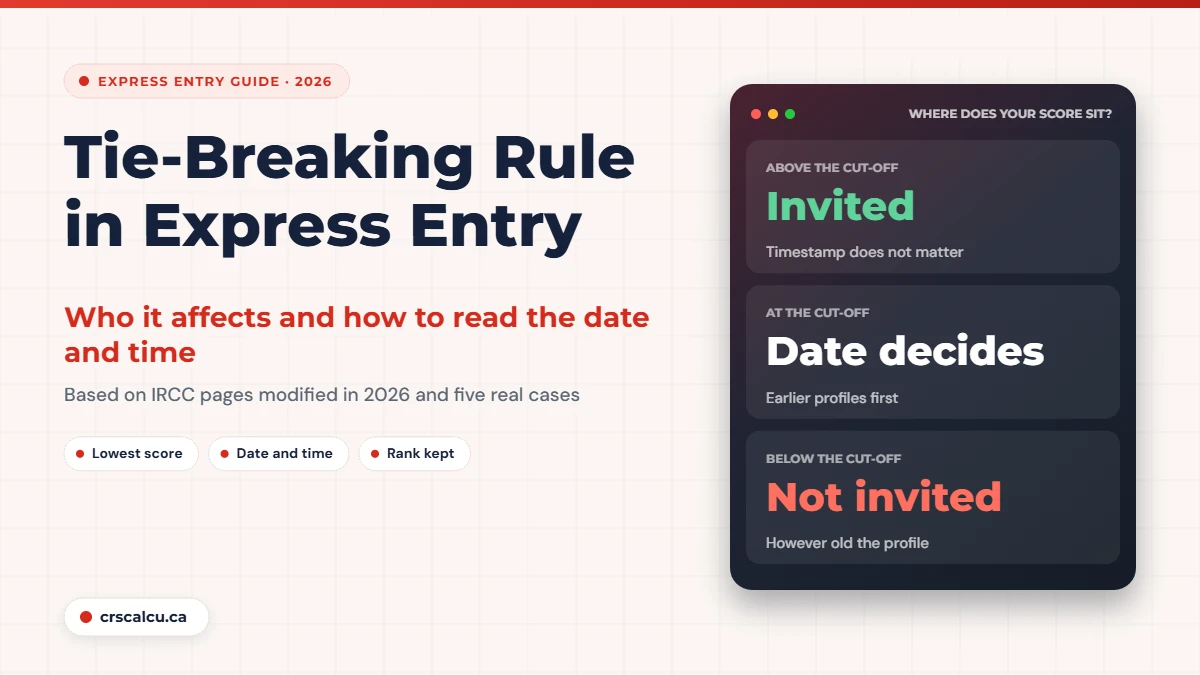
The tie-breaking rule is one sentence on IRCC’s rounds page, and it causes more confusion on draw day than anything else. People see a cut-off that matches their score, wait for an email that never arrives, and assume something broke.
Usually nothing broke. When more candidates sit at the lowest score than there are invitations left, IRCC needs a way to choose among them, and it uses the moment each profile was submitted. Earlier profiles go first. That is all the rule does, but the details matter: who it touches, what resets your timestamp and what does not.
We read IRCC’s rounds of invitations page, its create-profile page and its page for candidates not invited (all modified in 2026), plus five public forum threads from 2017 to 2024. This is general information, not legal advice.
Quick answer: how does the tie-breaking rule work?
IRCC’s rounds page (modified July 10, 2026) says that if more than one candidate has the lowest score, the cut-off is based on the date and time they submitted their Express Entry profiles. So the rule only matters if your score equals the lowest score invited in that round. Above it, the timestamp is irrelevant. At it, you are invited only if your profile was submitted before the published date and time. Updating your profile does not change your timestamp; a new profile does. See where your score sits with our CRS calculator.
Key takeaways
The tie-breaking rule in IRCC’s words
IRCC’s rounds of invitations page (modified July 10, 2026) describes each round with four facts: the date and time of the round, the CRS score of the lowest-ranked candidate invited, the number of invitations issued and the rank needed to be invited. Then it adds the rule: if more than one candidate has the lowest score, the cut-off is based on the date and time they submitted their Express Entry profiles.
That sentence explains why a round has a fixed number of invitations and a score that looks like a clean line. IRCC ranks everyone in the pool for that round, counts down until the invitations run out, and the last person invited sets the “lowest score”. If twenty people share that score and only eight invitations are left, the eight with the earliest profiles get them.
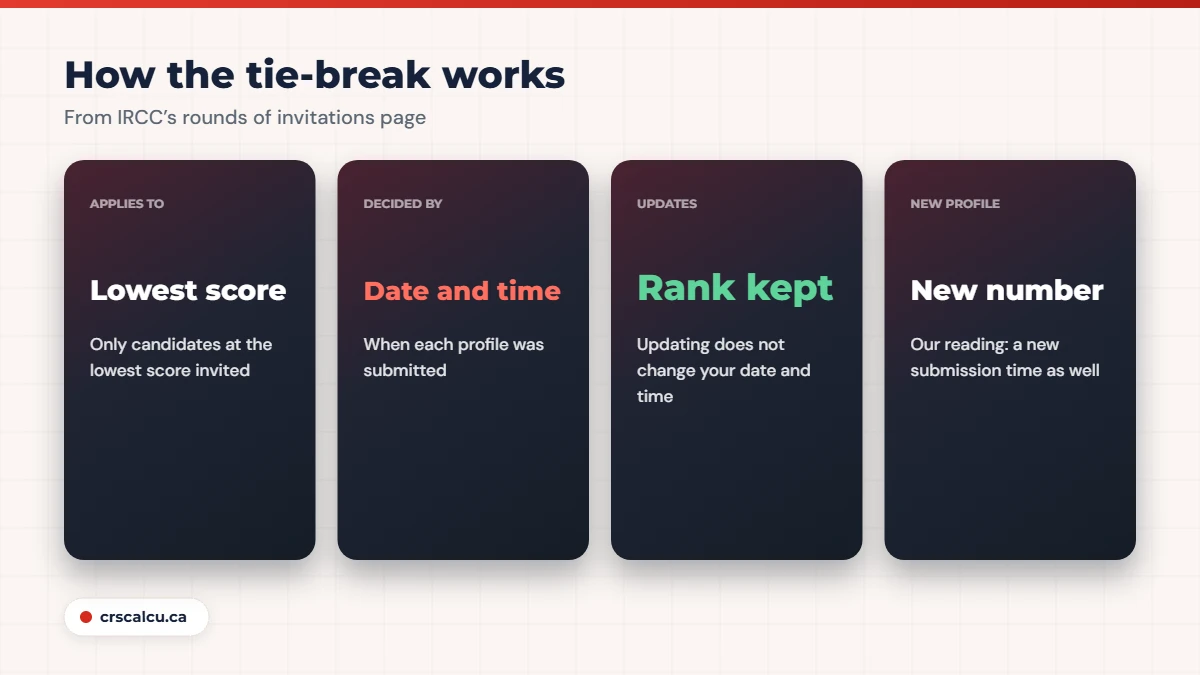
Who the tie-breaking rule affects
Only one group: candidates whose score is exactly the lowest score invited. Everyone above that score is invited whatever their timestamp, provided they are eligible for that type of round. Everyone below it is not invited, however old their profile is.
Candidate | Score | Profile submitted | Result |
|---|---|---|---|
A | 501 | Yesterday | Invited: above the lowest score |
B | 500 | March 1 | Invited: at the lowest score, before the tie-break time |
C | 500 | March 12 | Not invited: at the lowest score, after the tie-break time |
D | 499 | Eleven months ago | Not invited: below the lowest score |
A made-up round for illustration, with a lowest score of 500 and a tie-break of March 10. These are not real draw figures.
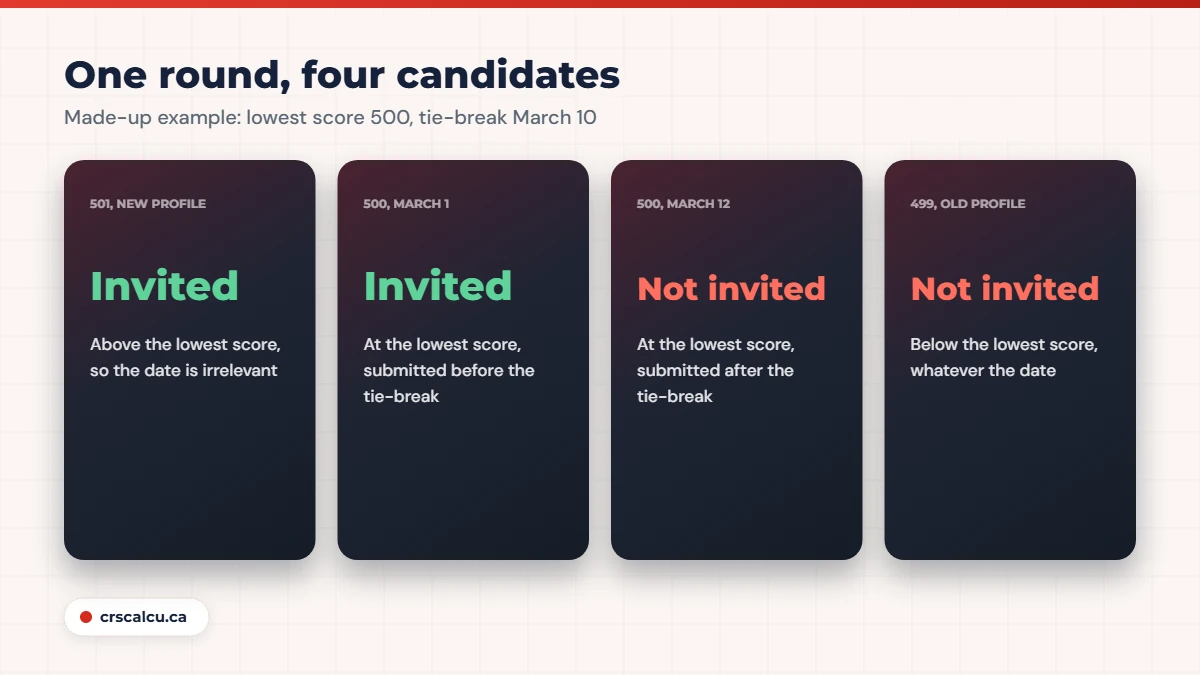
Candidate D is the one who feels cheated, and the rule gives them nothing. A profile that has waited almost a year does not outrank a higher score. Candidate A is the one who worries for no reason: a newer profile is not a handicap when you are above the line.
Real case: 517 against a cut-off of 515 (July 2024)
A candidate with 517 points had created their profile on May 17, 2024. A Canadian Experience Class round then invited 6,300 people with a cut-off of 515 and a tie-break date of February 3, 2024. Six hours later they had no invitation, and they asked whether the tie-break date, which was earlier than their profile, was the reason. An experienced reply said no: invitations can take time to appear after a round, up to 72 hours in their experience, and the candidate should wait. The poster thanked them. No further update was posted.
The reply is right about the rule. At 517 against 515, the timestamp plays no part. The “72 hours” is a forum figure; we did not find a delivery time on IRCC’s pages.
Real case: explaining a cut-off of 444 (March 2017)
In a long thread, several candidates reported having a score equal to or above a recent cut-off and no invitation. The explanation given each time was the tie-break: everyone above 444 was invited, and those with exactly 444 were invited only if they had submitted their profile before the stated time, which is given in UTC. Replies told people to compare their own submission time with that timestamp and to allow about a day for the system to issue invitations. Several posters later confirmed they had been invited once they understood which side of the timestamp they were on. One candidate with 448 reported in April 2018 that they were invited in a later round after declining an earlier invitation.
What sets your timestamp, and what resets it
The date and time in the rule are the date and time you submitted the profile. The question people ask next is whether editing the profile moves them to the back.
It does not. IRCC’s create-profile page (modified September 24, 2026) says that updating your profile does not change the date and time IRCC received it, so you keep your rank if you are in a tie-breaker situation. A new language result, a new job or a change in marital status can all go in without cost; see update Express Entry profile for the steps.
Action | Timestamp | Source |
|---|---|---|
Updating a submitted profile | Unchanged | IRCC create-profile page |
Declining an invitation | Not stated | IRCC says you return to the pool |
Profile expires after 12 months; new profile created | New profile, new number | IRCC page for candidates not invited |
Withdrawing and creating a new profile | New profile, new number | IRCC page for candidates not invited |
Our summary of IRCC’s create-profile page (modified September 24, 2026), respond-to-invitation page and page for candidates not invited (both modified June 22, 2026).
IRCC’s page for candidates who were not invited says a profile expires automatically after 12 months and that a new profile comes with a new Express Entry profile number. It does not use the word “tie-breaker”, but the rule runs on when a profile was submitted, and our reading is that a new profile has a new submission time. On declining, IRCC’s respond-to-invitation page says you go back into the pool; it does not say what happens to the timestamp, and we will not guess.
Real case: profile about to expire (May 2020)
A candidate whose profile dated from June 2019 was coming up to its 12-month expiry and worried that a recreated profile would carry a new submission date and lose out under the tie-break. Replies agreed the new profile would have a new date whether they withdrew or waited, and advised letting the old one expire and creating the new one that day, so there was no gap and no overlap. On July 28, 2020 the poster reported being invited after recreating the profile that month. Their account does not make clear whether their score was above the cut-off of that round, in which case the tie-break would not have applied to them at all.
Real case: expiry on the day of a draw (January 2023)
A candidate with 502 points had a profile due to expire on January 25, 2023, the day they expected the next round, and the last cut-off had been 507. They were unsure whether to create a new profile early. Several replies said a new profile was the safer choice, on the logic that losing a tie-break is bad but missing a round because the profile lapsed is worse. Another member pointed to IRCC’s statement that you may only have one profile at a time. By January 23 the poster reported having been invited on both profiles, and then faced a new question about work experience that had only just reached the required length.
Two invitations on two profiles is not a success to copy. IRCC’s Help Centre says you may only have one profile at a time and that this is set out in immigration law; we go through the risks in two Express Entry profiles. If your profile is about to expire, the page for candidates not invited gives the clean order: let it expire and create a new one, or withdraw it first.
At the cut-off and still not invited
Sometimes a candidate checks everything, appears to be on the right side of the timestamp and still hears nothing.
Real case: 496, before the tie-break, no invitation (September 2023)
A candidate had submitted a profile on July 12, 2023 with 496 points and believed they qualified under two programs. A round on August 15 had a cut-off of 496 and a tie-break of August 1, 2023, so their profile was earlier. Three weeks later they had no invitation, and several web forms had gone unanswered. Experienced members said similar reports existed elsewhere and that they had not seen anyone obtain an invitation after the fact; the suggestion was to wait for later rounds. In December 2023 other candidates described the same thing after a category round. No resolution was reported.
We cannot tell from a forum post why that happened. The possibilities people raised include the type of round, eligibility for the program being drawn, and a profile that changed around the time of the round. What the thread does show is that IRCC’s pages offer no appeal route for a missed round, and that the practical answer was the next draw.
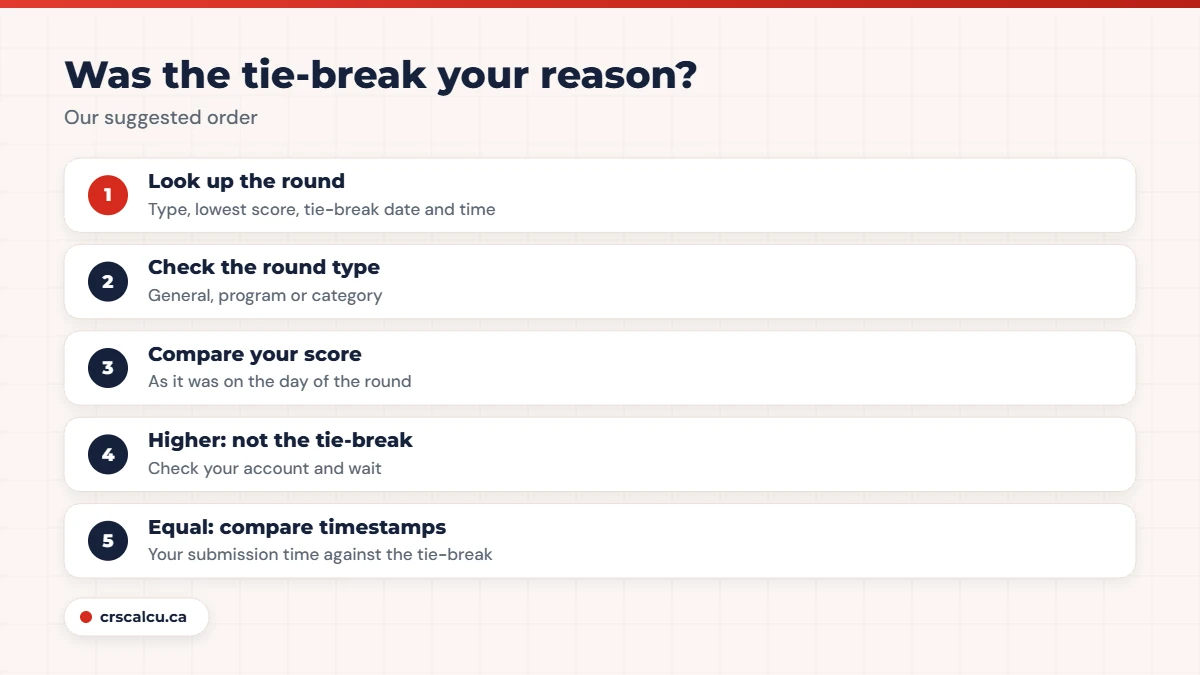
Checking whether the tie-break is your reason (our suggested order)
What you can do about it
You cannot go back and submit earlier, and no update will move your timestamp in either direction. The only lever is the score. A single additional point lifts you out of the tied group at that score, which is why small gains matter so much for candidates who keep landing on the cut-off. Look at the pool statistics to see how crowded your score band is, and at our next draw prediction for context.
Submit when you are eligible, not when you are perfect
Because updates keep your original date and time, there is an advantage in entering the pool as soon as you qualify and improving the profile afterwards. A profile submitted today with a score you later raise will always be older than one you wait three months to submit.
Five mistakes people make with the tie-breaking rule
Avoid these
What IRCC does not say
The rounds page states the rule in one sentence. It does not say how long invitations take to appear in accounts, what happens to the timestamp of a candidate who declines an invitation, or how a candidate can ask for a review if they believe they met the cut-off and the tie-break. On those points we only have forum experience, and we have labelled it as such.
Frequently Asked Questions
What is the tie-breaking rule in Express Entry?
IRCC’s rounds page says that if more than one candidate has the lowest score, the cut-off is based on the date and time they submitted their Express Entry profiles. Among candidates at that score, earlier profiles are invited first.
My score is higher than the cut-off. Does the tie-break date matter?
No. The rule only separates candidates who have exactly the lowest score invited in that round.
Does updating my profile change my tie-break date?
No. IRCC’s create-profile page says updating your profile does not change the date and time it was received, so you keep your rank in a tie-breaker.
Do I lose my place if my profile expires?
A profile expires after 12 months and a new one gets a new profile number. Our reading is that the new profile has a new submission time, since the rule is based on when a profile was submitted.
I had the cut-off score and an earlier profile but no invitation. What can I do?
Check the round type and your eligibility for it, and your score on that day. In the cases we read, people who sent web forms got no answer and were invited, if at all, in later rounds. IRCC’s pages describe no review process.
Is the tie-break time in my local time?
Forum posts quote the tie-break in UTC. Convert your own submission time before comparing.
Get above the tie
See which change would add the next point to your score.
Final Thoughts
The tie-breaking rule is narrow. It sorts candidates at one score, in one round, by one timestamp, and it never works against someone with a higher score. If you keep meeting it, the message is that you are one or two points from clearing the line, and the answer is in what CRS score you need.
If you believe you met both the score and the tie-break and were still not invited, or if your profile is close to expiry before a draw, a licensed immigration consultant or an immigration lawyer can look at your account with you.