Express Entry Guide · Updated October 2026
You ran your own business, found your own clients and paid your own taxes — so why does Express Entry treat your work differently from a salaried job?
By Aria Sterling · Checked against IRCC rules · 12 min read
Self-employed Express Entry is one of the most misunderstood topics in the whole system, because the answer is genuinely split. The same freelance year can count in one program, count for points in another way, and count for nothing in a third. Candidates who do not know the self-employed Express Entry split waste years claiming the wrong thing — or leave points on the table by assuming freelance work never counts at all.
This post draws the lines clearly — the complete self-employed Express Entry guide: what counts for the Canadian Experience Class, what counts for the Federal Skilled Worker Program, what counts for CRS points, and what proof actually persuades an officer. It is written for freelancers, contractors, agency workers, small business owners and anyone whose work history does not come with a simple employer letter.
Evidence base: IRCC’s program instructions and Help Centre answers on canada.ca, plus paraphrased reports from public applicant threads. This is general information, not legal advice.
Quick answer:
Self-employment in Canada does not count as Canadian work experience for the Canadian Experience Class — the regulations exclude it outright, and CEC needs third-party employment. But paid, skilled self-employment abroad can count for Federal Skilled Worker eligibility and for CRS foreign work experience, if you document it with contracts, invoices, payment proof, tax records and client letters. The question is never “does freelance count?” — it is “count for what, and where?” That is the self-employed Express Entry split in one paragraph.
Key takeaways
Self-Employed Express Entry: The Split — CEC vs FSW vs CRS Points
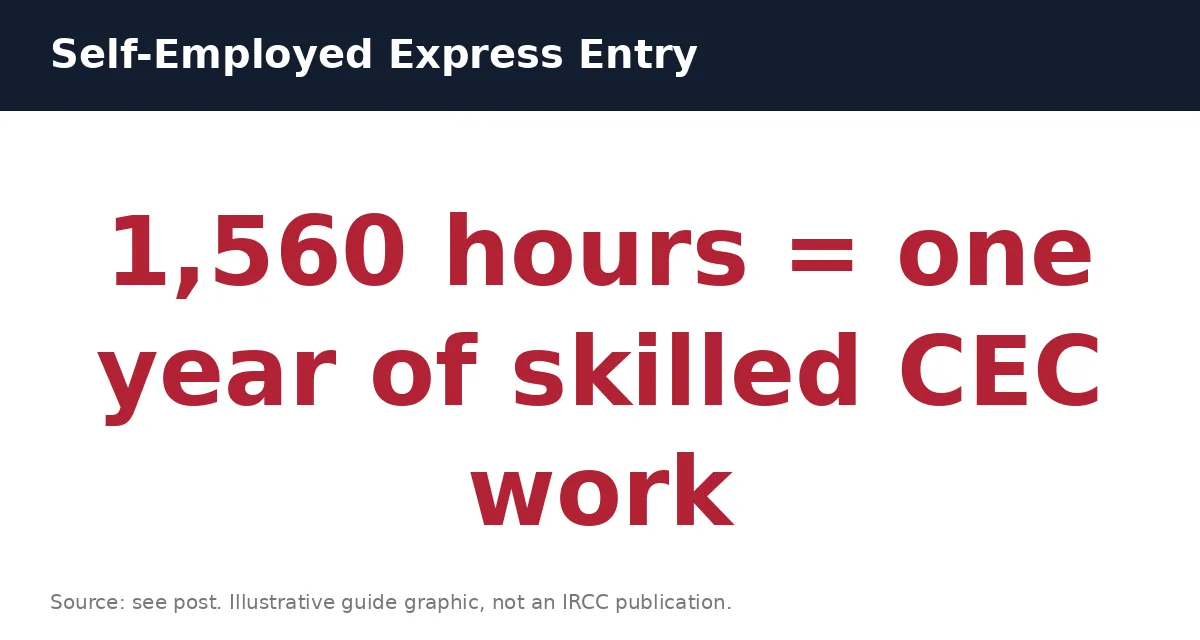
Start with the Canadian Experience Class, because its rule is the strictest and the most surprising. CEC requires at least one year (1,560 hours) of skilled work in Canada in the three years before you apply, in a TEER 0, 1, 2 or 3 occupation, while authorised to work. The regulations state that any period of self-employment shall not be included in calculating that qualifying experience. IRCC’s guidance puts it plainly: CEC requires skilled work in Canada through authorised employment by a third party, shown by documents such as T4 slips, Notices of Assessment and employer reference letters.
That means freelance work done in Canada — invoicing clients, working from home, filing your own taxes — builds no CEC eligibility, even if the work was skilled, continuous and well paid. It also does not matter whether your clients were Canadian. The exclusion is about the employment relationship, not the client list. The only widely noted exception is a temporary public policy for certain foreign-national physicians providing publicly funded medical services in Canada, who are told not to tick the self-employed box so their work can count. That exception is narrow, profession-specific, and should never be generalised to other occupations.
The Federal Skilled Worker Program is different. FSW has no equivalent self-employment exclusion. Its work requirement is one year of continuous, paid, skilled work (TEER 0, 1, 2 or 3) in the last ten years, and self-employment abroad can meet it if the work was genuinely paid and skilled and you can document it. The same logic applies to CRS points for foreign work experience: paid, skilled freelance work abroad can count toward foreign experience and toward transferability combinations, because the CRS foreign-experience rules do not carry the CEC exclusion.
Use of the work | Self-employment in Canada | Self-employment abroad |
|---|---|---|
CEC eligibility (Canadian experience) | No — excluded by regulation | Not Canadian experience at all |
FSW eligibility (skilled work requirement) | Possible in principle, but get advice — CEC and FSW treatment differ | Yes, if paid, skilled, continuous and documented |
CRS foreign work experience points | No — it is not foreign experience | Yes, if paid, skilled and documented |
CRS Canadian work experience points | No — excluded like CEC eligibility | Not Canadian experience |
Source: IRCC’s CEC guidance and FSW requirements on canada.ca. This table is our summary of those pages, not IRCC text. Provincial nominee streams have their own rules — check the stream. Keep that split in mind for every self-employed Express Entry claim you make.
Employed or Self-Employed? How Officers Decide
The hardest cases are the ones in between: a small shareholder who takes a salary, a contractor on a long placement with one client, a personal trainer paid through a gym. Officers do not decide these cases by job title or by what the contract says. They look at substance: who controlled the work, who set the terms, whether payroll deductions (Canada Pension Plan, Employment Insurance, income tax) were made, and whether a T4 slip was issued. A T4 is, for most CEC applicants, the key document that shows an employer-employee relationship existed.
If you own the company that pays you, control its decisions and set your own working terms, an officer may treat the work as self-employment for CEC even though a salary was paid. That does not make the work fake — it makes it the wrong kind of work for CEC. The same person might still use the experience for FSW or for CRS foreign experience if the work was abroad, but the CEC door stays closed for those months.
Contractors should ask themselves one honest question: if the client stopped tomorrow, would I be an employee who was laid off, or a business that lost a customer? Employees get T4s, deductions and employer direction. Businesses invoice, bear risk and find their own clients. IRCC’s test follows that reality, not the label on the contract. If you are unsure which side you fall on, talk to a licensed consultant before you tick any box — the box you tick in the profile follows you through the whole file. Tick the wrong box and a self-employed Express Entry file can unravel at verification.
Tip:
Do not hide self-employment to make a CEC claim fit. Tick the box honestly. A CEC claim built on hidden self-employment is a misrepresentation risk, while an honest FSW or PNP route built on the same work can succeed.
Self-Employed Express Entry: The Proof Package That Persuades
Self-employed proof is harder than employed proof for one reason: there is no employer to write the letter. You have to build the employer’s side of the file yourself, from third-party documents. The package that works has five layers, and the more layers you can show, the stronger the claim.
Layer 1 — The business existed. Business registration, articles of incorporation, trade licences, or sole-proprietor registration, as applicable in your country. This proves there was a real business, not just a story about one.
Layer 2 — The work happened. Client contracts or engagement letters showing the services, the period and the rate. Contracts alone are weak without the next layer, because a contract can exist without the work ever being done.
Layer 3 — The money moved. Invoices matched to bank credits or payment records, and tax returns showing the self-employment income. An invoice nobody paid proves nothing; a bank credit with no invoice proves income but not skilled work. Together, they prove paid skilled work.
Layer 4 — Third parties confirm it. Letters from clients stating what services you provided, when, and what they paid. These are the closest substitute for an employer letter, and they should come from the clients themselves, with contact details, not from you.
Layer 5 — Your explanation. A short letter of explanation tying the layers together: what the business did, who the clients were, how the work maps to the claimed NOC, and why each document is included. Keep it factual and short.
One warning from IRCC’s own guidance: self-declared duties or affidavits are not acceptable as proof of self-employed work experience on their own. Your statement can explain the file, but it cannot carry it. If your package is mostly your own words, it is not ready. Third-party paper, not your own words, is what carries a self-employed Express Entry claim.
Self-Employed Express Entry Traps and Mistakes
Every trap above hits self-employed Express Entry files hardest, because the proof burden is already higher.
Real Cases
Real case: Freelance digital media work, documented or not? (2023)
A freelance digital media worker asked how to prove foreign freelance experience without sole-proprietor registration. The thread’s advice centred on the same five layers used above: client contracts, invoices with matching payments, tax filings, and client letters describing the services. Registration helps, but the payment trail and client confirmation matter more than any single registration paper. No outcome was reported.
Real case: Small shareholder taking a salary (2022)
A candidate who owned a small share of an incorporated company with a partner, and took a salary to run it, asked whether the work was employed or self-employed for CEC. The thread’s consensus was uncomfortable: control and ownership pointed toward self-employment for CEC purposes, even with a salary. The practical advice was to test the work against FSW and PNP routes instead of forcing a CEC claim. No outcome was reported.
Real case: Personal trainer — employee or contractor? (2024)
A personal trainer living in Canada asked whether formally employed work (contract and payslips) or independent-contractor work would count for CEC. The answer in the thread drew the line cleanly: employed work with a T4 and deductions can count; independent-contractor work in Canada generally cannot, even for the same training sessions in the same gym. The job did not change — the employment relationship did. No outcome was reported.
Real case: The physician exception, not a general rule (2023)
Physicians discussing the public policy noted that certain foreign-national physicians providing publicly funded medical services can count self-employed Canadian work that would otherwise be excluded, and are told not to tick the self-employed box. Other posters stressed that this exception belongs to physicians under that policy only — it does not open CEC to freelancers generally. No outcome was reported.
Frequently Asked Questions
Does self-employment count for Express Entry?
It depends on the program. Self-employment abroad can count for Federal Skilled Worker eligibility and for CRS foreign work experience if it was paid and skilled. It does not count as Canadian work experience for the Canadian Experience Class, whose regulations exclude self-employment outright, so the same freelance year can be valuable in one route and worthless in another. That split is the whole self-employed Express Entry story: same work, different answers by program.
Why does self-employment not count for the Canadian Experience Class?
The regulations exclude any period of self-employment from CEC qualifying work experience. CEC requires skilled work in Canada through authorised employment by a third party, shown by documents like T4 slips and employer letters. The exclusion is about the employment relationship, not the quality of the work — a freelancer’s skilled work is real work, but it is not the third-party employment CEC was designed to reward. The exclusion is the single most important self-employed Express Entry rule for anyone in Canada.
Does freelance work abroad count for CRS points?
Paid, skilled freelance work abroad in a TEER 0, 1, 2 or 3 occupation can count as foreign work experience for CRS purposes, including transferability, if you can document it properly with contracts, invoices, payment proof and client letters. The key is documentation: without a payment trail and third-party confirmation, even genuine freelance work cannot be converted into points. Document it properly and self-employed Express Entry work abroad can count as foreign experience.
What proof do I need for self-employed work?
Business registration or incorporation documents, client contracts, invoices matched to payment records, tax returns, and third-party letters from clients stating the services provided and amounts paid. Your own statement alone is not enough, because self-declared duties are not accepted as proof of self-employed experience. The package must show the business existed, the work happened, and the money moved.
Can I count self-employed work I did in Canada for the Federal Skilled Worker Program?
FSW does not have the CEC self-employment exclusion, but the work must still be paid, skilled, continuous for at least one year, and documented. Get advice if your Canadian self-employment overlaps with a CEC claim, because the programs treat it differently — the same months may help FSW while being invisible to CEC, and claiming them for CEC risks recalculation after an invitation.
Do I tick the self-employed box in my profile?
Yes, honestly, for any period that was genuinely self-employed. Hiding it to make a CEC claim fit is misrepresentation, and officers check T4s, deductions and control to detect it. The one narrow exception is certain physicians under a public policy, who are told not to tick it — an exception that belongs to that policy only and must never be generalised to other occupations.
Can a provincial nominee program accept self-employment that CEC rejects?
Some provincial streams have different rules, so check the specific stream on the province’s official site. A nomination can also change the route entirely, since it adds 600 CRS points and may not depend on CEC eligibility at all. Never assume CEC rules apply to a provincial stream — read that stream’s own requirements, because they are what the province will actually assess.
Final Thoughts
Freelance work is real work, and Express Entry does recognise it — just not everywhere, and not on your word alone. The candidates who succeed with self-employment are the ones who stop asking “does it count?” and start asking “count for which program, and what proves it?” Answer those two questions honestly, build the five-layer package, and claim only the months the documents support. That is the mindset that turns self-employed Express Entry from a mystery into a plan.
If you are in Canada and CEC is your goal, the practical move is usually a salaried, third-party job for at least a year. If you are abroad, or FSW is your route, your freelance history may already be worth points — check it in the CRS calculator and, for a complicated history, talk to a licensed consultant (RCIC) or lawyer before you submit. A self-employed Express Entry file with a complicated history deserves that second pair of eyes.
Sources
We build free Express Entry tools and track every IRCC draw. This guide was checked against official IRCC sources and real applicant reports. This is general information, not legal advice. For your own case, talk to a licensed consultant (RCIC) or lawyer.
Last reviewed: October 29, 2026
Additional Details — Name: Self-Employed Express Entry in 2026: What Counts · Description: Self-employed Express Entry in 2026: freelance and self-employed work can count — but not for CEC. Learn the split and the proof that works.