Express Entry Guide · Updated October 2026
A nurse’s letter, an engineer’s letter and a tradesperson’s letter should not look alike — because the work, the proof and the traps are different in each — and neither should their reference letter sample.
By Aria Sterling · Checked against IRCC rules · 13 min read
A reference letter sample for a nurse, engineer or trades worker in Canada is only useful if it matches the occupation it is supposed to prove. Generic samples fail for a simple reason: officers do not compare your letter to a template, they compare it to the NOC — the lead statement and the main duties of the occupation you claimed. A letter that could describe any job in any hospital, firm or site will not survive that comparison, however polished it looks. That is why a reference letter sample must be occupation-specific, not generic.
This post gives you occupation-specific guidance for three of the most common Express Entry occupations: registered nurses, engineers, and trades workers. For each, you will find what the letter must prove, what good duties wording looks like (in the employer’s own words, never copied from the NOC page), and the mistakes that are specific to that occupation.
Evidence base: IRCC’s work-experience document guidance and NOC selection rules on canada.ca, plus paraphrased reports from public applicant threads. Sample wording below is illustrative, not a template to copy verbatim — the official source behind every reference letter sample in this post.
Quick answer:
Every letter needs the same skeleton — letterhead, employer contact, your name, positions, titles, dates, hours, salary and benefits, duties, and the signer’s name, title and signature. The duties paragraph is where occupations diverge: nurses prove clinical duties in a real setting, engineers prove design and supervision work on real projects, and trades workers prove trade tasks, hours and apprenticeship or journeyman standing. Duties must be described in the employer’s own words — never copied from the NOC page. That skeleton plus occupation-specific duties is what a reference letter sample must show.
Key takeaways
Reference Letter Sample: The Skeleton Every Letter Needs
Before the occupation-specific advice, the shared foundation. A standard letter is printed on company letterhead, signed by a supervisor or personnel officer whose name, title and contact details appear on it, and states: your name, every position held, job titles, main duties and responsibilities, job status if current, dates worked, hours per week, and annual salary plus benefits. If your letter is missing any of these, fix that first — no amount of clever duties wording compensates for missing dates or hours.
The duties test itself is worth restating, because it governs everything below. You must have performed the actions in the lead statement of the NOC and a substantial number of its main duties, including all of the essential duties. IRCC does not publish a fixed percentage, though guides commonly treat most duties as the practical benchmark. Your letter’s job is to make that test easy to pass: describe the actual work, in enough detail that an officer can tick off the duties one by one, without the letter ever quoting the NOC. A reference letter sample that quotes the NOC fails that test on sight.
Reference Letter Sample for Nurses: Clinical Duties
Registered nurses (NOC 31301) are among the most common Express Entry applicants, and their letters fail in a predictable way: hospital HR departments often refuse detailed duties letters, confirming only dates and title. A letter that says “Staff Nurse, 2021–2024” proves employment, not nursing. The fix is a second letter from the nursing supervisor or head nurse who actually assigned and observed the work, describing clinical duties in the real setting: the ward or unit, the patient group, and the tasks performed.
Good nurse duties wording is specific without being a copy of the NOC. It names the setting (“medical-surgical ward, 30 beds”), the patient work (“assessed patients on admission, monitored vital signs and symptoms, administered medications as prescribed”), the planning work (“developed and updated care plans with the treating team”), and the collaboration (“handed over to the next shift, briefed doctors on changes in condition, educated patients and families on discharge care”). That paragraph lets an officer match the NOC’s duties without the letter ever quoting them.
Illustrative wording (nurse):
“As Staff Nurse on the medical-surgical ward, she assessed patients on admission and during each shift, recorded and acted on changes in vital signs and symptoms, administered oral and intravenous medications as prescribed, maintained patient records, and worked with doctors and therapists to update care plans. She also supervised junior nursing staff on her shifts and educated patients and families about post-discharge care.”
Two nurse-specific points. First, if you worked in several units, list them separately with dates — a letter that merges intensive care, paediatrics and general medicine into one paragraph reads as generic, while separated roles read as a real career. Second, licensing is a separate question from eligibility: Express Entry eligibility is about the work performed, while actually practising as a nurse in Canada requires provincial registration. Do not confuse the two in your letter, and do not let a letter claim a licence you do not hold. A nurse reference letter sample must keep that line clear.
Engineers: Design and Supervision, Not Project Lists
Engineers (for example, civil engineers, NOC 21300, and mechanical engineers, NOC 21301) fail differently: their letters read like CVs. A letter that lists ten project names and says “responsible for design and supervision” tells the officer almost nothing, because every engineer on every project could claim the same sentence. What the officer needs is what you actually did on those projects: the design work, the calculations, the specifications, the standards, and the supervision.
Good engineer duties wording names the work: “prepared structural calculations and drawings for reinforced concrete frames”, “reviewed geotechnical reports and selected foundation types”, “prepared tender documents and evaluated contractor bids”, “supervised site works and checked construction against drawings and specifications”, “used [named software] for modelling and analysis”. One paragraph like that, for each role, is worth more than a page of project names. If you were a consultant rather than an employee, the same logic applies, plus the contract and payment evidence that proves the engagement was real.
Illustrative wording (civil engineer):
“As Site Engineer, he reviewed structural drawings and specifications, set out works on site, checked reinforcement and concrete works against design requirements, prepared daily progress reports, coordinated subcontractors, and reported defects and variations to the project manager. He also reviewed shop drawings submitted by suppliers for compliance with the design.”
Engineer-specific traps: claiming a senior title (“Project Manager”) while describing junior duties, or the reverse; letters from a company director who never supervised the engineering work, instead of the chief engineer who did; and letters that describe management of people but no engineering — which can push the claim toward a management NOC that does not match the experience. Match the letter to the NOC you claimed, not to the title you wish you had. An engineer reference letter sample must match the claimed NOC the same way.
Reference Letter Sample for Trades: Tasks, Hours, Standing
Trades workers — carpenters (NOC 72310), electricians (NOC 72410), welders, plumbers, mechanics — face the most practical proof problems. Work is often site-based, employers are small, foremen move on, and hours vary by season. A strong trades letter therefore does three things at once: it lists trade-specific tasks, it states hours per week clearly (full-time status matters), and it is supported by standing evidence — apprenticeship records, journeyman or trade certificates, union membership, or employer training records.
Good trades wording is concrete: “installed and repaired electrical systems in residential buildings, including wiring, panel installation, lighting circuits and testing”, “read and interpreted blueprints and electrical code requirements”, “diagnosed faults and carried out corrective maintenance”. Vague wording — “performed various electrical duties” — is the trades equivalent of a nurse letter that says only “Staff Nurse”. The officer cannot match vague duties to a NOC, so the claim fails even when the work was real.
Illustrative wording (electrician):
“As Journeyman Electrician, he installed, maintained and repaired electrical wiring, panels, lighting and control systems in commercial buildings, read blueprints and specifications, tested installations for safety and compliance, and diagnosed and repaired faults. He worked 40 hours per week and supervised two apprentices on site.”
Trades-specific support documents matter more here than in other occupations, because small employers sometimes cannot produce a formal letter at all. Apprenticeship completion records, trade certificates, union letters, and a foreman’s signed letter on plain paper (with verifiable contact details) together can carry a claim that no single document could. And if your employer refuses a full letter, the substitute-package approach from our earlier post applies in full — see the internal links below. A trades reference letter sample leans on the same substitute approach when the employer will not cooperate.
Occupation-Specific Mistakes
Occupation | Most common letter mistake | Fix |
|---|---|---|
Nurses | HR letter with dates and title only, no clinical duties | Add a nursing supervisor’s letter describing clinical duties in the real unit |
Engineers | Project list with no design or supervision tasks described | Describe calculations, drawings, specifications and site checks per role |
Trades | Vague duties (“various duties”) and no hours stated | List trade-specific tasks, state weekly hours, add apprenticeship/certificate evidence |
All three | Copying NOC wording word for word | Rewrite duties in the employer’s own words from the actual work |
All three | One merged paragraph for several different roles | Separate each position with its own dates and duties |
Source: IRCC’s work-experience document guidance and NOC selection rules on canada.ca. This table is our summary, not IRCC text. Use it alongside a reference letter sample for your own occupation.
Warning:
A letter that copies NOC wording is worse than a shorter, honest letter. Officers see copied wording constantly, and it undermines trust in the whole file — including the parts that are true.
Real Cases
Real case: Nurse with an HR-only letter (2022)
A nurse reported that the hospital would confirm employment but would not describe duties. The thread’s advice was to keep the HR letter and build around it: a supervisor’s letter from the ward, duty rosters, and assignment records. The pattern — central HR confirms the job, the clinical supervisor describes the work — is the standard solution for hospital staff. No outcome was reported.
Real case: Engineer whose letter listed projects, not tasks (2021)
An engineer asked why a letter naming major projects had not been enough. Posters pointed out that project names prove presence, not duties: the letter needed to say what the engineer did on those projects — design, calculations, supervision, checking — in the engineer’s own tasks. The fix was a rewritten letter from the supervising engineer, not a longer project list. No outcome was reported.
Real case: Tradesperson with a foreman’s letter (2023)
A trades worker whose small employer had no formal HR process asked whether a foreman’s signed letter would work. The thread’s view was that it could, especially when paired with trade certificates and pay records, as long as the foreman’s identity and contact details were verifiable. Formal letterhead is preferred, but a verifiable supervisor account beats no account at all. No outcome was reported.
Real case: Title mismatch, duties match (2022)
A candidate whose job title did not match the NOC title asked whether the claim was doomed. The thread’s answer was reassuring and correct: titles do not decide NOCs, duties do. A letter describing duties that matched the claimed NOC, under a different title, was the right approach — and inventing a matching title would have been misrepresentation. No outcome was reported.
Frequently Asked Questions
Should a nurse’s reference letter list every ward and procedure?
It should describe the nursing duties actually performed — patient assessment, care planning, medication administration, monitoring and collaboration — in the nurse’s real setting, with dates, hours and the supervisor’s details. A list of ward names without duties does not prove the NOC, and a letter that could describe any nurse in any hospital will not survive comparison against the registered-nurse duties. A nurse reference letter sample should read like a ward record, not a ward list.
What should an engineer’s reference letter emphasise?
Design and analysis work, calculations and specifications, site supervision, project responsibilities and the tools or standards used. Project names alone do not prove duties; the engineer’s actual tasks on those projects do. A letter that says what you calculated, drew, specified and checked on each project lets the officer tick off the NOC duties one by one, which is exactly what the substantial-duties test requires.
What makes a trades reference letter strong?
Trade-specific tasks performed, hours per week, apprenticeship or journeyman status, and a foreman or supervisor who can confirm the work. Union records and apprenticeship certificates support the letter but do not replace it, because they prove standing rather than daily duties. The letter itself must still list the trade tasks in concrete terms — installed, repaired, wired, tested — not vague phrases like various duties. That is the shape of a strong trades reference letter sample.
Can I copy the NOC duties into my reference letter?
No. Officers recognise copied NOC wording and treat it as a red flag. Write the duties in the employer’s own words, describing the actual work, and let the match to the NOC speak for itself. A letter that mirrors the NOC page reads as manufactured, and it undermines trust in the whole file — including the parts that are true.
What if my job title does not match my NOC title?
Titles do not decide NOCs; duties do. A letter that describes duties matching the NOC, even under a different title, is stronger than a letter with the right title and vague duties. Inventing a matching title to force the fit would be misrepresentation, while an honest title with matching duties is exactly what the substantial-duties test is designed to reward.
How long should a reference letter be?
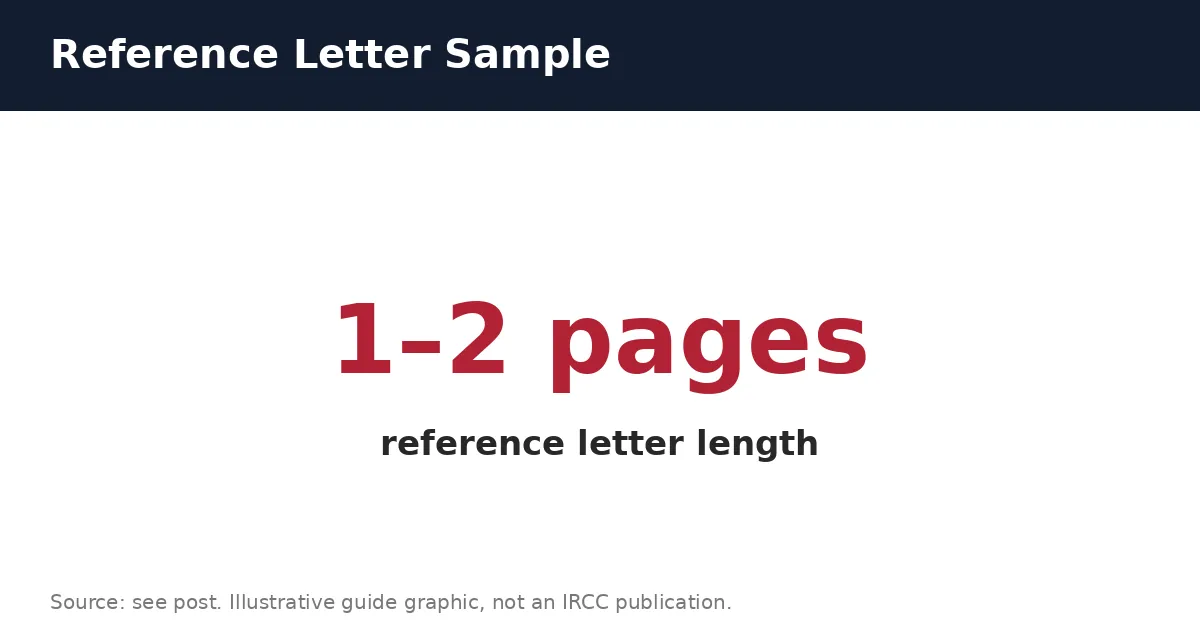
One to two pages is usually enough: the required facts plus a duties paragraph for each role. Length is not evidence; specific, verifiable duties are. A five-page letter that repeats the same vague duties adds nothing, while a one-page letter with concrete tasks, dates, hours, salary and a verifiable signer gives the officer everything needed to approve the claim. A reference letter sample of one to two pages proves the point: length is not evidence.
Can one letter cover several roles at the same employer?
Yes, if it lists each position, its dates and its duties separately. A single letter that merges three different roles into one vague paragraph is much weaker than one that separates them clearly, because the officer cannot tell which duties belong to which period. Separation also protects you: if one role’s duties are disputed, the other roles’ evidence stands on its own.
Final Thoughts
The best reference letter for your occupation is not the most impressive-sounding one — it is the most specific, verifiable account of what you actually did, written by someone who supervised it. Nurses: get the clinical supervisor’s account of your ward work. Engineers: describe design, calculations and site checks on real projects. Trades workers: list trade tasks, state your hours, and attach your standing evidence. In all three cases, write the duties in your employer’s own words and let the NOC match speak for itself. That specificity is what a reference letter sample is for.
If your employer will not cooperate, see our companion post on substitute evidence for refused reference letters (post 14 in this series), and if your duties do not clearly match one NOC, use the NOC finder and the CRS calculator to test the claim before you submit. For a complicated history, talk to a licensed consultant (RCIC) or lawyer. If your duties do not clearly match one NOC, a reference letter sample will not fix the mismatch — the NOC choice will.
Sources
We build free Express Entry tools and track every IRCC draw. This guide was checked against official IRCC sources and real applicant reports. This is general information, not legal advice. For your own case, talk to a licensed consultant (RCIC) or lawyer.
Last reviewed: October 29, 2026
Additional Details — Name: Reference Letter Sample in 2026: Nurses, Engineers, Trades · Description: Reference letter sample in 2026: duties wording for nurses, engineers and trades that matches the NOC — without copying it word for word.