Express Entry Guide · Updated October 2026
Can you declare a non-accompanying spouse to lift your CRS score — and what does that declaration actually cost you?
By Aria Sterling · Checked against IRCC rules · 13 min read
The non-accompanying spouse question is the most dangerous question in Express Entry, because the honest answer and the tempting answer look almost identical. The honest version: your spouse genuinely cannot come yet, for a real reason you can prove, and you declare that truthfully. The tempting version: your spouse fully intends to come, but you declare them non-accompanying to gain points, planning to sponsor them right after landing. The first is a legitimate choice. The second can end in refusal and a five-year ban.
This post is a decision guide, not a profile-change manual. It covers what the declaration does to your score, what it does not remove (medicals and full-family funds), what counts as a genuine reason, what triggers a procedural fairness letter, and what to do when plans change. If you only take one line from this post, take this: the score gain is small, and the risk of faking it is not.
We checked this guide against IRCC’s CRS criteria and family-member rules on canada.ca, plus public forum threads about non-accompanying declarations. This is general information, not legal advice.
Quick answer: Declaring a spouse non-accompanying moves you to the without-spouse scoring scale (core up to 500 instead of 460, with no spouse factors) — a modest gain, not a windfall. It does not remove your spouse from your family size for proof of funds, and it does not remove their medical exam. And it must reflect a genuine plan, supported by evidence, or it risks a misrepresentation finding.
Key takeaways
What a non-accompanying spouse declaration does to your score
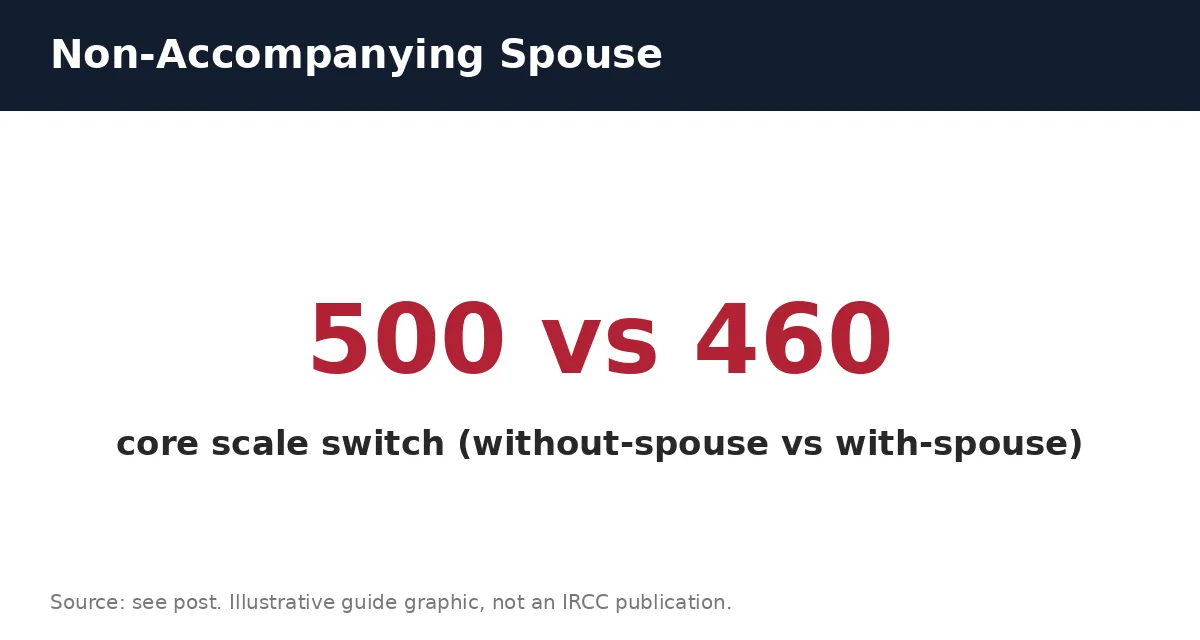
With an accompanying spouse, your core human capital is capped at 460 and your spouse can add up to 40 points, for a combined core of 500. With a non-accompanying spouse, your core is capped at 500 and your spouse adds nothing. The arithmetic is identical in structure to the permanent-resident-spouse case: the scale switches, and the spouse-factor section empties. In our companion worked example, a principal scoring 370 with an accompanying spouse scored 378 on the without-spouse scale — a gain of 8 points, not 40, not 100, not a transformation.
That small gain is the first thing to understand, because the forums often describe the move as if it unlocks a different league. It does not. If you are 50 points below the rounds you are watching, a non-accompanying declaration will not save you. If you are 5 points below, it might — but only if the declaration is true, and only after you have paid the medical and funds costs below. Run your own numbers in the CRS calculator in both directions before you even consider it.
What a non-accompanying spouse still needs: medicals and funds
Item | Accompanying spouse | Non-accompanying spouse |
|---|---|---|
Principal’s core scale | Up to 460 | Up to 500 |
Spouse factors | Up to 40 | 0 |
Family size for proof of funds | Counts | Still counts — full family size |
Medical exam for spouse | Required | Still required |
Medical exam for children | Required | Still required, including non-accompanying children |
Visa issued with principal | Yes | No — sponsorship later, if eligible |
Source: our summary of IRCC’s CRS criteria and family-member requirements (canada.ca). The table’s wording is our summary, not IRCC’s text.
The medical rule is the one people miss, and it is the one with permanent consequences. Every family member must be declared, and non-accompanying family members must still complete medical exams. Under IRPR s.117(9)(d), a dependent who was not medically examined before the parent became a permanent resident may never be sponsored later. That is not a delay; it is a door closing. The same logic applies to a non-accompanying spouse: if the medicals are not done, a later sponsorship can fail on that ground alone.
One timing note to check, not to rely on blindly: guides report that since August 21, 2026, Express Entry permanent residence applications have required medical exam results for the principal applicant and all family members up front at application. Treat that as a timing check for your own file — confirm the current instruction in your document checklist — rather than as settled text.
The funds rule surprises people just as much. A spouse and two children staying behind still make a family of four for settlement funds. If you are invited under the Federal Skilled Worker Program, you must show the four-person amount even though only one visa is being issued. Leaving a non-accompanying child out of the family-size count is one of the most common errors in the forums, and it is also one of the easiest for an officer to catch.
Warning:
A non-accompanying spouse still needs a medical exam, and your family size for funds still includes them. If either of those surprises you, you have not yet understood the declaration — do not make it until you have.
What counts as a genuine reason
Genuine reasons share one feature: they exist independently of the CRS score. Examples from guides and threads include a spouse finishing a degree or a fixed-term contract abroad, a spouse caring for an elderly parent, a spouse whose own career or business cannot move yet, or a family that has decided, for real reasons, to settle in stages. What makes them genuine is not the category — it is the evidence. A foreign employment contract, university enrolment, a lease, utility bills, bank activity in the home country, travel records, or caregiving proof all show a life that is actually happening abroad.
“My score is too low” is not a genuine reason. Neither is “we will sponsor them right after landing,” stated as the plan from the start. Officers read the declaration together with the evidence: if the spouse’s life is visibly in Canada already — a shared address, a Canadian work or study permit, a job in Canada — the declaration will not survive contact with the facts, no matter how it is worded.
The misrepresentation line
Misrepresentation, under section 40 of the immigration legislation, covers directly or indirectly misrepresenting or withholding material facts. Declaring a spouse non-accompanying only to gain CRS points, when the true intention is for the spouse to settle in Canada with you, falls squarely in that territory. The consequences are refusal and a five-year ban on Canadian immigration — not a warning, not a re-application next month.
Procedural fairness letters (PFLs) are how this usually surfaces. The red flags officers look for: a spouse living or working in Canada at a shared address; a spouse holding a Canadian work or study permit; failure to update a change (a spouse moves to Canada after the declaration); vague or inconsistent explanations; an intent to sponsor immediately after landing stated in the file; and admissibility steps not completed for the non-accompanying family members. A PFL is your chance to answer — but it is also a sign the officer already doubts the story. The time to make the story true is before you submit, not after the letter arrives.
When plans change
Plans genuinely change, and IRCC expects you to update your file when they do. If your spouse’s situation changes before you submit the permanent residence application — the contract ends, the degree finishes, the family decides to come together — switch the declaration back to accompanying, even if it costs you the invitation. Losing an invitation hurts; a misrepresentation finding ends the journey for five years. The maths is not close.
If the plan changes after you have submitted, correct the record promptly and get legal advice before you write anything. Do not quietly proceed with a declaration you know is no longer true, and do not invent a backdated reason. A prompt correction with a clear explanation is treated very differently from a story that unravels under questioning.
Real cases
Real case: the spouse already in Canada (forum thread, 2024)
A candidate declared a spouse non-accompanying while the spouse was living and working in Canada at the same address. Posters warned that the shared address and the spouse’s Canadian work permit made the declaration unbelievable, and that a procedural fairness letter was likely. Outcome: no outcome was reported.
Real case: the medical nobody did (forum thread, 2023)
A candidate asked whether a non-accompanying child needed a medical exam, assuming the answer was no since the child was not coming. The thread answer was yes — and that skipping it could permanently block a later sponsorship under the family-member rules. Outcome: corrected before submission, according to the thread.
Real case: the funds surprise (forum thread, 2024)
A candidate counted only themselves for proof of funds, leaving out a non-accompanying spouse and child. Other posters corrected the family size to three, which raised the minimum by thousands of dollars and changed the candidate’s timeline. Outcome: no outcome was reported.
Real case: the genuine staged move (forum thread, 2023)
A candidate’s spouse was completing a fixed-term teaching contract abroad, with a lease, payslips and an end date to prove it. The thread treated this as the textbook genuine case: a real reason, with documents, independent of the score. Outcome: no outcome was reported.
Frequently Asked Questions
Does declaring my spouse non-accompanying raise my CRS score?
It can, but only through the scale switch: with a non-accompanying spouse you are scored on the without-spouse scale, up to 500 core points instead of 460, with no spouse factors. It adds no extra points beyond that switch. In our worked example the switch was worth only 8 points, not the windfall forum posts suggest.
Does a non-accompanying spouse still need a medical exam?
Yes. Non-accompanying family members still need medical exams, including a non-accompanying spouse and children. Skipping a medical can permanently block a later sponsorship. Book the medical even for family members who will not travel with you, and keep the proof.
Do I need proof of funds for a non-accompanying spouse?
Yes, for the full family size: a non-accompanying spouse and two children staying behind still count as a family of four for settlement funds, even though no visa is issued for them with you. Leaving a non-accompanying child out of the count is one of the easiest errors for an officer to catch.
Can I declare my spouse non-accompanying just to get more points?
No. Making this declaration when they truly intend to settle with you can be treated as misrepresentation, leading to refusal and a five-year ban on Canadian immigration. A five-year ban is the consequence, not a warning, so the declaration must reflect a genuine plan.
What reasons for a non-accompanying spouse are genuine?
Genuine family obligations, career constraints, or residence abroad, supported by evidence such as employment contracts, enrolment, leases, utilities, bank activity, or caregiving proof. The evidence must show a life actually happening abroad — a contract, enrolment, lease, or caregiving duty — independent of the CRS score.
What if my spouse’s plans change after I declare them non-accompanying?
If the plan changes before you submit the permanent residence application, switch back to accompanying even if it costs the invitation. After submission, correct the record promptly and get legal advice. Losing an invitation hurts, but a misrepresentation finding ends the journey for five years.
Is a low CRS score a valid reason to declare a spouse non-accompanying?
No, not on its own. Wanting a higher score is not a genuine reason for separation. The declaration must reflect a real plan, supported by evidence, not a scoring tactic. Officers read the declaration together with the evidence, and a scoring motive alone does not survive that reading.
Final Thoughts
The non-accompanying spouse declaration is a small scoring lever with large side effects. Before you touch it, run both directions in the CRS calculator, count the full family for funds, book the medicals, and ask yourself the question an officer will ask: is there a real reason, with documents, that has nothing to do with points? If the answer is yes, declare it truthfully and completely. If the answer is no, leave the declaration alone and find your points elsewhere — language, education, experience, or a provincial nomination.
If you are anywhere near this line, talk to a licensed consultant (RCIC) or lawyer before you submit. This is the one declaration where a short professional review can be the difference between a staged move and a five-year ban.
Sources
This guide was checked against official IRCC sources and real applicant reports. This is general information, not legal advice. For your own case, talk to a licensed consultant (RCIC) or lawyer.
Last reviewed: October 29, 2026