Express Entry Guide · Updated October 2026
Saskatchewan’s SINP surprised you with an ECA demand for every degree — so how do OID and Express Entry actually differ, and what does the grid reward?
By Aria Sterling · Checked against Saskatchewan’s official pages · 13 min read
The Saskatchewan SINP is the program that catches careful applicants off guard. Federally, you assess your highest credential and move on. In Saskatchewan, you must be ready to document every credential you claim points for — degree plus complete transcripts, translated if needed — or the application is closed and you are asked to reapply. That single difference has derailed more SINP applications than any points shortfall, and it is why this guide exists.
This Saskatchewan SINP Express Entry guide compares the two main International Skilled Worker routes — Express Entry and Occupations In-Demand — explains the current points grid, untangles the occupation-eligibility change, and tells you exactly how to prepare the education documents that Saskatchewan actually wants.
We checked this guide against the Government of Saskatchewan’s SINP pages (saskatchewan.ca), including the Occupations In-Demand page and the points-grid page, plus public forum threads about SINP education documents. This is general information, not legal advice.
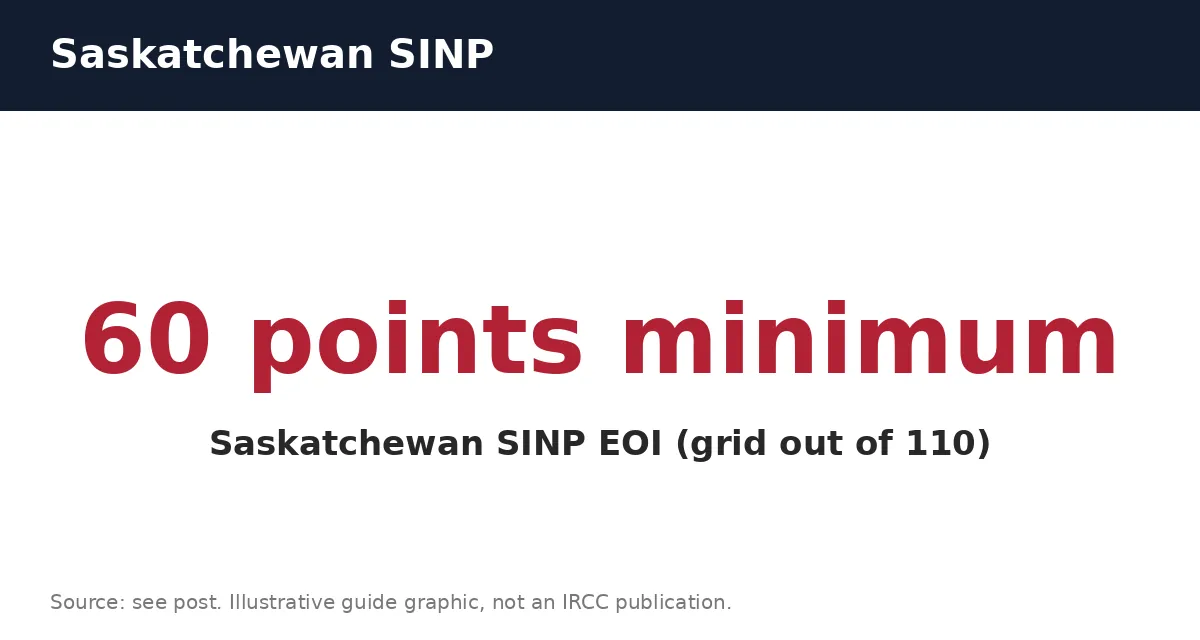
Quick answer: Both routes use an Expression of Interest scored on the Saskatchewan SINP grid, with a minimum of 60 points — which Saskatchewan currently states out of 110. Express Entry requires a federal Express Entry profile and leads to a 600-point nomination; Occupations In-Demand needs no federal profile and no job offer, but it is a base stream with a paper-based federal stage. Either way, document every credential you claim points for, or expect the application to be closed.
Key takeaways
Saskatchewan SINP routes: EE vs OID vs job-offer streams
The Saskatchewan SINP International Skilled Worker category has three main sub-categories, plus newer job-offer pathways. Express Entry is the federal-linked route: you must hold a federal Express Entry profile, you do not need a job offer, and a successful nomination adds 600 CRS points. Occupations In-Demand is the base route: no federal Express Entry profile, no job offer, and a paper-based federal stage after nomination instead of a CRS boost. The Employment Offer sub-category requires an approved Saskatchewan job offer. Saskatchewan’s procedures page also lists Agriculture Talent, Health Talent, and Innovation and Tech Talent pathways — job-offer-based routes for specific sectors, whose current criteria you should confirm on the Saskatchewan pages, since this guide’s core comparison is EE versus OID.
Saskatchewan SINP OID minimum requirements are specific: at least one year of post-secondary education or training comparable to the Canadian system; at least one year of paid work experience in the past ten years, related to your field of education or training, in a highly skilled occupation; minimum CLB 4; proof of eligibility for Saskatchewan licensure if your occupation is regulated or requires mandatory certification; and proof of settlement funds and a settlement plan. Miss any one of those, and the grid score does not matter.
The Saskatchewan SINP points grid, factor by factor
Factor | Top scores |
|---|---|
Education (Canadian equivalency) | Master’s or doctorate 23; Bachelor’s or 3+ year degree 20; trade certification equivalent to Saskatchewan journeyperson 20; two-year diploma 15; certificate of at least two semesters 12 |
Skilled work experience, in the 5 years before application | 5 years 10; 4 years 8; 3 years 6; 2 years 4; 1 year 2 |
Skilled work experience, in the 6–10 years before application | 5 years 5; 4 years 4; 3 years 3; 2 years 2; less than 1 year 0 |
Language, first test (CLB) | CLB 8+ 20; CLB 7 18; CLB 6 16; CLB 5 14; CLB 4 12; no test 0 |
Language, second test (CLB) | CLB 8+ 10; CLB 7 8; CLB 6 6; CLB 5 4; CLB 4 2 |
Age | 22–34: 12; 35–45: 10; 18–21: 8; 46–50: 8; under 18 or over 50: 0 |
Source: Government of Saskatchewan points-grid page (saskatchewan.ca), Factor I: Labour Market Success, maximum 80 points. Work experience must relate to the job on the application, and one year means 12 full months. Language levels use the CLB conversion for IELTS, CELPIP, PTE Core, or TEF — check IRCC’s conversion page for your test.
Two Saskatchewan SINP warnings belong with this table. First, the grid total: older and third-party guides describe the grid as 60 out of 100, but Saskatchewan’s current Occupations In-Demand page states a minimum of 60 points out of 110 on the Point Assessment Grid. The five factors above are Factor I (80 points); the remaining points come from Factor II, Saskatchewan connections. Use the current official page’s total, not an older guide’s, when you calculate your minimum. Second, meeting 60 is not enough. Saskatchewan invites from the top of the pool, and recent invitation levels have run far above the minimum — treat 60 as permission to enter the pool, not as a prediction of invitation.
Warning:
Work experience counts only if it relates to the job on your application. Five years in an unrelated field earns nothing on this grid, however impressive it looks on a résumé.
Occupation eligibility: the list that changed
Occupation eligibility is the part of the Saskatchewan SINP that has moved most. Older guides describe a positive in-demand occupations list: if your occupation was on the list, you were eligible. Guides from 2026 describe a different approach — an excluded-occupations list, where a skilled job not on the excluded list is considered eligible — alongside priority sectors for 2026 (healthcare, agriculture, skilled trades, mining, manufacturing, energy, and technology, with at least half of nominations reserved for these industries in one guide). Those 2026 details are third-party-sourced, not verified on saskatchewan.ca for this guide, so treat them as a check item, not a fact: open the current Saskatchewan occupation page before you rely on any older list, and confirm whether your occupation is eligible today.
The same Saskatchewan SINP caution applies to job-offer salary claims: one guide says Saskatchewan job offers must meet or exceed the provincial median salary for the occupation since 2024. That was not verified to the official page for this guide, so check it on the Saskatchewan site if you are applying under a job-offer route rather than assuming it.
ECAs for all degrees: the Saskatchewan surprise
Here is the Saskatchewan SINP difference that gives this post its subtitle. Federally, applicants typically assess their highest credential. Saskatchewan’s Occupations In-Demand page states the rule plainly for claimed credentials: if you claim 20 points for having a university degree, you must attach a copy of your university degree and complete transcripts — plus a translated version if the documents are not in English or French. The principle extends across the grid: every credential you claim points for needs its documents. A second degree you claim points for needs its transcripts too. A trade certification you claim points for needs its proof too.
Saskatchewan SINP practical steps: list every credential you intend to claim points for before you submit; obtain the degree or diploma and complete transcripts for each; get certified translations for anything not in English or French; and confirm each credential’s Canadian equivalency where Saskatchewan requires it. Applications with missing documents or untranslated documents will be closed, with a letter asking you to reapply — Saskatchewan does not hold your file open while you chase a transcript from a university abroad. Start the transcript requests first; they are the slowest documents in the whole package.
The Expression of Interest: one profile, no announced draws
Both Saskatchewan SINP sub-categories use an Expression of Interest: a pre-application profile, not the application itself. Profiles are scored, ranked, and invited in periodic draws through an Invitation to Apply. Draw dates are not announced in advance, so past draw timing does not predict the next one. You can hold only one active Expression of Interest profile, and you cannot be in both pools at once — choosing EE or OID is a real choice, not a hedge. Pick the route that matches your situation: EE if you hold a federal profile and want the 600-point nomination; OID if you have no federal profile, no job offer, and a strong grid score with complete documents.
Check your federal position first in the CRS calculator, and compare provinces on our immigration paths page. If Saskatchewan is your province, confirm the current grid, occupation list, and document checklist on the Saskatchewan pages linked below before you submit — provincial details change, and the official page is the only version that matters.
Real cases
Real case: the second degree with no transcripts (forum thread, 2024)
A candidate claimed points for two degrees but uploaded transcripts for only the highest one, following the federal habit. The thread warned that Saskatchewan requires documents for each claimed credential, and that a missing transcript could close the application. Outcome: no outcome was reported.
Real case: 60 points, no invitation (forum thread, 2023)
A candidate scored exactly 60 and asked why no invitation arrived. Posters explained that 60 is the minimum to submit, not the invitation level — draws invite from the top of the pool, and the top has run far above 60. Outcome: clarified in the thread.
Real case: OID or Express Entry? (forum thread, 2024)
A candidate with a federal Express Entry profile debated whether to enter the OID pool instead. The thread answer was that only one active profile is allowed, so the choice had to be made — EE for the 600-point nomination route, OID for the base route without a federal profile. Outcome: no outcome was reported.
Real case: occupation on an old list (forum thread, 2023)
A candidate relied on an older in-demand occupations list and found the occupation treatment had changed. The thread advice was to check the current Saskatchewan page rather than any guide’s list. Outcome: no outcome was reported.
Frequently Asked Questions
What is the difference between SINP Express Entry and Occupations In-Demand?
Express Entry requires a federal Express Entry profile and leads to a 600-point nomination if successful. Occupations In-Demand needs no federal profile and no job offer, but it is a base provincial stream with a paper-based federal stage. The Express Entry route leads to a 600-point nomination, while the base route ends in a paper-based federal stage.
How many points do I need for Saskatchewan SINP?
At least 60 points on the current Saskatchewan SINP assessment grid, which Saskatchewan states out of 110 points. Meeting 60 is only the minimum to submit an Expression of Interest; invitations go to the top of the pool. Recent invitation levels have run far above the minimum, so treat 60 as entry to the pool, not a prediction.
Can I be in both the OID and Express Entry pools at once?
No. You can hold only one active Expression of Interest profile, and you cannot be in both the Occupations In-Demand and Express Entry pools at the same time. Choosing between the two pools is a real decision, because only one active profile is allowed at a time.
Does SINP require an ECA for every degree?
The Saskatchewan SINP requires documents for every credential you claim points for, including the degree and complete transcripts, with translations if not in English or French. Be ready with assessments for each claimed credential. Translations are required for anything not in English or French, and missing documents close the application.
Does a Saskatchewan nomination add CRS points?
Yes, for the Saskatchewan SINP Express Entry sub-category: a provincial nomination adds 600 CRS points. The Occupations In-Demand stream is not Express Entry-linked, so it does not use the CRS score. The Occupations In-Demand stream is not Express Entry-linked, so it never uses the CRS score at all.
Final Thoughts
The Saskatchewan SINP rewards preparation more than points. Sixty points gets you into the pool; complete documents get you through the application. The candidates who succeed are the ones who read the grid, chose one pool, confirmed their occupation on the current page, and chased every transcript before submitting. The candidates who fail are often the ones with higher scores and a missing document.
Confirm the current Saskatchewan SINP grid and checklist on Saskatchewan’s official pages below, check your federal score in the CRS calculator, and if your education history spans several institutions or countries, talk to a licensed consultant (RCIC) or lawyer before you claim points for credentials you cannot yet document.
Sources
This guide was checked against official Saskatchewan and IRCC sources and real applicant reports. This is general information, not legal advice. For your own case, talk to a licensed consultant (RCIC) or lawyer.
Last reviewed: October 29, 2026