Express Entry Guide · Updated October 2026
ECA for Spouse in Express Entry: Is It Required, How Many Points It Adds and When It Is Worth It (Real Cases)
Your spouse’s degree can add up to ten points to your score. It can also add nothing, if nobody has assessed it. Here is how to decide whether the report is worth ordering.
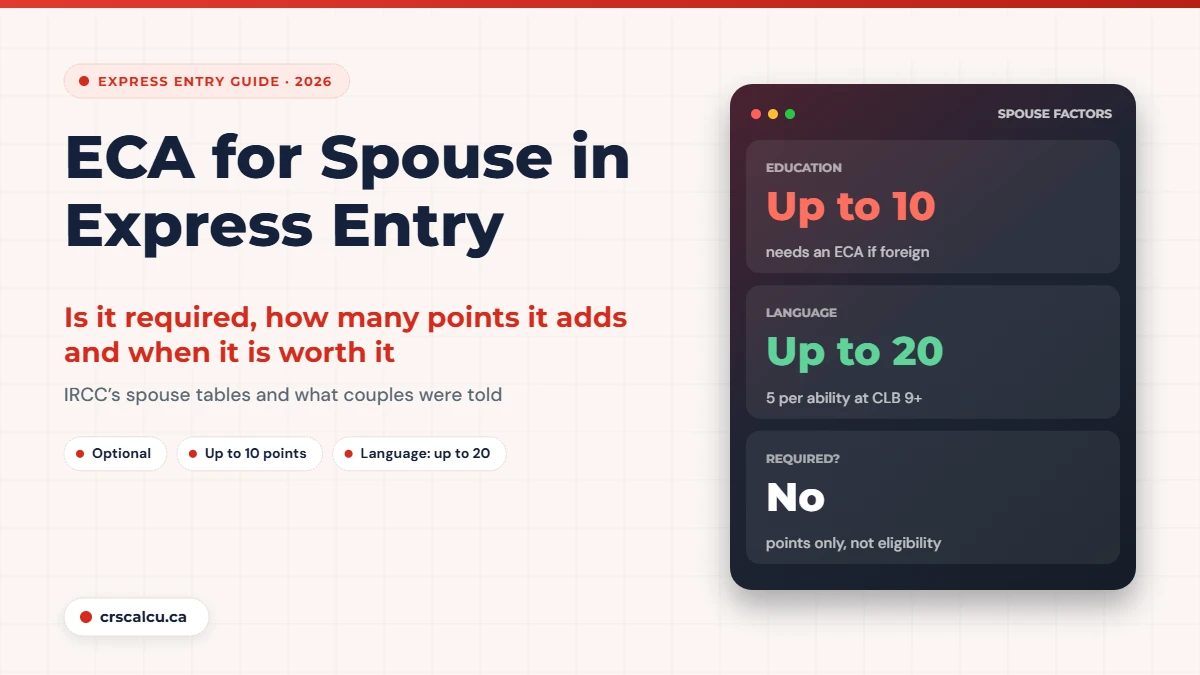
An ECA for spouse is one of the first optional decisions a couple faces in Express Entry. The principal applicant’s education has to be assessed if it was completed abroad and they want points for it. The spouse or partner’s education is different. Nobody requires the report. The only question is whether the points it unlocks are worth the fee and the wait.
The confusion is understandable, because the two tools people use give different signals. The eligibility questionnaire asks almost nothing about a spouse. The score calculator asks about their education, their language test and their Canadian work. Both are right: a spouse does not affect whether you are eligible, and does affect how you rank.
We read IRCC’s page on educational credential assessments and the spouse tables in the ranking criteria, along with four public forum threads from 2014 to 2018 in which couples asked whether the report was mandatory and what it was worth.
Quick answer: do I need an ECA for my spouse?
No, it is not required. IRCC’s ECA page (modified June 22, 2026) lists a spouse or partner’s foreign credentials among the reasons you might get an assessment, and the purpose is points. With a valid report, an accompanying spouse’s education earns up to 10 points: 8 for a bachelor’s degree or three-year program, 9 for two or more credentials, 10 for a master’s, professional degree or doctorate. Without one, a foreign credential earns no spouse education points. The rules for the report itself are in ECA validity.
Key takeaways
Is an ECA for spouse required?
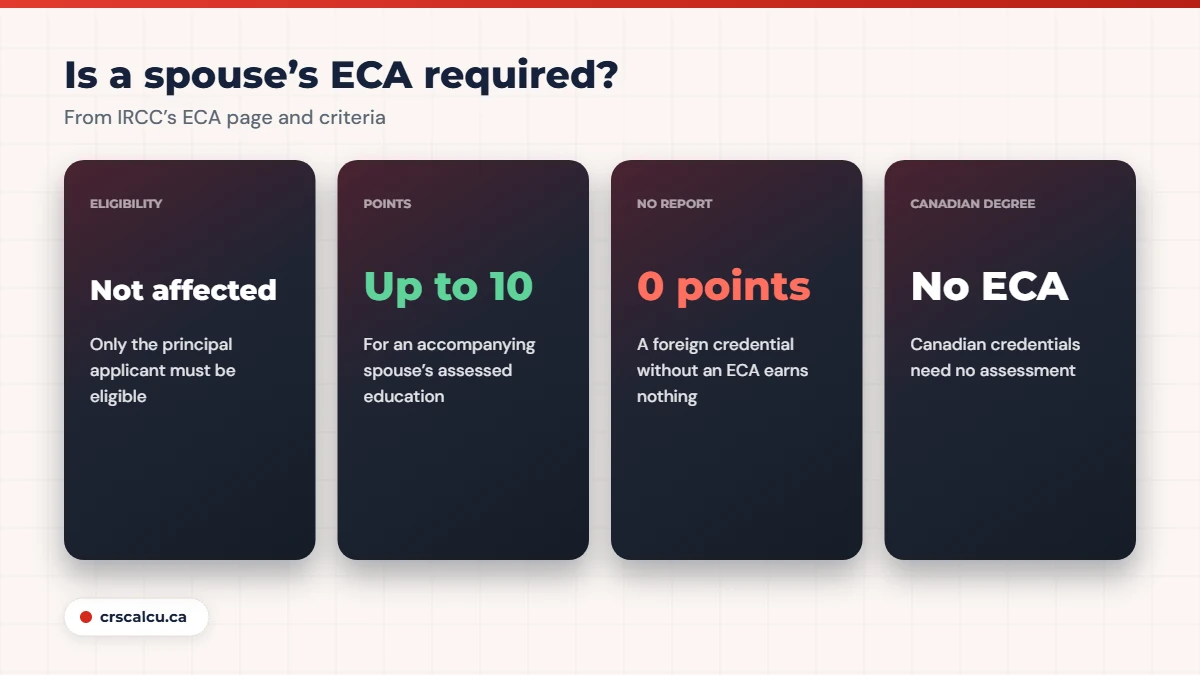
IRCC’s page on educational credential assessments says you need one in three situations: you completed your education outside Canada and are the principal applicant under the Federal Skilled Worker Program; you want ranking points for education completed outside Canada; or you have a spouse or partner whose foreign credentials you want assessed. The first is about eligibility. The other two are about points.
So the only person whose education can decide eligibility is the principal applicant, and then only for one program. Your spouse’s degree never makes or breaks eligibility.
Real case: the calculator asks, the eligibility tool does not (July 2018)
A principal applicant noticed that the score calculator asked for their spouse’s credential assessment while the eligibility tool did not mention it, and asked whether the spouse’s report added points at all. A member explained the difference: only the principal applicant has to be eligible, so the eligibility questions leave the spouse out. The ranking criteria, on the other hand, include a section for a spouse’s factors, and assessed education is one of them. So yes, the report adds points.
Real case: “not required, but it gives you extra points” (December 2014 to September 2015)
Just before Express Entry opened, an applicant asked whether a spouse’s assessment was mandatory and whether it brought points. An experienced member answered that it is not required but adds points, and suggested using the spouse’s current married name on the request. Over the following months the thread went back and forth on the rules for the Federal Skilled Worker Program, until members settled it: the report is needed only if you want the spouse’s education points. A later reply added that a spouse’s master’s degree can be assessed alone, without the bachelor’s degree before it.
The same applies to a common-law partner. IRCC’s tables and its ECA page speak of a “spouse or common-law partner” throughout, and the points are identical.
How many points an ECA for spouse adds
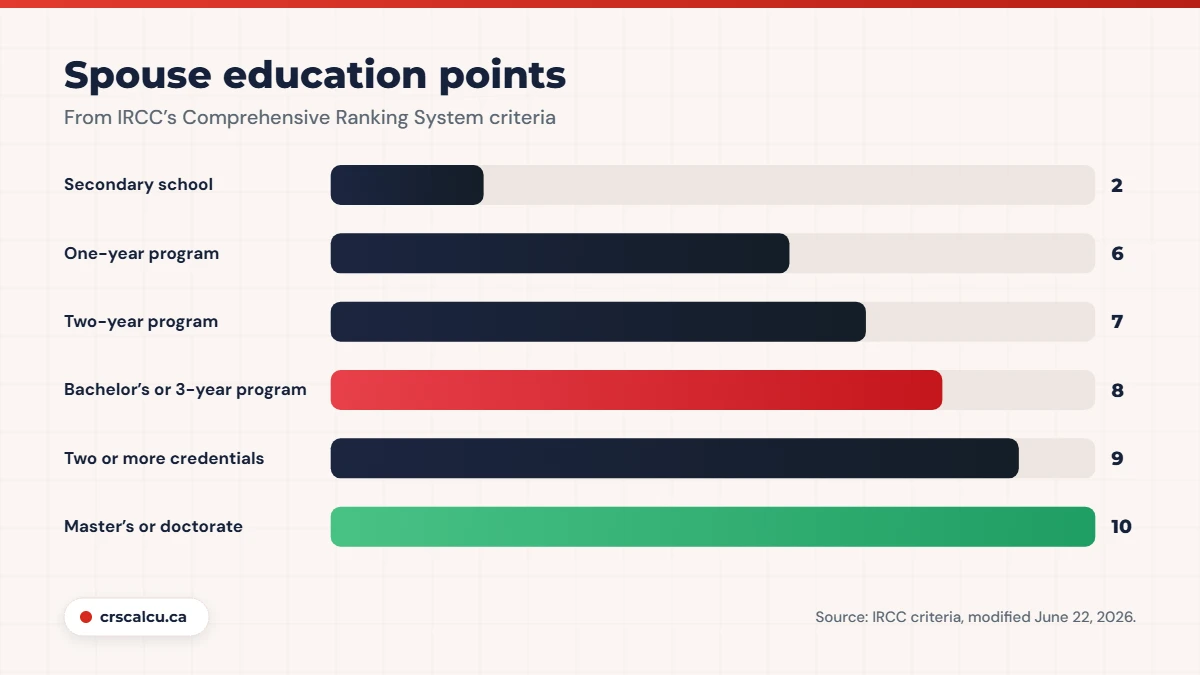
IRCC’s criteria (modified June 22, 2026) give a separate, smaller table for a spouse or common-law partner’s education.
Spouse’s level of education | Points |
|---|---|
Less than secondary school | 0 |
Secondary school | 2 |
One-year post-secondary program | 6 |
Two-year post-secondary program | 7 |
Bachelor’s degree, or a program of three or more years | 8 |
Two or more credentials, one of them three years or longer | 9 |
Master’s degree, professional degree or doctorate | 10 |
From IRCC’s Comprehensive Ranking System criteria (modified June 22, 2026).
The steps are small. The difference between a spouse with a bachelor’s degree and one with a master’s is 2 points. The difference between an assessed bachelor’s degree and no assessment at all is 8.
Real case: declared less to skip the report (January to June 2015)
In an early thread, couples debated whether a spouse’s assessment and language test were needed to claim the spouse’s points. One member cited the Express Entry instructions: a spouse’s credential must be Canadian, or the spouse must have a valid credential assessment. A user said they had simply declared a lower level of education for a spouse who held a degree, to avoid the cost and paperwork. The experienced member’s reply was plain: without the assessment, the system will not give you those 8 points.
That is an honest choice with a known price. What you should not do is enter the degree without the report and hope. After an invitation you would have to upload the assessment, and the score that got you invited would not hold. If your score drops below the cut-off of your round, IRCC’s advice is to decline: see declining an ITA.
The language test usually matters more
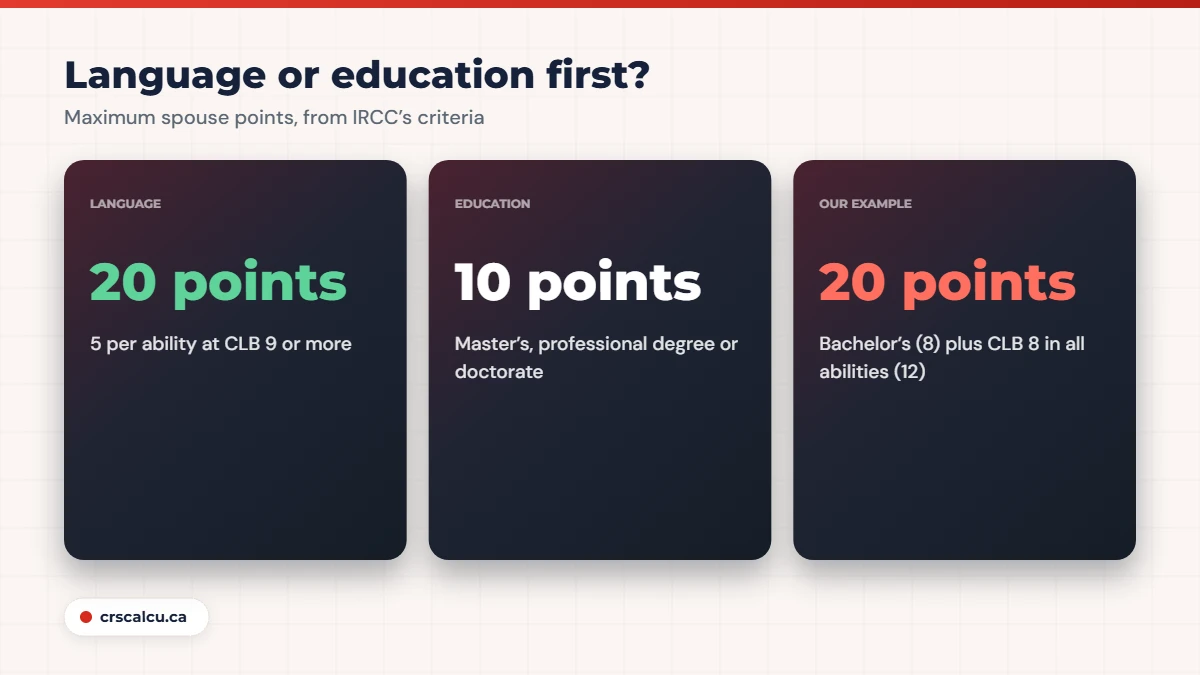
A spouse’s first official language is scored per ability: 1 point at CLB 5 or 6, 3 at CLB 7 or 8 and 5 at CLB 9 or more, to a maximum of 20. That is twice what education can add. The criteria also give points for a spouse’s Canadian work experience.
Real case: “my consultants disagree” (July 2016)
An applicant getting conflicting advice asked whether a spouse’s language test and credential assessment would raise their rank. Members confirmed that neither is mandatory and both help: by their count, up to 10 points for education and up to 20 for language. A long-time member added a dose of realism. The applicant’s score was 379, far below anything that had been invited directly at that time, and 30 points would not close the gap. The better use of effort was the principal applicant’s own language score, or a provincial nomination.
That reply is the right way to think about it. Spouse points are worth chasing when you are close. They do not rescue a profile that is far away. Convert your spouse’s test scores with our CLB calculator to see which tier they reach.
When an ECA for spouse is worth ordering
This is our own way of weighing it. Work out your score three ways in the CRS calculator: with no spouse factors, with the spouse’s language only, and with language and education.
Order the spouse’s ECA if
It may not be worth it if
Our example, using IRCC’s tables: a spouse with a bachelor’s degree and CLB 8 in every ability adds 8 points for education and 12 for language, 20 in all. With CLB 9 the language part rises to 20, for 28. The education report accounts for 8 of those points in both cases.
Our example: what a spouse costs and gives back
To see why spouse points matter, compare the two grids. This is our own arithmetic from IRCC’s tables, leaving age aside. Take a principal applicant with a bachelor’s degree, CLB 9 in every ability and one year of Canadian work experience.
Factor | Without a spouse | With a spouse | Difference |
|---|---|---|---|
Education (bachelor’s) | 120 | 112 | -8 |
First language (CLB 9 x 4) | 124 | 116 | -8 |
Canadian work (1 year) | 40 | 35 | -5 |
Subtotal | 284 | 263 | -21 |
Our arithmetic from IRCC’s criteria (modified June 22, 2026). Age points also differ between the two grids and are not included here.
So before age is counted, this applicant starts 21 points lower with an accompanying spouse. If the spouse then brings a bachelor’s degree with an ECA and CLB 8 in every ability, that is 8 + 12 = 20 points back, which closes nearly all of the gap. Without the ECA it is 12, and the couple stays 9 points behind. That is the real value of the report: not a bonus, but getting back to level.
How to get it right
Our suggested steps
Order both reports together if you can
If the principal applicant still needs an assessment too, starting both at once saves weeks. In a 2014 thread a member also pointed out that sending two of one person’s degrees in a single request avoids paying twice. Check the organization’s current fees before you decide which credentials to include.
Five mistakes people make with a spouse’s ECA
Five mistakes from the rules and the threads
That last point is worth a minute. With a spouse on the application, IRCC’s tables give the principal applicant slightly fewer points for the same age, education and language: for example 112 for a bachelor’s degree where a single applicant gets 120. The spouse’s factors are how a couple earns those points back. Run your numbers in the CRS calculator with and without them.
Frequently Asked Questions
Is an ECA for spouse mandatory in Express Entry?
No. A spouse or partner’s assessment is optional. It is needed only if you want ranking points for their education completed outside Canada.
How many points does a spouse’s ECA add?
Up to 10. IRCC’s table gives 8 points for a bachelor’s degree or three-year program, 9 for two or more credentials, and 10 for a master’s, professional degree or doctorate. Lower levels earn 2 to 7.
What happens if I do not get my spouse’s degree assessed?
You get no spouse education points for a foreign credential. Your eligibility is not affected.
Does my spouse need a language test too?
Not to be included, but it earns points: up to 20 for a spouse’s first official language, which is more than education can add.
Does my spouse need an ECA for a Canadian degree?
No. IRCC says you do not need an assessment for a Canadian degree, diploma or certificate.
Should I assess my spouse’s bachelor’s and master’s?
Usually only the highest. A master’s recognized as a master’s already gives the maximum 10 points.
See what your spouse’s factors add
Enter their education and language levels and compare your total with recent Express Entry cut-offs.
Final Thoughts
An ECA for spouse is a small, optional lever: up to 10 points for an accompanying spouse’s education, with nothing awarded for a foreign credential that has not been assessed. Their language test is the bigger lever at up to 20. Order the report when you are close to the cut-off and have time, and never enter a level you cannot back with a report.
If you are deciding which partner should be the principal applicant, or whether to include a spouse as accompanying at all, the arithmetic is more involved than one table. A licensed consultant can run both profiles with you. The calculator is a good place to start.