Express Entry Guide · Updated October 2026
Travel History for Express Entry: Which Trips to List
Ten years of trips, from memory, in date order. It is the section people dread, and the one they most often get slightly wrong. Here is what the form asks, how to rebuild your record, and what happened to applicants who missed a trip.
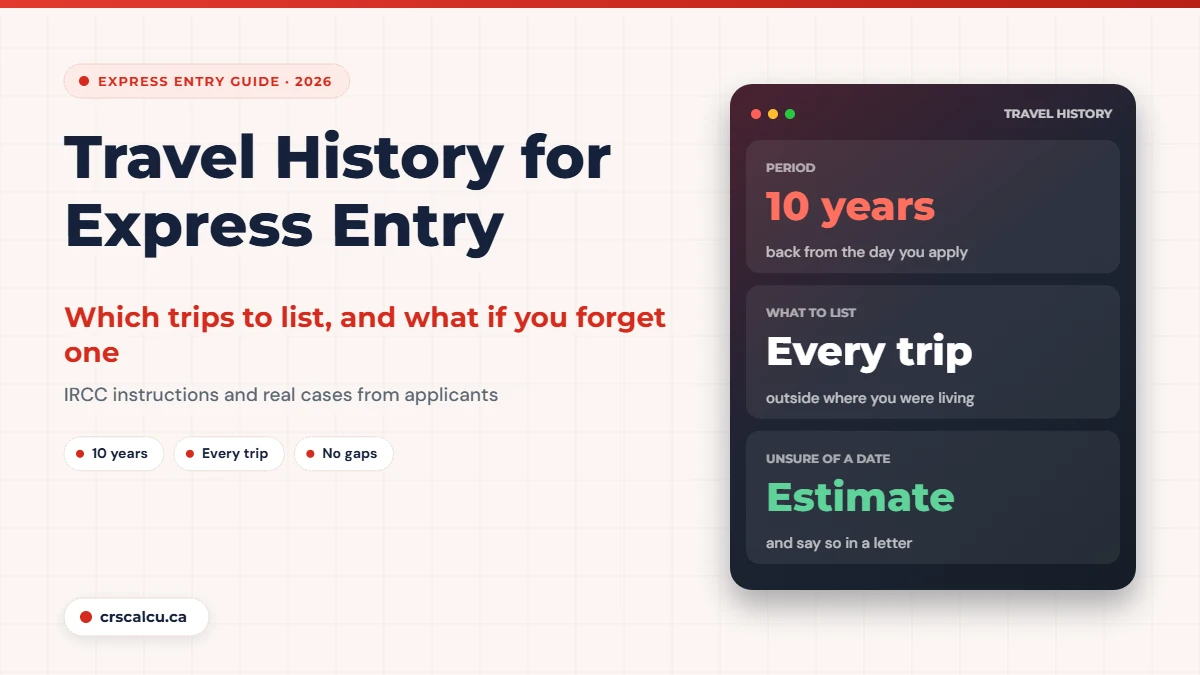
Travel history for Express Entry is the part of the permanent residence application where you list trips you have taken over the last 10 years. It is filled in after an invitation, not in the profile. The form asks for trips outside your country of origin or of residence, with dates, destination and purpose. Officers compare it with your addresses, your personal history and your police certificates.
There is no penalty for a long list. The risk is in the gaps: a trip that appears in a passport stamp or a border record but not in your form.
We read IRCC’s instructions on background information and forum threads from 2016 to 2022 where applicants asked which trips count, ran out of rows, or found a forgotten trip after they had already submitted. This is what they learned.
Quick answer: travel history
List every trip in the last 10 years that took you outside the country where you were living, with exact dates if you have them. Count the 10 years back from the day you complete the form. Rebuild dates from passport stamps, border records, tickets and emails. If you cannot confirm a date, give your best estimate and say so in a short letter. If you find a missed trip after submitting, tell IRCC through the web form.
Key takeaways
What the Travel History Section Asks
In the application form you complete after an invitation, there is a section for trips. An applicant in November 2017 quoted its wording: details of any trips taken outside your country of origin or residence in the last ten years. For each trip you give the dates, the country, the location and the reason.
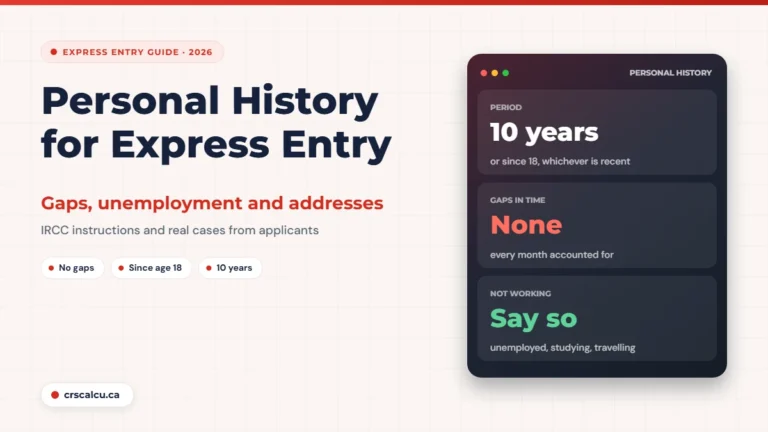
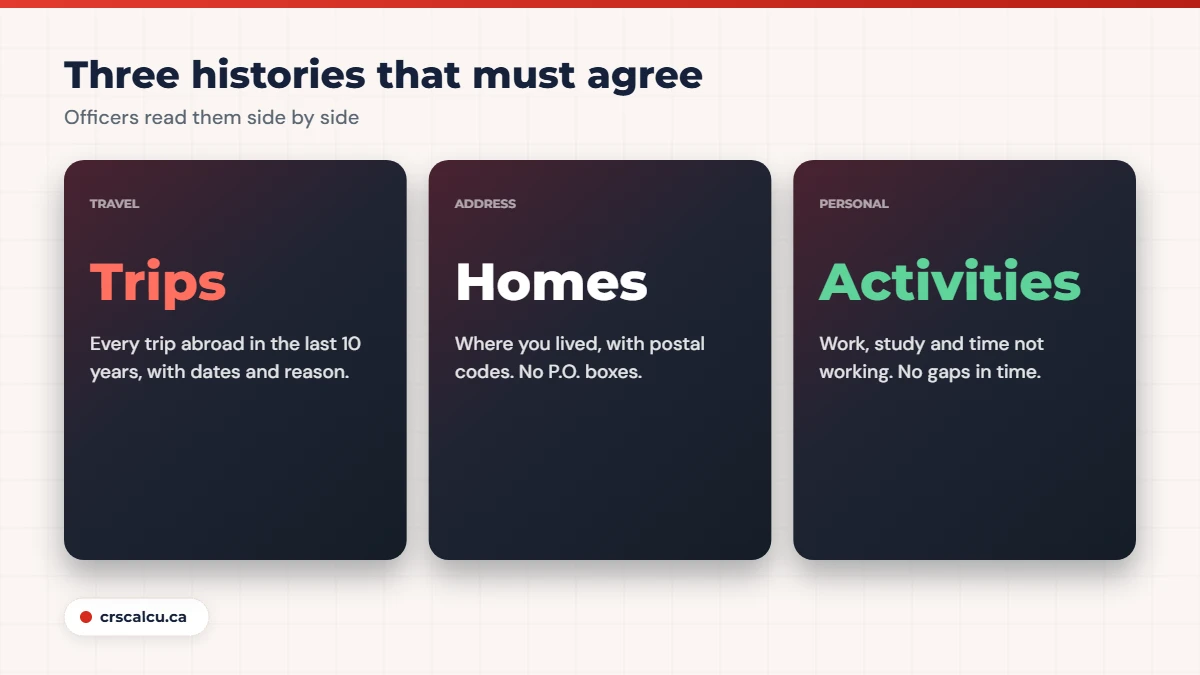
It sits beside two related sections. Personal history accounts for what you were doing in every period. Address history lists where you lived. IRCC’s instructions for the background form are strict on both: account for the time since you turned 18 or the past 10 years, whichever is most recent, and do not leave gaps. Processing is delayed if you do not account for all periods of time.
Section | What it records | Period |
|---|---|---|
Travel history | Trips outside your country of origin or residence | Last 10 years |
Address history | Where you lived, with postal codes | Since age 18 or the past 10 years, whichever is most recent |
Personal history | Work, study, unemployment and other activities, with no gaps | Since age 18 or the past 10 years, whichever is most recent |
Address and personal history rules are from IRCC’s Schedule A instructions (IMM 5669). The travel wording is as quoted by applicants from the online form.
Which Trips to List
This is where forum members have disagreed for years, so it is worth laying out both readings.
Example: do visits home count?
In January 2017, an applicant who had moved from India to Canada in 2014 asked whether three or four visits back to India had to be listed. One senior member said to explain every stamp in the passport. Another said travel between your country of residence and your country of origin did not need reporting. A November 2017 thread on the same question split the same way.
The form’s wording, outside your country of origin or residence, can be read to leave out trips home. But there is no benefit in leaving them out and a clear cost if an officer reads it differently. Our suggestion is the cautious one: list every trip that took you across a border from wherever you were living at the time, visits home included.
Trip | List it? | Why |
|---|---|---|
Holiday to a third country | Yes | Outside both origin and residence |
Business trip abroad, even for two days | Yes | Short trips still leave records |
Day trip across the border by car | Yes | Border agencies record crossings |
Visit to your home country while living abroad | Yes, to be safe | Readings differ, and extra entries do no harm |
Airport transit without leaving the terminal | Usually not a trip | Mention it only if you entered the country |
Travel inside the country where you live | No | Not a trip abroad |
Our cautious reading, based on applicant experience. The form itself is the authority.
Example: 52 trips and 30 rows
In February 2018, a frequent traveller found the form had room for only 30 trips. They had 52 in ten years. The fix members gave was simple: fill the rows in the form, then put the rest in a separate document, in the same layout, and upload it in the optional documents section.
How Far Back, and From When
Ten years, but ten years from what date?
Example: counting from the right day
In September 2022, an applicant asked whether a 10 year history meant starting from January 2012 or September 2012. An experienced member answered that the period counts back from the day you fill in and sign the application, so from September 2012. They added that an officer can ask for more history if needed.
If you were under 18 for part of those ten years, the travel section still asks for the trips. The personal and address sections use the later of your 18th birthday or the ten year mark.
How to Rebuild Ten Years of Travel
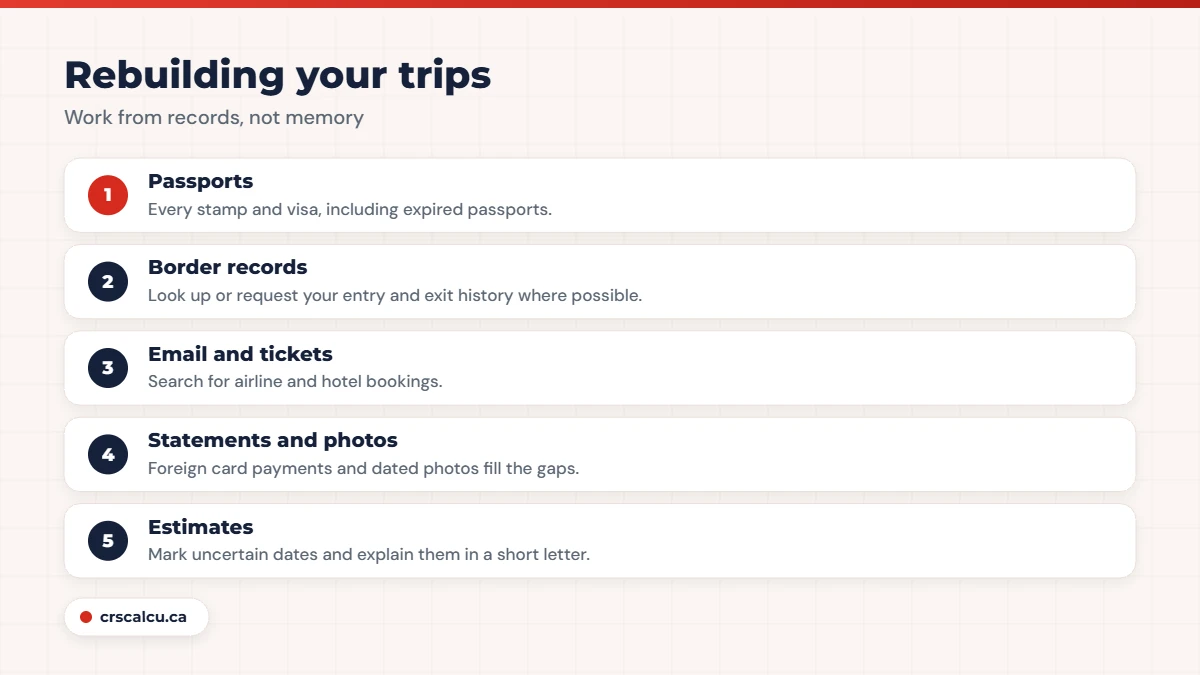
Nobody remembers every date. You do not have to. You have to reconstruct them from records.
Sources applicants used
Example: more border crossings than the record showed
In October 2018, an invited applicant in Vancouver who often drove into the United States found that the American border website showed only their most recent 100 crossings. Older ones had no stamps. A member advised checking under each passport number, building a full list in a spreadsheet, giving best guesses for unknown dates, and adding a letter that said so.
That advice is the heart of this section. An honest estimate that is labelled as an estimate is not a false statement. A confident date that turns out to be wrong can look like one. Say what you know, say what you are unsure of, and explain how you worked it out. Our guide to the letter of explanation for Express Entry shows the format.
Keep It Consistent With Everything Else
Officers do not read the travel section alone. They read it against the rest of the file.
Cross-checks to run before you submit
One poster in the November 2017 thread shared a warning: their application had been rejected over date discrepancies between what they entered and what their police certificates showed. Small differences in a holiday date are one thing. A six month stay that appears in one section and not in another is a different matter.
If You Forgot a Trip After Submitting
It happens constantly, and the experience on the forums is calmer than you might expect.
Example: a one day trip with no stamp
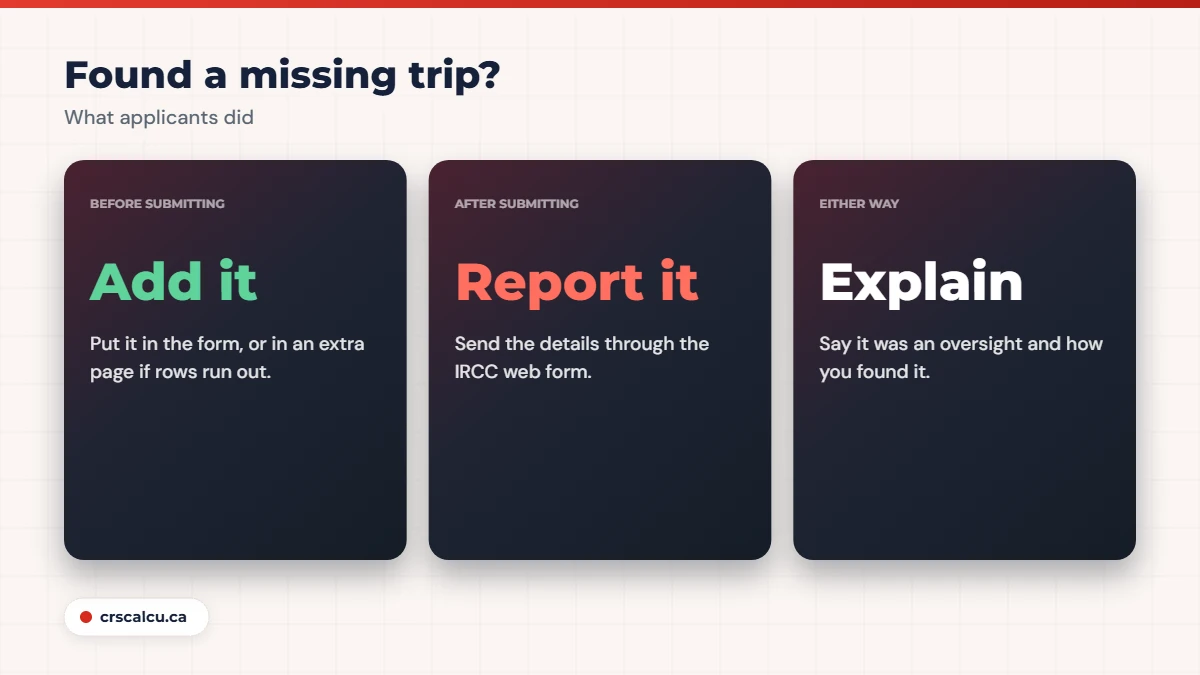
In June 2016, a Canadian Experience Class applicant who had submitted on May 22 received their official border records and found a single day trip to the United States that was missing from the form. There was no stamp, and it was not in the American online record. Members did not see it as material, and suggested sending IRCC a note about the oversight to be safe.
The reasoning was that one forgotten day trip does not change any decision an officer has to make. That is not a licence to be careless. Canadian law treats leaving out or misstating facts that matter as misrepresentation, and the consequences are serious. The protection is to correct the record yourself, as soon as you notice.
If you find a missing trip
IRCC’s page on updating an application says to use the web form to submit new information that it did not request. A correction to your own form is exactly that.
Habits that cause trouble
Travel history is one part of a larger file. For the full list of what goes in, see the Express Entry document checklist.
Frequently Asked Questions
How many years of travel history does Express Entry need?
The last 10 years. Applicants are advised to count back from the day they complete and sign the application form.
Do I have to list every trip?
List every trip that took you outside the country where you were living. Short trips and day trips count. Extra entries do no harm, while a missing one can raise questions.
Do trips to my home country count?
Forum members read the wording differently. The cautious approach is to list them, since they appear in your passport and border records.
What if I do not remember the exact dates?
Rebuild them from stamps, tickets, emails and statements. If a date is still uncertain, give your best estimate and say it is an estimate in a short letter.
What if I forgot a trip after submitting my application?
Tell IRCC through the web form as soon as you notice. Give the dates and country and explain that it was left out by mistake.
What if the form does not have enough rows?
Fill the rows provided, then list the remaining trips in a separate document in the same layout and upload it with your application.
Still in the pool? Check your score first
Travel history comes after an invitation. See how your CRS score compares with the latest cutoffs.
Final Thoughts
Travel history for Express Entry rewards the applicant who starts early. Go through your passports now, while you are still in the pool, and build the list once. When the invitation arrives you will be copying dates, not hunting for them.
List everything, estimate honestly where records run out, and make sure the trips agree with your addresses and police certificates. If you find a mistake later, correct it yourself. Officers forgive an oversight far more easily than a silence.