CRS Points Guide · Updated September 2026
Non-Accompanying Spouse Express Entry: More CRS Points or a Big Mistake? (Real Cases)
How your CRS changes, the real point gaps applicants saw, and the non-accompanying spouse Express Entry rules that still apply.
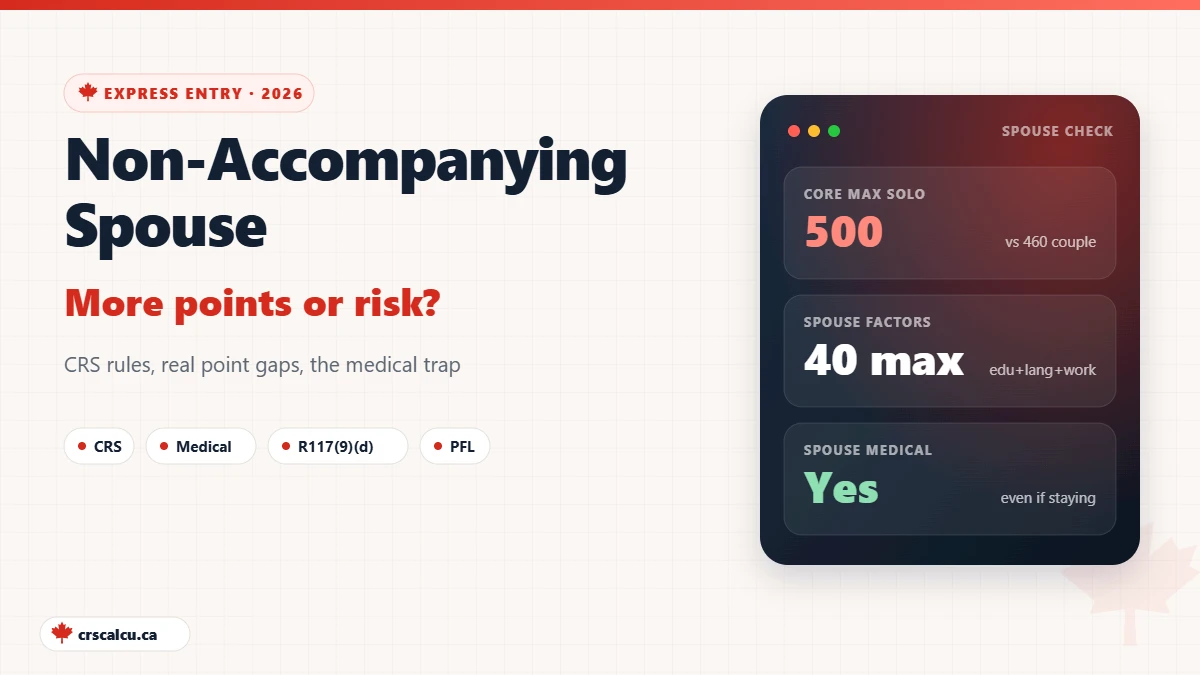
If you’re married and your CRS score sits just under the cutoff, you’ve probably looked at the non-accompanying spouse Express Entry option. You list your spouse as not coming, and your score goes up. Sometimes by 14 points, sometimes by 33.
But there are strings attached. Your spouse still needs a medical exam. Your proof of funds still counts them. And if your spouse lives with you in Canada, officers may ask why they are “not coming.”
We read 16 threads on a large Canadian immigration forum, posted from 2017 to 2026, and checked each rule against IRCC’s own pages.
Quick answer: do you get more points with a non-accompanying spouse?
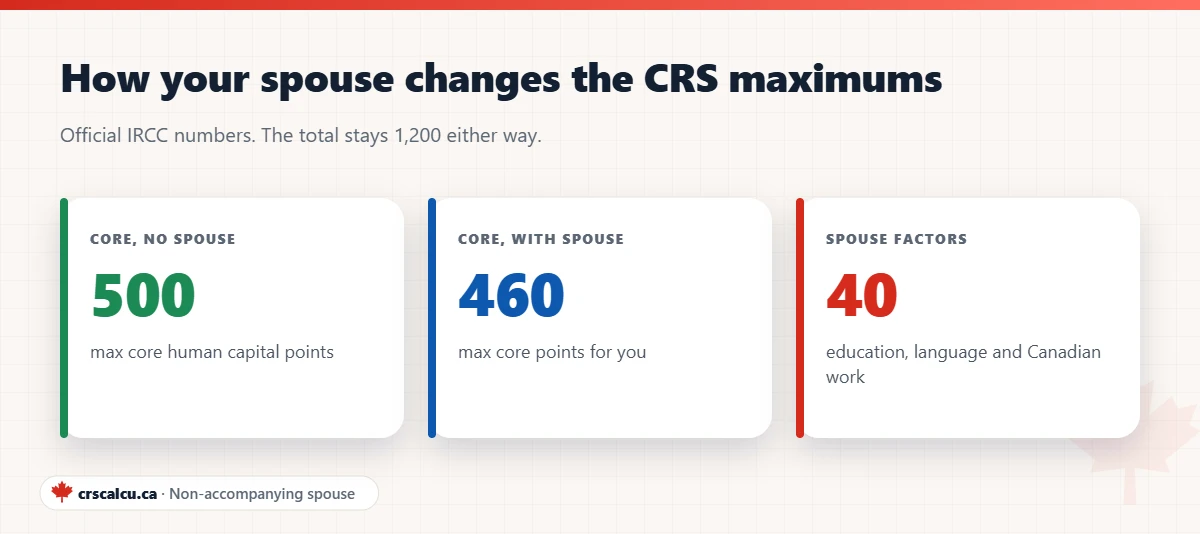
Usually, yes. In a non-accompanying spouse Express Entry profile, you are scored as single. Your core human capital maximum goes from 460 to 500 points, and the 40 spouse points drop out. Real applicants saw gains of about 12 to 33 points. But your spouse must still be declared, pass an IRCC medical exam, and be counted in your proof of funds.
Key takeaways
What Is a Non-Accompanying Spouse in Express Entry?
A non-accompanying spouse is your spouse or common-law partner who will not immigrate with you as part of your PR application. You still list them. You just tell IRCC they are not coming, at least not now.
IRCC defines an “accompanying family member” as a family member coming with you to Canada who is not a Canadian citizen or PR. So you are scored as single if your spouse is not coming, or is already a Canadian citizen or PR.
The official CRS criteria page says that in both cases you “earn points as if you don’t have a spouse or partner.” That one line is why the non-accompanying spouse Express Entry question comes up so often.
Part of the CRS | Spouse coming with you | Spouse not coming (or citizen/PR) |
|---|---|---|
Core human capital (you) | Up to 460 | Up to 500 |
Spouse factors | Up to 40 | 0 |
Skill transferability | Up to 100 | Up to 100 |
Additional points (PNP, French, sibling, etc.) | Up to 600 | Up to 600 |
Total possible | 1,200 | 1,200 |
Source: IRCC CRS criteria and the current Express Entry Ministerial Instructions.
The total is 1,200 either way. Alone, all 500 core points depend on you. As a couple, 40 of them depend on your spouse.
How CRS Scores Change: 500 vs 460 Core Points
Your age, education, language and Canadian work are all worth a little less when your spouse is coming. Those small drops add up fast.
Factor (principal applicant) | With spouse | Without spouse |
|---|---|---|
Age 20 to 29 | 100 | 110 |
Age 30 | 95 | 105 |
Bachelor’s degree (3+ years) | 112 | 120 |
Master’s degree | 126 | 135 |
PhD | 140 | 150 |
First language CLB 9 (per ability) | 29 | 31 |
First language CLB 10+ (per ability) | 32 | 34 |
Canadian work, 2 years | 46 | 53 |
Canadian work, 5+ years | 70 | 80 |
Source: IRCC Comprehensive Ranking System criteria. Language points are per ability, so multiply by 4.
At CLB 10 you lose 2 points per ability with a spouse, so 8 across all four. Add 10 for age and 9 or 10 for education, and you’re near 30 points behind.
What your spouse can win back
Your spouse can earn up to 40 points back, but only with an ECA, a test result or Canadian work to prove it.
Spouse factor | Points | Maximum |
|---|---|---|
Education: secondary school | 2 | 10 |
Education: bachelor’s degree | 8 | 10 |
Education: master’s or PhD | 10 | 10 |
Language: CLB 5 or 6 (per ability) | 1 | 20 |
Language: CLB 7 or 8 (per ability) | 3 | 20 |
Language: CLB 9+ (per ability) | 5 | 20 |
Canadian work: 1 year | 5 | 10 |
Canadian work: 5+ years | 10 | 10 |
Source: IRCC CRS criteria, section B (spouse or common-law partner factors).
Not sure what CLB your spouse’s scores give? Convert them with our CLB calculator. It’s the first number you need before you decide anything.
Real Point Gaps Applicants Saw
Most guides use made-up examples. Here are the real numbers non-accompanying spouse Express Entry applicants posted. Your own gap will be different.
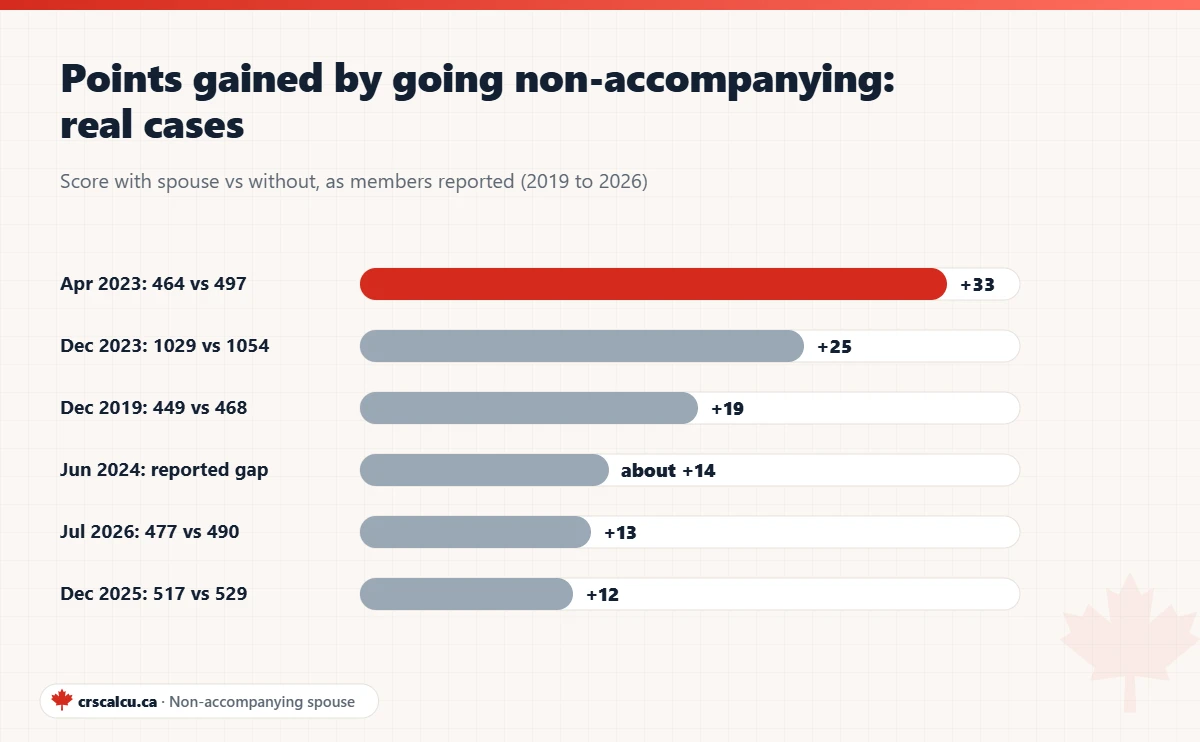
Date | With spouse | Without spouse | Gap |
|---|---|---|---|
December 2019 | 449 | 468 | +19 |
April 2023 | 464 | 497 | +33 |
December 2023 (with PNP) | 1029 | 1054 | +25 |
June 2024 | not given | not given | about +14 |
December 2025 (partner without ECA) | 517 | 529 | +12 |
July 2026 (spouse IELTS planned) | 477 (projected) | 490 | +13 |
Scores as posted by members of a large Canadian immigration forum. We did not verify them.
Real case: 33 points on the table
In April 2023, a PGWP holder with 2 years of Canadian experience had 464 points with their spouse and 497 without. That’s a 33-point gap. But the spouse was in Canada on a work permit. Replies said this is hard to justify when the spouse lives in Canada, and that past refusals involved “spouse in Canada and no letter of explanation.” In December 2023, another reply called a low CRS “a very safe and valid reason,” as long as you say so openly.
Notice the December 2025 case. The partner’s ECA was delayed. Without it, the couple scored 517. With it, the member expected 527. So the 12-point gap was mostly one missing document.
Break-Even Example: When Does Your Spouse Pay Off?
Let’s run one common profile. You are 30, with a master’s degree and CLB 9 in all four abilities, and no Canadian work. Skill transferability and additional points are the same either way, so we only compare core points.
The math, step by step
Spouse profile | Spouse points | Couple core total | vs 364 solo |
|---|---|---|---|
No test, no ECA, no Canadian work | 0 | 337 | −27 |
Bachelor’s ECA only | 8 | 345 | −19 |
Bachelor’s + CLB 7 in all four | 8 + 12 = 20 | 357 | −7 |
Bachelor’s + CLB 9 in all four | 8 + 20 = 28 | 365 | +1 |
Master’s + CLB 9 + 1 year Canadian work | 10 + 20 + 5 = 35 | 372 | +8 |
Worked example using the official IRCC CRS grid. Your own numbers will differ.
A spouse with no documents costs this applicant 27 points. A spouse with a degree and CLB 9 wipes out the loss. If your spouse can reach CLB 9, a test may beat the non-accompanying spouse Express Entry route.
The gap gets bigger if you have Canadian experience, since those points also drop with a spouse. That’s why the April 2023 applicant, with 2 years in Canada, saw 33 points. Run both versions in our CRS calculator before you touch your profile. Our guide on how to calculate your CRS score walks through each factor.
Tip: one score, two runs
Enter your details once with “spouse coming” and once with “spouse not coming.” Then check the latest draw cutoffs. If both scores are above or both are below recent cutoffs, the non-accompanying choice may not change anything for you.
Non-Accompanying Spouse Express Entry Rules: Medical Exam and Declaration
A spouse who is not coming is still part of your application. You must declare them, list their details, and have them examined.
IRCC’s Express Entry medical exam page is blunt: “Your family members must also have a medical exam even if they aren’t coming with you.” The Help Centre adds that if a non-accompanying dependant is inadmissible, it “might make you inadmissible” too.
Real case: “Can my spouse skip the medical?”
In December 2019, a provincial nominee thought their non-accompanying spouse could skip the upfront medical. They were mixing it up with a spousal sponsorship rule. Senior members corrected them: in Express Entry, the spouse must do the medical before you submit, or “your application will be refused.” The applicant booked the spouse’s exam right after the police certificate.
What a non-accompanying spouse still needs
IRCC Help Centre answer 256 warns that if you leave a family member out, “you may not be able to sponsor” them later. That leads straight to the rule most people have never heard of.
R117(9)(d): Why Skipping the Medical Can Block Sponsorship
Section 117(9)(d) of the Immigration and Refugee Protection Regulations is short and harsh. It says your family member cannot be sponsored if, when you applied for PR, they were a non-accompanying family member and “was not examined.”
In plain words: if your spouse was not declared or not examined, you may never be able to sponsor them, even after citizenship.
Warning: the relief policy never covered Express Entry
IRCC had a public policy easing this rule from September 10, 2023, set to end September 10, 2026. It only covered refugees, protected persons and family-class immigrants, never Express Entry. A proposed fix was still “in the exploratory phase” in April 2026. It is not law.
So if you choose the non-accompanying spouse Express Entry route, treat the medical as part of your own application. Book it early and keep the panel physician’s confirmation.
Sponsoring Your Spouse Later: Timeline and Trade-Offs
A non-accompanying spouse Express Entry file does not bring your spouse later by itself. You’ll need a separate spousal sponsorship once you are a PR, with new forms, fees and a new medical.
In June 2024, a member living in Canada with a spouse and a Canadian-born daughter abroad had about a 14-point gap. Replies said listing the spouse as non-accompanying was “perfectly normal,” with no misrepresentation concern. But they reminded them the spouse would not get PR at the same time. Members guessed about a year for sponsorship, so check IRCC’s current processing times.
The two paths compared
Ask yourself: is the extra time apart shorter than your wait in the pool at a lower score? If draws are near your “with spouse” score, waiting may be better.
Proof of Funds Still Counts Your Spouse
Some websites say a non-accompanying spouse Express Entry profile only needs funds for one person. That’s wrong. IRCC’s proof of funds page says to count your spouse and children “even if they’re Canadian citizens or permanent residents” or “not coming to Canada with you.”
When we checked, the page listed $15,263 for one person and $19,001 for two. So a married applicant needs the two-person amount either way. Always check the current table before you submit, since IRCC updates it.
The exemptions don’t change. If you apply under the Canadian Experience Class, or you have a valid job offer and are authorized to work in Canada, you don’t need to show funds. Our proof of funds guide covers the documents IRCC wants.
Spouse Already in Canada? The PFL Risk
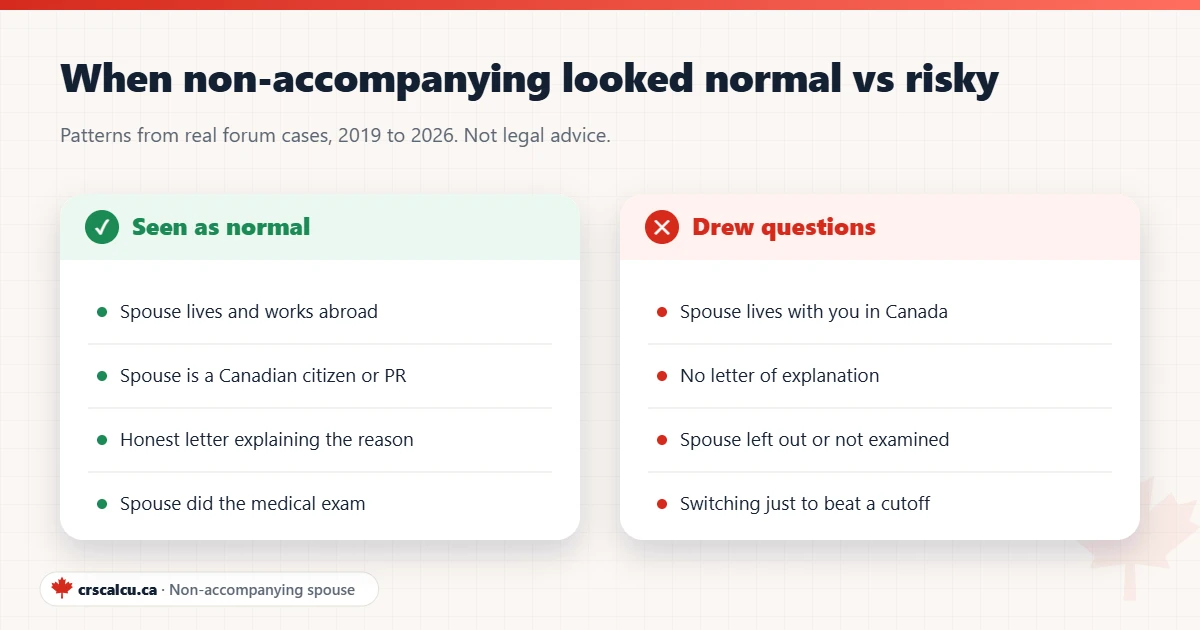
This worried forum members most. If your spouse lives with you in Canada, calling them “non-accompanying” can look odd, and an officer may send a procedural fairness letter (PFL).
Real case: pregnant, 19 points short, spouse in Canada
In December 2019, an applicant who was five months pregnant had 449 points with her spouse and 468 without. The spouse was in Canada. She wanted to apply alone, then sponsor her spouse and baby. One experienced member warned that PFLs were going to non-accompanying spouses in Canada. Another said they seemed limited to files without a letter of explanation. No final outcome was posted.
In January 2020, a couple both held work permits in Canada. Members said to be fully upfront: a letter of explanation with the real reason (more points) and your sponsorship plan. They mentioned “multiple” PFLs and said you may need to show your spouse will leave Canada.
Real case: approved with the spouse in Canada the whole time
In February 2025, a member shared a real outcome. They had listed their spouse as non-accompanying because of a low CRS, while the spouse stayed in Canada the whole time. They submitted in June 2024, got a final decision in October 2024 and received their eCOPR in December 2024. They said their file was processed in Kitchener, and noted that scrutiny had recently increased.
The pattern: approved members were open about the reason, and reported PFLs came in files with a spouse in Canada and no explanation. Misrepresentation can lead to a refusal and a five-year ban, so if your spouse is in Canada, talk to a licensed consultant (RCIC) or a lawyer first.
What to put in your letter of explanation
Keep it short and honest. Say your spouse is not coming for now, give the real reason (including points, if true), and say you plan to sponsor them after landing.
Switching to Accompanying After Your ITA
Plans change. Your spouse’s ECA arrives, or they decide to come. On the Express Entry apply page, IRCC says that if your situation changes, you should “re-calculate your score before applying.” If it falls below the lowest score in your round, “you should decline the invitation.” If you apply anyway, you may be refused with no fee refund.
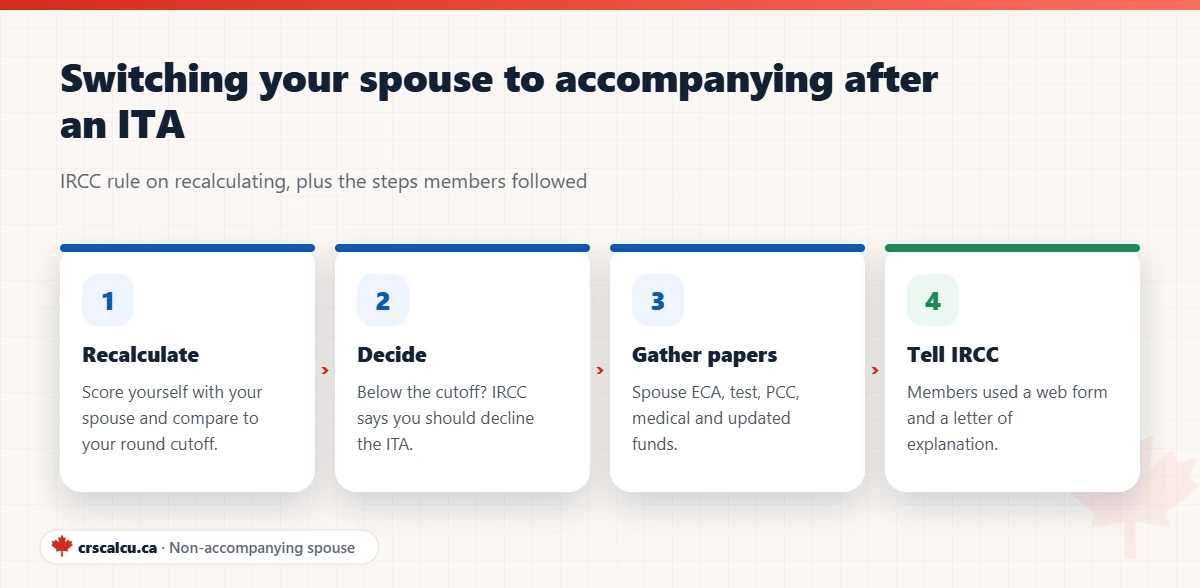
How members switched a spouse to accompanying
In June 2021, an applicant invited near the 368 cutoff added their spouse and submitted. Members said that’s fine if the new score stays above the cutoff. In a November 2021 AAIP case, nomination points made the switch safe.
Provincial nominees: keep your files consistent
In December 2023, an OINP nominee had an ITA at 1054. Adding the spouse would drop it to 1029, still far above the 470 cutoff. One reply warned the nomination might be tied to the family as listed, so the applicant didn’t switch. In September 2023, members said to keep provincial and federal forms consistent.
Taking the spouse’s test after the ITA
In July 2026, an applicant had an ITA at 490 with a 475 cutoff. Their spouse would take IELTS after the ITA, for a projected 477. One reply asked if this was gaming the cutoff. A September 2026 reply said a test taken before you submit can be fine if you stay above the cutoff.
In August 2022, a member who married after the ITA wanted to switch after a passport request. The only reply noted you have one year from the medical date to land.
Canadian Citizen or PR Spouse: Scored as Single
If your spouse is already a Canadian citizen or PR, the CRS scores you as single automatically. You don’t choose this. You still declare your spouse in the profile and in your forms.
Real case: Canadian citizen partner, approved without an ADR
In October 2022, a CEC applicant listed their Canadian citizen common-law partner as non-accompanying and filled in all the partner’s details. The member reported that no police certificate or medical was requested for the partner, though documents about the partner’s family were. In January 2023, they were approved with no extra document request.
This is the cleanest non-accompanying spouse Express Entry case, since your spouse is already where you’re going. Just remember that points tied to an accompanying spouse, like your spouse’s sibling in Canada, only count when the spouse is accompanying.
Common Non-Accompanying Spouse Express Entry Mistakes
Non-accompanying spouse Express Entry mistakes we saw
In that July 2017 case, the applicant had 394 points and hoped to pass 400 for an Ontario stream. A consultant suggested dropping the spouse. Members said the honest way is to list them as non-accompanying, or improve IELTS instead.
Frequently Asked Questions
Does the non-accompanying spouse Express Entry option always give more points?
Usually, but not always. You are scored as single, so your core maximum rises from 460 to 500. Real applicants reported gains of about 12 to 33 points, and a strong spouse can close the gap.
How many points can my spouse add?
Up to 40 points: 10 for education, 20 for language and 10 for Canadian work experience. A spouse with no ECA, test or Canadian work adds nothing.
Does a non-accompanying spouse need a medical exam?
Yes. IRCC says family members must have a medical exam even if they are not coming with you. Skipping it can lead to refusal.
Can I sponsor my spouse after I get PR?
Yes, if you declared them and they were examined when you applied. If they were not examined, R117(9)(d) can stop you from ever sponsoring them.
Is it misrepresentation to list my spouse as non-accompanying for points?
Listing a real spouse as non-accompanying is allowed. Hiding a spouse or giving a false reason is not. Members advised a clear letter of explanation.
My spouse lives with me in Canada. Can they be non-accompanying?
Members said it is possible but riskier, and PFLs were reported. One member was approved in 2024 after being open about the reason.
Can I change my spouse to accompanying after the ITA?
Yes, but recalculate first. If your score falls below your round cutoff, IRCC says to decline the invitation.
Do I need proof of funds for a spouse who is not coming?
Yes. IRCC counts your spouse in your family size even if they are not coming or are a citizen or PR, unless you are exempt from proof of funds.
How am I scored if my spouse is a Canadian citizen or PR?
You are scored as if you have no spouse. You must still declare them in your profile and forms.
Should my spouse take a language test instead?
Often, yes. In our example, a spouse with a bachelor’s degree and CLB 9 closed a 27-point gap. Run both options in the CRS calculator first.
Compare your score with and without your spouse
Test the non-accompanying spouse Express Entry option both ways in our free CRS calculator before you change anything.
Final Thoughts
The non-accompanying spouse Express Entry option is legal, and it often adds real points. But it’s not a trick. Your spouse is still declared, still examined and still counted in your funds. The applicants who did well were honest about why.
Before you pick the non-accompanying spouse Express Entry path, run your score both ways. If your spouse can close the gap with a test or an ECA, you may not need to leave them behind at all. If they can’t, book their medical early and write a clear letter.