Express Entry Guide · Updated October 2026
Name Mismatch in Express Entry: Passport vs Degree, WES Reports and Affidavits (Real Cases)
Your passport says one thing, your degree says another, and your WES report prints both. Here is what IRCC actually asks for, and how applicants with mismatched names got through.

A name mismatch in Express Entry worries people far more than it usually should. The typical story goes like this: the passport shows a full surname, the university transcript shows a single initial, and the reference letter from an old employer uses a short form everyone at the office knew. Nothing is fake. The paperwork was simply produced by different offices over twenty years.
IRCC does not publish a special form for this. What it does publish is a clear rule about which name goes into your profile, a duty to tell them if your name changes while they process the file, and a process to correct mistakes on the final document. Everything in between is about making it easy for an officer to see that all the papers belong to one person.
We read the IRCC pages that deal with names and went through public forum threads from 2017 to 2020 where applicants described the exact mismatch they had and what they sent. This guide puts the two together, and is honest about where the official instructions stop.
Quick answer: does a name mismatch get an Express Entry application refused?
Not by itself. IRCC tells you to type your surname as it appears on your passport, travel or identity document and not to use initials. Other documents that spell the name differently are then explained, usually with a short letter of explanation and proof that links the two versions. The real risk is a profile name that does not match the passport, or a change of name you never reported.
Key takeaways
What IRCC actually says about names
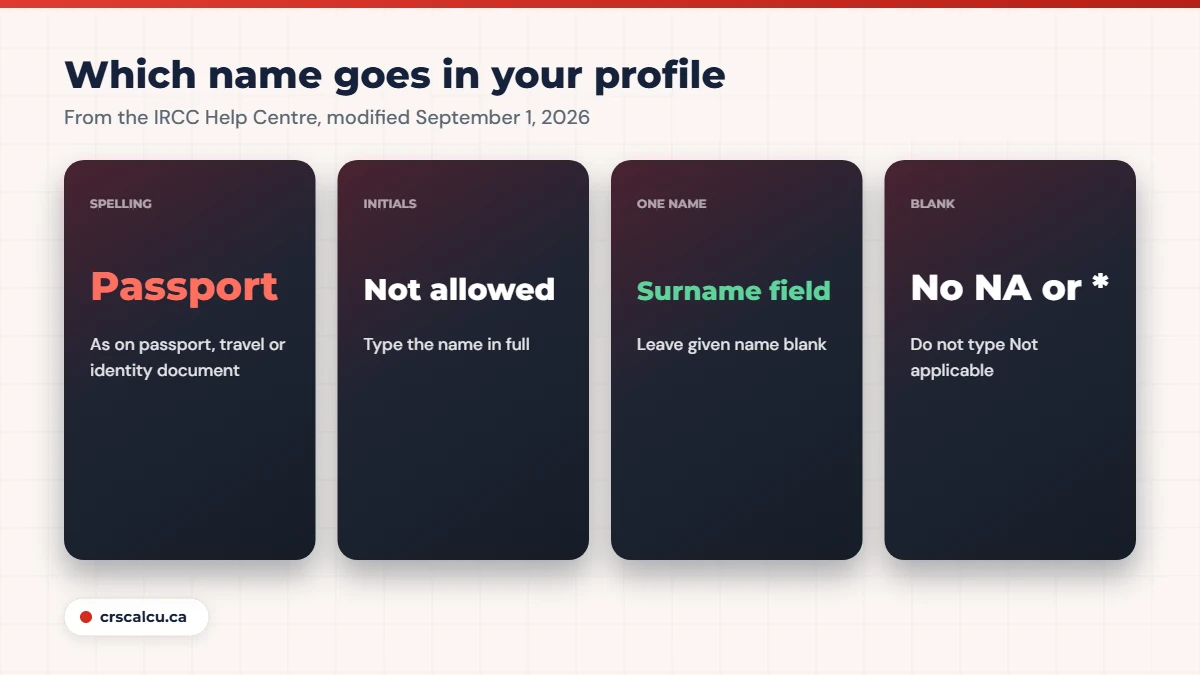
There are only a handful of official lines on this, so it is worth reading them slowly. The Help Centre answer “What do you mean by surname?” (modified September 1, 2026) says your surname is your family name, and that when you fill out applications you should type it as it appears on your passport, travel or identity document. It adds a short instruction that catches a lot of South Asian applicants: do not use initials.
The same answer covers people with a single name. If there is no family name on the passport, you enter all your given names in the surname field and leave the given name field blank. You do not enter “Not applicable”, “*” or “NA”.
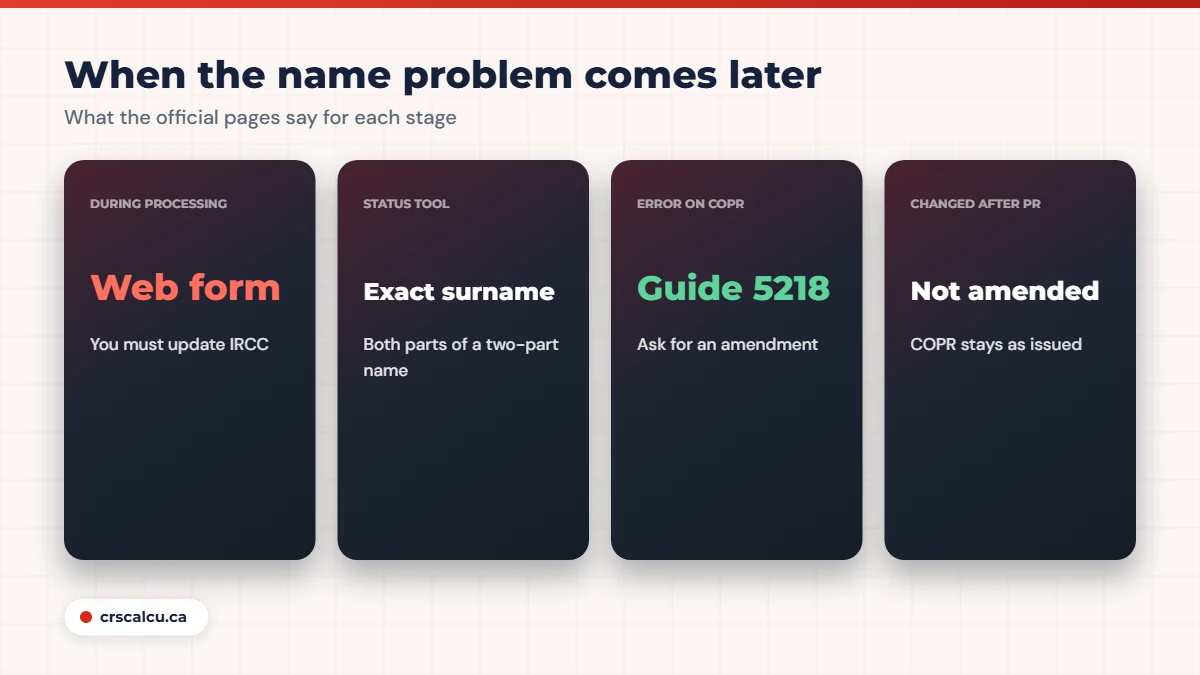
A second Help Centre answer, about checking your status online (modified April 17, 2026), shows how literal the system is. It says to enter the surname exactly as it appears on your immigration document or on letters from the office handling your file. Its own example is a two-part family name: if the document lists both parts, typing only one of them means the status tool will not find your case.
Situation | What IRCC says | Where it is written |
|---|---|---|
Which spelling to use | As it appears on your passport, travel or identity document | Help Centre, “What do you mean by surname?” |
Initials | Do not use initials | Same answer |
No family name on passport | All given names in the surname field; given name field blank | Same answer |
Empty name field | Do not enter “Not applicable”, “*” or “NA” | Same answer |
Name changed during processing | You must update IRCC using the web form | Help Centre, name change and status |
Mistake on the final PR document | Request an amendment (Guide 5218) | Guide 5218, modified April 21, 2026 |
Our summary of the IRCC pages listed under Sources, read on October 5, 2026. The wording in the middle column follows the official text closely.
The four mismatches applicants report most
Reading through forum threads about a name mismatch in Express Entry, the same four patterns come up again and again. None of them involve a different person. They are all the same person recorded in different ways.
1. Initials instead of a full surname
This is the classic one. School and university records carry an initial, the passport carries the expanded surname. Because IRCC says not to use initials, the profile follows the passport and the degree becomes the document that needs explaining.
2. A middle name or father’s name that changes from paper to paper
In many naming traditions the middle name is the father’s given name, and clerks shorten or vary it. One document has the long form, another has the everyday form. First and last names match, the middle does not.
3. A single name, or no surname at all
Some passports have one name only. The rule above applies: everything goes in the surname field. The mismatch then appears on documents where a helpful clerk invented a first name and last name split.
4. A married or legally changed name
Older degrees and job letters are in the previous name, the passport is in the new one. Here there is normally a clean legal document that links the two, such as a marriage certificate or a name change certificate.
Real case: full surname on the passport, initials at school (December 2017)
An applicant posted that the passport carried the full name while school records showed only initials for the surname. Replies suggested a notarized affidavit stating that both versions belong to one person, and one member pointed out that a birth certificate or school leaving record naming the father correctly could also bridge the gap. The poster also considered reapplying for a birth certificate with the expanded name. No final outcome was reported in the thread.
What an ECA report does with two spellings
Your Educational Credential Assessment is often where the mismatch first becomes visible, because the organization receives transcripts directly from the university and compares them with the name you registered under.
Real case: the assessment report printed both names (October 2018)
One applicant received an ECA report that noted the difference: the full name on the assessment and a shortened surname on the academic documents, with both versions acknowledged in the report. Other members said that if the report recognized the degree as equivalent, the name note was not the important part, and suggested a notarized “one and the same person” affidavit at the permanent residence stage. The poster had not yet applied a few months later and did not post a result.
The useful point in that thread is that the report was still issued and still showed the Canadian equivalency. That is the part Express Entry needs for education points. If you are still choosing an organization or checking dates, our guide to ECA validity covers the five-year rule.
Real case: a middle name that did not match (July 2019)
A poster preparing for an ECA had matching first and last names everywhere, but the middle name, which was the father’s name, appeared in two different forms on the degree and the passport. One reply said they had sent a legal affidavit with their certificates and received their report. Another, from a long-time member, said middle name differences are common and often pass without comment, and that IRCC can ask for more if it wants it. A third suggested an affidavit attested by a lawyer. The poster asked whether an original or a copy was needed and did not report back.
Six ways to fix a name mismatch before you submit
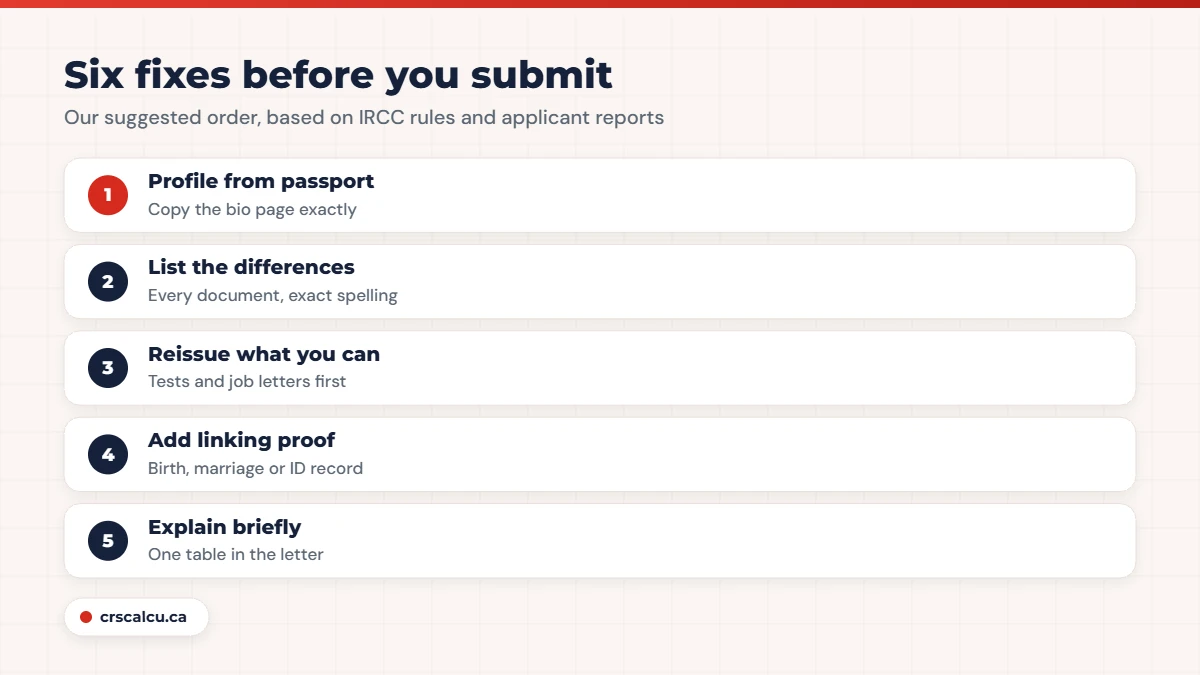
None of these are complicated. The aim is that an officer who opens your file can follow the name from the passport to every other document in under a minute.
Six fixes, in the order we would do them
If the affidavit or any linking document is not in English or French, it needs a translation that meets IRCC’s rules. We explain who can translate in certified translation for Express Entry.
Real case: several name versions, no affidavit, PR approved (August 2020)
In a thread about a father’s name that was longer on work and study papers than on the passport, a member who already had permanent residence described their own file. Their name appeared in more than one form across their degrees and documents. They did not get an affidavit. They wrote a plain explanation in the letter of explanation and attached a copy of an ID card as support, and said IRCC raised no questions. The same thread suggested a notarized affidavit for harder cases, such as an abbreviation that is not obviously the same word.
Keep the explanation boring
An officer does not need the history of your family’s naming customs. They need a table that says “transcript: surname shown as an initial; passport: surname in full; same person, see birth certificate attached”. Short, factual and backed by one document works better than two pages of apology.
Where a name mismatch in Express Entry really causes trouble
The forum cases above are about supporting documents. The cases that hurt are different, and they are worth separating.
Higher-risk situations
If your name changes after you apply
Marriage, divorce and legal name changes do not wait for immigration timelines. The official line is short: tell IRCC. The Help Centre says you must update them using the web form if your name changed during the application process, and that the online status tool will accept the new surname once the file has been changed.
In practice that means sending the new passport bio page and the legal document that links the old name to the new one. If you married after getting your invitation, there is more to update than the name, including your spouse’s details and documents.
If the mistake is on your Confirmation of Permanent Residence
Sometimes the applicant did everything right and the final document still comes out wrong. Guide 5218 (modified April 21, 2026) is the process for that. It lets permanent residents ask IRCC to correct information such as family name, given names or date of birth on the Confirmation of Permanent Residence when the record is wrong.
Two limits in that guide matter. First, a request to change a name needs a photocopy of the documents that link the previous name to the new name. Second, personal information that changed after the date permanent residence was granted will not be amended on that document. So a spelling error is fixable. A marriage that happened after landing is not a reason to reissue it.
Final check before you press submit
A mismatch is paperwork, not a points problem. It does not change your score, so while you sort it out you can still calculate your CRS score and keep an eye on the latest draw cut-offs. For everything else you upload after an invitation, use our Express Entry document checklist.
Frequently Asked Questions
Does a name mismatch in Express Entry lead to refusal?
A different spelling on a supporting document is not listed by IRCC as a reason for refusal. What IRCC does require is that you type your name as it appears on your passport, travel or identity document, and that you report a name change during processing. Explain the rest clearly and attach proof that links the versions.
Which name do I use if my passport and degree are different?
The passport. IRCC’s Help Centre says to type your surname as it appears on your passport, travel or identity document and not to use initials. The degree is then explained as a supporting document.
What if I have only one name on my passport?
IRCC says to enter all your given names in the surname field and leave the given name field blank. Do not type “Not applicable”, “*” or “NA”.
Do I need a “one and the same person” affidavit?
We did not find it on any IRCC page we read, so we cannot call it a requirement. Applicants on public forums often included one, and at least one reported being approved with only a letter of explanation and an ID card. An affidavit is reasonable extra support when the two versions are not obviously the same name.
My ECA report shows two versions of my name. Is it still valid?
In the forum case we read, the report listed both versions and still gave the Canadian equivalency. The equivalency is what Express Entry uses for education points. Keep the report, and explain the two spellings in your letter of explanation.
I got married after submitting my application. What do I do about my name?
Tell IRCC. The Help Centre says that if your name changed during the application process you must update them using the web form. Send the document that links your old and new names along with your new passport page if you have one.
Names sorted? Check the number that decides your invitation
A spelling difference does not change your points. Run your profile through the calculator and compare it with the most recent cut-offs.
Final Thoughts
A name mismatch in Express Entry feels serious because names feel serious. In the files we read about, it was handled the same way every time: profile from the passport, a short explanation, one document that connects the dots, and an affidavit when the gap was wide.
If your situation involves a different date of birth, more than one identity document in different names, or a past application under another name, that is beyond a spelling issue. Speak to a licensed consultant or lawyer before you submit.