Express Entry Guide · Updated October 2026
French-Language Proficiency Category in Express Entry: Who Qualifies, NCLC 7 and Whether Learning French Is Worth It (Real Cases)
It has become the best-known shortcut in Express Entry, and it is not short. One rule decides who is in: level 7 in every French ability. Here is what that takes.
The French-language proficiency category is the part of Express Entry that candidates with good profiles and not-quite-enough points talk about most. In a category-based round, IRCC invites only those candidates in the pool who meet a specific requirement. For this category the requirement is French, and the rounds have regularly reached candidates whose scores would not have been invited otherwise.
That has produced two kinds of confusion. Some people believe a little French is enough, and are surprised to learn that a level 5 does nothing for the category. Others believe it is a separate program with its own application. It is neither. It is the same pool, the same profile and the same programs, with one extra filter.
We read IRCC’s category-based selection page, its language test page and the ranking criteria, along with four public forum threads from 2023 and 2024 in which candidates asked what level is needed, how long it takes to get there, and what happens after an invitation through the category.
Quick answer: who qualifies for the French-language proficiency category?
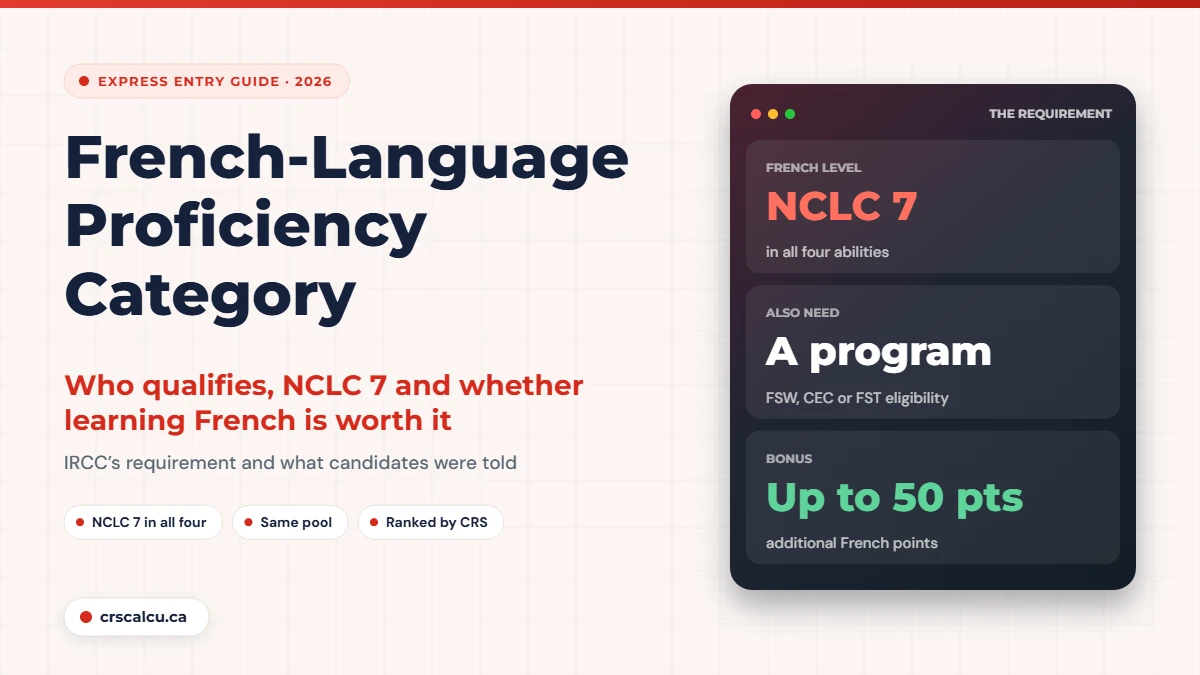
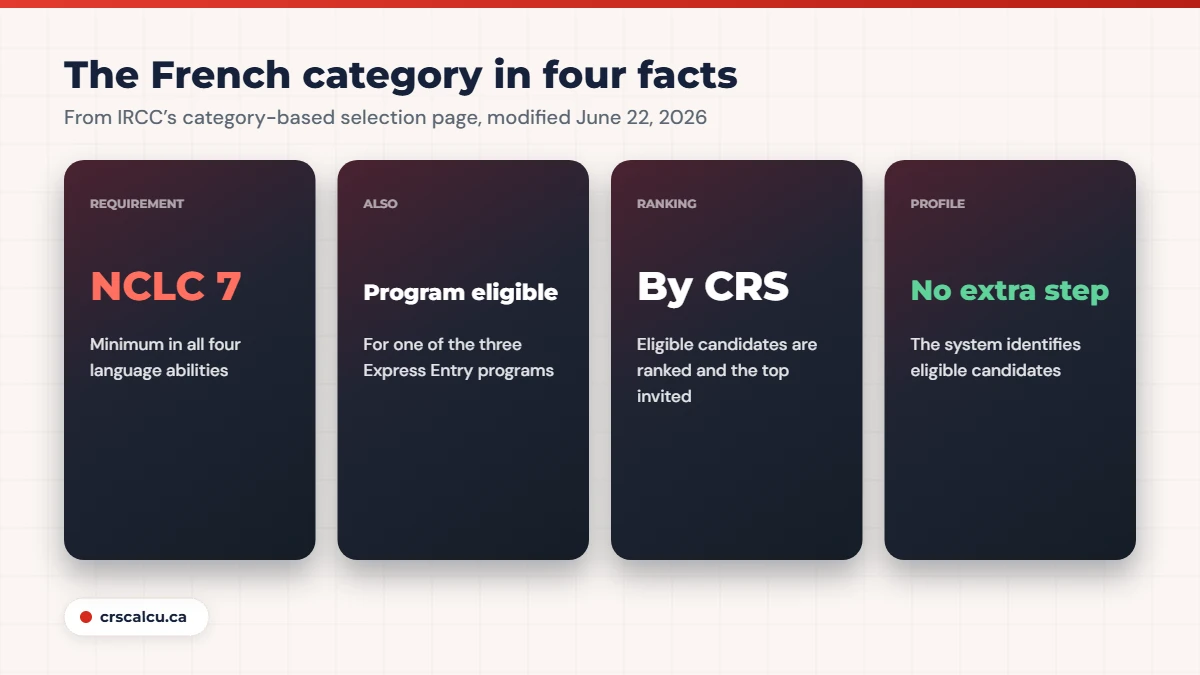
IRCC’s category-based selection page (modified June 22, 2026) sets one requirement for this category: French test results showing a minimum score of 7 in all four language abilities on the Niveaux de compétence linguistique canadiens, the NCLC scale. You must also be eligible for one of the three Express Entry programs and meet the instructions for that round. There is no separate application: IRCC says the system identifies eligible candidates from the profile. The tests and scores are compared in TEF vs TCF for Express Entry.
Key takeaways
What the French-language proficiency category is
IRCC’s page describes category-based rounds in one sentence: it invites candidates in the Express Entry pool who are eligible for a specific category established by the Minister to meet an identified economic goal. The page lists the current categories. French-language proficiency is the first on the list, and the only one defined by language instead of occupation.
Three things on that page correct the most common misunderstandings.
Question | What IRCC says |
|---|---|
What is required? | French test results showing a minimum of 7 in all 4 abilities on the NCLC scale |
Is that all? | No. You must be eligible for an Express Entry program and meet the round’s instructions |
Who is invited in a round? | Eligible candidates are ranked by CRS score and the top-ranking are invited |
Do I apply to the category? | No. Candidates stay in the pool and the system identifies who is eligible |
How are categories chosen? | From labour market information and projections, and input from provinces, territories and stakeholders |
Our summary of IRCC’s “Express Entry: Category-based selection” page (modified June 22, 2026).
So the category does not replace the ranking. It changes who you are ranked against. In a general round you compete with everyone in the pool. In a French round you compete only with candidates who also have NCLC 7 in every ability.
NCLC 7 in all four abilities: what it means in test scores
IRCC accepts two French tests, TEF Canada and TCF Canada, and results must be less than two years old when you complete your profile and when you apply. Its conversion tables give the scores for NCLC 7.
Ability | TEF Canada | TCF Canada |
|---|---|---|
Speaking | 310 | 10 |
Listening | 249 | 458 |
Reading | 207 | 453 |
Writing | 310 | 10 |
From IRCC’s “Express Entry: Language test results” page (modified June 22, 2026).
Forum members usually describe this level as upper-intermediate French. It is a real working level of the language, well beyond tourist or classroom-beginner French, and it has to be shown in all four abilities in one sitting.
Real case: “is level 5 enough?” (April 2024)
A candidate with 445 points, CLB 7 in English and level 5 in French asked whether that French result qualified them for the French category. They had looked at recent French round cut-offs and saw their score was above them. Members explained that the category requires level 7 in all four abilities, so level 5 does not qualify, however the total score compares. There was some confusion in the thread about whether “7” meant a level, a band or a number of points. A member also confirmed that you cannot retake a single ability; the whole test is taken again. The poster accepted they would need to improve their French.
Real case: a score around 500 and a request for proof (November 2024)
A candidate with a score of about 500 asked for the minimum French level for the category, and when told it was level 7, asked for a source. An experienced member replied that level 4 or 5 is not enough for French rounds, quoted the official requirement of a minimum of 7 in all four abilities, and pointed to IRCC’s page. They added that the level is reachable in about a year with real effort.
Both candidates had made the same assumption: that their total score was the only thing that mattered. In a category round, the filter comes first.
You still have to be eligible for a program
The category is a way of being selected from the pool. It is not a way into the pool. IRCC’s page says candidates must be eligible for one of the three Express Entry programs. That means the usual requirements: skilled work experience in TEER 0 to 3, the program’s language minimum, and for the Federal Skilled Worker Program, education and 67 points on its own grid. See minimum CLB for Express Entry and TEER 4 and 5.
Either official language can meet the program minimum. IRCC’s language page gives each minimum as a CLB level in English or the same NCLC level in French. A candidate whose French is stronger than their English can enter French as the first official language.
Real case: invited through the category, then the usual wait (October 2023 to September 2024)
A candidate who had been invited in a French proficiency round and had received their acknowledgment of receipt asked how long processing takes for category-based applications. A member replied with the general standard of 80% of applications within six months. The thread then turned to questions from others. Members said level 7 in French is needed whichever language you declare first, and that you should put the language with the higher scores first. On preparation, one said eight months can be realistic at three to four hours a day with a good course. No decision on the original application was posted.
After an invitation, an application through this category is processed like any other. Our post on Express Entry processing time explains the six-month standard.
The points that come with it
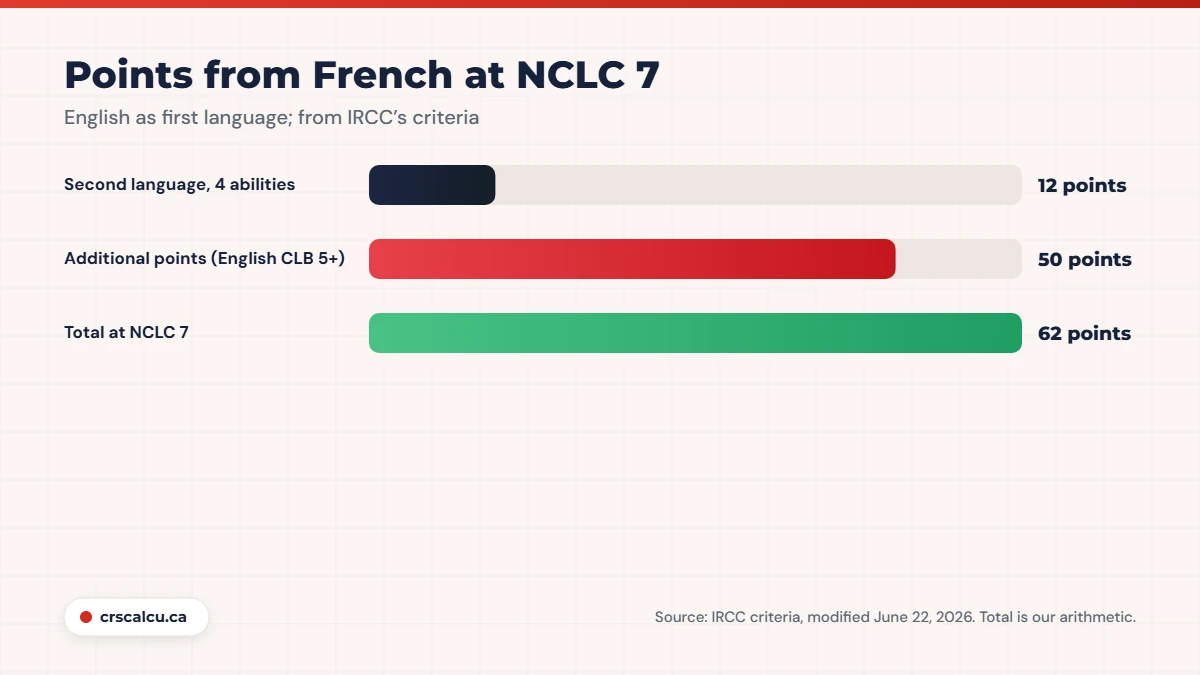
Reaching NCLC 7 in every ability does more than open the category. IRCC’s criteria page gives additional points for French: 50 if you also have CLB 5 or higher in all four English abilities, and 25 if your English is CLB 4 or lower. French entered as a second official language earns 3 points per ability at NCLC 7 or 8 and 6 at NCLC 9 or more.
Our arithmetic for a candidate with English as first language and French at exactly NCLC 7 in everything: 12 second-language points plus 50 additional points, or 62 points on top of the rest of the profile. That raises your rank in a French round and in general rounds too.
Real case: “does French put me in a separate stream?” (May 2024)
A candidate with a score above 490 asked whether learning French would raise their score or move them into a separate, easier category. Members explained that it does both things at once: French adds points to the same profile, and with level 7 in all abilities you also become eligible for French rounds while staying eligible for general ones. Beginner French earns nothing. One person who had done it said it took two years from zero. Another estimated 12 to 24 months depending on commitment. One called it a bit of a gamble, since categories can change, and others said French is useful for life in Canada either way.
Is learning French worth it?
That last thread sets out the trade-off fairly. On one side, the reward is large: the additional points, the category, and a language that helps with work and daily life in much of the country. On the other, the cost is a year or two of serious study, and the category itself is a policy choice.
On the policy point, IRCC’s page says categories are chosen using labour market information and input from partners, and that it reports to Parliament each year on the categories used. Nothing on the page guarantees that a category will continue or how many invitations it will receive. The additional points for French are part of the scoring criteria, which is a separate rule.
French may be worth the effort if
Think again if
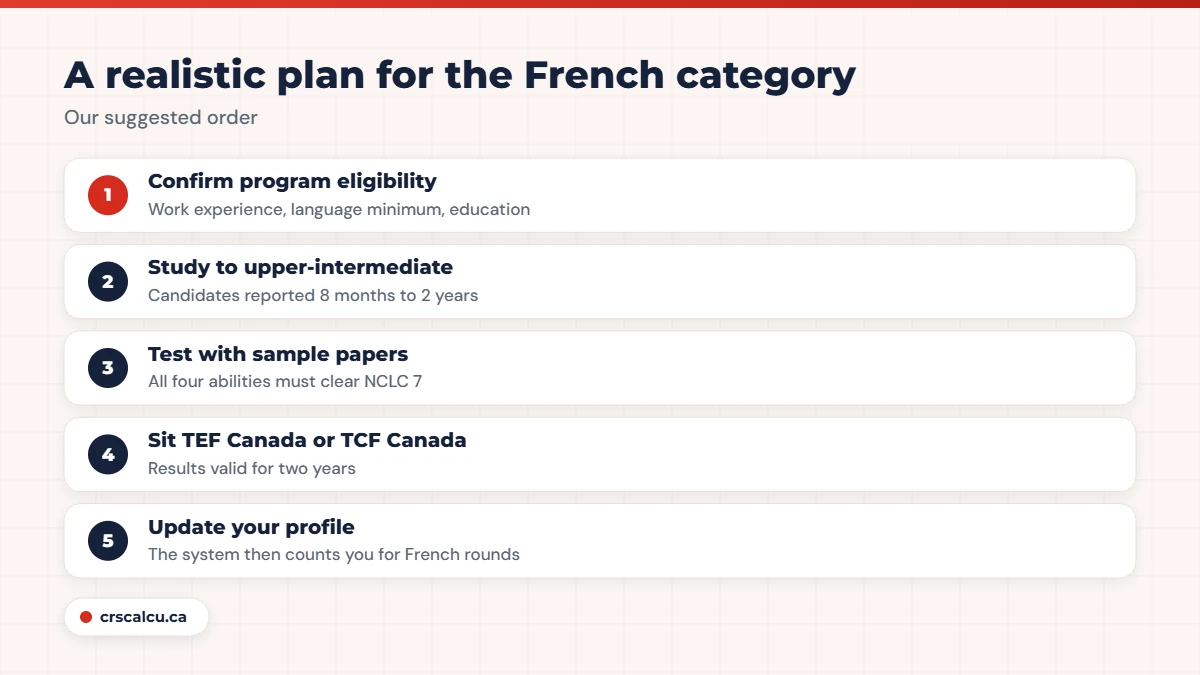
Book the test when practice papers say you are ready
Because all four abilities must reach level 7 in one sitting and single abilities cannot be retaken, a test taken too early is a fee spent on finding out that writing is still at level 6. Use timed sample papers, convert each ability with our CLB calculator, and book when your weakest ability clears the line with room to spare.
Five mistakes people make with the French category
Five mistakes from the rules and the threads
To see what French would do for your own profile, add NCLC 7 as a second language in the CRS calculator and compare the new total with past rounds on our category-based draws page.
Frequently Asked Questions
What is the French-language proficiency category?
It is one of the categories IRCC uses for category-based rounds of invitations in Express Entry. In those rounds only candidates who meet the French requirement are ranked and invited.
What level of French do I need?
A minimum of 7 in all four language abilities on the NCLC scale, shown by TEF Canada or TCF Canada results. Level 5 or 6 does not qualify for the category.
Do I need to apply separately for the French category?
No. IRCC says candidates remain in the pool and the system identifies who is eligible from their profile information. You need valid French results entered in your profile.
Do I still need English?
You need to meet the language minimum of your program in English or French. To get 50 additional points for French you also need CLB 5 or higher in all four English abilities; with English at CLB 4 or lower the additional points are 25.
How long does it take to reach NCLC 7 from zero?
Forum candidates reported between about eight months of intensive study and two years. One who had done it said two years from no French at all.
Can I retake just one ability of the French test?
Forum members reported that you cannot; the whole test is taken again. Check the test provider’s current rules before you book.
See what French would add to your score
Enter NCLC 7 as a second language and compare your new total with recent general and French rounds.
Final Thoughts
The French-language proficiency category has one gate, NCLC 7 in all four abilities, and it sits inside the ordinary Express Entry system. You need to be eligible for a program, you are ranked by score against other French-speaking candidates, and you gain additional points whether or not a French round is held. For a candidate with time and persistence it is one of the few ways to change a profile substantially.
It is also a long project built on a category that IRCC can change. If you are choosing between a year of French and another route, such as a provincial program, more Canadian experience or a better English score, a licensed consultant can help you compare them for your case.