Express Entry Guide · Updated October 2026
Two Express Entry Profiles: What IRCC Allows and What Gets People in Trouble (Real Cases)
A forgotten password, an agent who opened a second profile, an old profile you never withdrew. Here is the rule, and how to fix a duplicate before it costs you.
Hardly anyone sets out to have two Express Entry profiles. It happens by accident: a lost password and a fresh account, a consultant who submits something without telling you, an old profile from two years ago that you assumed had vanished. Then an invitation arrives and the question becomes urgent.
IRCC’s position is short. You may only have one profile at a time. What takes longer to work out is what counts as a second profile, what does not, and how to get back to one without making things worse.
We read IRCC’s Help Centre answers, its create-profile page and its page for candidates who were not invited (all modified in 2026), plus five public forum threads from 2017 to 2026. This is general information, not legal advice.
Quick answer: can you have two Express Entry profiles?
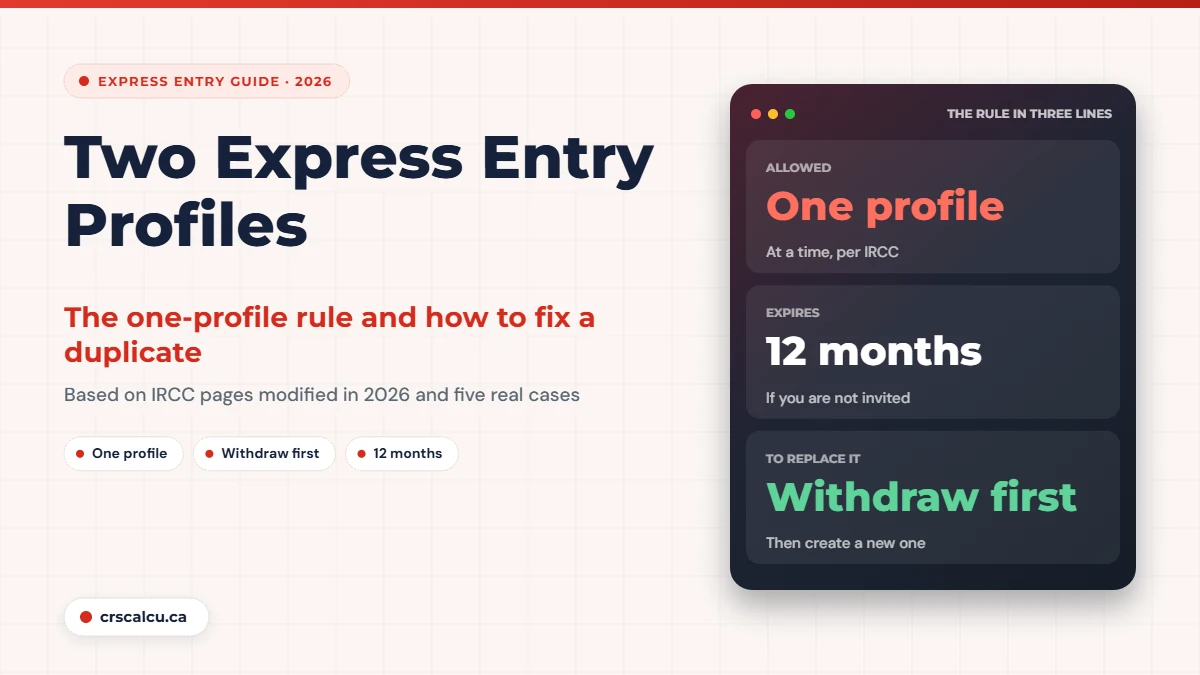
No. IRCC’s Help Centre (modified September 1, 2026) says you may only have one profile at a time, that this is set out in Canada’s immigration law, and that more than one profile will not improve your chances or let you be invited under a different program. If you want to start again while a profile is active, IRCC says to withdraw your existing profile first. An expired or withdrawn profile is not a second profile. Before you rebuild anything, check your numbers in our CRS calculator.
Key takeaways
Two Express Entry profiles: the rule in IRCC’s words
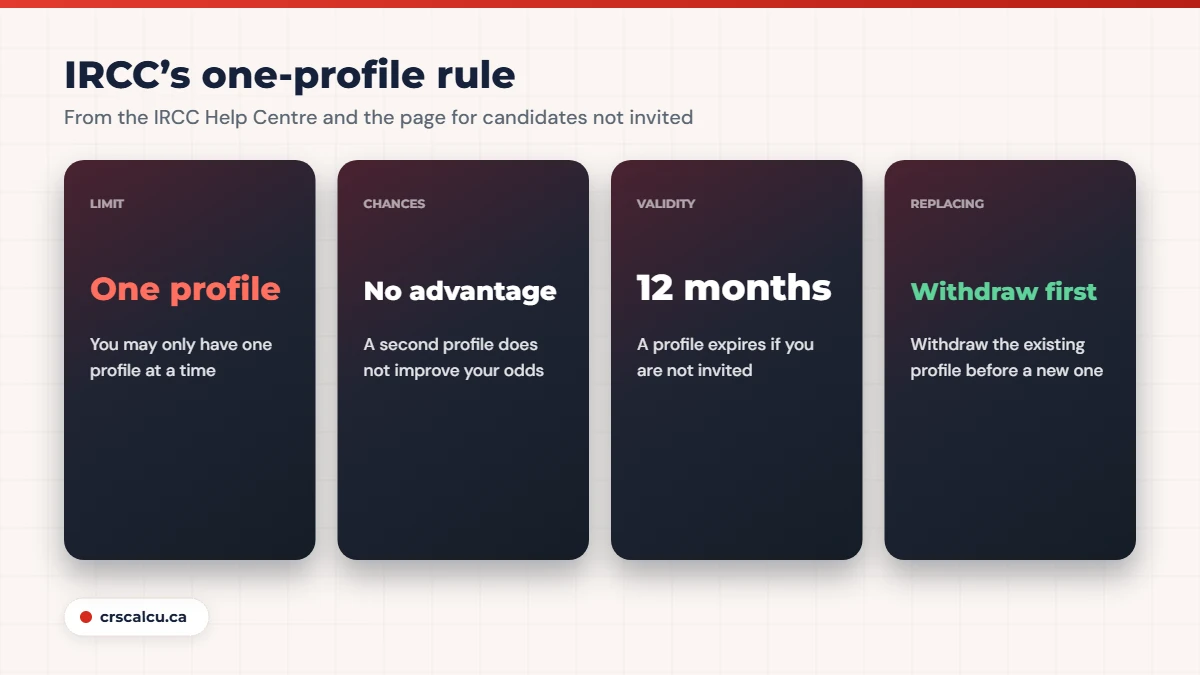
The Help Centre answer to “Can I have more than one Express Entry profile?” (modified September 1, 2026) is one of the shortest on the site. It says no: you may only have one profile at a time, and this is set out in Canada’s immigration law. It then deals with the two reasons people try it anyway. Creating more than one profile will not give you a better chance of being invited, and it will not allow you to be invited under a different program.
That second point matters because many duplicates start with a program question. Someone qualifies for both the Canadian Experience Class and the Federal Skilled Worker Program and thinks a profile for each is the way to cover both. It is not needed. IRCC’s create-profile page (modified September 24, 2026) has a section on being eligible for more than one program, and the Help Centre explains that the system assesses you for all of them from a single profile and invites you in a set order: Canadian Experience Class first, then Federal Skilled Worker, then Federal Skilled Trades. You do not get to pick, and a second profile does not change the order. Our guide to the Canadian Experience Class covers the first of those.
What counts as a second profile, and what does not
The rule is about profiles that are active at the same time. Much of the worry in the threads we read was about things that are not that.
Situation | What IRCC’s pages say | Our reading |
|---|---|---|
Old profile expired after 12 months; you create another | You can still create a new profile | Allowed |
Old profile still active; you want a fresh start | Withdraw your existing profile first | Allowed only after withdrawal |
Profile found ineligible and locked | Create a new profile | Allowed |
Invitation expired with no response | Profile is removed; a new one is needed | Allowed |
Two active profiles for the same person | Only one profile at a time | Not allowed |
Our summary of IRCC’s page for candidates not invited (modified June 22, 2026), respond-to-invitation page (June 22, 2026) and Help Centre answers (modified September 1, 2026). The third column is our reading.
IRCC’s page for candidates who have not been invited (modified June 22, 2026) says a profile expires automatically if you are not invited within 12 months of submitting it. It is then removed from the system and you get a message in your account. The page says you can still create a new profile, and it adds a warning: do not create a new one until the existing profile expires, and if you do, you will need to withdraw the existing one first.
Accounts are not profiles
A sign-in and a profile are different things. People lose a password, register again and end up with two sets of login details. The Help Centre rule we read talks about profiles, not accounts, and we did not find an IRCC page that penalizes a spare login with nothing submitted under it. That said, the forum cases show how quickly a spare login turns into a spare profile.
Real case: forgotten password, two invitations (May 2017)
A candidate created a profile, forgot the password and built a second profile under another email address. The second profile was invited. After recovering access to the first account, the candidate found that it had been invited too. They declined the invitation on the old account, removed that profile and applied through the new one, then worried the application would be refused over the duplicate. Replies said the real problem is having more than one active profile at once, because it distorts how invitations are shared out, and that withdrawing the old one was the right move. In July 2017 the poster reported an acknowledgment of receipt and was waiting for processing. No final decision was posted.
Real case: several logins, no active profile (April 2023)
A poster had opened one account in 2021, which lapsed in 2022, then another in 2022. With language results expiring and draw scores high, they did not go ahead. Later they entered the pool again under a new login, noticed discrepancies and withdrew that profile. They were left with two accounts, no active profile and a fear of consequences. An experienced reply said that if the old profiles had expired or been withdrawn there was nothing to worry about, and suggested starting clean with one login and a new profile. A later reply added that several logins are possible but it is wiser to stick to one. No further outcome was reported.
When someone else creates the second profile
The hardest version of this problem is the one you did not cause. IRCC’s rule does not make an exception for a profile a representative submitted in your name, so the practical task is to find out what exists and get control of it.
Real case: a consultant’s unauthorized profile (March 2019)
After a consultant’s error led to a refusal, the consultant created a new profile without the client’s agreement. The client ended the relationship but could not confirm whether that profile had been withdrawn, and feared having two active profiles once they submitted their own. An experienced reply separated accounts from profiles: two accounts are fine, two profiles are the problem. The suggested steps were to notify IRCC through the web form that the representative no longer acted for them, using the representative form, to demand the login details from the consultant, to complain to the regulator if the consultant refused, and to attach a letter of explanation if an invitation came. No resolution was reported; later posters in 2020 and 2023 described the same worry.
If a representative may have submitted a profile for you (our checklist)
Couples: one profile each?
The Help Centre answer is addressed to “you”, a single candidate. It does not say whether spouses may each hold a profile that lists the other, and we did not find an IRCC page that does. Forum opinion is split between people who did it and withdrew the spare as soon as one was invited, and people who see it as taking two tickets in one draw. We go through the points side of that decision, and the cases, in principal applicant in Express Entry. If you are tempted, get advice first, and make sure both profiles tell the same truth about the family.
How to withdraw your existing profile
IRCC’s page for candidates not invited gives the steps, and they are short.
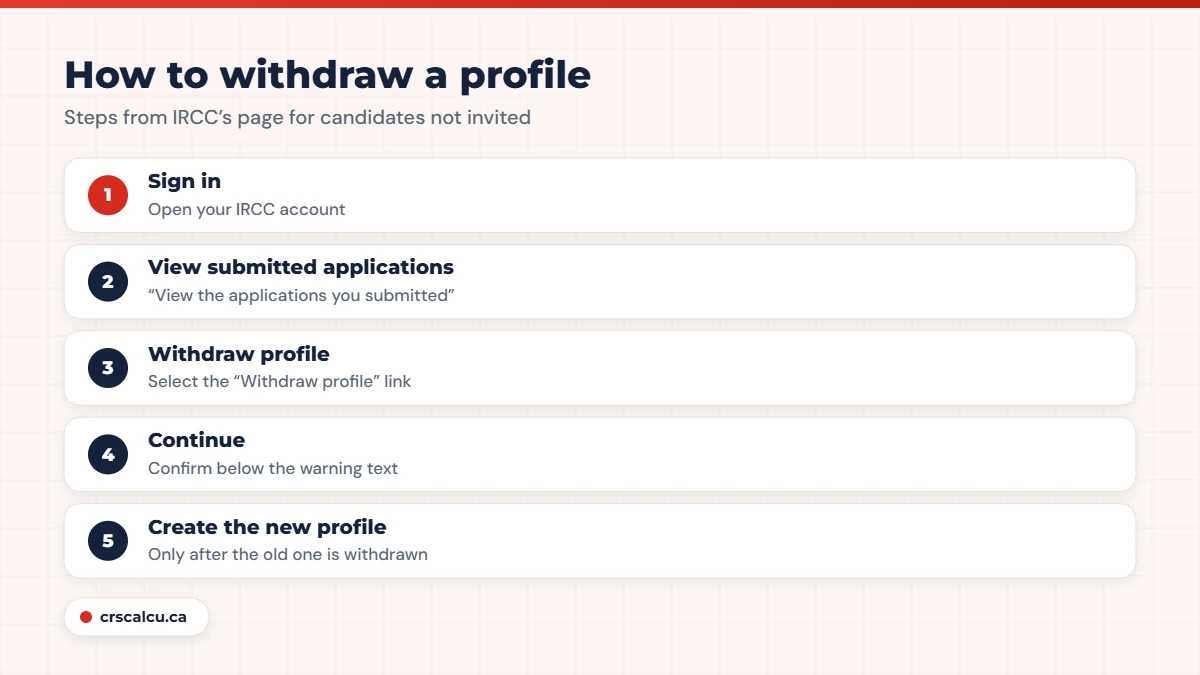
Withdrawing a profile (IRCC’s steps)
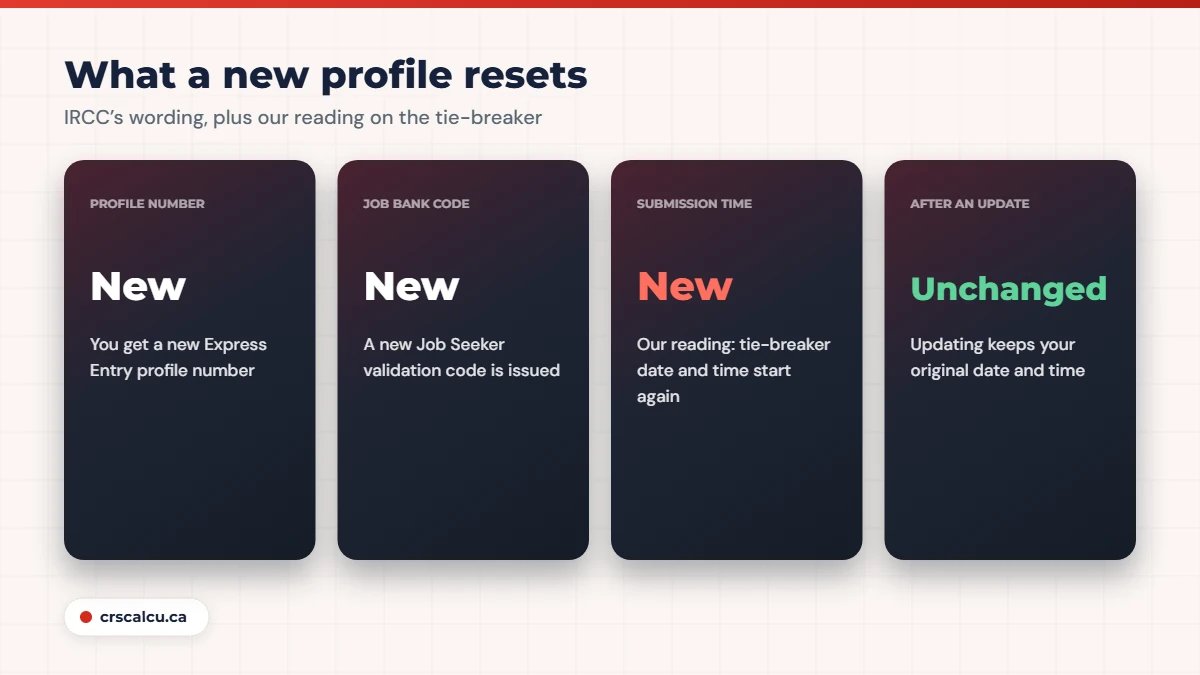
When you submit the new profile, the same page says you get a new Express Entry profile number and a new Job Seeker validation code for Job Bank.
Think before you withdraw
A new profile is new in every sense. IRCC’s create-profile page says that updating a profile does not change the date and time IRCC received it, so you keep your rank in a tie-breaker. Our reading is that withdrawing and starting over does the opposite: the new profile has a new submission time, and you go to the back of the line among candidates with the same score. If the only thing wrong with your profile is a detail you can edit, edit it. The Help Centre says a submitted, eligible profile can be updated.
Your situation | Better route | Why |
|---|---|---|
New language result, new job, new degree | Update the profile | Your submission date and time stay the same |
Marital status or family changed | Update the profile | IRCC says to keep it up to date |
Profile shows as ineligible and cannot be changed | Create a new profile | The Help Centre says a new one is required |
A duplicate exists under another login | Withdraw the spare | Only one profile at a time |
Our reading of IRCC’s create-profile page (modified September 24, 2026) and Help Centre answers (modified September 1, 2026).
If you are sitting just under recent scores, look at the latest draw cut-offs and the pool statistics before giving up a submission date. In a tie, that date decides who is invited.
Old profiles and the questions they raise later
An expired or withdrawn profile does not break the one-profile rule. It can still come back as a question when you apply: did the old profile say the same things as the new one?
Real case: the old profile said “single” (July 2026)
A poster had created a profile in 2024 that wrongly gave their marital status as single although they were married. They withdrew it when they noticed. In 2026 they submitted a correct profile with the spouse, were invited, and both gave biometrics. They then worried that the old error needed explaining. Several replies suggested a short letter of explanation sent by web form, on the basis that volunteering a mistake looks better than having an officer find it. Others noted that the withdrawal and the consistent declaration of the spouse since then pointed to an honest error. One reply recommended asking an immigration lawyer whether a letter was needed. No outcome was reported.
IRCC’s create-profile page warns that if it finds you gave false information or left out important details, it can refuse the application, find you inadmissible and bar you from applying for five years. An honest mistake in a profile you withdrew is not the same as a false statement in a live application, but the warning explains why people in these threads lean toward explaining. If the earlier error was about your occupation, see our post on a wrong NOC code.
Real case: “Have you applied to IRCC before?” (February 2017)
A candidate who had declined an earlier invitation and never submitted an application was building a new profile and did not know how to answer whether they had applied to IRCC before. One experienced reply said to answer no, because a profile is not an application. In March 2021 a senior member added that answering yes and giving the old profile number was also acceptable, as long as the applicant explained the choice in a letter at the application stage. No outcome was reported, and later posters kept asking the same question.
We could not find an IRCC page that settles that question, so we will not pretend to. What both replies share is the habit worth copying: whatever you answer, be ready to explain it. Declining an invitation, by the way, does not create a duplicate. IRCC’s respond-to-invitation page says a declined candidate goes back into the pool with the same profile; see declining an ITA.
Five mistakes that lead to two Express Entry profiles
Avoid these
What IRCC does not say
The pages we read do not describe what happens to a person found with two active profiles, whether IRCC links profiles created under different logins, or how spouses with a profile each are treated. The law is stated, the consequences are not. Treat any forum claim about what IRCC “will” or “will not” check as an opinion.
Frequently Asked Questions
Is it illegal to have two Express Entry profiles?
IRCC’s Help Centre says you may only have one profile at a time and that this is set out in Canada’s immigration law. It does not describe the consequence of having two, but it is clear the second one gives no advantage.
My old profile expired. Can I make a new one?
Yes. IRCC’s page for candidates not invited says a profile expires automatically after 12 months without an invitation and that you can still create a new profile.
I forgot my password and made a new account. What now?
A second login is not a second profile by itself. If you submitted a profile under both, keep one and withdraw the other using “View the applications you submitted” and “Withdraw profile”.
Will a second profile let me be invited under a different program?
No. The Help Centre says more than one profile will not allow you to be invited under a different program. One profile is assessed for all the programs you qualify for.
Do I lose my place if I withdraw and create a new profile?
You get a new profile number, and our reading of IRCC’s tie-breaker wording is that the new profile has a new submission date and time. Updating an existing profile keeps the original date and time.
Can my spouse and I each have a profile?
IRCC’s one-profile answer is written for a single candidate and does not address spouses. We found no IRCC page on it. Get professional advice before doing this.
Check your score before you rebuild
If you are replacing a profile, confirm your CRS number first so the new one is right the first time.
Final Thoughts
The rule on two Express Entry profiles is one sentence long, and most people who break it do so by accident. If you find a duplicate, the fix is usually simple: decide which profile is correct, withdraw the other, and keep a record of when you did it.
If a representative created a profile you cannot access, if an old profile contained an error, or if you have already been invited on more than one, speak to a licensed immigration consultant or an immigration lawyer before you submit an application.