Express Entry Guide · Updated October 2026
Express Entry Processing Time: The 6-Month Standard, When the Clock Starts and Why Some Files Take Longer (Real Cases)
Six months is the number everyone quotes. Fewer people know what it actually measures, when it starts counting, or what the other 20% of applicants went through.
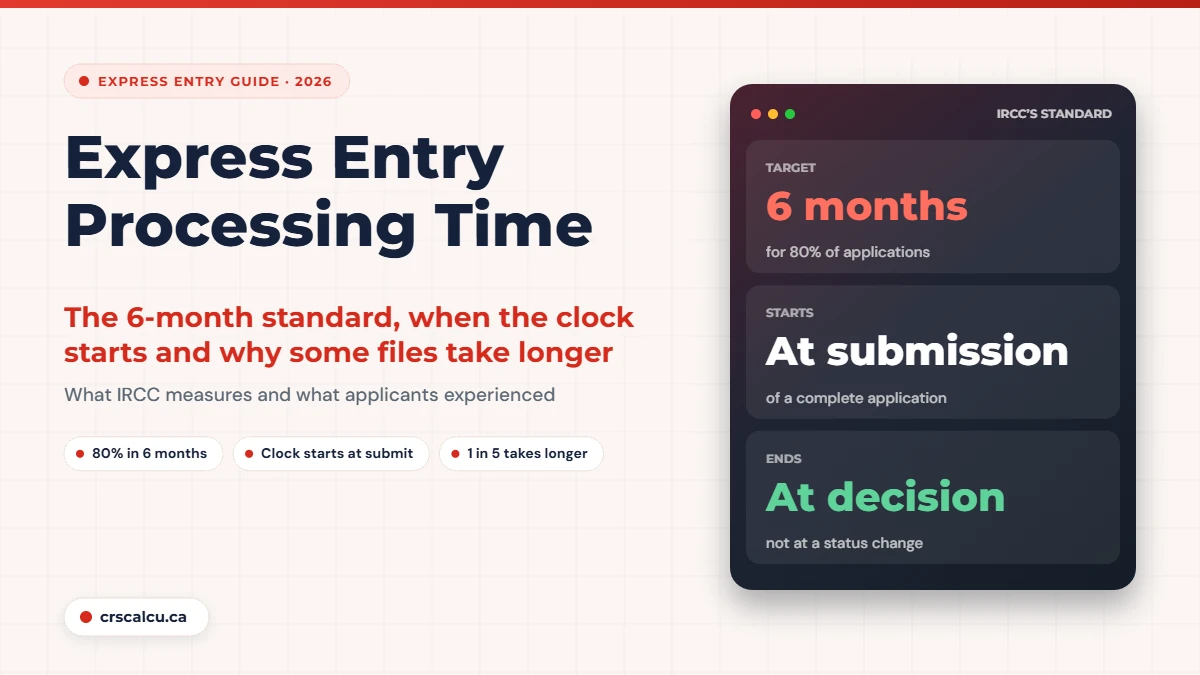
Express Entry processing time is the first thing people ask about after they submit, and the answer they usually get is “six months”. That number is real. It is also widely misunderstood, because it describes how IRCC performed on most applications, not a promise made to yours.
The gap between those two things is where the anxiety lives. Some applicants are approved in weeks. Some sit on “we are processing your background check” for the better part of a year. Both groups applied through the same system and were given the same number.
We read IRCC’s Help Centre answers on how processing times are calculated, the 2024 Express Entry year-end fact sheet and the page on what happens after you apply, along with four public forum threads from 2015 to 2024. We do not print a “current” processing time here, because it changes and IRCC’s own tool is the only place that has it.
Quick answer: what is the Express Entry processing time?
IRCC’s standard is six months for 80% of applications. Its 2024 year-end fact sheet says IRCC met that standard in 2024 for the Canadian Experience Class and the Federal Skilled Worker Program. The clock starts the day you submit a complete application online and stops when a decision is made. Around one in five files takes longer. For today’s estimate, use IRCC’s processing times tool; for what counts as “complete”, see our Express Entry document checklist.
Key takeaways
Express Entry processing time: what the six months really means
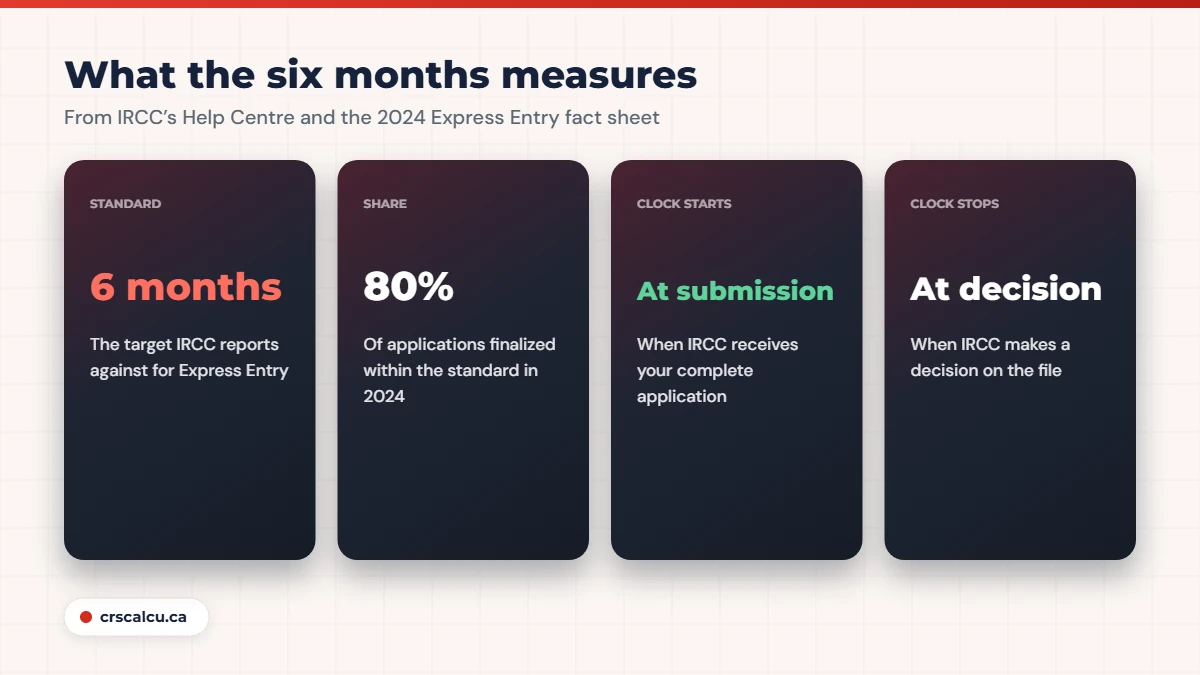
The clearest official statement we found is in the Express Entry Year-End Report 2024 fact sheet (modified November 3, 2025). It says that in 2024 IRCC met its processing standard by finalizing 80% of all applications for the Canadian Experience Class and the Federal Skilled Worker Program in six months. It adds that processing for Express Entry candidates nominated by a province came down from seven months in 2023 to six months in 2024, and that times for every Express Entry program except the Federal Skilled Trades Program fell between 2022 and 2024.
Read that sentence again with the 80% in mind. It means four out of five files were finished within six months. It also means that one in five was not, in a year when IRCC met its target.
Question | What IRCC says | Where it is written |
|---|---|---|
What is the standard? | 80% of applications finalized in 6 months (CEC and FSW, 2024) | Express Entry Year-End Report 2024 fact sheet |
How is a processing time calculated? | Historical: how long it took to process 80% of complete applications in the past | Help Centre, how processing times are calculated |
Is there another method? | Forward-looking: based on applications in inventory and how many IRCC expects to process each month | Same answer |
When does the clock start? | The day IRCC receives your complete application; online, when you submit | Help Centre, when processing time starts |
When does it stop? | When IRCC makes a decision | Same answer |
Why might mine take longer? | Some parts need extra review; the file is “complex or non-routine” | Help Centre, complex or non-routine applications |
Our summary of the IRCC pages listed under Sources, read on October 5, 2026. The first two Help Centre answers were modified September 1, 2026.
Service standard and current processing time are not the same number
IRCC’s Help Centre describes two ways of producing a processing time. The historical method looks back: how long did it take to process 80% of complete applications? The forward-looking method estimates ahead, using the number of applications of that type waiting in the inventory, how many IRCC expects to process each month, and the yearly immigration levels.
The service standard is the target. The figure in IRCC’s processing times tool is the current measurement or estimate. They can match, and they can drift apart. That is why we will not print today’s figure in a post you may read months from now. Check the tool on the day you want to know, and note the date beside it.
Real case: “the website says six months, what is it really?” (February 2024)
A Federal Skilled Worker candidate invited in mid-February 2024 asked for real timelines, since the official site showed six months. A reply explained that the figure reflects how long 80% of past applications took, so some take longer, and that nobody can predict an individual file. Later posts in the same thread showed how wide the range is: one applicant who had sent documents in January 2023 was still dealing with additional requests and a repeat medical in mid-2024, and another had given biometrics in July 2024 and was still under review months later.
When the clock starts, and what does not count
This trips people up because Express Entry has several dates that feel like a beginning: the day you entered the pool, the day you were invited, the day you submitted, the day IRCC acknowledged the application. Only one of them starts the clock. The Help Centre says your processing time starts the day IRCC receives your complete application and, for online applications, that is when you submit.
So the weeks you spent in the pool do not count, and neither do the days you used from the Express Entry ITA deadline. The word “complete” matters too. If the file fails the completeness check, it is not slow, it is over: see what happens when an application is rejected as incomplete.
What happens during those months
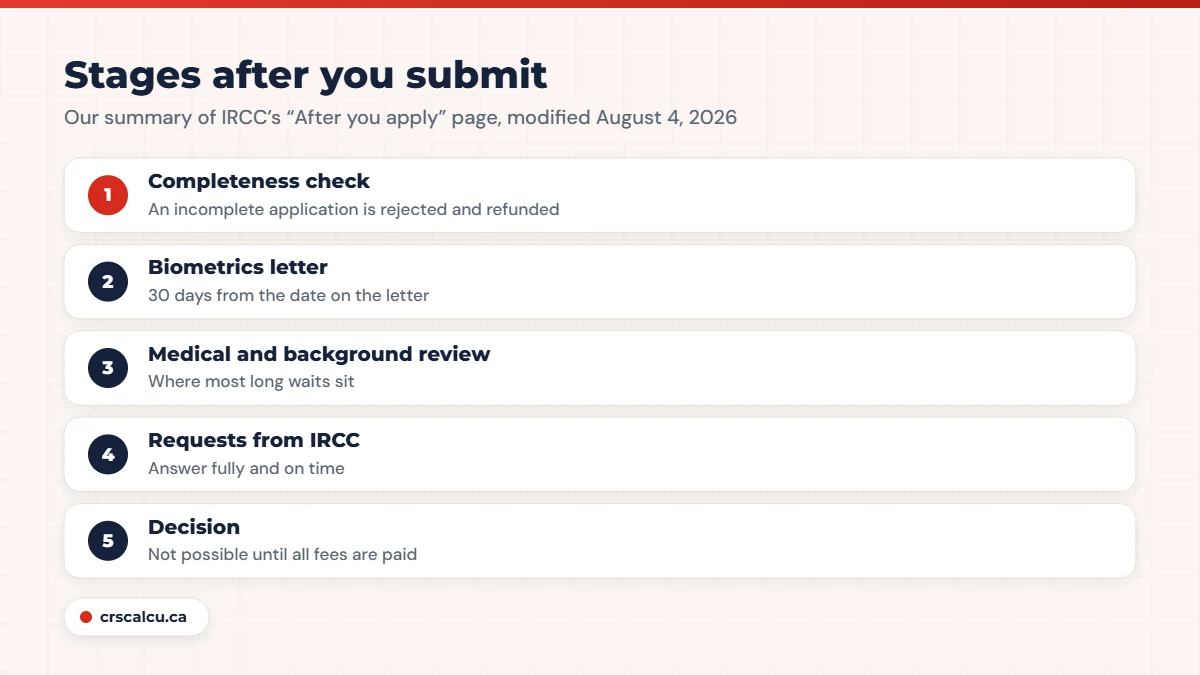
IRCC’s “After you apply” page (modified August 4, 2026) sets out the order of events, and applicants on forums watch for each one. Later posts in this series cover the acknowledgment of receipt, application status messages, background checks and file notes in detail. Here is the short version.
The stages applicants watch for
Real case: from acknowledgment to passport request in days (November 2015)
A thread started to calm anxious applicants collected fast timelines. One Canadian Experience Class applicant inside Canada reported a passport request within eight weeks. Another listed an acknowledgment on October 14, medical passed the next day, a request for a background form on October 19 and a passport request on October 26. A third counted nine days from acknowledgment to passport request. These are self-reported and almost a decade old, but they show that a clean file could move very quickly.
Those cases are the other end of the 80%. They do not tell you what will happen to your file, any more than the slow ones do.
Six reasons a file runs past the standard
IRCC’s Help Centre says it considers an application complex or non-routine if some parts need extra review or processing, and that such a file may take longer than the normal processing time. For permanent residence it gives examples. We have put them in a list, with one more reason that comes from an IRCC message an applicant shared.
Six reasons, and where each comes from
Real case: background check message for months, then approval (February to June 2019)
An applicant who had submitted within a month of the invitation wrote in February 2019 that more than six months had passed and that the account had shown a background check in progress for three to four months. A friend’s file was past eight months. Members suggested ordering the file notes. Another shared an IRCC reply saying about 20% of applications are more complex and take longer. In June 2019 the poster returned to say the decision had arrived and permanent residence was approved.
Three of those six reasons are in your hands before you ever submit: a complete file, a medical done at a sensible time, and documents that are easy to verify. Clear reference letters and a gap-free personal history are the two places where verification most often slows down.
What you can do when it runs past six months
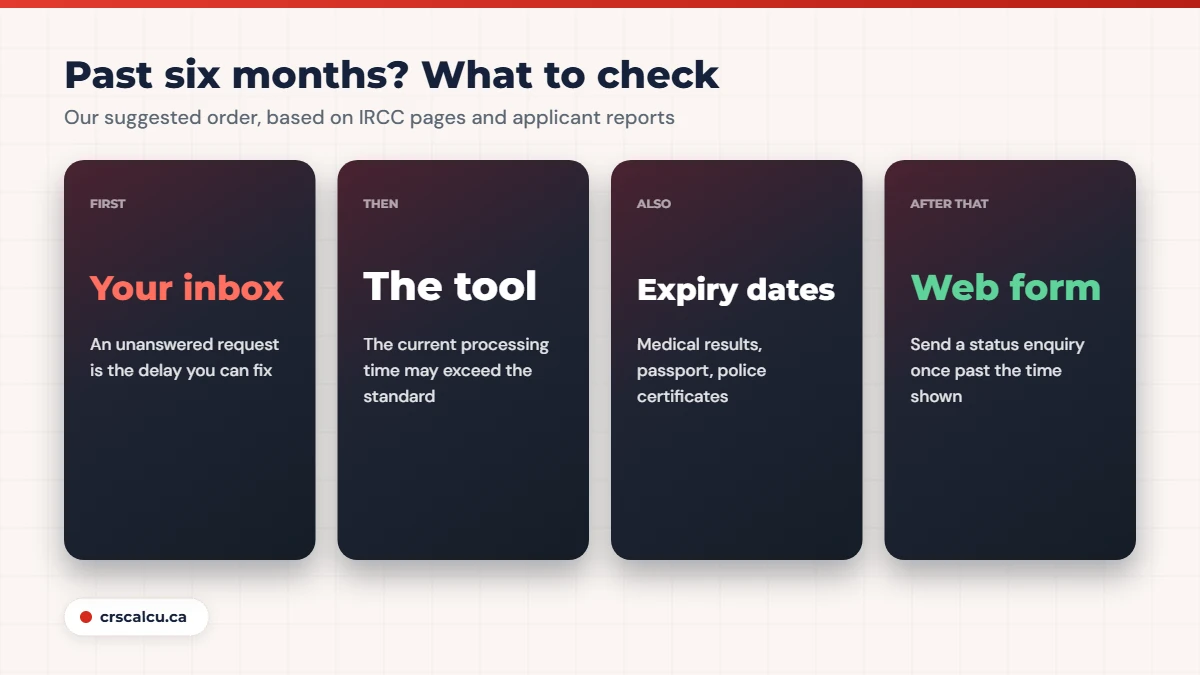
The honest answer from the threads is: less than you would like. IRCC’s Help Centre does not list a way to buy or request faster processing for a routine case. What you can do is make sure nothing is waiting on you, and then find out what the file is waiting on.
Our suggested order once you pass the standard
Real case: nine months of silence, and what did not help (January 2019 to January 2020)
An applicant who submitted in March 2018 had seen nothing after the medical passed in April and was told by IRCC only that processing times vary. Members advised ordering file notes, which they said took 30 to 45 days to arrive. A later post in the thread described a second application filed in January 2019 that took about twelve months, with several sets of file notes, help from a Member of Parliament’s office and a lawyer along the way. It was approved in December 2019. The writer’s own verdict was that none of the calls or interventions moved the file.
Do not let a document expire while you wait
A long wait can create its own delay. If your medical results or passport will run out before a decision, IRCC may have to ask for new ones. Keep a note of each expiry date from the day you submit, and tell IRCC through the web form if you renew a passport.
None of this changes your points. If you are still in the pool and reading ahead, your waiting time there depends on your score and the draws, not on processing. You can check where you stand with the CRS calculator and the latest draw cut-offs.
Frequently Asked Questions
What is the Express Entry processing time in 2026?
IRCC’s standard is six months for 80% of applications, and its 2024 fact sheet says that standard was met in 2024 for the Canadian Experience Class and Federal Skilled Worker Program. The current figure changes, so check IRCC’s processing times tool on the day you want to know.
When does the six months start?
IRCC’s Help Centre says processing time starts the day it receives your complete application. For an online application that is the day you submit, not the day you were invited or entered the pool.
Why is my application taking longer than six months?
The standard covers 80% of applications. IRCC says a file is complex or non-routine when parts of it need extra review, with examples such as missing documents, criminal issues, an expired medical exam, ongoing background checks and admissibility concerns.
Can I pay to speed up my application?
We did not find any IRCC page that offers faster processing of a routine Express Entry application for a fee. In the forum cases we read, phone calls and enquiries did not visibly change the timeline.
Does a provincial nomination change the processing time?
The 2024 fact sheet says processing for Express Entry candidates nominated by a province fell from seven months in 2023 to six months in 2024. Check the tool for the current figure for your program.
What should I do if I hear nothing for months?
Make sure no request is sitting unanswered in your account or email, check that no document has expired, and once you are past the time shown in the tool, send a status enquiry through the IRCC web form. Many applicants also order their file notes to see what stage the file is at.
Still in the pool? Your wait depends on your score
Processing only starts after an invitation and a complete application. See how your points compare with recent cut-offs.
Final Thoughts
Express Entry processing time is best read as a range with a well-known middle. Six months covers most files, a clean one can finish much sooner, and a complex one can run well past it without anything being wrong. The parts you control are all at the front: a complete application, documents that are easy to verify, and fast, full answers when IRCC asks.
If your file is far past the current processing time, your status in Canada is about to run out, or IRCC has raised a concern about admissibility, that is the moment to speak to a licensed consultant or lawyer. They can read your file notes with you and tell you whether waiting is still the right move.