Express Entry Guide · Updated October 2026
Express Entry vs PNP: 6 Differences and How the Two Fit Together (Real Cases)
People ask which is better, as if they were rivals. They overlap. One is a ranking system, the other is a province choosing you, and many nominees use both.
The Express Entry vs PNP question is usually framed as a choice between two doors. It is closer to a choice between one door and a side entrance that often leads back to the first. Express Entry is the federal system that ranks candidates and invites the highest scores. The Provincial Nominee Program lets a province pick people it wants, and a nomination can be used inside Express Entry or outside it.
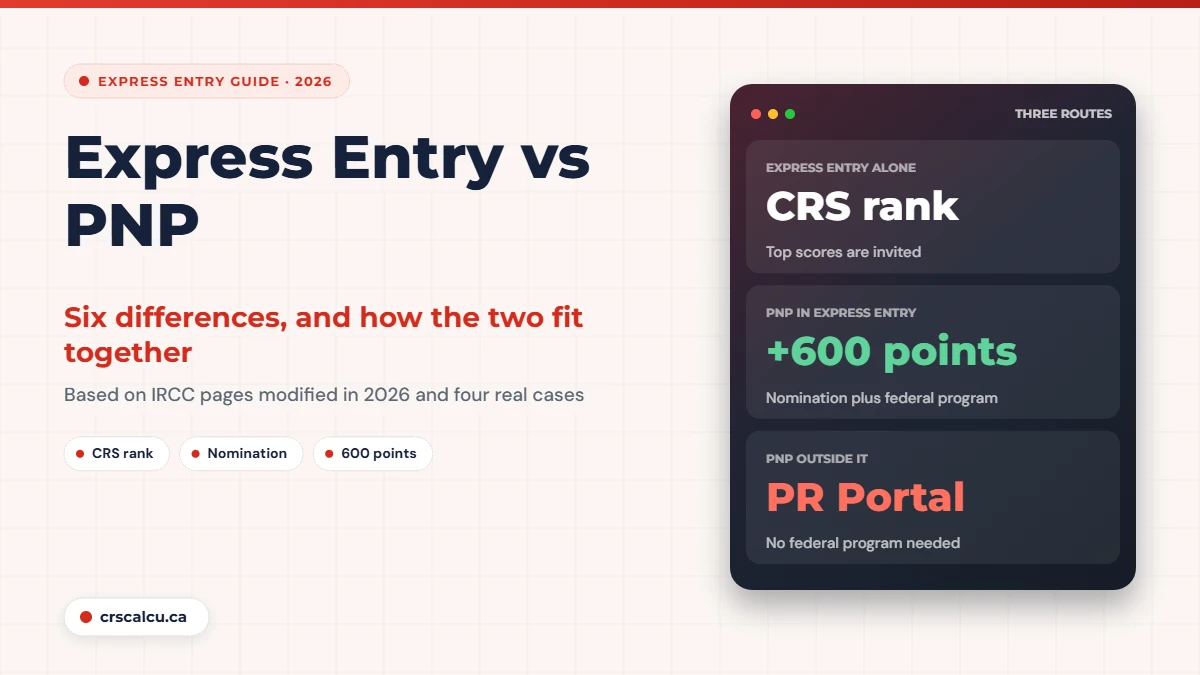
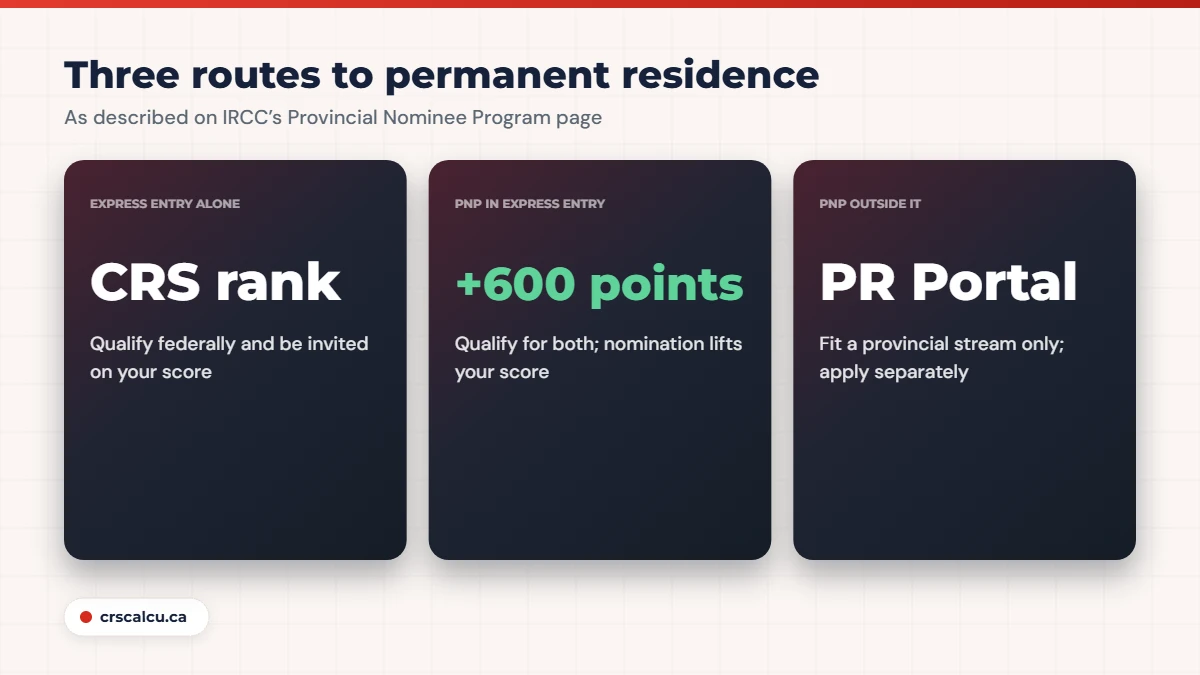
So there are really three routes: Express Entry on your own score, a provincial nomination that adds 600 points to an Express Entry profile, and a provincial nomination followed by a separate application that never touches the pool. Which ones are open to you depends on whether you qualify for a federal program, how your score compares with recent rounds, and whether a province has a stream that fits you.
We read IRCC’s Provincial Nominee Program pages and its Express Entry program pages (all modified in 2026), plus four public forum threads from 2015 to 2023. Processing times quoted in the cases are what posters cited at the time. This is general information, not legal advice.
Quick answer: what is the difference between Express Entry and PNP?
Express Entry is a federal ranking system: you need to qualify for one of three federal programs, and IRCC invites the top CRS scores. The Provincial Nominee Program is a province selecting you under its own criteria. IRCC’s page describes two ways to use a nomination. In the Express Entry process, for people who also qualify for a federal program, the nomination adds 600 extra points. In the non-Express Entry process, for people who do not, you apply for permanent residence through the PR Portal. Start with your own score in our CRS calculator.
Key takeaways
Three routes, not two
IRCC’s Provincial Nominee Program page (modified September 14, 2026) sets out two application options for nominees. The Express Entry process applies if you qualify for both the province or territory’s stream and a federal program under Express Entry; you get 600 extra points, which helps you get invited to apply. The non-Express Entry process applies if you qualify for the province’s stream but do not qualify for a federal program under Express Entry.
Add plain Express Entry with no nomination, and the map looks like this.
Route | Who it is for | How permanent residence is applied for |
|---|---|---|
Express Entry alone | Candidates who qualify for a federal program and have a competitive CRS score | Invitation from the pool, then an online application |
PNP, Express Entry process | Candidates who qualify for a federal program and a provincial stream | Nomination adds 600 points, then invitation and online application |
PNP, non-Express Entry process | Candidates who fit a provincial stream but not a federal program | Application through the PR Portal after nomination |
Our summary of IRCC’s Provincial Nominee Program page (modified September 14, 2026) and its non-Express Entry application page (modified June 5, 2026).
People sometimes call the second route an “enhanced” nomination and the third a “base” nomination. Those are common labels, not IRCC’s terms on the pages we read.
Express Entry vs PNP: six differences
Question | Express Entry alone | Provincial Nominee Program |
|---|---|---|
1. Who selects you? | IRCC, by CRS rank in each round | A province or territory, by its own criteria |
2. What must you qualify for? | One of three federal programs | A provincial stream; plus a federal program if using Express Entry |
3. What decides the outcome? | Your score against the round’s cut-off | The province’s decision; then 600 points or a separate application |
4. Where must you plan to live? | Anywhere outside Quebec | The province or territory that nominated you |
5. How many stages? | Profile, invitation, application | Provincial application first, then the federal stage |
6. How long? | IRCC says times vary | IRCC says times vary; a provincial stage comes first |
Our summary of IRCC’s Express Entry program pages (modified September 24, 2026) and Provincial Nominee Program pages (modified 2026).

1 to 3. Who chooses, and on what
In Express Entry nobody chooses you in particular. You meet the minimums for the Federal Skilled Worker Program, the Canadian Experience Class or the Federal Skilled Trades Program, your profile is scored, and rounds invite from the top down. We compare the first two in FSW vs CEC.
In the Provincial Nominee Program a province looks for something specific: an occupation it is short of, a job offer from a local employer, a graduate of its own institutions, a connection to the province. IRCC’s page says each province and territory has its own requirements and streams. A candidate who is ordinary on the CRS table can be exactly what a province wants. Our BC PNP and Alberta calculators show two provincial scoring systems.
Real case: one province, two kinds of stream (November 2016)
Someone with a job offer from an employer in British Columbia could not tell whether to use the province’s skills immigration stream or its Express Entry stream, since both had a skilled worker category. A reply drew the line clearly: for the Express Entry stream you have to meet the requirements of both Express Entry and the province; for skills immigration you only have to meet the province’s. Another member added the processing times being quoted then, roughly six months for the Express Entry route against sixteen for the paper-based one. No outcome was reported.
The first half of that answer matches IRCC’s page today. The timings are from 2016 and should not be read as current.
4. Where you must plan to live
This is the difference people weigh least and regret most. IRCC’s Express Entry program pages (modified September 24, 2026) say you must plan to live outside Quebec, and that if you are a provincial nominee, you must settle in the province or territory that nominated you. A nomination is a commitment to a place. If you would not move there without it, think hard before accepting; see move to another province after PR and, for Quebec, Express Entry and Quebec.
5 and 6. Stages and time
A provincial route has an extra stage by construction: the province assesses you before IRCC does. IRCC’s pages say processing times vary with the type of application, whether it is complete, how easily information can be verified and how quickly you respond, and that they can lengthen when more people apply than there are places in the immigration levels plan. They do not rank the routes by speed.
Real case: waiting for a draw, or going provincial? (March 2023)
A candidate waiting for Canadian Experience Class rounds asked whether a provincial Express Entry stream would be quicker than waiting. An experienced member cautioned that published processing times reflect recently finished cases, some from old backlogs, and are a poor guide. They added that provincial programs are slower by nature, because you pass through the provincial stage before the file reaches IRCC, and that they bring extra checks and fees. The poster later gave their details: 487 points, a work permit expiring in November 2024, and eligibility for two streams in one province. They did not say what they chose.
That poster’s real constraint was the permit expiry date. When a clock like that is running, the comparison is not which route is faster on average but which one can realistically finish in time; our guide to TR to PR pathways covers the options for people already in Canada.
When a nomination does not go through Express Entry
IRCC’s non-Express Entry application page (modified June 5, 2026) says that once you have been nominated you apply online for permanent residence through the Permanent Residence Portal. You pay processing fees for yourself and anyone you include, a biometrics fee when you submit, and the right of permanent residence fee when the application is approved.
Real case: nominated in a stream outside Express Entry (October 2023)
A master’s graduate had applied to a province’s graduate stream and was waiting for a decision. Seeing two different processing times on the federal site, 17 months for the portal route and 9 for Express Entry as they cited them, they asked which to use after nomination. An experienced member explained that this particular stream is not an Express Entry stream: the nomination would add no points to a profile and would never produce an invitation from the pool, so the portal route was the only one. Others added details on documents for family members. In December 2023 the poster advised a newcomer to wait for the province’s decision before collecting time-limited documents such as police certificates.
The lesson is to check, before you apply to a province, which kind of stream it is. A nomination from a non-Express Entry stream cannot be converted into 600 points. How the Express Entry kind works is covered in provincial nomination in Express Entry.
Can you pursue both at once?
Real case: Express Entry and a paper-based nomination together (July 2015)
A candidate asked whether they could be in the Express Entry pool under the Canadian Experience Class while also applying to a province’s program. Several members said yes, and one said they had done exactly that. They quoted IRCC guidance of the time to the effect that if you become a permanent resident through one application, the other is withdrawn. The timings mentioned were about 6 months for Express Entry against 16 to 20 for paper-based applications. Follow-up questions about fees and account logins went largely unanswered, and no outcomes were reported.
We did not find that guidance on the pages we read for this post, so treat it as a report from 2015. What is clear today is that being in the pool does not stop a province from considering you, and that some provinces search the pool and send notifications of interest. What you may not do is hold two Express Entry profiles; see two Express Entry profiles.
Which route fits you?

Our suggested order
If you are stuck below the cut-off with no provincial fit, the remaining lever is your score: see improve CRS score and no ITA in Express Entry, and watch the latest draw cut-offs.
Five mistakes people make comparing Express Entry vs PNP
Avoid these
What IRCC does not say
IRCC’s pages do not list provincial streams or their criteria, do not publish a speed comparison between the routes, and do not say on the pages we read what happens when a person has both an Express Entry profile and a non-Express Entry provincial application under way. Each province’s own site is the authority on its streams.
Frequently Asked Questions
Express Entry vs PNP: which is better?
Neither in general. If your CRS score is competitive, Express Entry alone has fewer stages. If it is not, a provincial nomination can add 600 points or give you a route outside the pool, at the cost of a provincial stage and a commitment to that province.
Can I apply to both Express Entry and a PNP?
You can be in the Express Entry pool and be considered by a province; some provinces send notifications of interest to candidates in the pool. You cannot hold two Express Entry profiles.
Does every provincial nomination give 600 points?
No. Only a nomination used through the Express Entry process does. IRCC’s page describes a separate non-Express Entry process for people who do not qualify for a federal program.
Do I need to qualify for Express Entry to get a PNP nomination?
Not for the non-Express Entry process, which is for people who qualify for the province’s stream but not for a federal program. For the Express Entry process you need both.
Is the PNP slower than Express Entry?
IRCC says processing times vary and does not rank the routes. Forum members point out that a provincial route adds a provincial stage before the federal one.
Do I have to live in the province that nominates me?
IRCC’s Express Entry program pages say a provincial nominee must settle in the province or territory that nominated them.
Find out which route you need
If your CRS score already clears recent rounds, you may not need a province at all.
Final Thoughts
Express Entry vs PNP is less a contest than a sequence of questions. Do you qualify federally? Is your score enough? If not, does a province want what you have, and do you want to live there? The answers place you on one of three routes, and for many people the provincial route simply ends inside Express Entry with 600 more points.
Provincial streams open, close and change with little notice. Before you pay a provincial fee or accept a nomination, check the province’s current rules and speak to a licensed immigration consultant or an immigration lawyer.