Express Entry Guide · Updated October 2026
67 Points for Express Entry: The Federal Skilled Worker Grid, Factor by Factor, and Why It Is Not Your CRS Score (Real Cases)
There are two scores in Express Entry and people mix them up constantly. One is out of 100 and decides whether you get in. The other is out of 1,200 and decides whether you get invited.
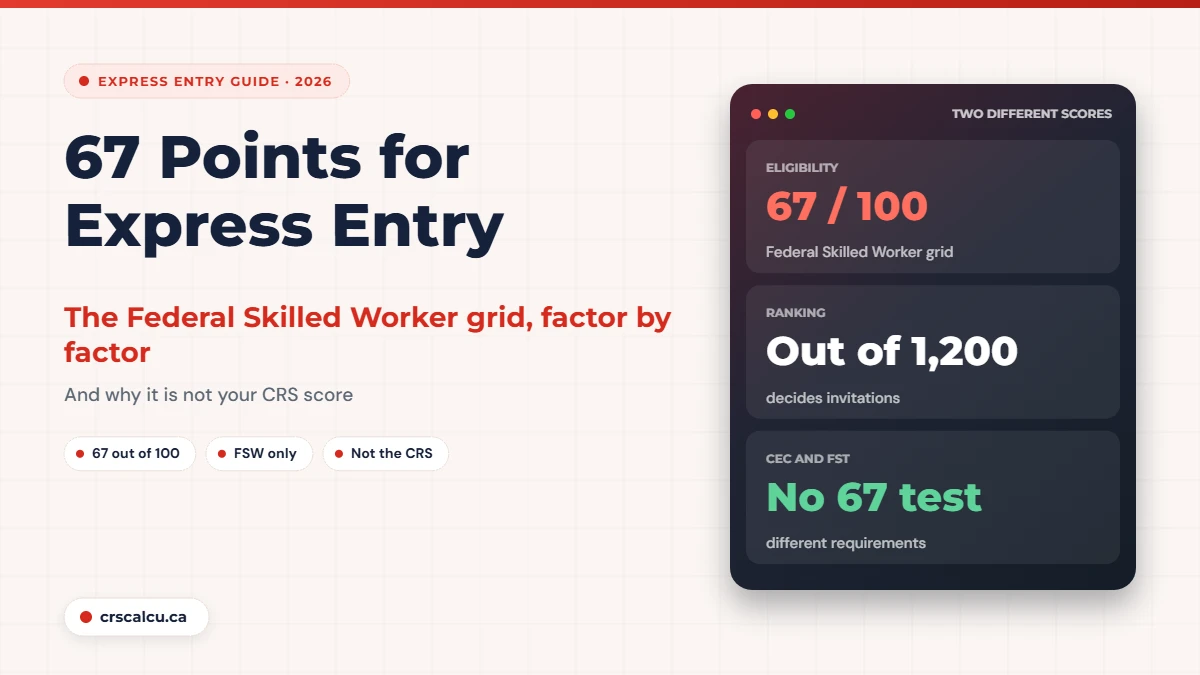
The 67 points for Express Entry are the pass mark of the Federal Skilled Worker Program, the route most people use when they apply from outside Canada. It is a grid of six factors worth 100 points in total. Score 67 or more and you meet that part of the program’s requirements. Score 66 and your profile is not eligible under it.
It is not the number you see quoted when a round of invitations is announced. That is the Comprehensive Ranking System score, a separate calculation out of 1,200 that ranks everyone in the pool. You can have 80 on the first grid and still be far from an invitation. You can also be invited without ever being tested on the first grid, if you qualify through Canadian experience instead.
We read IRCC’s Federal Skilled Worker Program page and the education table on its credential assessment page, and five public forum threads from 2017 to 2023 in which applicants confused the two scores or found themselves a few points short of 67.
Quick answer: what are the 67 points for Express Entry?
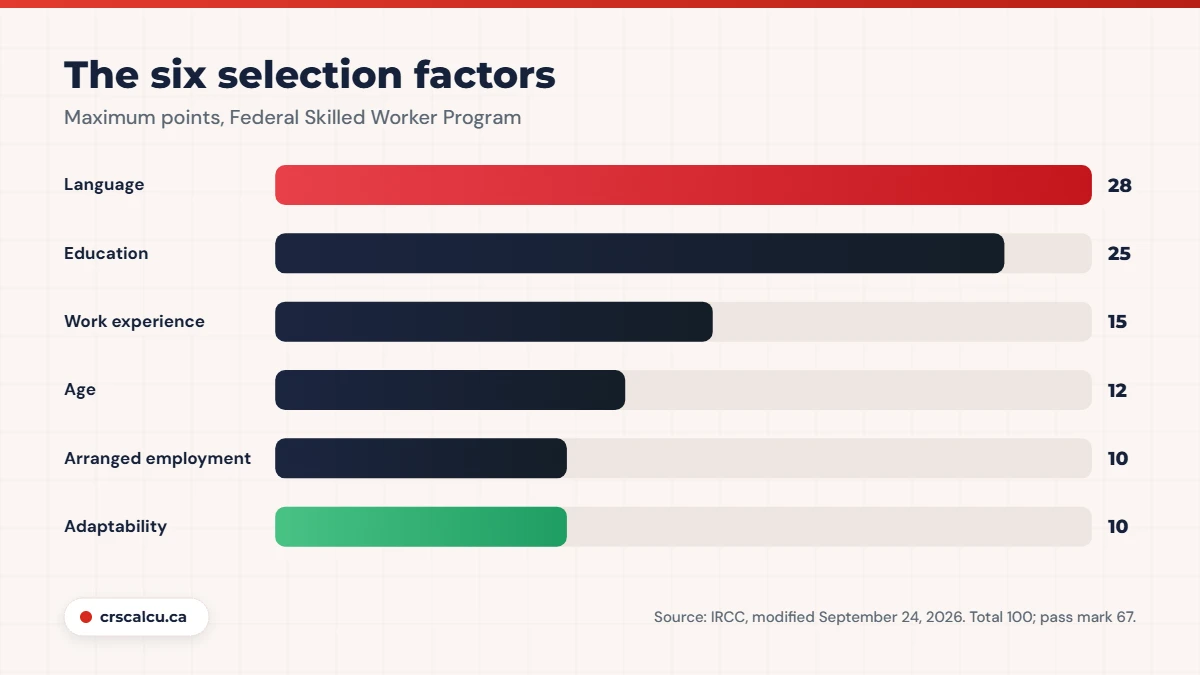
They are the minimum score on the Federal Skilled Worker Program selection factors. IRCC’s page (modified September 24, 2026) lists six factors: language (28), education (25), work experience (15), age (12), arranged employment (10) and adaptability (10), for a maximum of 100, and says that if you score 67 points or higher you may qualify. It applies to that program only, and it is separate from the ranking score that decides invitations. Our FSW points calculator adds it up for you.
Key takeaways
The six factors behind the 67 points
IRCC’s page sets out the grid as follows.
Factor | Maximum points |
|---|---|
Language skills | 28 |
Education | 25 |
Skilled work experience | 15 |
Age | 12 |
Arranged employment in Canada | 10 |
Adaptability | 10 |
Total | 100 |
From IRCC’s “Express Entry: Federal Skilled Worker Program” page (modified September 24, 2026). Pass mark: 67.
The four largest factors are the ones nearly everyone relies on: language, education, experience and age add up to 80. Most applicants reach 67 from those alone, without a job offer.
Language: up to 28 points
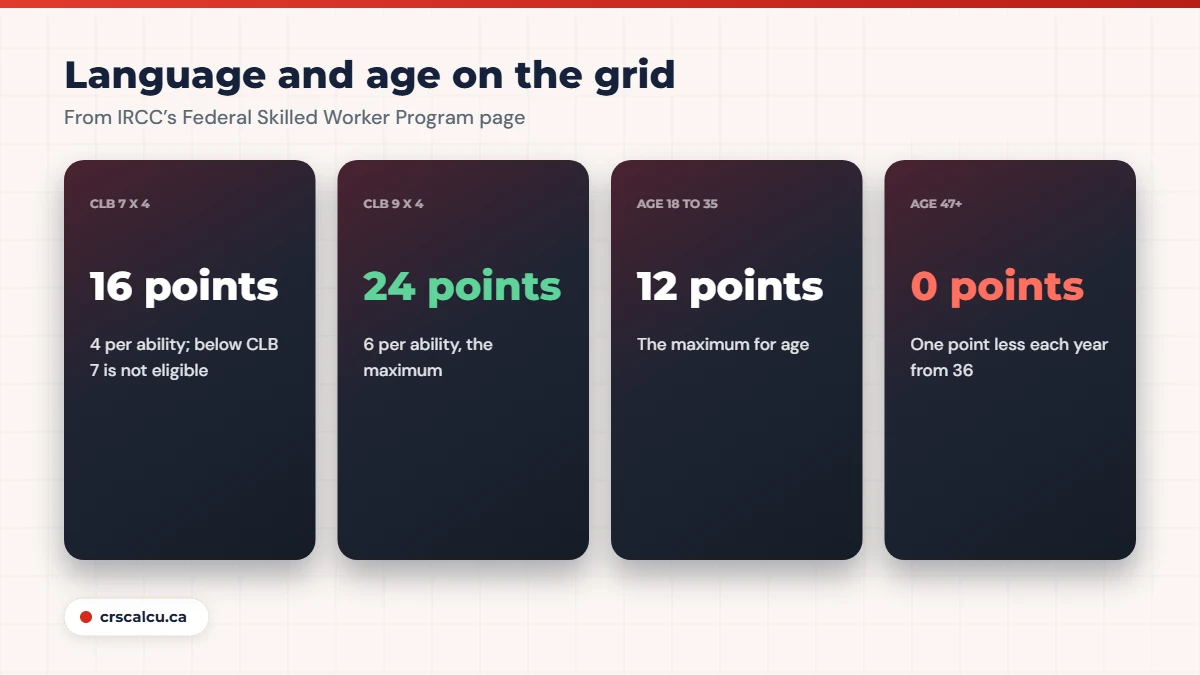
Your first official language is scored per ability.
Level in that ability | Points |
|---|---|
CLB 9 or higher | 6 |
CLB 8 | 5 |
CLB 7 | 4 |
Below CLB 7 | Not eligible to apply |
From the same IRCC page. Four abilities give a maximum of 24. A second official language adds 4 points if you have CLB 5 or higher in all four abilities.
CLB 7 across the board is 16 points. CLB 9 across the board is 24. One ability below CLB 7 does not just cost points; it makes you ineligible for this program. See minimum CLB for Express Entry for the test scores behind each level.
Education: up to 25 points
The education points sit on IRCC’s credential assessment page, in a table for this program. They depend on the Canadian equivalency your report states.
Canadian equivalency | Points |
|---|---|
Doctoral degree | 25 |
Master’s degree | 23 |
Two or more credentials, one of three years or longer | 22 |
Bachelor’s degree or three-year credential | 21 |
Two-year credential | 19 |
Secondary school | 5 |
From IRCC’s “Educational credential assessment” page (modified June 22, 2026). The page also gives a value for a one-year credential.
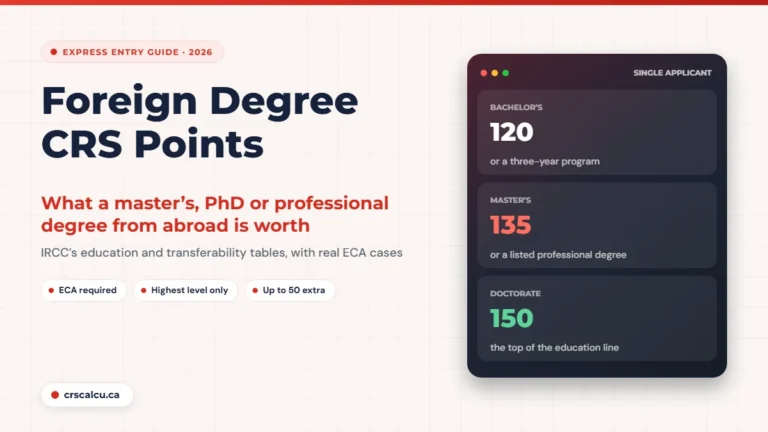
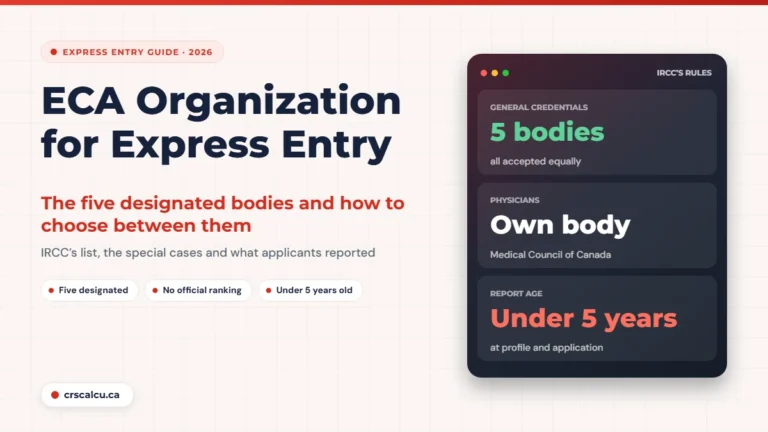
The drop from any post-secondary credential to secondary school is steep, and without a valid assessment a foreign degree is not counted at all. That gap was the whole story in one of the cases below. See ECA organization for Express Entry for who can issue the report.
Work experience and age
Experience | Points | Age | Points |
|---|---|---|---|
1 year | 9 | 18 to 35 | 12 |
2 to 3 years | 11 | 36 | 11 |
4 to 5 years | 13 | 40 | 7 |
6 years or more | 15 | 47 or older | 0 |
From IRCC’s Federal Skilled Worker Program page. Age points fall by one for each year from 36 (11 points) to 46 (1 point).
The experience must be skilled, paid and within the last ten years, and you need at least one continuous year in your primary occupation to be eligible at all: see primary occupation.
Arranged employment and adaptability
Arranged employment is worth 10 points and needs a qualifying job offer of at least one year from a Canadian employer. Most overseas applicants do not have one and do not need it.
Adaptability is a set of smaller items, capped at 10 points in total.
Item | Points |
|---|---|
Your past work in Canada: at least 1 year, full-time, TEER 0 to 3 | 10 |
Your past studies in Canada: at least 2 academic years, full-time | 5 |
Your spouse or partner’s language: CLB 4 or higher in all four abilities | 5 |
Your spouse or partner’s past studies in Canada | 5 |
Your spouse or partner’s past work in Canada: at least 1 year | 5 |
Arranged employment in Canada | 5 |
A relative in Canada who is a citizen or permanent resident, aged 18 or older | 5 |
From IRCC’s Federal Skilled Worker Program page. The relatives listed include a parent, grandparent, child, sibling, aunt, uncle, niece or nephew. Maximum for adaptability: 10.
These are the points that rescue a profile sitting at 62 or 64. A spouse with a basic language result or a sibling in Canada is worth 5. See sibling points for how a sibling also counts in the ranking score.
Two worked examples
These are our own illustrations, added up from the tables above.
Our example A: passes comfortably
Our example B: short, then rescued
Example B also shows the limits of the grid as a guide. Reaching 69 makes that applicant eligible. It says nothing about whether their ranking score is competitive.
One practical warning about both examples. Every point you count has to be proved after an invitation. Education needs the credential assessment, language needs the test report, work needs reference letters that show skilled duties and hours, and a relative in Canada needs proof of the relationship and of their status and residence. If an item cannot be documented, leave it out of your sum now. A profile that clears 67 only on points you cannot prove is not really eligible, and the problem will surface at the application stage, when it costs an invitation instead of a recalculation.
67 points for Express Entry is not your CRS score
Real case: “67 out of 100, or 420 out of 1,200?” (January 2018)
An applicant asked what the difference was between a 67 out of 100 score and a 420 out of 1,200 score. The first reply put it in two lines: 67 is the minimum to qualify to enter, and the other score decides whether you are selected over other candidates in a round. A later reader asked why the first mattered if the second decided everything. The answer: you do not apply to the program separately, you create a profile, and the 67-point test is a filter you must pass before your ranking counts.
Real case: 68 points and no chance (November 2023)
Someone asked whether they could expect an invitation with 68 eligibility points. Members explained that invitations depend on the ranking score. Theirs was 369, at a time when invitations were going to scores around 500, and several replies said plainly that there was no chance at that level. The suggestions were a provincial program, better language results and French.
Real case: over 67, under 400 (May 2017)
An applicant comfortably above 67 found their ranking score was below 400. Members suggested retaking the language test, looking at provincial nomination, and having every post-secondary credential assessed for both partners. One advised creating the profile anyway, since cut-offs move. The poster planned to order assessments for their own and their spouse’s additional credentials.
The two scores even treat the same facts differently.
Real case: second-language rules differ between the two (August 2020)
An applicant had strong English and uneven French: level 9 in reading and listening, level 4 in writing and speaking. They met 67 without French and asked whether the strong French abilities could still earn ranking points. One senior member said the minimum was needed in all four abilities. Another pointed out that the eligibility grid and the ranking score have different rules. A week later the applicant reported the result in their profile: 6 + 6 + 0 + 0 ranking points for the second language.
On the 67-point grid, a second language earns 4 points only with CLB 5 in all four abilities. In the ranking score, each ability is scored separately.
When you do not need 67 points for Express Entry at all
The grid belongs to one program. IRCC’s comparison of the three programs shows that the Canadian Experience Class asks for a year of skilled work in Canada and a language minimum, with no education requirement, and the Federal Skilled Trades Program has its own rules. If you qualify through one of those, the 67 points never come into it. See Canadian Experience Class and Federal Skilled Trades Program.
Real case: 47 points until the degree was counted (September 2017)
An applicant with CLB 8 and a ranking score of 385 was told by the system they were no longer eligible to be in the pool. They assumed a higher language score would fix it. Members explained that a ranking score is not enough; you must qualify for a program. On the six factors the applicant had only 47, because they had given themselves no education points for a foreign bachelor’s degree that had not been assessed. With the degree counted, the total came to 68. The fix was a credential assessment, not a language retake.
Five mistakes people make with the 67 points
Five mistakes from the rules and the threads

Once you are past 67, the work is all on the other score. Enter your profile in the CRS calculator and compare the result with the latest draw cut-offs. If the profile itself was rejected, see not eligible for Express Entry.
Frequently Asked Questions
What are the 67 points for Express Entry?
They are the pass mark on the Federal Skilled Worker Program’s six selection factors: language, education, work experience, age, arranged employment and adaptability, worth 100 points in total. You need 67 or more to qualify under that program.
Is 67 points enough to get an invitation?
No. It makes you eligible under the Federal Skilled Worker Program. Invitations go to the highest-ranked candidates on the separate ranking score out of 1,200.
Do I need 67 points for the Canadian Experience Class?
No. The 67-point grid applies only to the Federal Skilled Worker Program.
How many points do I get for language on this grid?
For your first official language, 4 points per ability at CLB 7, 5 at CLB 8 and 6 at CLB 9 or higher, to a maximum of 24. A second official language adds 4 points with CLB 5 or higher in all four abilities.
How many points do I get for age?
12 points from age 18 to 35, then one point less for each year: 11 at 36, down to 1 at 46 and 0 at 47 or older.
I have 64 points. How can I reach 67?
Look at adaptability first: a spouse with CLB 4 in all abilities, past study or work in Canada, or a qualifying relative in Canada each add 5, to a maximum of 10. Raising one language ability by a level adds 1 point.
Past 67? Now check the score that counts
Eligibility is step one. See how your ranking score compares with recent Express Entry cut-offs.
Final Thoughts
The 67 points for Express Entry are a door, not a ranking. They belong to the Federal Skilled Worker Program, they come from six factors, and most applicants clear them through language, education, experience and age alone. If you are short, the cause is usually an unassessed degree, a language ability under CLB 7, or adaptability points you have not counted.
If you pass only by a point or two, or by relying on a relative or a job offer, check the conditions for those items carefully before you create a profile. A licensed consultant can confirm a borderline case. And once you are through the door, turn your attention to the other score.