Express Entry Guide · Updated October 2026
Express Entry ITA Deadline: The 60 Days, What Happens If You Miss Them and a Week-by-Week Plan (Real Cases)
Sixty days sounds generous until one police certificate is stuck at a local station. Here is what the official pages say about the clock, and how to spend it.

The Express Entry ITA deadline is short on purpose. IRCC’s page on responding to an invitation says it in bold: your invitation to apply is valid for 60 days only. In that time you fill in the full application, collect every document on your personalized checklist, book a medical exam, pay, and press submit.
Most people manage it. The ones who end up on forums at day 55 nearly always have the same problem: one slow document that they started on late. Sometimes it is a police certificate from a country they left years ago. Sometimes it is an employer who takes three weeks to sign a letter. Occasionally it is a credit card on the final evening.
We read IRCC’s pages on invitations, police certificates, missing documents and payments, and four public forum threads from 2015 to 2021 where applicants ran close to the line or over it. The plan further down is ours, not an IRCC rule, and we say so wherever that matters.
Quick answer: how long is the Express Entry ITA deadline and can it be extended?
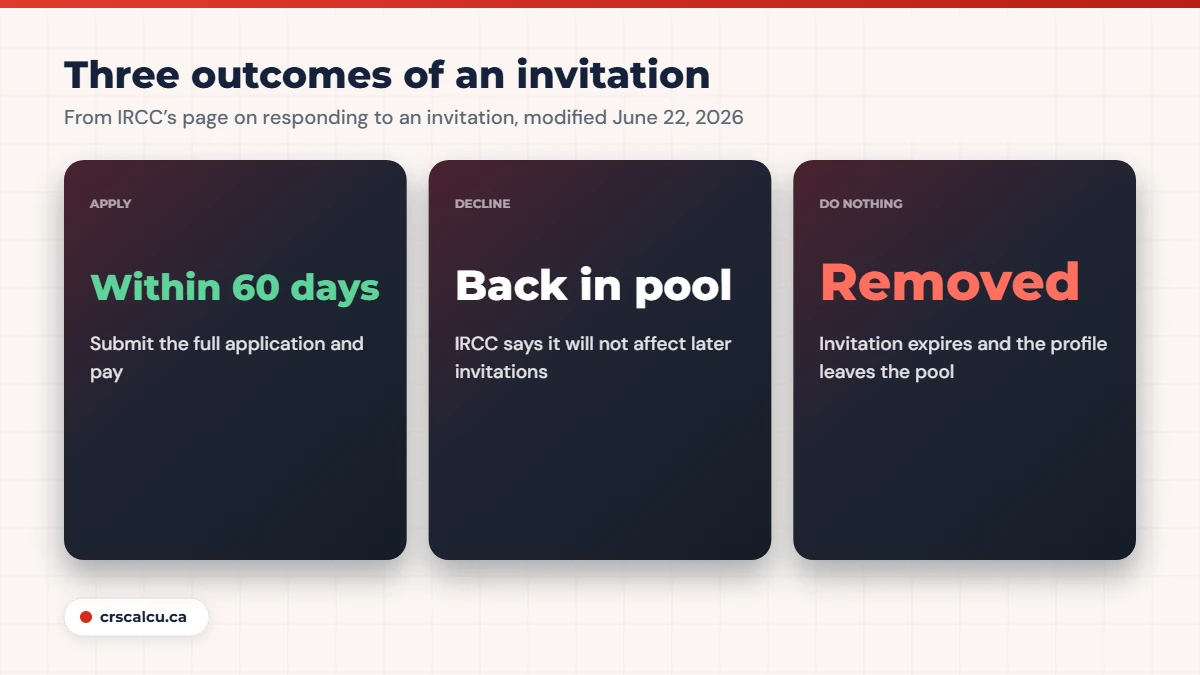
You have 60 days from the invitation. IRCC’s page says that if you do not decline and do not apply within 60 days, the invitation expires and your profile is removed from the pool. We found no IRCC page that offers an extension of the 60 days. If one document will not arrive in time, IRCC accepts a letter of explanation with proof that you tried, at least for police certificates. If the file cannot be completed honestly, declining puts you back in the pool.
Key takeaways
What IRCC says about the 60 days
There are only five or six official sentences about the deadline, and they are worth reading in order because each one closes off a common assumption.
Question | What IRCC says |
|---|---|
How long do I have? | Your invitation to apply is valid for 60 days only |
What if I decline? | You are put back into the Express Entry pool of candidates |
Does declining hurt me later? | It will not affect whether or not you are invited to apply later |
What if I neither decline nor apply? | The invitation expires and your profile is removed from the pool |
How do I get back in after that? | Fill out and submit a new Express Entry profile and meet the eligibility criteria |
What if my situation changed? | Re-calculate your score before applying; if it is below the lowest score in your round, you should decline |
Our summary of “Apply for permanent residence through Express Entry: respond to your invitation” (modified June 22, 2026), read on October 5, 2026.
Notice what is missing. The page has no line about extending the 60 days, and no line about how the days are counted to the hour. We looked for both and did not find them on any IRCC page we read. So plan as if the deadline cannot move and as if it ends earlier than you think.
The line about re-calculating matters more than people expect. A birthday, an expired language test or a change in your job can lower your points between the invitation and the application. Run the numbers again in our CRS calculator and compare them with the cut-off for your round on the latest draws page. If you are now below it, IRCC’s own advice is to decline, and we explain how in declining an ITA.
Which documents eat the 60 days
IRCC’s application page says the system gives you a personalized document checklist once you complete the online form. For most applicants it includes police certificates, proof of funds, and civil documents such as birth and marriage certificates, on top of the documents you used for your profile. The page also tells you to get your medical exam after you are invited. Our Express Entry document checklist goes through each slot.
IRCC does not publish how long each document takes, because that depends on the country, the office and the clinic. What we can say from the threads is which ones people were still waiting for at the end.
The slow four, according to applicants
Real case: everything ready except one police clearance (February 2019)
An applicant invited in mid-December had the whole file ready apart from a police clearance certificate from India. The local station was slow because they had lived at their current address for less than a year, and a visit to a regional office was needed. They asked whether to decline. Replies were split: one said to upload proof of the request and of the delay within the 60 days and not to decline, another said declining only made sense for someone well above the cut-off who could count on another invitation. The poster leaned toward submitting with a letter explaining the delay. No final outcome was reported in the thread.
Our suggested 60-day plan, week by week
This is our plan, built from the official requirements and from where applicants lost time. IRCC does not publish a schedule. Treat the weeks as an order of work, and move faster wherever you can.
When | What to do | Why then |
|---|---|---|
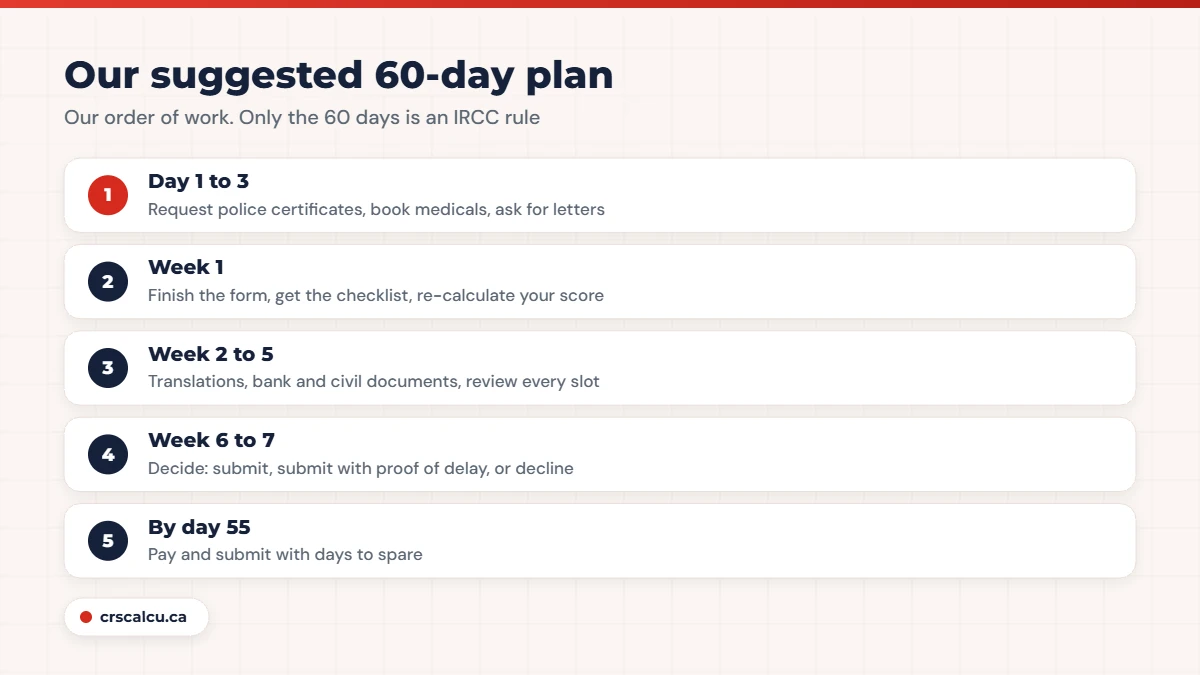
Day 1 to 3 | Request every police certificate, book medical exams, ask employers for letters | These depend on other people and cannot be rushed later |
Week 1 | Fill in the online form so the personalized checklist appears; re-calculate your score | You cannot see your full document list until the form is done |
Week 2 to 3 | Send documents for translation; collect bank letters and civil documents | Translators need originals; banks need notice |
Week 4 to 5 | Review every slot; chase anything outstanding; draft letters of explanation | Leaves time to replace a weak document |
Week 6 to 7 | Decide: submit complete, submit with proof of a delay, or decline | A decision made at day 45 is calmer than one at day 59 |
By day 55 | Pay and submit | A buffer for payment and upload problems |
Our suggested plan, not an IRCC rule. The only fixed number in it is IRCC’s 60 days.
Start the slowest thing before you open the form
The most common regret in the threads is spending the first two weeks on the online form while the police certificate request sat unsent. The form can be finished in a few evenings. A certificate from abroad cannot be hurried at day 50, so request it on day one and keep the receipt.
If a document will not arrive in time
Here the official pages are more helpful than most people realize. IRCC’s Express Entry police certificates page (modified June 22, 2026) says that if a certificate is not available by the deadline, you can upload a letter of explanation together with proof that you made your best effort to get it on time. It lists what counts as proof: a confirmation receipt, a payment receipt, a delivery notice, a tracking number, or an explanation from the issuing agency showing why there is a delay or why the certificate cannot be issued.
The same page carries the warning. If the officer is not satisfied that you made your best effort, the application may be rejected for being incomplete. A separate Help Centre answer on missing documents (modified September 1, 2026) says an application without a required document could be delayed, returned or refused, and that the officer reviewing it decides whether it is complete without the document.
Real case: a spouse’s certificate that needed 60 to 75 days (November 2021)
An inland Canadian Experience Class applicant had everything uploaded except a spouse’s police certificate from Mexico. The request had gone through the Canadian embassy there, which confirmed receipt and quoted 60 to 75 days, longer than the invitation itself. An extension request sent two weeks earlier had brought only a generic reply. A member explained that what mattered was showing the request had reached the embassy in time, since that certificate is sent to IRCC directly, and said their own application had been approved without any explicit confirmation about the certificate. The poster’s final result was not reported.
So the choice near the end is between three paths, and it helps to see them side by side.
Three ways to finish the 60 days
If you submit with a placeholder, expect IRCC to ask for the real document later. We cover how those requests work in additional document request. If the gap is too big to explain, an application rejected as incomplete costs you the invitation anyway, so declining may be the cleaner route.
What happens if you miss the Express Entry ITA deadline
IRCC’s wording is plain. If you do not decline and do not apply within 60 days, the invitation expires and your profile is removed from the pool. To be considered again you fill out and submit a new Express Entry profile and meet the eligibility criteria at that point.
Real case: most of the form filled in, deadline passed (September 2020)
A Canadian Experience Class candidate did not submit in time, although most of the application was already completed. They asked how to get back into the pool. A reply set out what happens when an invitation goes unanswered: it expires, the candidate is no longer in the pool, and a new profile is needed, with the minimum criteria assessed again. No outcome was reported in the thread.
A new profile is scored on the day you create it. If a language test has aged out or a birthday has passed, the new score can be lower than the one that got you invited. That is the real cost of letting an invitation lapse instead of declining it.
Last-day risks: payment, uploads and time zones
The final step is payment, and the system will not let you submit without it. IRCC’s Help Centre lists why online payments are refused: card details that do not match what your bank has on file, a card type that is not supported, 3-D Secure not active, or a billing address entered in the wrong order. Our post on Express Entry fees describes two 2017 cases where a declined card locked the payment screen for one to two hours near the deadline.
Uploads are the other trap. IRCC’s instructions say a file must be less than 4 MB or it will not upload, and that several documents for one slot should be combined into one file. Compressing scans at midnight is not where you want to be.
Real case: paid on the last day, then told the invitation had expired (September 2015)
An applicant submitted and paid with about a day left and received a success message. Shortly afterwards a notice appeared saying the invitation had expired. Members suggested possible causes, including a lag in transmission and a time zone difference between the applicant’s location and the system, and advised calling IRCC instead of waiting on a written enquiry, which could take about a month. No resolution was reported in the thread.
We cannot tell you what time zone the system uses, because IRCC does not say on the pages we read. That uncertainty is the reason our plan ends at day 55.

Before you press submit
Frequently Asked Questions
How many days is the Express Entry ITA deadline?
Sixty. IRCC’s page says your invitation to apply is valid for 60 days only. Within that time you must either submit the application or decline the invitation.
Can IRCC extend the 60 days?
We did not find any IRCC page that offers an extension of the invitation. In one 2021 forum case an applicant who asked for more time received only a generic reply. Plan as if the deadline is fixed.
What happens if I miss the deadline?
IRCC says that if you do not decline and do not apply within 60 days, the invitation expires and your profile is removed from the pool. You need to submit a new profile and meet the eligibility criteria again.
Is it better to decline or to let the invitation expire?
Decline. IRCC says a declined invitation puts you back into the pool and does not affect later invitations. An expired invitation removes your profile, so you start again with a new one.
My police certificate will not arrive in time. What can I do?
IRCC’s police certificates page says you can upload a letter of explanation and proof that you made your best effort to get it on time, such as a payment receipt or tracking number. If the officer is not satisfied, the application may be rejected as incomplete.
Should I submit on the last day?
Avoid it. Payment problems and file size limits are common, and IRCC does not publish the exact hour or time zone at which an invitation ends. In one 2015 case an applicant who paid on the final day was told the invitation had expired.
Invited? Re-check your score before you apply
IRCC tells you to re-calculate if anything has changed since your profile. It takes two minutes and it decides whether to apply or decline.
Final Thoughts
The Express Entry ITA deadline rewards people who start with the slow documents and finish early. Request police certificates and book the medical in the first three days, get the form done in the first week so the checklist appears, and aim to submit by day 55. If one document is late, use the letter and proof route IRCC describes. If the file cannot be made complete, decline and keep your profile.
If your score has dropped since the invitation, if a document may never be issued, or if you are unsure whether a placeholder is enough, speak to a licensed consultant or lawyer before the last week. The decision between submitting and declining is much easier with ten days left than with one.