Express Entry Guide · Updated October 2026
Right of Permanent Residence Fee (RPRF): Who Pays, When to Pay and How Refunds Work (Real Cases)
It is the one Express Entry fee you can choose to pay later, and one you can get back. Here is what IRCC says about the RPRF, and what happened to applicants who paid early, paid late or asked for it back.
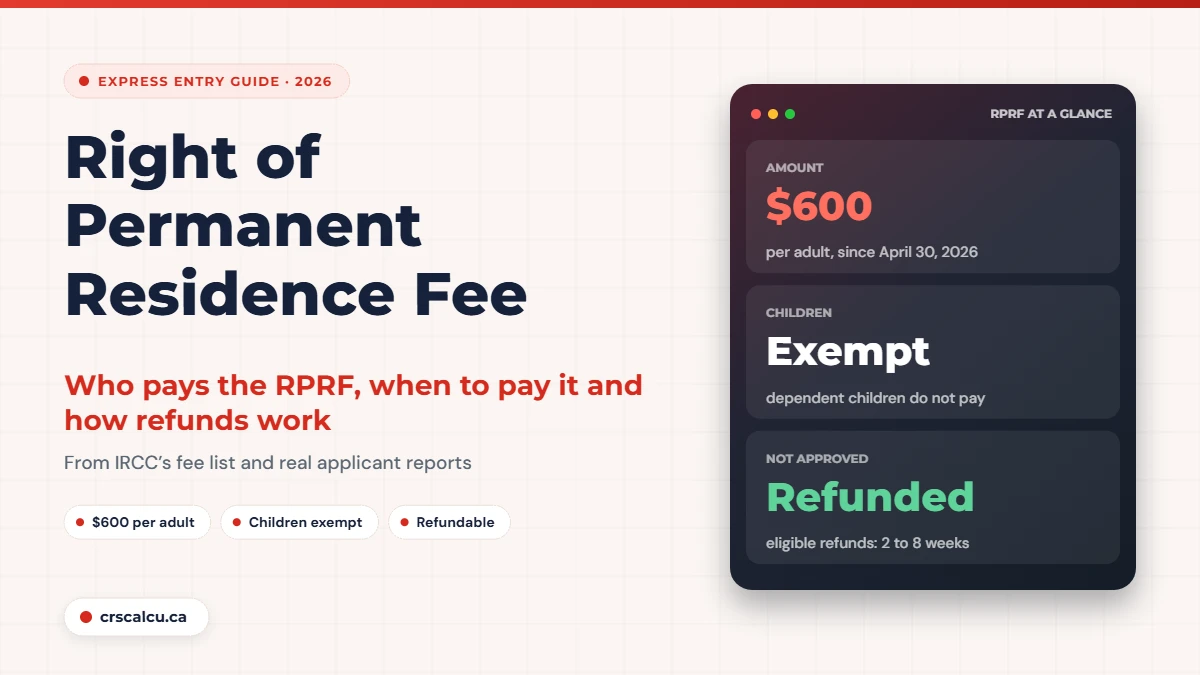
The right of permanent residence fee, usually shortened to RPRF, is the odd one out among Express Entry costs. The processing fee has to be paid the day you submit. The RPRF does not: IRCC lets you pay it with the application or leave it until they ask, and it is one of the few fees that comes back if your application is not approved.
That flexibility is where the questions start. Some people skip it, get an RPRF request months later and wonder if it means approval. Others pay it upfront, see a fee increase, and are not sure whether they owe more. Others withdraw or are refused and want the money back.
We read six IRCC pages on the fee, refunds and fee changes (listed under Sources with their dates) and public forum threads from 2018 to 2025 where applicants described their own RPRF request, late payment, top-up or refund question. Where the official pages stop, we say so.
Quick answer: how much is the RPRF and when do you have to pay it?
IRCC’s fee list shows the right of permanent residence fee at $600 for the principal applicant and $600 for an included spouse or partner. Dependent children do not pay it. You can pay it with your application or later when IRCC asks, but IRCC’s advice is to pay everything at once to avoid delays. If your application is not approved, the RPRF is refunded. For the full cost picture, see our breakdown of Express Entry fees.
Key takeaways
What the right of permanent residence fee is and what it costs
The Help Centre answer “What is the Right of Permanent Residence Fee?” (modified September 1, 2026) says the RPRF “is paid by permanent resident applicants when their applications are approved”. It is the charge for the status itself, separate from the processing fee for assessing your file.
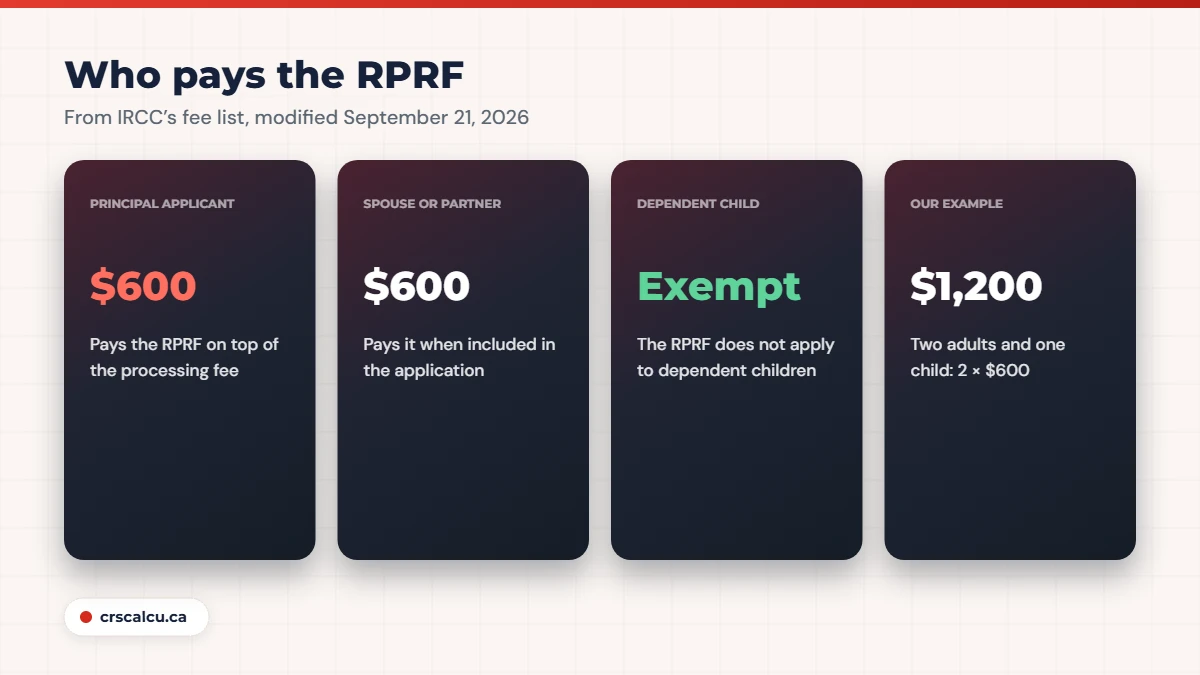
The amount comes from IRCC’s fee list (modified September 21, 2026). Under economic immigration, which includes Express Entry, the list prices an adult two ways: $1,590 with the RPRF and $990 without it. The $600 difference is the RPRF, which also has its own line on the list. The same two prices apply to a spouse or partner you include. A dependent child is $270, with no RPRF on top.
Person | Pays the RPRF? | Amount on the fee list |
|---|---|---|
Principal applicant | Yes | $600 |
Spouse or common-law partner included in the application | Yes | $600 |
Dependent child | No, exempt | $0 |
Our summary of the IRCC fee list (modified September 21, 2026) and the Help Centre answer on the RPRF (modified September 1, 2026), read on October 5, 2026.
Our example, using those figures: a couple applying with one child pays 2 × $600 = $1,200 in RPRF. The child adds nothing. Processing fees, biometrics and outside costs such as the medical exam are separate, and our Express Entry fees post has the full table. Money sent to IRCC also cannot sit in the balance you show as proof of funds, so plan for both.
Who pays the RPRF and who is exempt
The fee list (modified September 21, 2026) gives the exemptions in one sentence. The RPRF does not apply to the dependent children of a principal applicant or sponsor, to sponsorship applications for adopted children or for an orphaned brother, sister, niece, nephew or grandchild, or to protected persons, including applicants eligible on humanitarian and compassionate grounds and convention refugees.
For Express Entry, only the first item matters: your dependent children do not pay. The rest belongs to family sponsorship or refugee streams. The page lists no exemption based on age, income, country or economic program.
The fee list prices the RPRF for a spouse or partner you include. If your spouse is not coming with you, read our guide to a non-accompanying spouse first, because that choice changes much more than one fee.
7 RPRF rules to avoid delays
The seven rules, from the official pages
Pay it upfront or wait for the RPRF request?
IRCC allows both, and says which it prefers. The Help Centre says the RPRF “can be paid at the same time as your application fees to help reduce delays during processing”. The Express Entry page is blunter: avoid delays by paying all of your fees now.
IRCC does not publish how long the delay is if you wait. All we can offer is what applicants reported, and those are individual files.
Real case: asked for the RPRF after paying only the processing fee (February 2018)
An applicant who had paid the processing fee online was asked for the RPRF and believed it was already paid. Replies explained that these are two separate charges and advised paying the RPRF and uploading the receipt through the online account. In the same thread, another applicant paid the RPRF on March 21, 2018 and received an approval letter on April 23, 2018, with one more document request in between. A third was still waiting more than a month after paying.
Does an RPRF request mean you are approved?
The Help Centre says the fee is paid when applications are approved, so many applicants read a request as good news. But IRCC also invites everyone to pay it on day one, and nowhere says a request equals a decision. Treat it as a step, not a result.
Real case: an RPRF request within a month of the acknowledgment (January 2020)
A poster whose application was acknowledged on December 24, 2019 wrote in late January that an RPRF request had arrived, with the medical and biometrics done, and asked what it meant. Members said a request usually shows the file has passed early review and is waiting for a final officer. One warned it is not a guarantee, since more checks can follow. One reply reported a passport request eight days after the RPRF request. Others waited longer, and the original poster did not report a final result.
How to pay the RPRF later if you skipped it
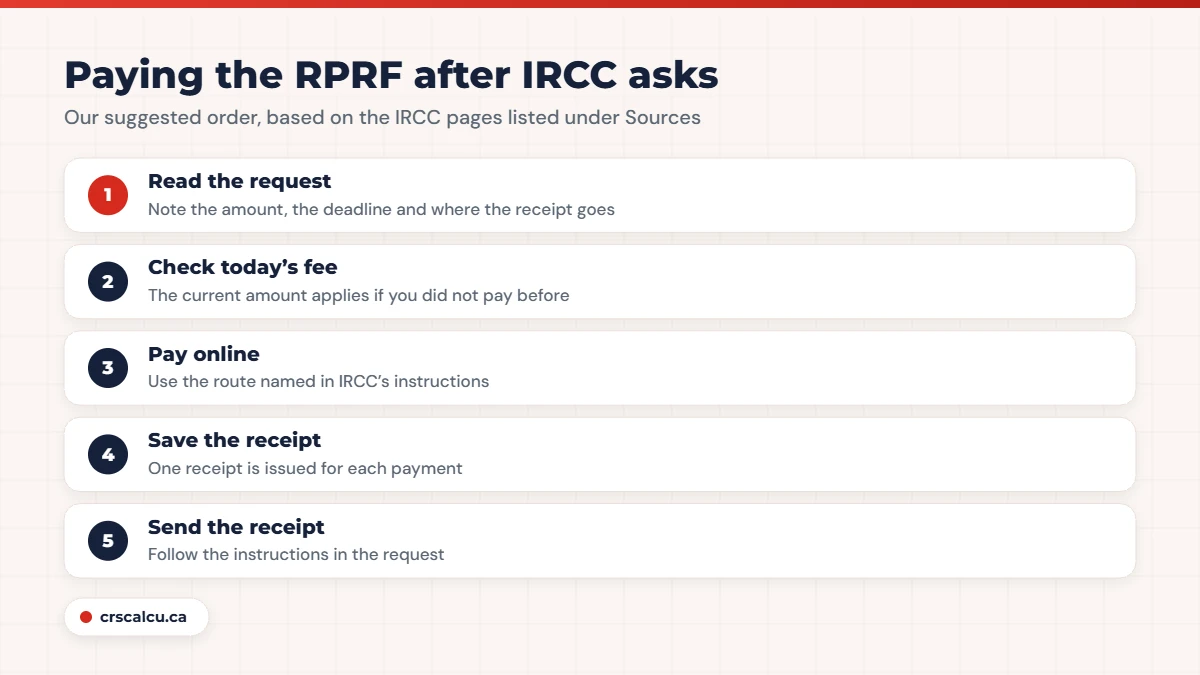
The official description is short. The Express Entry “Pay your fees” page (modified June 22, 2026) says you pay through your IRCC secure account with a debit or credit card, and that you can pay after you apply if you did not pay your RPRF when you applied. The Help Centre adds that IRCC will contact you with instructions.
The fee changes page names a category in the online payment tool called “Make an additional payment or pay other fees”, says you get one receipt for each payment, and for the receipt says only this: follow the instructions in the request IRCC sent you. We could not confirm the screens for a late RPRF payment from a public IRCC page, so the request itself is your instruction sheet.
Real case: no payment link in the account (July 2023)
An Express Entry applicant could not find a payment link in their account. A reply pointed them to IRCC’s online payment tool, choosing permanent residence and the RPRF for an application already submitted, then sending the receipt. The next day the poster reported that the payment and receipt upload had worked and the RPRF item in their account showed a new status. Another member said paying late had cost them about a month and recommended paying upfront.
IRCC’s pages give no number of days for paying after a request. The deadline is whatever your letter says, so pay well inside it and keep the receipt.
What a fee increase does to your RPRF
IRCC’s notice of March 27, 2026 announced that the right of permanent residence fee would go from $575 to $600 on April 30, 2026. It says permanent residence fees are adjusted every two years, and that applications received on or after that date are subject to the new fees. The fee changes page shows the previous step too: $515 to $575 on April 30, 2024.
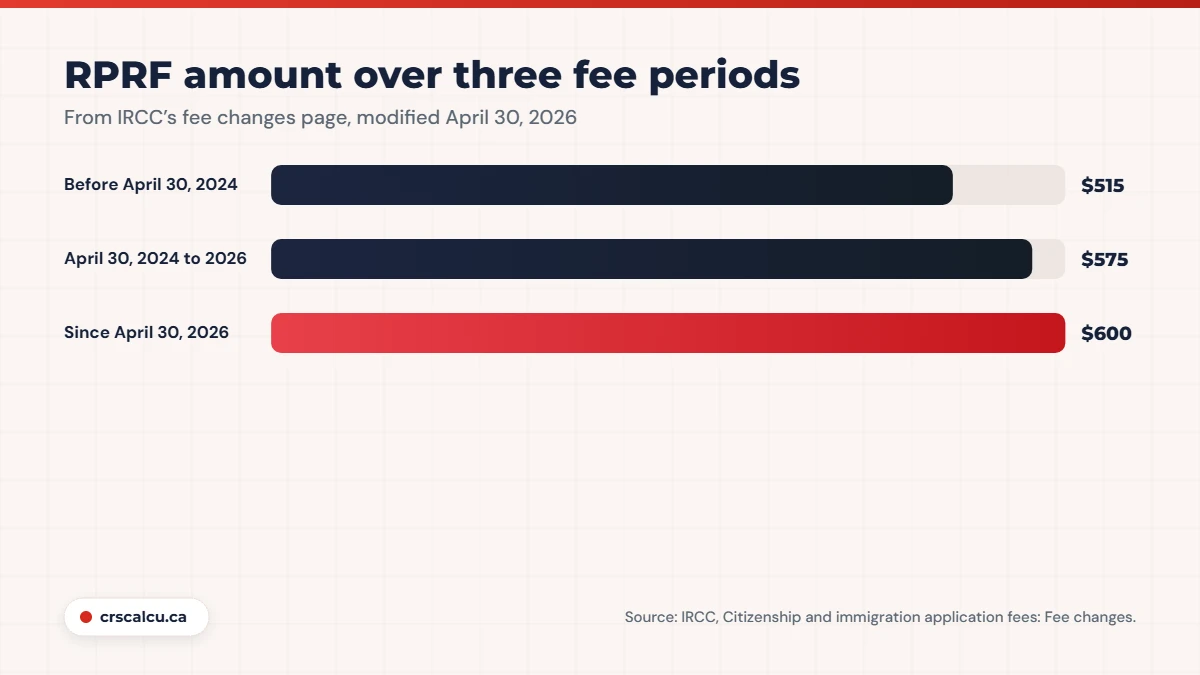
For anyone who delayed the RPRF, the fee changes page (modified April 30, 2026) is clear: if you applied without paying it, you must pay the new amount, even if you paid the processing fee and applied before the change. Our example: an applicant who submitted in March 2026 without the RPRF and pays it today owes $600, not $575. A fee increase is a second reason, after delays, to pay it upfront.
The harder question is what happens if you did pay the RPRF in full and the amount rose afterwards. The page’s “pay the difference” section is written around applications that were in the mail when the fee changed. We found no IRCC rule for an online applicant who paid the full RPRF before an increase, and the two forum reports we read point in different directions.
Real case: paid upfront, then asked for the difference (August 2024)
A poster had paid the RPRF together with their application. After the fee rose, IRCC sent a request on June 7, 2024 for the difference, and they paid it the next day. More than 50 days later they were still waiting and asked whether the request was a good sign. Nobody had replied when we read it. No final outcome was reported in the thread.
Compare that with a July 2022 thread. An Express Entry applicant who paid the RPRF with an August 2021 application noticed at the passport request stage that the listed fee was higher. Replies said no extra payment was needed and the original receipt was enough. The poster did not say whether IRCC ever asked for more.
Our reading: do not send extra money on a guess. If IRCC wants a difference it will say so, and the fee changes page tells you how: calculate the difference, pay it in the online payment tool, and submit the receipt the way the request tells you.
RPRF refund: when you get it back and how to ask
Three official pages cover refunds.
Situation | What IRCC says | Official page |
|---|---|---|
Application is not complete | IRCC tells you and refunds the processing fee and the RPRF, if you paid it | Express Entry: Pay your fees |
You withdraw before processing starts | Full refund | Ask for a refund |
Refused or withdrawn after processing starts | The RPRF is one of the few fees still refundable; the processing fee is not | Ask for a refund |
Paid upfront, application not approved | The RPRF will be refunded | Help Centre: What is the RPRF? |
Approved, but you never became a permanent resident | Not addressed on the pages we read | None found |
Our summary of the Express Entry “Pay your fees” page (modified June 22, 2026), “Ask for a refund” (modified November 15, 2024) and the Help Centre answer on the RPRF (modified September 1, 2026).
The processing fee is different. The Express Entry page says IRCC will not refund it once processing starts. If you have not applied yet, no fees are involved, and declining an ITA is a separate decision.
How to request an RPRF refund (from IRCC’s “Ask for a refund” page)
Two gaps. The Help Centre says the RPRF “will be refunded” when an application is not approved, but not whether that happens without a request. And the refund page does not say which route applies to fees paid inside an Express Entry account. If the payment is not under “My receipts”, the web form is the other route it gives.
Real case: visa issued, not used, refund unclear (March 2023)
In a family sponsorship file, not Express Entry, a sponsor had paid the RPRF and the relative had received the confirmation documents but had not landed in Canada. The sponsor asked whether withdrawing would bring the RPRF back. Replies disagreed: one member thought yes because the person never landed, another thought no because the application was finalized. No final outcome was reported in the thread.
That case sits in the gap in the table: the official pages do not describe an approved applicant who never lands. If that is you, ask IRCC in writing.
Mistakes that cost time or money
Six RPRF mistakes to avoid
None of this changes your points. The RPRF only matters once you have an invitation, so if you are still in the pool, the useful work is to calculate your CRS score and compare it with the latest draw cut-offs.
Frequently Asked Questions
How much is the right of permanent residence fee in 2026?
IRCC’s fee list (modified September 21, 2026) shows $600. It rose from $575 on April 30, 2026. The principal applicant pays it, and so does an included spouse or partner.
Do dependent children pay the RPRF?
No. The fee list says the RPRF does not apply to the dependent children of a principal applicant. A child still has a processing fee of $270.
Is it better to pay the RPRF upfront or when IRCC asks?
Both are allowed. IRCC’s Express Entry page says to avoid delays by paying all of your fees at once, including the RPRF. If you wait, IRCC contacts you with instructions, and you pay whatever the fee is on that day.
Does an RPRF request mean my application is approved?
IRCC does not say so. A request is not a decision letter. In the threads we read, one applicant got a passport request within days of an RPRF request and others waited weeks or longer.
The fee went up after I applied. Do I owe the new amount?
If you applied without paying the RPRF, yes. The fee changes page (modified April 30, 2026) says you must pay the new amount. If you had already paid the RPRF in full, we found no published rule. Wait for IRCC to ask before sending more.
How do I get an RPRF refund if my application is refused or withdrawn?
The RPRF stays refundable after processing starts. IRCC’s refund page says to sign in to the payment service account, open “My receipts” and select “Request a refund”, or to use the web form if you paid another way. Eligible refunds can take 2 to 8 weeks.
Fees are the easy part. Is your score high enough?
The RPRF only comes up after an invitation. Check your points and compare them with recent rounds.
Final Thoughts
The right of permanent residence fee is simple once you separate it from the processing fee: $600 per adult, nothing for children, payable now or later, and refundable if you are not approved. In the threads we read, the advice repeated most often was to pay it with the application and keep the receipt.
If your case is unusual, for example a refund after a visa was issued but not used, or a request for a fee difference you think you do not owe, speak to a licensed immigration consultant or lawyer before you act.