Express Entry Guide · Updated September 2026
Proof of Funds for Express Entry: Gift Deeds, EPF, Gold and Real Cases
How much money you need, what IRCC accepts, and what real applicants did with gift deeds, fixed deposits, EPF and a spouse’s account.
You finally got your ITA. Then you open the document list and see “proof of funds.” Suddenly you have a hundred questions. Can my dad send me the money? Does my EPF count? What about the gold my parents bought 20 years ago?
You are not the only one asking. On one large immigration forum, two gift deed threads alone have more than 400,000 views. We read those threads plus dozens of newer ones from 2025 and 2026. This guide on proof of funds for Express Entry is built from what real applicants did, what worked, and what got them into trouble.
Every rule below is checked against IRCC’s official page. Where something is just forum experience, we say so clearly.
Quick answer: how much proof of funds do you need for Express Entry?
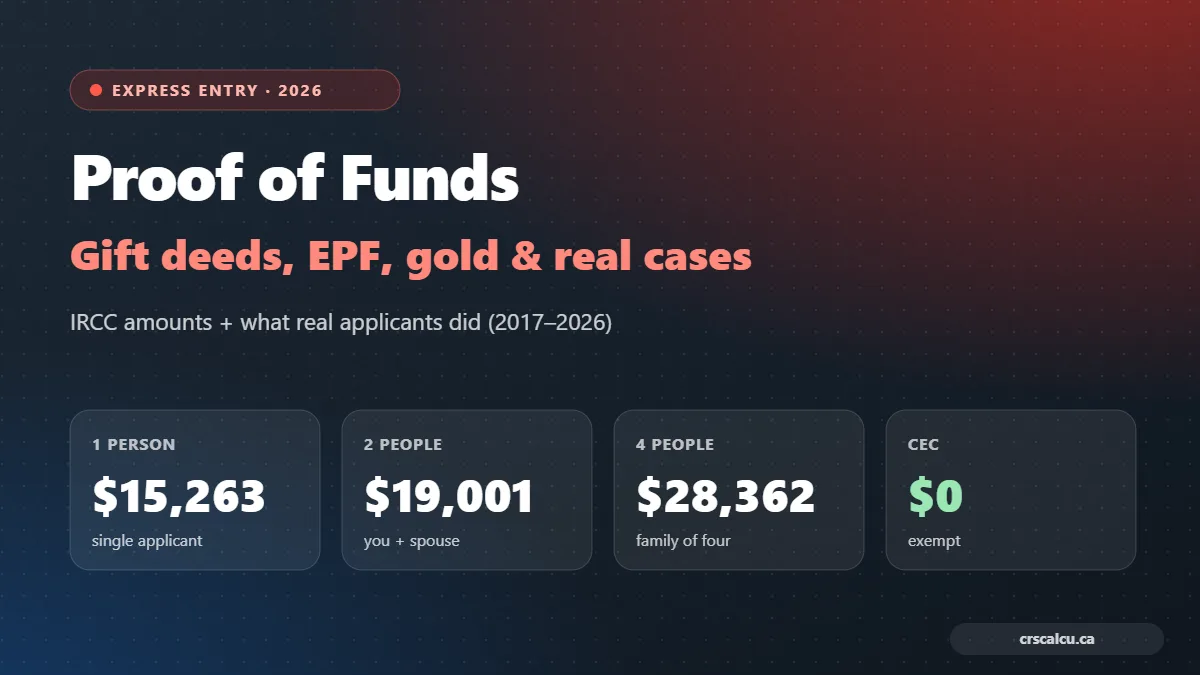
IRCC currently lists $15,263 for one person, $19,001 for two, and $28,362 for a family of four. The money must be yours, not borrowed, and easy to use. You do not need proof of funds if you were invited under the Canadian Experience Class, or if you are authorized to work in Canada and have a valid job offer.
Key takeaways
What Is Proof of Funds for Express Entry?
Proof of funds (often called POF) shows IRCC that you can support yourself and your family for the first months in Canada. It is sometimes called “settlement funds.” You do not pay this money to anyone. It stays in your account, and you use it after you land.
Many people mix this up with application fees. They are different. The PR fees (about $1,590 per adult) are paid to IRCC. Proof of funds is your own money that you keep. You need both, so plan your budget with that in mind.
One member put it simply in 2026: IRCC mainly wants to know that the money is really yours and not a loan. Most of the questions in this guide come back to that one idea.
How Much Proof of Funds Do You Need in 2026?
The amount depends on your family size, not on where you live now. Count yourself, your spouse or partner, and your dependent children, even if some of them are not coming with you.
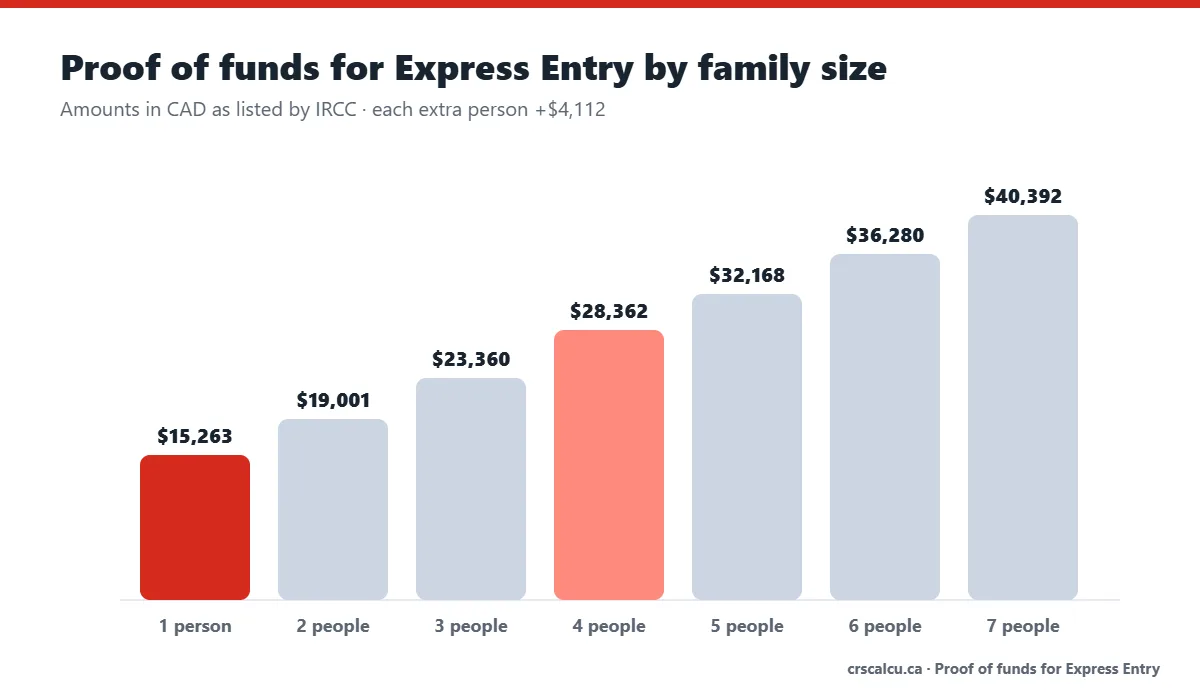
Family members | Funds required (CAD) |
|---|---|
1 | $15,263 |
2 | $19,001 |
3 | $23,360 |
4 | $28,362 |
5 | $32,168 |
6 | $36,280 |
7 | $40,392 |
Each extra person | +$4,112 |
Amounts as listed on IRCC’s proof of funds page (last modified June 2026). IRCC usually updates them once a year, so check before you apply.
Keep a little more than the minimum. Exchange rates move. One member warned others to keep extra savings to cover currency swings, because the officer checks the value in Canadian dollars on the day they review your file.
When do you need to have the money?
You need the funds when you create your profile, when you submit your application, and until you receive your PR visa. A 2025 reply summed it up: have the money when you get the ITA and when you apply, and keep it while IRCC processes your file.
Who Needs Proof of Funds and Who Is Exempt?
This is the question that cost one applicant a lot of stress and $5,000 in agency fees. Read it carefully.
Your situation | Proof of funds needed? |
|---|---|
Invited under Canadian Experience Class (CEC) | No |
Federal Skilled Worker (FSW) with no job offer | Yes |
Federal Skilled Trades (FST) with no job offer | Yes |
FSW or FST, authorized to work in Canada with a valid job offer | No |
PNP nominee invited under FSW | Usually yes |
French or category draw, invited under FSW | Yes |
The program on your ITA decides this, not the draw name.
Real case: “My agency said I was exempt”
In 2025, an applicant working in Canada on an open work permit was invited under FSW. Her agency told her she did not need proof of funds because she had a job. A month after she applied, IRCC asked for proof of funds anyway. Other members pointed out the problem: the job offer exemption needs a work permit tied to that employer, and hers was not. She had spent most of her savings on the agency and could not show the funds.
Her backup plan is a good lesson. Once she passed 12 months of Canadian work, she became eligible for CEC and made a new profile. If you are close to 12 months of Canadian experience, waiting for a CEC invitation can remove the proof of funds problem completely. Learn more in our Canadian Experience Class guide.
What counts as a valid job offer for the exemption?
IRCC says the job must be with one employer, full time, paid, and continuous. You must also be working for the employer named on your work permit. A PGWP or other open work permit usually does not meet this, because it is not tied to one employer.
What IRCC Accepts as Proof of Funds
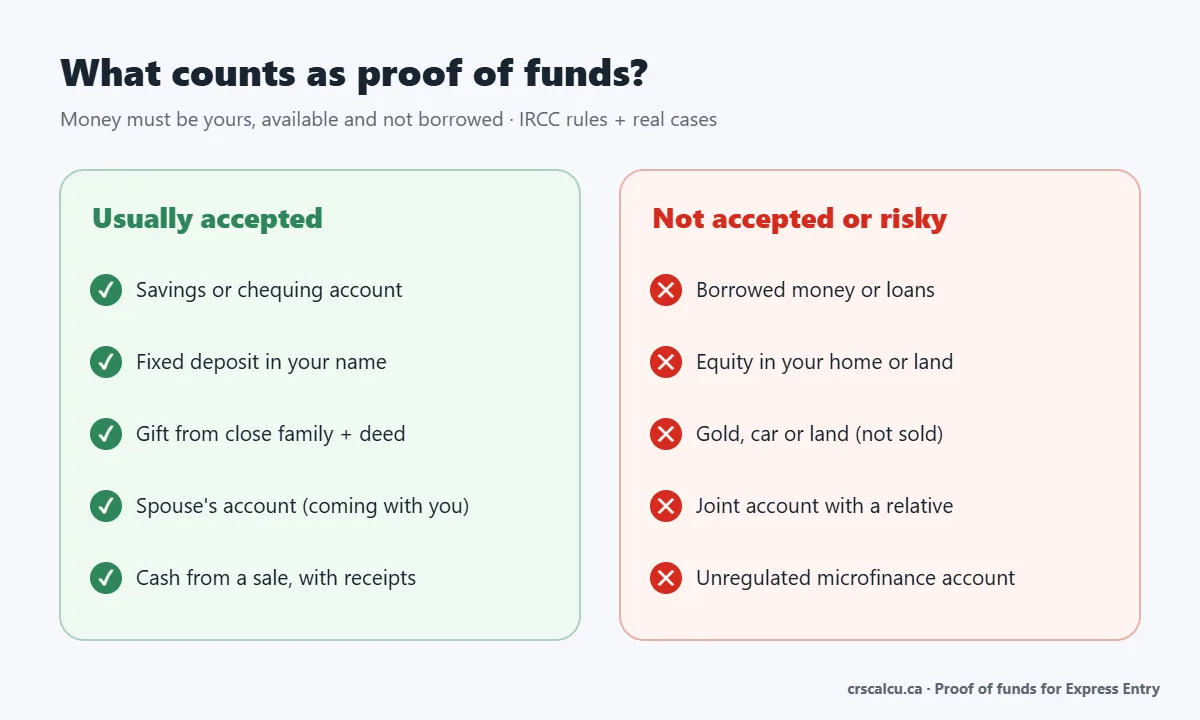
IRCC is clear on the basics. The money must be available to you, easy to transfer, and not tied to a debt. Here is how the common options compare, based on IRCC’s rules and what real applicants reported.
Type of money | Accepted? | What real applicants said |
|---|---|---|
Savings or chequing account | Yes | The standard option. Get an official bank letter. |
Fixed deposit (FD) | Usually yes | Many members used FDs, often for gifted money. |
Gift from close family | Yes | Needs a gift deed and a clear money trail. |
Spouse’s account (spouse coming with you) | Yes | Show that you have access to the money. |
EPF / provident fund | Sometimes | Used for 40–60% of funds with an official letter. |
Stocks, RRSP, TFSA, FHSA | Risky | Members advised cashing out and showing the trail. |
Gold, car, land | Not as-is | Sell first, deposit the cash, keep the receipts. |
Borrowed money or loans | No | IRCC does not allow borrowed funds. |
Equity in property | No | IRCC says home equity cannot be used. |
Based on IRCC’s proof of funds page and forum reports from 2017–2026.
What the Bank Letter Must Show
IRCC asks for an official letter from each bank where you have an account. It must be on the bank’s letterhead and include the bank’s address, phone number and email, your name, your debts, and for each account: the account number, the date it was opened, the current balance, and the average balance for the past 6 months.
Bank letter checklist
What if my bank will not write a letter?
This happens more than you think. In 2025, one applicant said TD Bank told them it does not issue these letters, but gave them IRCC’s list of requirements instead. Another member in 2017 said their bank refused too, so they uploaded 6 months of statements and wrote a letter of explanation disclosing an old credit card debt.
In 2025, someone with a Scotiabank letter that did not show the 6-month average was advised to attach 6 months of statements as well. Another reply noted that many banks can email the letter now, so you may not need to visit a branch.
Does the account need to be 6 months old?
Not always. In 2025, an applicant from Iran had a US dollar account that was only 5 and a half months old at submission time. The reply was that the 6-month history is not a hard rule. What matters is proving the money is yours, not borrowed, and that you can use it when you arrive.
A new account with a clear source of money is fine. A sudden deposit with no explanation is what raises questions. That is why proof of funds for Express Entry is really about the paper trail, not only the balance.
Gift Deed for Proof of Funds: How It Really Works
The gift deed is the most searched part of proof of funds for Express Entry. It is a signed document where a family member states that they are giving you money as a gift, with no need to pay it back.
Real applicants used gift deeds for part or all of their funds. In 2020, one member said 90% of their funds came from a sister and the file was moving fine. Another said the whole amount came from their parents. We found no IRCC rule that limits the gift to 50% of your funds, even though some blogs claim it.
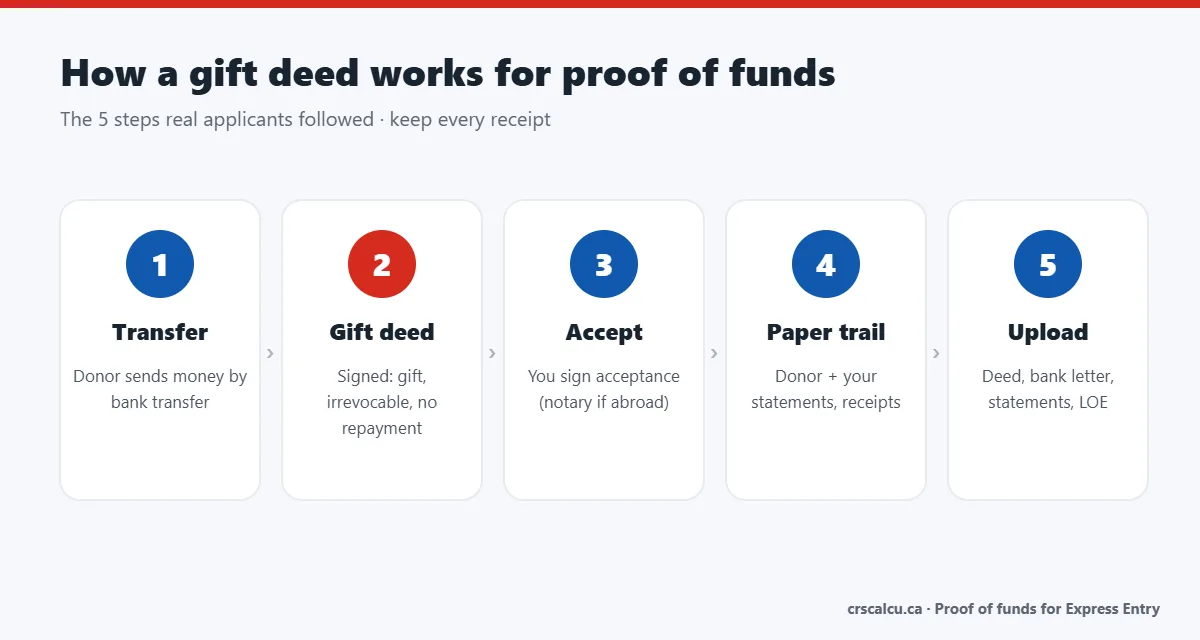
How members did a gift deed, step by step
Real case: a brother’s gift that worked
In 2026, a member said they gifted money to their brother and his application went through. They gave a gift deed made by a lawyer or notary, bank transfer receipts, a donor affidavit saying the money was legally obtained, and a letter of explanation. Their tip: the wording of the gift deed matters a lot.
Can I get the gift after my ITA?
Yes. A 2017 reply said it clearly: receiving a gift after the ITA is fine and is not misrepresentation. Just make sure the money is in your account before you submit, and keep it there. In 2026, another member was reminded that officers can ask for updated statements later, so the gift must be real.
Do I need to prove where the donor got the money?
Members disagree here. In 2026, two replies said you do not need to show the donor’s source of income upfront. Another member advised keeping the donor’s bank trail anyway, in case an officer asks. The safest path is to keep those papers ready even if you do not upload them.
Gift deed in another country or currency
In 2025, a member from Uzbekistan asked if the deed could be in soums while the transfer was in dollars. The reply: local currency is normal, just get the deed translated. In 2023, a member living in Canada whose father was in India was told they could sign the acceptance later, where they live.
How to Enter Proof of Funds in Your Express Entry Profile
There are two places where proof of funds for Express Entry shows up. First, in your online profile, you type the amount of money you will bring to Canada. Second, after your ITA, you upload the documents that prove it.
Enter an amount you can actually prove on the day you apply. Do not guess high. If the number in your profile is above the minimum but your documents show less, the officer will see the gap.
What to upload after your ITA
Do PNP applicants need proof of funds?
A provincial nomination adds 600 points, but it does not remove proof of funds. What matters is the federal program on your ITA. If a nominee is invited under FSW, they still need funds unless they meet the job offer exemption. Some provinces also check funds during their own process. A 2021 member noted that Manitoba’s checklist asked for proof of funds before the nomination.
Can You Use Your Spouse’s Money?
Yes, if your spouse or partner is coming with you. IRCC says you can count money in a joint account, and you may count money in your spouse’s own account if you show you have access to it.
In 2026, a principal applicant under a French draw had all the funds (about $40,000) in his wife’s account. He was told this works, with a letter showing he has access. He then asked if his own loan would be subtracted. The reply: it might, depending on the loan. That is why you should still disclose your own accounts and debts.
Real warning: joint account with a relative
In 2025, an applicant’s husband had a joint account with his aunt, because he could not open one alone. Replies were firm: it is about whose account it is and who has access, not whose money it really is. A joint account with a relative who is not coming to Canada adds risk. Move the money to your own or your spouse’s account.
EPF, Fixed Deposits, Gold and Investments
Can EPF be used as proof of funds?
Sometimes, and only partly. In 2019, one member said they got PR using an India EPFO statement for about 60% of their funds, with a letter from the PF commissioner saying the money was theirs and had no lien. Another said 40% of her funds came from EPF and she got her passport request.
In 2021, a member from Sri Lanka was told to show most of the money in cash and use EPF only as extra. The pattern is clear: EPF helped when people had an official letter showing the amount they could withdraw, and when cash covered the rest.
Is a fixed deposit (FD) better than savings?
Many Indian applicants moved gifted money into an FD and uploaded the FD statement right away. They believed this avoided the 6-month average question. That is forum practice, not an IRCC rule. An FD is fine if the bank letter lists it, but the officer will still see a new, large deposit, so you still need the gift deed and trail.
Can I use gold or sell my car?
Not directly. In September 2026, someone asked about using gold their parents bought in 2001. The answer: proof of funds is cash in the bank, not gold. Sell it, deposit the money, and keep the sale receipt and the bank record. In 2017, a member selling a car was told to ask for a cheque instead of cash, so there is a paper trail.
Stocks, RRSP, TFSA and FHSA
Replies in 2025 said RRSP and FHSA money is not ideal because it is not easy to access. Investment statements were questioned unless they show money you can use right away. If most of your savings are invested, cash out enough and keep the records.
Large Deposits and Money Transfers: What to Explain
A big deposit is not a problem by itself. An unexplained big deposit is. In 2023, a member who moved money between their own savings and chequing accounts was advised to add a short letter of explanation. In 2025, another applicant with $200,000 in movements between their own accounts worried about the same thing.
In late 2025, an FSW applicant whose balance dipped below the minimum for a while, because of investments, asked if that was a problem. They were told not to overthink it, since the funds were back above the minimum. Still, the safest plan is to keep the minimum untouched from ITA until landing.
Deposits that need a letter of explanation
Real Refusals and Problems to Learn From
Real case: refused because of a microfinance bank
In 2026, an applicant’s file passed the completeness check but was refused about seven weeks later. The reason: the funds were in a local microfinance institution that IRCC did not accept as a valid financial institution. After the refusal, the applicant moved the money to a major commercial bank and asked for reconsideration. A reply explained that reconsideration is up to the officer and usually works only when the officer made a mistake with the documents already on file.
The lesson: keep your proof of funds for Express Entry in a regular, licensed bank. If your money is in a microfinance account, credit union or mobile wallet, move it well before you apply.
Spending the money before landing
In 2026, an FSW applicant with a COPR had an emergency and spent part of the funds just before her flight. Members said most people are not asked at the airport, but if you are, it can cause serious trouble. One 2025 reply listed the risks: being sent back, being asked to prove funds later, or even having the application cancelled.
Showing Proof of Funds When You Land
Many people forget this step. When you land as a new PR, a border officer can ask to see your funds. Most members said they were never asked, but they carried proof anyway.
What to carry when you land
One more tip from 2025: if you move a large amount out of an Indian bank account, you may pay tax at the source (TCS). Plan the transfer timing with that in mind.
Common Proof of Funds Mistakes
Mistakes real applicants made
Most of these mistakes come from one thing: not knowing which program you were invited under. Check your ITA. If it says CEC, you can skip proof of funds. If it says FSW, prepare it early. See our latest Express Entry draws to understand which programs are being invited.
Frequently Asked Questions
How much proof of funds do I need for Express Entry?
IRCC currently lists $15,263 for one person, $19,001 for two, $23,360 for three and $28,362 for four. Each extra family member adds $4,112. Check IRCC’s page before you apply, as amounts are updated.
Do CEC applicants need proof of funds?
No. If you were invited under the Canadian Experience Class, you do not need to show proof of funds. You still need to upload a short letter explaining the exemption if the system asks for a document.
Can I use a gift from my parents as proof of funds?
Yes. Gifts from close family are accepted when you have a gift deed, a bank transfer record and the money in your account. The money must be a real gift, not a loan.
Can I get a gift deed after my ITA?
Yes. Forum members confirmed that receiving a gift after the ITA is fine. Make sure the money is in your account before you submit your application.
Can I use my spouse’s bank account?
Yes, if your spouse is coming with you. Show that you have access to the money, for example with a signed letter from your spouse. Joint accounts with your spouse also count.
Can EPF be used as proof of funds?
Some applicants used EPF for 40 to 60 percent of their funds with an official letter showing the withdrawable amount. Most were advised to show the rest as cash in a bank account.
Does my money need to be in the bank for 6 months?
IRCC asks for the 6-month average balance in the bank letter, but a newer account is not automatically refused. You must show where the money came from and that it is not borrowed.
Can I use property or gold as proof of funds?
No, not directly. IRCC does not accept home equity. You can sell gold, a car or property, deposit the money and show the sale papers.
Do I need proof of funds for a PNP?
If you were invited through Express Entry under the Federal Skilled Worker Program, you usually do. Provinces can also ask for proof of funds in their own process.
Will I be asked for proof of funds at the airport?
Possibly. Most members were not asked, but a border officer can ask. Carry an updated bank statement or letter when you land.
Not sure which program you qualify for?
Check your CRS score and see if you could be invited under CEC, where no proof of funds is needed.
Final Thoughts
Proof of funds for Express Entry is not about being rich. It is about showing clean, honest money that is really yours. The applicants who had no problems were the ones with a clear paper trail and a simple story.
Start preparing before your ITA. Pick one bank, keep the money there, collect your gift deed papers early, and ask your bank for the letter as soon as you are invited.