Express Entry Guide · Updated October 2026
You are a civil engineer, a cybersecurity specialist, or an engineering technologist — and the STEM category draw you have been waiting for has not happened all year.
By Aria Sterling · Checked against IRCC rules · 13 min read
A STEM category draw Express Entry round is supposed to be the fast lane for science, technology, engineering and mathematics workers: IRCC filters the pool to one occupation list, then invites by rank inside that smaller group. In 2026, though, the lane has stayed empty. No STEM category draw had been held in 2026 as of October 16, 2026, even though STEM was renewed as one of the ten 2026 categories.
This post explains who qualifies, which occupations actually count after the 2025 list shake-up, what the new 12-month experience rule means, and what to do while you wait — because waiting badly is how good candidates lose a year.
Evidence and sources: This post is based on IRCC’s category-based selection announcements and the 2026 category list, plus the site’s own category draws page, which tracks rounds actually held. Occupation lists are quoted from the February 2025 STEM update and the 2026 renewal; always re-check the current list on canada.ca. This is general information, not legal advice.
Quick answer
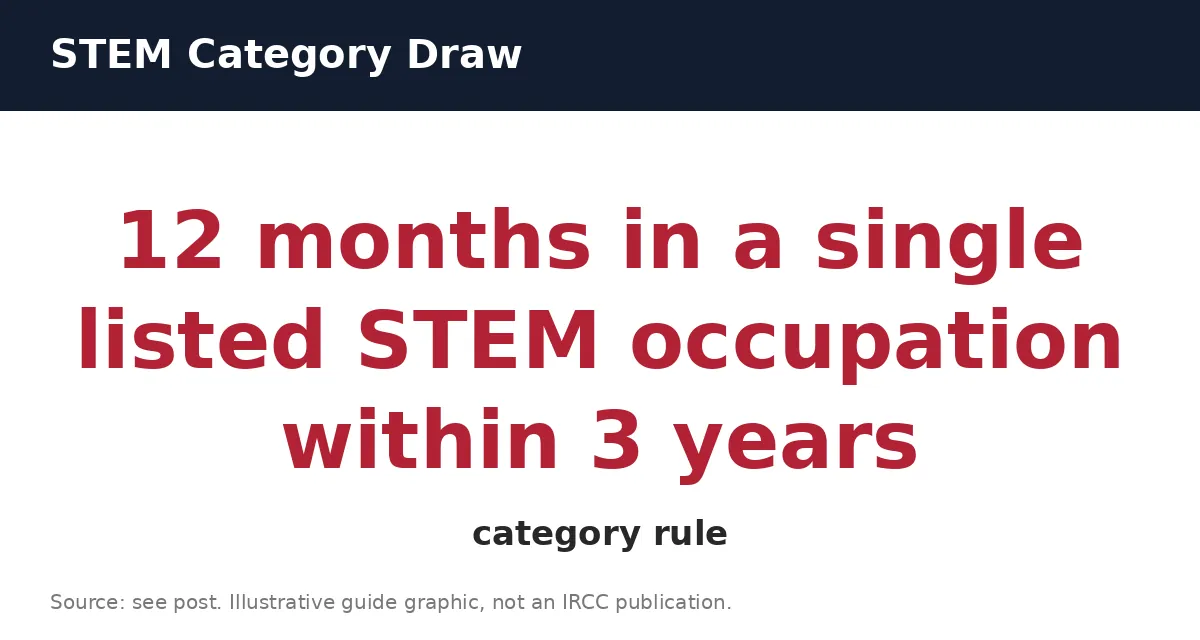
To qualify for a STEM category draw, you need at least 12 months of full-time work experience (or the part-time equivalent) in a single listed STEM occupation within the last three years, gained in Canada or abroad, and you must also qualify under the Federal Skilled Worker Program, the Canadian Experience Class, or the Federal Skilled Trades Program. The 2026 STEM list is much narrower than the original one: software developers, software engineers, data scientists, web developers and designers, and computer systems managers were removed in 2025, while engineering technologists, geological and mechanical engineers, and insurance agents and brokers were added. No STEM category draw had been held in 2026 as of October 16, 2026 — so your strategy has to cover both a future STEM round and the general and provincial routes that are actually running now.
Key takeaways
How a STEM category draw works
A category draw filters first and ranks second. IRCC takes everyone in the Express Entry pool, keeps only the candidates whose profile shows qualifying experience in a listed STEM occupation, and then invites the highest-ranked candidates inside that smaller group. That is why category rounds can invite people with scores well below the general cutoff: the competition is the STEM list, not the whole pool.
There is no separate STEM application. You enter the Express Entry pool normally, your profile records your work history with NOC codes, and IRCC’s system decides whether you fall inside the category. That makes the accuracy of your NOC codes the whole game — a wrong code does not just cost you points, it removes you from the category entirely.
The 2026 qualification rule, in full
Requirement | 2026 rule |
|---|---|
Work experience | At least 12 months full-time (or equal part-time) in a single listed STEM occupation, within the last 3 years |
Continuous? | No — unlike the old 6-month rule, the 12 months do not need to be continuous |
Where gained | Canada or abroad — either counts for STEM |
Program eligibility | Must also qualify under FSW, CEC, or FSTP |
Single occupation | The 12 months must be in one listed occupation, not split across two |
Source: IRCC category-based selection announcements for 2026 and the February 18, 2026 category announcement, read October 2026.
Two details deserve emphasis. First, the jump from six months to twelve months is the single biggest 2026 change for occupation categories, and it applies to the renewed categories including STEM. Any guide, video, or consultant still quoting six months continuous is describing a rule that no longer exists. Second, “within the last three years” is measured from your profile, not from your graduation or your first job — experience that ages out of the window stops counting, so timing your profile matters.
Warning:
Do not claim a listed NOC for work your duties do not support. IRCC checks duties against the NOC description, and a mismatch discovered after an invitation can cost you the invitation — and your credibility in later applications.
Which occupations count — and which were removed
The February 2025 update removed 19 occupations from the STEM list and added six. The removals hit the most famous tech jobs hardest; the additions leaned toward engineering technologists and traditional engineering.
Still listed (examples) | NOC |
|---|---|
Architecture and science managers | 20011 |
Civil engineers | 21300 |
Mechanical engineers | 21301 |
Electrical and electronics engineers | 21310 |
Geological engineers | 21331 |
Industrial and manufacturing engineers | 21321 |
Cybersecurity specialists | 21220 |
Civil engineering technologists and technicians | 22300 |
Electrical and electronics engineering technologists and technicians | 22310 |
Mechanical engineering technologists and technicians | 22301 |
Insurance agents and brokers | 63100 |
Removed occupation | NOC |
|---|---|
Software developers and programmers | 21232 |
Software engineers and designers | 21231 |
Computer and information systems managers | 20012 |
Data scientists | 21211 |
Web designers | 21233 |
Web developers and programmers | 21234 |
Source: IRCC STEM category occupation list as updated February 2025, corroborated across 2025–2026 program coverage. Confirm the current list on canada.ca before relying on any single NOC.
Notice the pattern: the list now favours engineering and applied-science roles over software. A civil engineering technologist with a diploma and twelve months of experience is inside the category; a senior software developer with ten years of experience is not. Fair or not, that is the list — and planning around the old list is the most expensive mistake a STEM candidate can make in 2026.
If your occupation was removed from the list
If you are a software developer, data scientist, or web developer who built a plan around STEM draws, do not wait for the list to change back. Lists are refreshed annually and there is no promise your occupation returns.
Your realistic alternatives are: general Express Entry rounds, where your CRS score is the only filter; a provincial nomination, which adds 600 points; French-language points, which open the busiest category of 2026; and the November 2026 Labour Market Integration factor, under which a job offer in an eligible high-wage occupation can earn 50, 70 or 100 CRS points (see our category draws page for the current picture).
Check your score with our CRS calculator and our NOC and TEER finder before you rebuild the plan — and check whether any second occupation in your work history is on a current category list.
What to do while there is no STEM category draw
Tip:
If your CRS score is close to general-round levels, the highest-value move while waiting is usually language: a higher CLB can lift your score across every round type at once. Our guide to improving your CRS score walks through the levers in order of impact.
Common mistakes
Real cases
Real case: The developer who planned on the old list (2025)
A software developer with five years of experience built his whole timeline around STEM draws, then discovered his NOC had been removed in the February 2025 update. He pivoted to a provincial nomination search and French-language study instead of waiting for a round he could no longer enter. No outcome was reported.
Real case: The technologist who qualified and waited (2026)
A civil engineering technologist confirmed her NOC was on the current list, completed her twelve months, and entered the pool — then watched months pass with no STEM round. She kept her profile current and is now also pursuing a provincial stream. No outcome was reported.
Real case: The engineer with split experience (2026)
An engineer had seven months in one listed occupation and six months in another and assumed thirteen months total qualified him. It did not — the rule needs twelve months in a single listed occupation — so he stayed in his current role to complete the year. No outcome was reported.
Real case: The candidate who let a language test lapse (2026)
A mechanical engineer with qualifying experience missed a provincial opportunity because his language results had expired while he waited for a STEM round. He re-tested before doing anything else. No outcome was reported.
Frequently Asked Questions
Has there been a STEM category draw in 2026?
No STEM category draw had been held in 2026 as of October 16, 2026. That can change at any time, so check the standing category draws page rather than assuming the pattern will hold for the rest of the year, and plan around routes that are running now.
How much work experience do I need for a STEM category draw?
For a STEM category draw under the 2026 rules, at least 12 months of full-time work experience, or the part-time equivalent, in a single listed STEM occupation within the last three years. The experience does not need to be continuous, which is a change from the old rule.
Can my STEM experience be from outside Canada?
Yes. For STEM, qualifying experience may be gained in Canada or abroad. That is different from the physician, senior manager and researcher categories, which require Canadian experience, so do not confuse the two sets of rules. Your location matters far less than your occupation and your twelve months.
Are software developers still eligible for STEM draws?
No. Software developers and programmers, software engineers and designers, data scientists, computer systems managers, web designers and web developers were removed from the STEM list in the February 2025 update. Check the current list before assuming otherwise. If your occupation was removed, rebuild your plan around other routes.
Do I also need to qualify under a federal program?
Yes. Category eligibility is not enough on its own. You must also meet the requirements of the Federal Skilled Worker Program, the Canadian Experience Class, or the Federal Skilled Trades Program, or a category invitation cannot lead anywhere. Keep that underlying eligibility valid while you wait for a round.
What should I do while waiting for a STEM round?
Keep your profile current, keep your language scores valid, check whether you qualify for another category or a provincial nomination, and consider French-language points. Do not let your profile go stale while you wait for a STEM category draw that may not come this year.
Final Thoughts
STEM in 2026 is a story of a narrower list, a longer experience requirement, and a round that has not come yet. If your occupation is on the current list and your twelve months are banked, you are positioned — but position is not a plan. Keep your profile current, build a parallel route through a province or through French, and let the category page tell you when a round actually happens.
If your occupation was removed, stop waiting for its return and rebuild around the routes that are running now. The candidates who succeed in slow-category years are the ones who never depended on a single round. A STEM category draw may come back, but it is not a plan on its own.
Sources
Disclaimer: This article is general information only and is not legal or immigration advice. Category lists and experience rules change annually, and a wrong NOC can cost you an invitation. For advice about your own situation, talk to a licensed immigration consultant (RCIC) or an immigration lawyer, and always confirm the current occupation list on canada.ca before relying on it.
Last reviewed: October 29, 2026