Express Entry Guide · Updated October 2026
Trades Category in Express Entry: Occupations, Rules and the FST Mix-Up (Real Cases)
Electricians, plumbers, welders and carpenters can be invited in their own rounds. First, know that the trades category and the trades program are two different things.
The trades category in Express Entry confuses people for a simple reason: there is also a Federal Skilled Trades Program, the names are nearly the same, and they are not the same thing. One is a category of invitation rounds. The other is one of the three programs that make you eligible for Express Entry in the first place.
New rules, November 3, 2026: From November 3, 2026, a job offer used for FST eligibility no longer needs an LMIA. Job-offer CRS points need an occupation on IRCC’s high-wage list (IRCC names electricians as an example). IRCC pauses rounds for up to two weeks while it recalculates profiles. Check your score under the new rules · IRCC details
You can be invited in a trades round without ever qualifying under the trades program, as long as you qualify under one of the other two. And you can qualify under the trades program in an occupation that is not on the category list. Sorting out which applies to you is most of the work.
We read IRCC’s category-based selection page (modified June 22, 2026), including the trade occupations list, its eligibility page for the three programs, and five public forum threads from 2018 to 2023. This is general information, not legal advice.
Quick answer: who qualifies for the trades category?
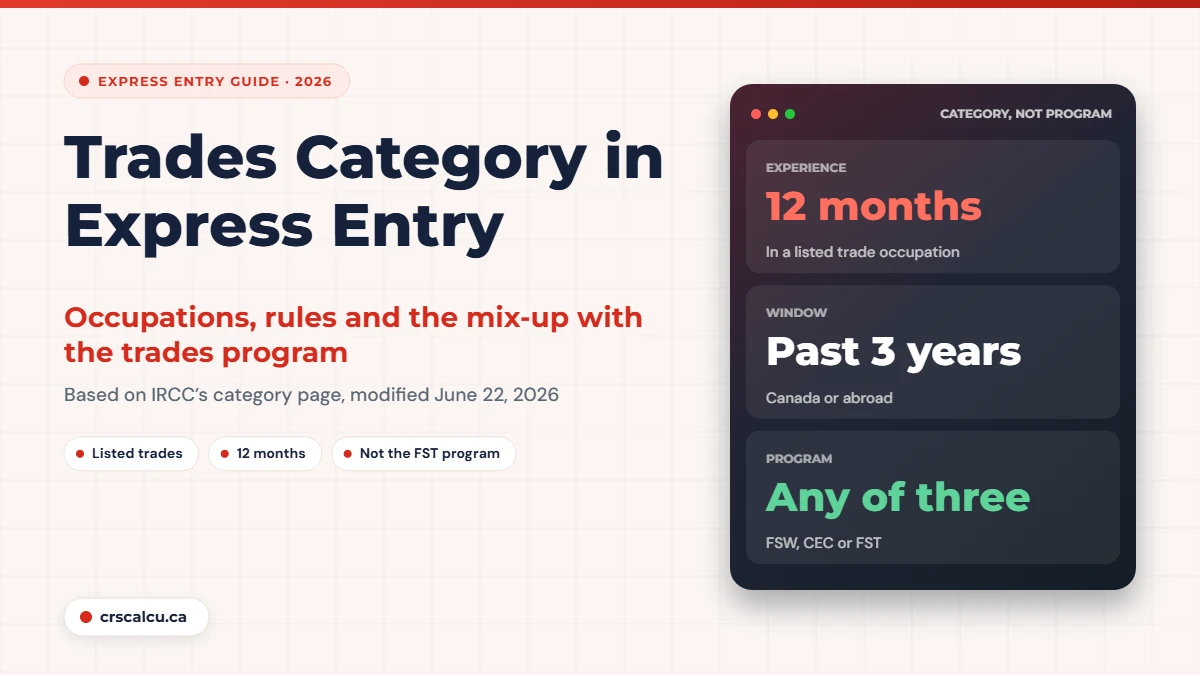
You qualify if you are eligible for any Express Entry program and have, within the past 3 years, at least 12 months of full-time work experience (or an equal amount of part-time) in an occupation on IRCC’s trade occupations list. The list we read covers construction, electrical, pipe, metal and mechanical trades, among others. You do not need to qualify under the Federal Skilled Trades Program specifically, and the category page sets no requirement for a job offer or a certificate of qualification. Check your score with our CRS calculator.
Key takeaways
The trades category and the trades program are different things
IRCC’s eligibility page (modified June 22, 2026) describes the Federal Skilled Trades Program as one of three ways to be eligible for Express Entry. Its minimums are two years of full-time work in a skilled trade in the last five years, a valid job offer or a certificate of qualification from a Canadian authority, and language at CLB 5 for speaking and listening and CLB 4 for reading and writing. We explain it in our Federal Skilled Trades Program guide.
The trades category is something else. IRCC’s category-based selection page (modified June 22, 2026) describes rounds for candidates who are already eligible for an Express Entry program and who also have recent experience in a listed trade occupation. The highest-scoring candidates who meet both conditions are invited.
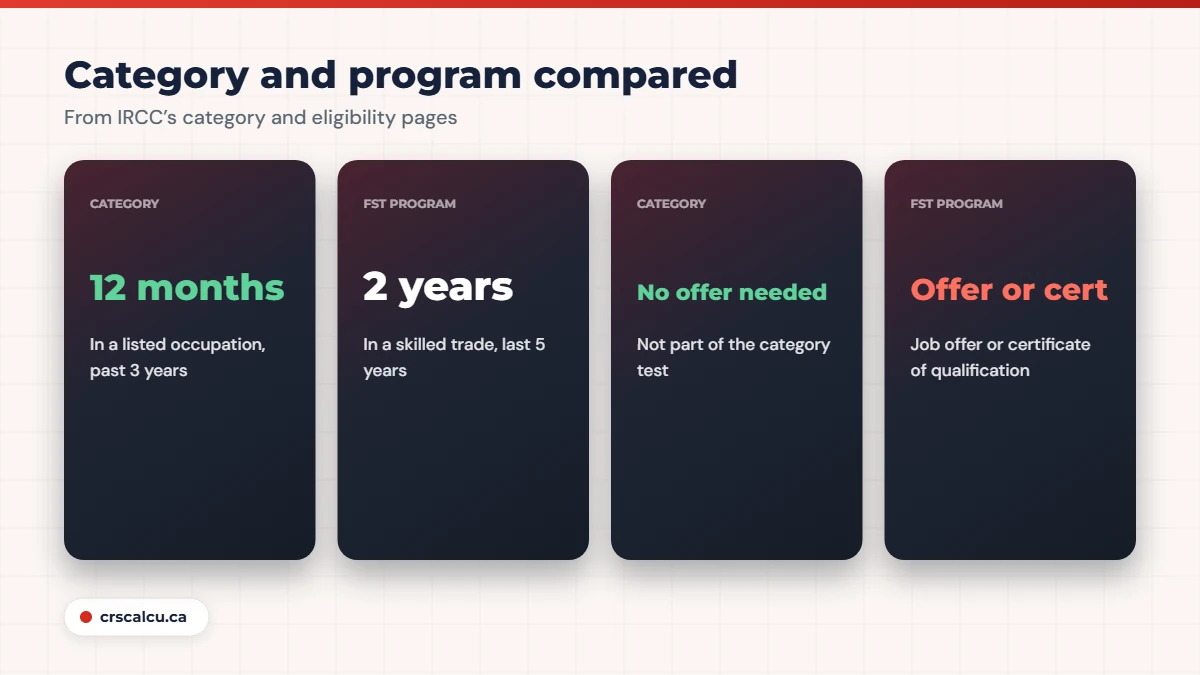
Question | Trades category | Federal Skilled Trades Program |
|---|---|---|
What is it? | A type of invitation round | One of three eligibility programs |
Experience | 12 months in a listed occupation in the past 3 years | 2 years in a skilled trade in the last 5 years |
Job offer or certificate? | Not part of the category test | One of the two is required |
Language | Whatever your eligibility program requires | CLB 5 speaking and listening; CLB 4 reading and writing |
Which occupations? | Those on IRCC’s trade occupations list | Skilled trades as defined for the program |
Our summary of IRCC’s category-based selection page and Express Entry eligibility page (both modified June 22, 2026).
In practice many people invited in trades rounds are Canadian Experience Class candidates: tradespeople who have worked a year or more in Canada. Others are Federal Skilled Worker candidates with trade experience abroad. We compare those two programs in FSW vs CEC.
Which occupations are in the trades category
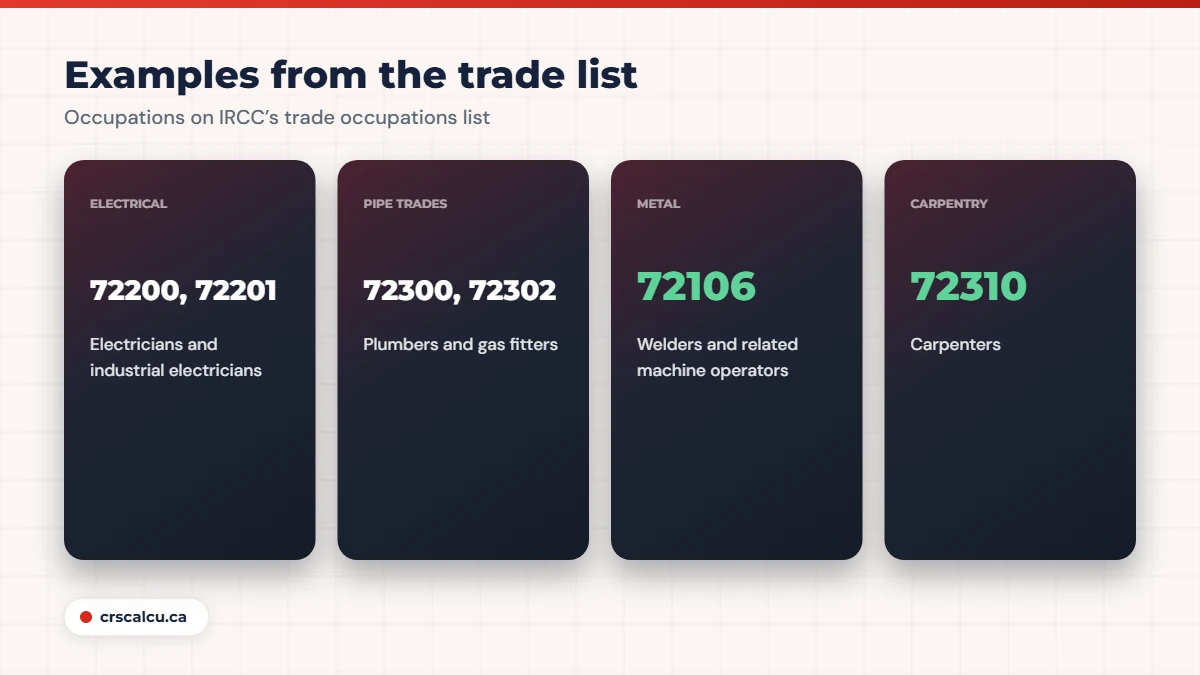
We have grouped the list on IRCC’s page for reading. The numbers are the five-digit NOC codes shown there.
Group | Occupations (NOC code) | TEER |
|---|---|---|
Construction management | Construction managers (70010), home building and renovation managers (70011), construction estimators (22303) | 0 and 2 |
Electrical | Electricians, except industrial and power system (72200), industrial electricians (72201), electrical mechanics (72422) | 2 |
Pipe trades | Plumbers (72300), gas fitters (72302) | 2 |
Carpentry and masonry | Carpenters (72310), cabinetmakers (72311), bricklayers (72320) | 2 |
Metal trades | Machinists and machining and tooling inspectors (72100), sheet metal workers (72102), welders and related machine operators (72106) | 2 |
Mechanics | Construction millwrights and industrial mechanics (72400), heavy-duty equipment mechanics (72401), heating, refrigeration and air conditioning mechanics (72402) | 2 |
Finishing trades | Concrete finishers (73100), roofers and shinglers (73110), painters and decorators (73112), floor covering installers (73113) | 3 |
Other | Water well drillers (72501), other technical trades (72999), contractors and supervisors in oil and gas drilling (82021), butchers, retail and wholesale (63201) | 2 and 3 |
Grouped by us from IRCC’s category-based selection page (modified June 22, 2026). Check the live list before relying on it; categories and occupations have been revised more than once.
Notice what is not there. Cooks (63200) did not appear on the list as we read it in 2026, although cooks feature in a great many forum questions about trades. Neither did several transport and mechanic occupations that people assume are trades. The only reliable test is your own code against the current list. Find the code in our NOC and TEER finder.
Real case: a cook and the “qualified trades” message (February 2023)
A candidate whose main Canadian experience was as a cook, with earlier work abroad as a database analyst, saw a message in the profile about qualified trades occupations and wondered whether they had to submit a trade certificate. They had planned to rely on an employer letter, tax documents and pay stubs. A reply explained that their occupation code was close to, but not the same as, the trades codes the message referred to, so the message did not apply to them. Nothing further was posted.
Real case: cooks with a year of Canadian work (September 2023)
Someone helping friends who worked as cooks in Ontario, on employer-specific permits with more than a year of experience, had been told about two routes and then found that the province’s Express Entry skilled trades stream excluded cooks. A senior member set out what was actually open: the Canadian Experience Class through Express Entry, on their own score, or a provincial foreign worker stream outside Express Entry that needs the employer’s support. A later poster waiting on a provincial invitation was told to check which occupations the province had been selecting. No outcomes were reported.
Those two threads make the same point from different directions. Being a tradesperson in the everyday sense does not put you in a trades list. Each list, federal category or provincial stream, names its own codes. If you are tempted to pick a listed code that is near your job, read wrong NOC code in Express Entry first.
The 12 months and the 3 years
For occupation categories, IRCC’s page asks for at least 12 months of full-time work experience, or an equal amount of part-time experience, in a listed occupation, accumulated within the past 3 years. On the same page, the general description of the occupation categories says the experience need not be continuous and can be gained in Canada or abroad.
Seasonal and project-based work is common in the trades, so count carefully. Twelve months of full-time work means the hours, not just the calendar: see 1,560 hours. Gaps between contracts do not disqualify you, since continuity is not required, but they do not count either. And the 3-year window moves forward every day; experience from four years ago does nothing for the category, even if it still helps your program eligibility.
Every job has to be proven if you are invited. Trades employers are not always used to writing detailed letters; our post on the reference letter for Express Entry lists what IRCC needs in one.
Certificates of qualification: where they matter
A certificate of qualification is not part of the category test. It matters in two other places. It is one of the two ways to meet the Federal Skilled Trades Program, the other being a job offer. And it can add points on the CRS table; we cover the details in certificate of qualification in Express Entry.
Real case: certificate of qualification and the Canadian Experience Class (September 2019)
A candidate with a certificate of qualification, a two-year college diploma and one year of full-time skilled work in Canada asked whether they could apply under the Canadian Experience Class and still claim the points for the certificate. An experienced member said yes: that class has no education or training requirement, only skilled Canadian work, and the same points table applies whichever program you are eligible under. Asked whether the certificate still counts if you are working in a different field or province, the member said the points table does not specify that. The poster was satisfied with the answer.
Real case: an overseas trade certificate and no assessment body (January 2018)
A worker in Canada on a temporary permit held a trade certificate from a four-year apprenticeship abroad and could not find an organization to assess it for education points. Replies pointed out that an educational credential assessment is needed for the Federal Skilled Worker Program but not for the Canadian Experience Class or the Federal Skilled Trades Program, and that the trades program needs two years of experience plus either a job offer or Canadian certification. The poster said they held a Canadian welding certification and a job offer, though in different occupations, and worried about a permit expiring in April. No outcome was reported.
An overseas trade certificate is not a Canadian certificate of qualification. If your route depends on one, check with the provincial body that issues it.
Do trades files move at the same speed?
IRCC’s pages say processing times vary and promise nothing for any program.
Real case: a long wait under the trades program (February 2021)
An applicant inside Canada under the Federal Skilled Trades Program had been waiting more than 14 months since their acknowledgment of receipt in December 2019, with eligibility still under review. Others in the thread reported waits of 20 months and more from the same period, medical exams being extended, and a sense that other streams were moving faster. Suggestions were to order file notes, contact a Member of Parliament and use the web form. As of November 2021 the original poster reported no change.
That was during the pandemic backlog and concerns one program at one time. It is a reminder that an invitation starts a process whose length nobody guarantees, and that a qualification check on a trade can add steps.
Checking whether you qualify
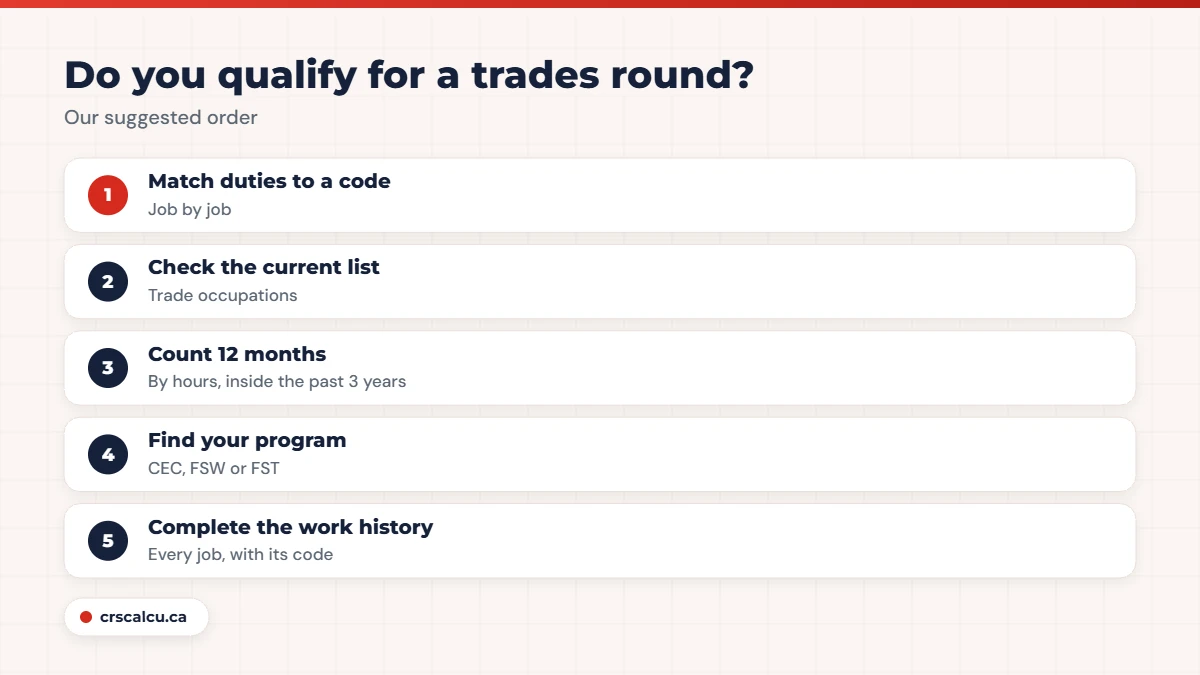
Our suggested order
For how category rounds work in general, see category-based draws; the same 12-month test applies in the healthcare category.
Five mistakes people make with the trades category
Avoid these
What IRCC does not say
IRCC does not publish a schedule of category rounds or say how often trades rounds will be held. The category page we read does not mention job offers or certificates of qualification. And it does not explain why an occupation is on or off the list.
Frequently Asked Questions
What is the trades category in Express Entry?
It is one of IRCC’s category-based selection categories, called trade occupations. Rounds for it invite candidates who are eligible for an Express Entry program and have 12 months of recent experience in a listed trade occupation.
Is the trades category the same as the Federal Skilled Trades Program?
No. The program is one of three ways to be eligible for Express Entry and has its own requirements. The category is a type of invitation round open to eligible candidates from any of the three programs.
Do I need a certificate of qualification for a trades round?
The category page sets a work experience test and does not mention one. A certificate matters for the Federal Skilled Trades Program and can add CRS points.
Are cooks in the trades category?
Cooks (63200) were not on the trade occupations list as we read it on IRCC’s page modified June 22, 2026. Butchers (63201) were. Check the live list.
Does trade experience outside Canada count?
IRCC’s page says experience for the occupation categories can be gained in Canada or abroad. You still need to be eligible for an Express Entry program.
What language level do I need?
The level required by the program you are eligible under: CLB 7 for the Federal Skilled Worker Program, CLB 7 or 5 for the Canadian Experience Class depending on TEER, and CLB 5 and 4 for the Federal Skilled Trades Program.
Check your score for a trades round
Calculate your CRS, then compare it with trades round cut-offs, not general ones.
Final Thoughts
The trades category gives skilled tradespeople their own rounds, and the test for it is narrower and simpler than most people fear: a listed code, 12 months, the past 3 years, and ordinary eligibility under any one program. The confusion comes almost entirely from the similarly named program and from lists that keep changing.
If your duties sit between two codes, if your work is seasonal and hard to count, or if you are relying on a certificate issued abroad, speak to a licensed immigration consultant or an immigration lawyer before you build the profile.