Express Entry Guide · Updated October 2026
FSW vs CEC: 7 Differences That Matter in Express Entry (Real Cases)
Two programs, one profile, and you do not get to pick. Here is how they differ, how the system chooses, and where people get caught.
The FSW vs CEC question usually arrives in one of two forms. Either “which one should I apply under?”, or, after an invitation, “why does my account say the other one?”. Both come from the same misunderstanding. You do not apply under a program. You submit one Express Entry profile, and the system works out which programs you qualify for.
New rules, November 3, 2026: From November 3, 2026, both FSW and CEC candidates can earn new Labour Market Integration points, and FSW job offers no longer need an LMIA. IRCC pauses rounds for up to two weeks while it recalculates profiles. Check your score under the new rules · IRCC details
The differences still matter a great deal, because they decide whether you qualify for one, both or neither, whether you need settlement funds in the bank, and what happens when a detail in your work history shifts you from one to the other at the worst moment.
We read IRCC’s eligibility page, the two program pages, the proof of funds page and the Help Centre (all modified in 2026), plus five public forum threads from 2018 to 2024. This is general information, not legal advice.
Quick answer: what is the difference between FSW and CEC?
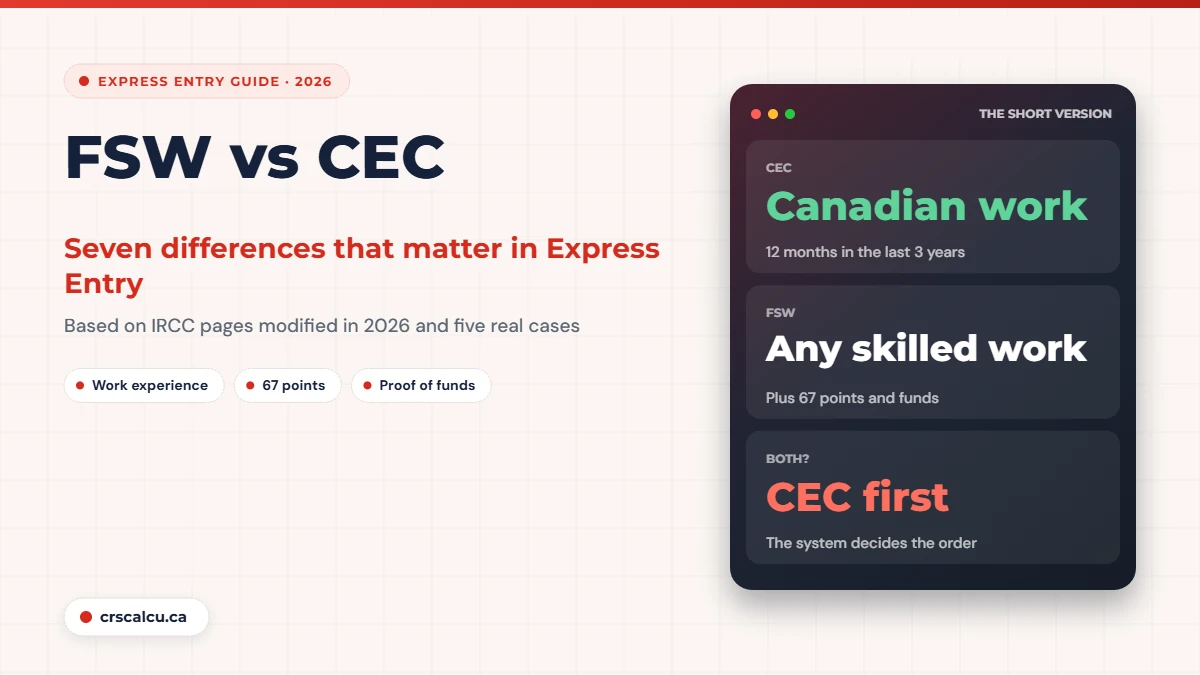
The Canadian Experience Class is for people with at least one year of skilled work in Canada in the last three years; it has no education requirement and no settlement funds requirement. The Federal Skilled Worker Program accepts skilled work from anywhere in the last ten years, but adds a secondary education minimum, a 67-point selection grid and proof of funds. If you qualify for both, IRCC’s system invites you under the Canadian Experience Class first. Both are ranked on the same CRS table, so check your number in our CRS calculator.
Key takeaways
One profile, three programs, no choice
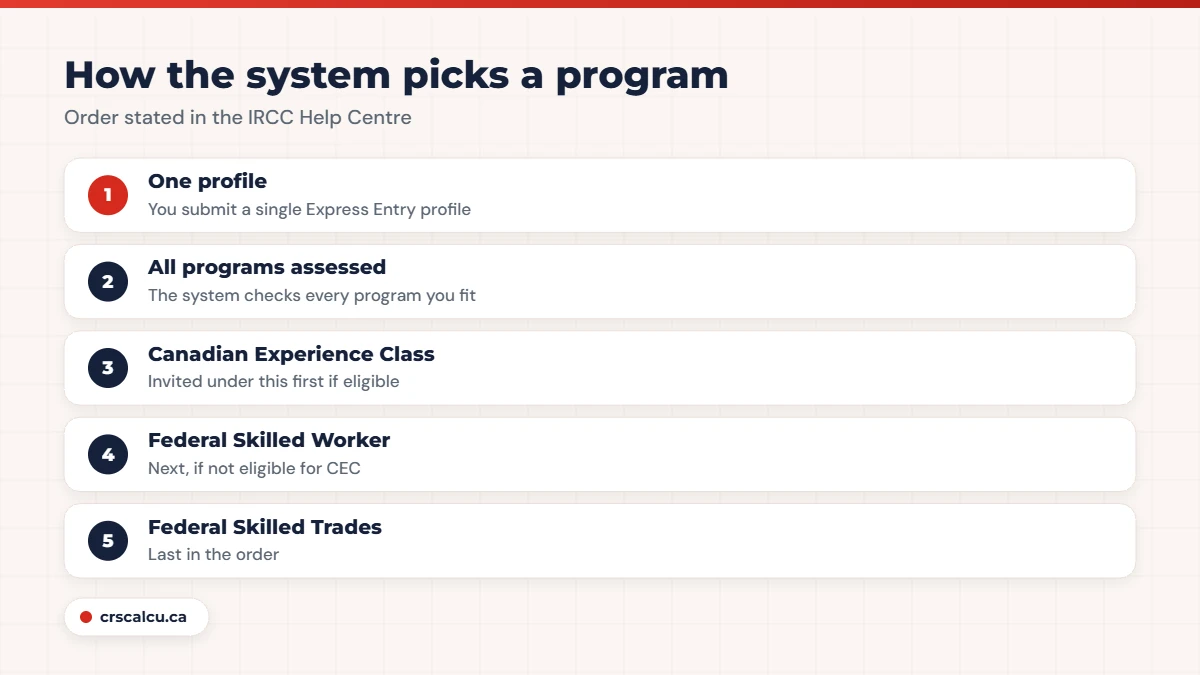
IRCC’s create-profile page (modified September 24, 2026) has a section for people who are eligible for more than one program, and the Help Centre (modified April 17, 2026) states the order in which the system invites: Canadian Experience Class first, then Federal Skilled Worker, then Federal Skilled Trades. You cannot pick. A second profile does not change that either; see two Express Entry profiles.
Real case: eligible for both, hoping for CEC (January 2019)
An applicant inside Canada with 465 points saw that the profile qualified under both programs and wanted to make sure the invitation came under the Canadian Experience Class. A veteran member explained that when a candidate is eligible for both, the invitation is issued under the Canadian Experience Class by default, then set out the full order. The applicant had also entered zero for settlement funds and asked whether that was a mistake; the reply was that it would not matter under that class. In February 2019 the applicant confirmed the invitation had come under the Canadian Experience Class.
FSW vs CEC: the seven differences
Requirement | Canadian Experience Class | Federal Skilled Worker |
|---|---|---|
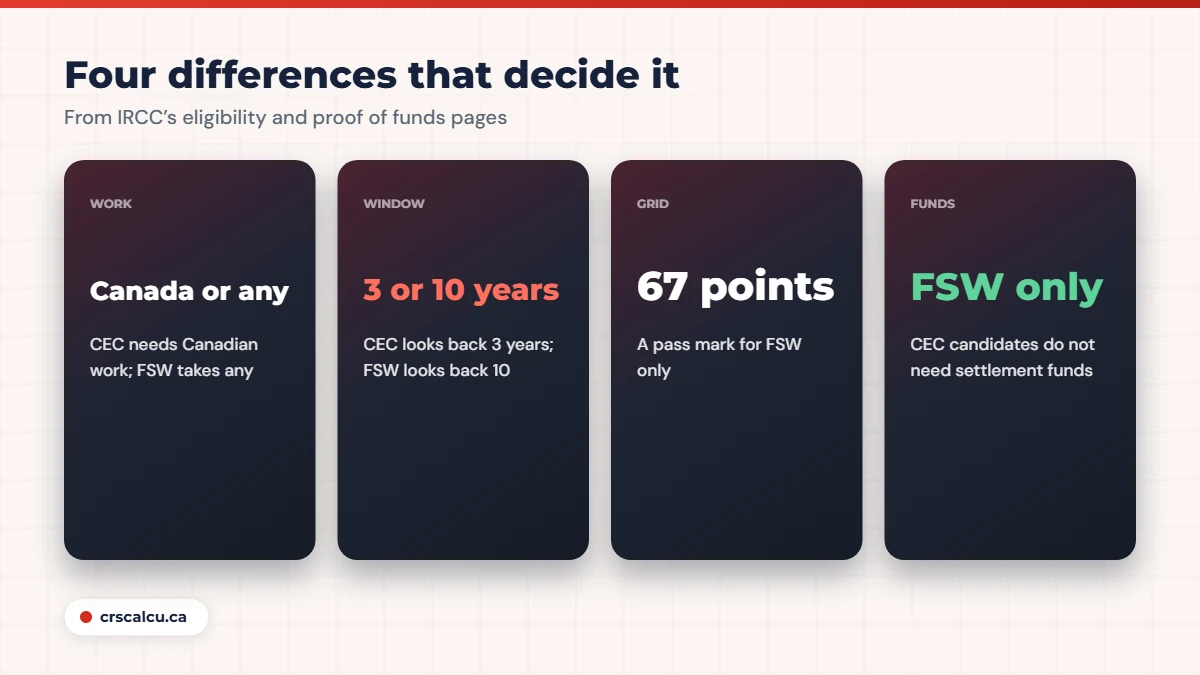
1. Where the work was done | In Canada only | Anywhere |
2. When and how much | 12 months in the 3 years before the invitation | 1 continuous year in the last 10 years |
3. Work that does not count | Work while a full-time student, co-op terms, self-employment, unpaid work | Unpaid work; student work and self-employment can count |
4. Education | No requirement | Secondary education at minimum |
5. Language | CLB 7 for TEER 0 or 1; CLB 5 for TEER 2 or 3 | CLB 7 in all four abilities |
6. Selection grid | None | 67 points out of 100 |
7. Settlement funds | Not required | Required, unless you have a valid job offer and can work in Canada |
Our summary of IRCC’s eligibility page (modified June 22, 2026), the two program pages (modified September 24, 2026) and the proof of funds page (modified June 22, 2026).
1 and 2. The work, and the window
For the Canadian Experience Class, the Help Centre puts it this way: at least 12 months of full-time work, or an equal amount of part-time, in Canada, in the three years before you are invited, in TEER 0, 1, 2 or 3. For the Federal Skilled Worker Program, IRCC’s page asks for one year of continuous paid work, or 1,560 hours, within the last ten years, in the same occupation as your primary one, and says hours above 30 a week are not counted. Our post on 1,560 hours shows how to count.
The three-year window is the detail that bites. It is measured back from the invitation, so it moves every day.
Real case: invited under CEC, three months short (December 2018)
An applicant was invited on October 29, 2018 under the Canadian Experience Class. Their Canadian work had run from September 2013 to July 2016. While filling in the application, the system showed that they met only the Federal Skilled Worker requirements. Forum members worked out why: within the three years before the invitation, October 2015 to October 2018, they had about nine months of Canadian work, not twelve. Replies said minimum requirements have to be met both at invitation and at application, and suggested either adding proof of funds or withdrawing. The applicant asked to withdraw on December 14, 2018. IRCC’s reply, as they reported it, was that score updates made after a round do not apply to that round, and that they should wait for a future one.
If you have left Canada and are relying on older Canadian experience, read leaving Canada during Express Entry for how that window closes.
3. Work that does not count
IRCC’s Canadian Experience Class page says you cannot count work done while you were a full-time student, co-op terms, self-employment (with an exception for certain physicians), unpaid work or work done without authorization. The Federal Skilled Worker page is wider: student work can count if it was paid and continuous and meets the other rules, and self-employment can count.
Real case: graduate with internships, apply now or wait? (March 2021)
A recent graduate of a Canadian university had six months of work since graduating and 16 months of internships during the degree. They asked whether to enter under the Federal Skilled Worker Program now, or wait six more months to qualify for the Canadian Experience Class, since the internships would not count there. The advice was to wait for the Canadian Experience Class, partly on reasoning about job offer points that no longer applies. The poster accepted that.
The reasoning in that thread has dated, because job offer points were removed from the CRS in 2025. The underlying question has not. Under today’s rules, nothing stops a candidate entering the pool as soon as they qualify under one program and letting the profile pick up the other when the year of Canadian work is complete; updating a profile does not change its tie-breaker time.
4, 5 and 6. Education, language and the 67 points
The Canadian Experience Class has no education requirement, although education still earns CRS points. The Federal Skilled Worker Program requires at least secondary education, and foreign credentials need an assessment to count. Language minimums differ too: CLB 7 across the board for Federal Skilled Worker, and for the Canadian Experience Class CLB 7 if your work is in TEER 0 or 1 and CLB 5 if it is in TEER 2 or 3. Check your occupation in the NOC and TEER finder and convert scores with the CLB calculator.
Only the Federal Skilled Worker Program has a selection grid. You need 67 points out of 100 across six factors: language (up to 28), education (25), experience (15), age (12), arranged employment (10) and adaptability (10). It is a pass mark, separate from the CRS. Test yours in the FSW points calculator.
7. Settlement funds
IRCC’s proof of funds page (modified June 22, 2026) says funds are required under the Federal Skilled Worker and Federal Skilled Trades programs, and not if you apply under the Canadian Experience Class or if you have a valid job offer and are authorized to work in Canada. The amounts on the page, which it says were updated on July 7, 2025, start at $15,263 for one person, $19,001 for two and $28,362 for a family of four.
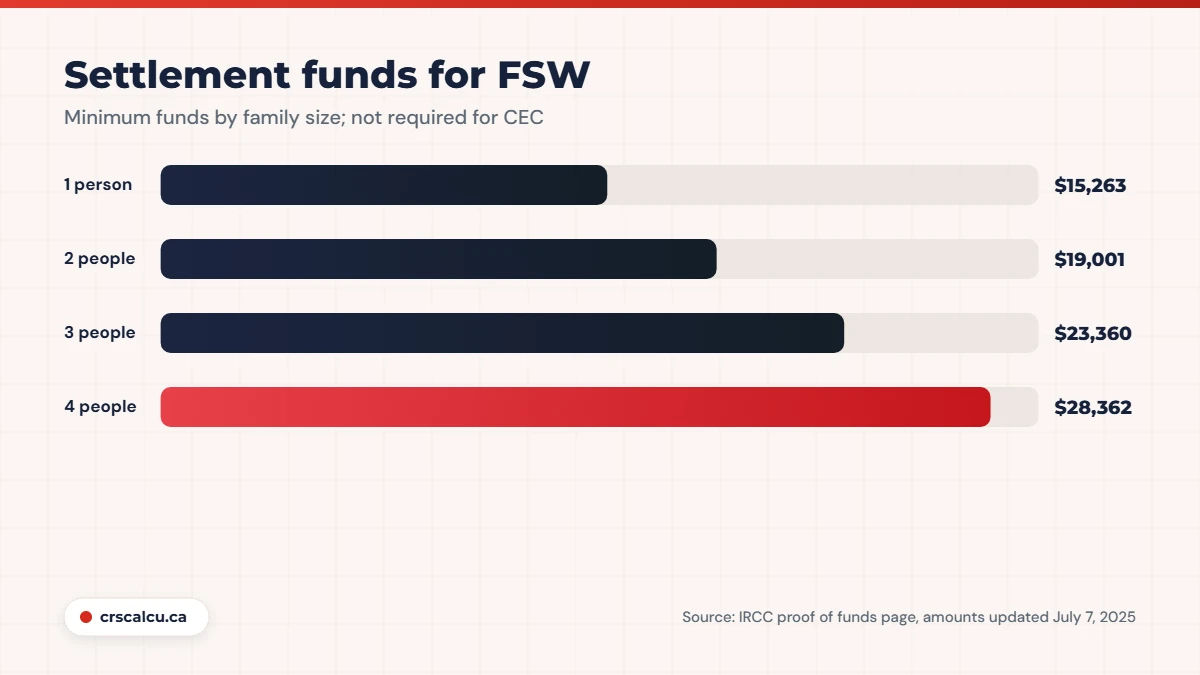
The same page adds a warning that fits this topic exactly: the system may find you eligible for more than one program, and you may not know which one you will be invited under, so keep your funds information current.
Real case: eligible for both, funds or not? (September 2022)
A candidate who qualified under both programs had listed their foreign job as the primary occupation, because their single year of Canadian work was split across two occupations. They asked whether they would have to show funds after an invitation. An experienced member answered that if the invitation comes under the Canadian Experience Class, funds are not needed. Nothing further was posted.
The reply is correct as far as it goes. The December 2018 case above shows the other half: if your Canadian year falls out of the window, the same profile becomes a Federal Skilled Worker file, and funds are suddenly required. Our proof of funds post covers the full table and which money counts.
Does the program change your CRS score?
No. Both programs are ranked on the same Comprehensive Ranking System. What differs is the raw material. On the CRS criteria page (modified June 22, 2026), one year of Canadian work experience earns 40 core points for a candidate without a spouse and also feeds two skill transferability pairs. Foreign work earns no core points and counts only through transferability. So a typical Canadian Experience Class candidate has a line of points a typical Federal Skilled Worker candidate does not, at the cost of a year or more spent working in Canada first.
Do the rounds treat them differently?
Real case: CEC rounds and general rounds (June 2024)
A poster asked how Canadian Experience Class draws differ from general ones, whether the fees differ and whether one route is better for someone eligible under both. A veteran member explained that rounds limited to the Canadian Experience Class, when they are held, invite only candidates eligible under that class, while general rounds are open to candidates from both programs. They added that fees are the same and that there is one profile, which determines the programs you qualify for.
IRCC’s rounds page lists the type of each round. Category-based rounds are a third kind: IRCC’s category page says you must first be eligible for one of the Express Entry programs, then meet the category’s own test. See category-based draws and the latest draw cut-offs for which types have been running.
Which one fits you?
You are probably a Canadian Experience Class candidate if
You are probably a Federal Skilled Worker candidate if
Many people tick both lists. If so, prepare for both: keep your funds documented even though the Canadian Experience Class would not ask for them. Our Canadian Experience Class guide has more on the first list, and the Federal Skilled Trades Program guide covers the third program.
Five mistakes people make with FSW vs CEC
Avoid these
What IRCC does not say
IRCC’s pages do not tell you, before an invitation, which program a borderline profile will be invited under, and they do not describe a way to switch programs after an invitation. In the 2018 case the only route offered was to withdraw and wait for another round.
Frequently Asked Questions
FSW vs CEC: which is easier?
Neither is easier in general. The Canadian Experience Class has fewer requirements but needs a year of skilled work in Canada. The Federal Skilled Worker Program takes foreign experience but adds an education minimum, a 67-point grid and settlement funds.
Can I choose which program I am invited under?
No. IRCC’s Help Centre says that if you are eligible for more than one program, the system invites in this order: Canadian Experience Class, Federal Skilled Worker, Federal Skilled Trades.
Do I need proof of funds for the Canadian Experience Class?
No. IRCC’s proof of funds page says funds are not required if you apply under the Canadian Experience Class. It also warns that you may not know which program you will be invited under.
Does CEC need an educational credential assessment?
The Canadian Experience Class has no education requirement. You still need an assessment for foreign credentials if you want CRS points for them.
Is the CRS cut-off different for each program?
The CRS table is the same. Cut-offs vary by round, and some rounds are limited to one program or category. Check the type of each round.
My Canadian work was as a student. Can I use FSW?
IRCC’s Federal Skilled Worker page says student work can count if it was paid, continuous and meets the other requirements. It does not count for the Canadian Experience Class.
See your CRS score, then your 67 points
Run the CRS calculator first. If you are relying on foreign experience, check the selection grid as well.
Final Thoughts
FSW vs CEC is not a choice you make. It is a description of what your history qualifies you for, and for many people the answer is both. Know which requirements you meet, keep the documents for either outcome, and watch the three-year window if your Canadian experience is not recent.
If your work history is borderline for either program, or your account shows a different program from the one you expected after an invitation, speak to a licensed immigration consultant or an immigration lawyer before you submit.