Express Entry Guide · Updated October 2026
Express Entry Document Checklist: What to Upload After an ITA (Real Cases)
Sixty days sounds generous until you start collecting papers from three countries. One missing page can send the whole file back. Here is what goes on the checklist, what only some people need, and where real applications went wrong.
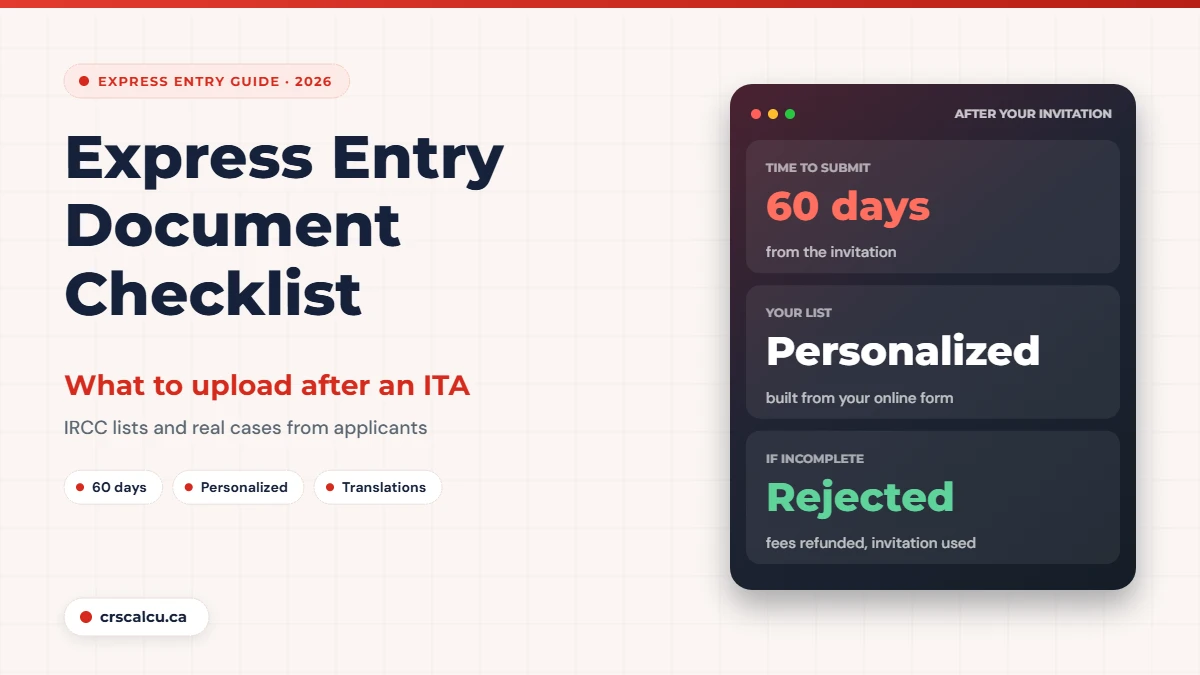
The Express Entry document checklist is a personalized list the IRCC system builds for you once you have completed the online form after an invitation to apply. It tells you exactly which documents to upload. You have 60 days from the invitation to upload them all and submit. If the application is not complete, IRCC rejects it and refunds the processing fees.
There is no single checklist that fits everyone. A single applicant in Canada and a family of four abroad will see different lists. But the building blocks are the same, and you can prepare nearly all of them before the invitation arrives.
We pulled the lists from IRCC’s current Express Entry pages and read forum threads where applicants were rejected for one missing certificate or one missing scan. Both are below.
Quick answer: the Express Entry document checklist
After an invitation, complete the online form and the system gives you a personalized document checklist. Expect police certificates, proof of funds, a medical exam, language results, education proof and work experience letters, plus family documents if they apply to you. Anything not in English or French needs a certified translation and a scan of the original. You have 60 days. An incomplete application is rejected, not paused.
Key takeaways
What the Express Entry Document Checklist Is
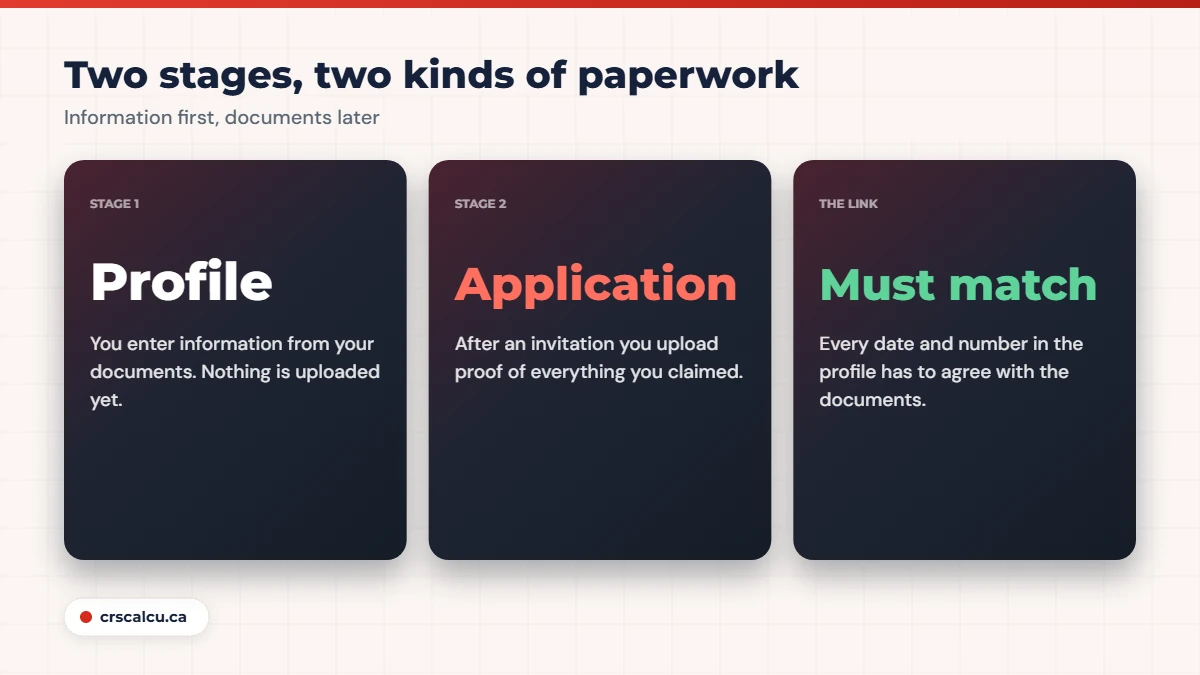
Express Entry works in two stages, and each has its own paperwork. To create a profile you need information from your documents, not the documents themselves. After an invitation, the documents have to be uploaded as proof of what you claimed.
IRCC’s application page explains how the second list is made: the system gives you a personalized document checklist once you have completed the online form. Your answers about family, travel, work and education decide what appears on it. The invitation itself is valid for 60 days only.
Documents You Need for Your Profile
IRCC says you may need information from some or all of these when you create a profile. You are not asked to upload them yet, but every number and date you enter must match them later.
Document | Who needs it |
|---|---|
Passport or travel document | Everyone |
Language test results | Everyone |
Canadian education proof, or an ECA report for immigration purposes | Federal Skilled Worker applicants, and anyone claiming points for foreign education |
Proof of work experience | Anyone claiming work experience |
Certificate of qualification in a trade | If you have one |
Provincial nomination | If you have one |
Proof of funds | If your program requires it |
Police certificates | Start early, as IRCC advises |
Source: IRCC, Express Entry documents page (modified October 2, 2026).
One passport detail is easy to miss. IRCC says that if your passport expires within 6 months from the day you apply, you should renew it. Do that before you enter the pool, because a new passport number means updating your profile.
Documents After the Invitation
These are the documents IRCC’s Express Entry pages name for the application itself. Your own checklist will show the ones that apply to you.
Document | Notes | Our guide |
|---|---|---|
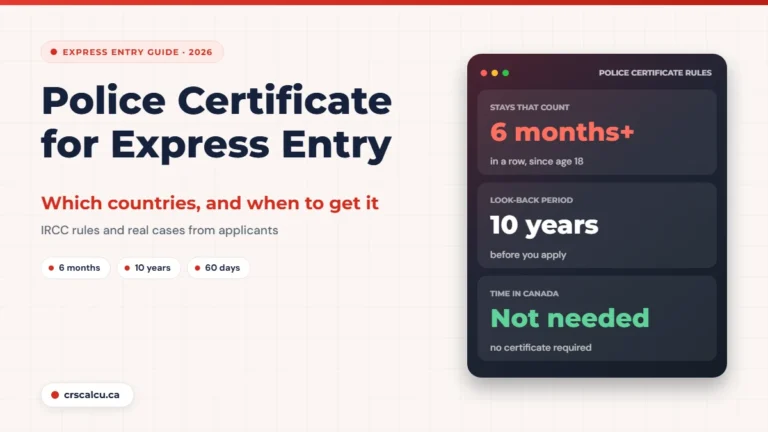
Police certificates | Each country where you stayed 6 months or more in a row since age 18, in the last 10 years | |
Medical exam confirmation | From a panel physician, for you and all family members | |
Proof of funds | Official letters from your bank, if your program requires funds | |
Proof of work experience | Reference or experience letters from employers | |
Education proof | ECA report, or Canadian credential | |
Language test results | Must still be valid | |
Passport | Biographical page | – |
Compiled from IRCC’s Express Entry documents and application pages. Your personalized checklist is the final word.
Family Documents
IRCC lists these for applicants whose family situation calls for them.
If they apply to you
If your spouse is not coming with you, the family documents still apply. See our guide to a non-accompanying spouse in Express Entry.
Documents Only If Your Checklist Asks
IRCC is specific about a second group. You should provide these only if they are included in your personalized document checklist.
Conditional documents
Uploading things nobody asked for does not strengthen a file. It gives the officer more to read. If something unusual needs explaining, a short letter of explanation in the right slot does more than a stack of extras.
Translation and Scan Rules
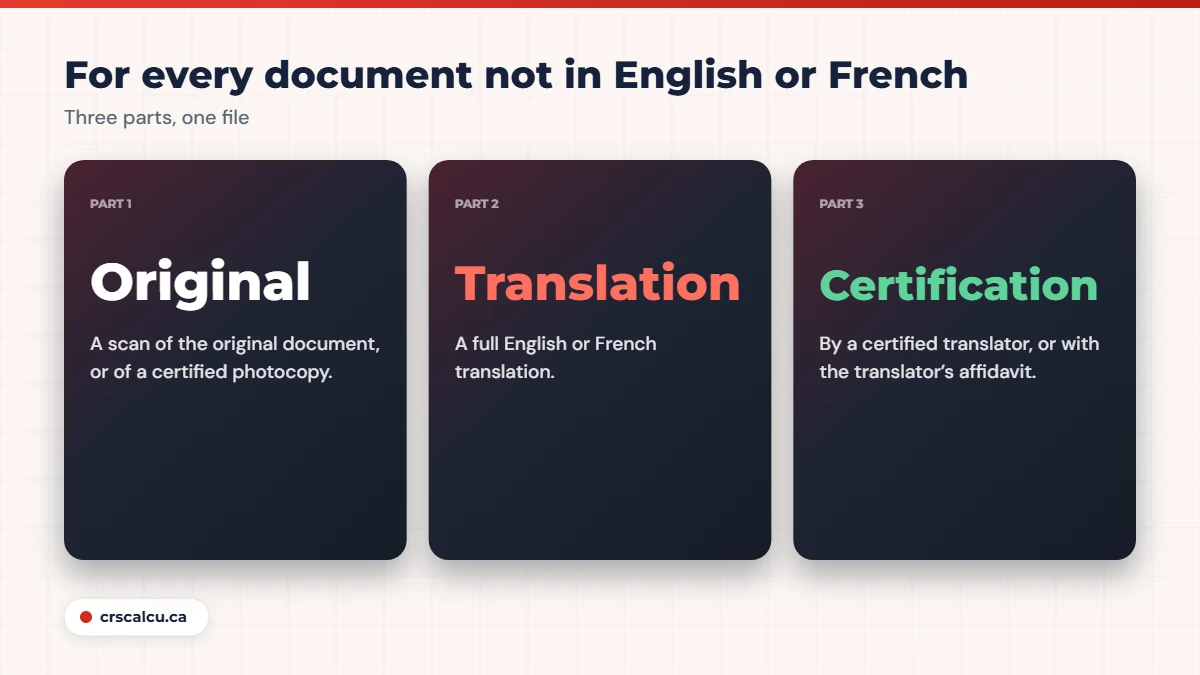
Any document that is not in English or French must come with an English or French translation. IRCC accepts two kinds: one done by a certified translator, meaning a member of a professional association whose seal or stamp shows the membership, or one accompanied by an affidavit from the translator, sworn before someone authorized to take oaths.
The translation does not replace the document. IRCC also asks for a scan of the original document, or a scan of a certified photocopy of it.
Real case: translations uploaded, originals forgotten
In January 2019, an applicant who had submitted on December 29, 2018 realized they had uploaded only the translations of both spouses’ police certificates, the marriage certificate and two children’s birth certificates. The Arabic originals were missing. Members urged them to send the originals through the IRCC web form at once. They later reported the documents were forwarded to the processing office.
That applicant caught it within days and acted. The safer habit is to build each file as a pair from the start: original first, translation behind it, saved as one PDF.
What Gets an Application Rejected
IRCC’s page on what happens after you apply leaves no doubt: if your application is not complete, it is rejected and the processing fees are refunded. Rejected at this stage means returned. You are not banned. But the invitation is used up.
Real case: transcripts without the degree certificate
In January 2021, an applicant invited on November 25, 2020 was rejected on January 12, 2021. The reason given was incompleteness: they had uploaded transcripts for a Canadian credential but not the degree certificate itself. They were not given a chance to add it. Members explained that officers do not have to ask for a missing document.
It is a hard lesson, and a common one. The checklist slot said proof of the credential. Transcripts show courses. The certificate shows completion.
Gaps that come up again and again
If you truly cannot get a document in time, IRCC’s guidance is to upload a letter explaining why, with proof of your efforts, in that document’s slot. That is very different from leaving it blank.
A 60 Day Plan That Works
You cannot do everything in the last week. You also should not do everything in the first, because some documents expire.
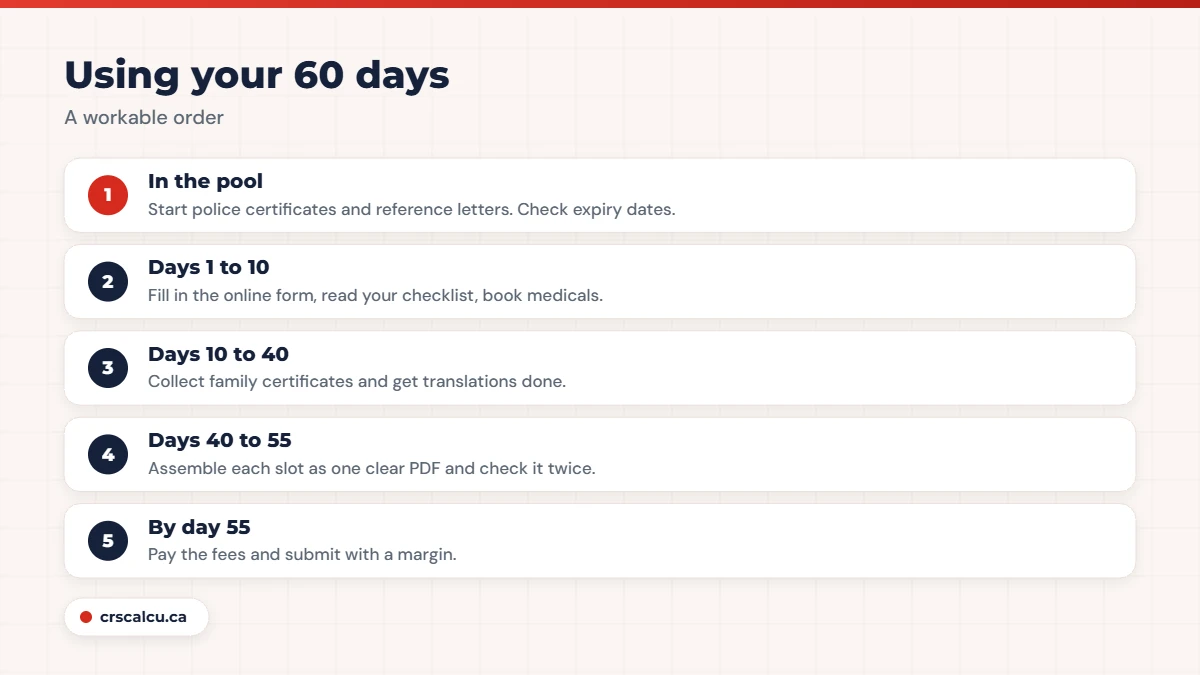
When | Do this | Why |
|---|---|---|
While in the pool | Order police certificates for countries you have left. Ask employers for reference letters. Check ECA and language test dates | These are slow, and they keep |
Days 1 to 10 | Complete the online form. Read your personalized checklist. Book medicals. Request bank letters | The checklist is the real list |
Days 10 to 40 | Collect family certificates. Send documents for certified translation. Get the police certificate for the country you live in now | Translations take time |
Days 40 to 55 | Assemble each slot as one clear PDF. Check names, dates and numbers against your forms | Catches mismatches |
By day 55 | Pay fees and submit | Leaves a margin for system errors |
Our suggested schedule. Adjust it to your own documents.
On submission you pay at least the processing fee and the biometrics fee. Keep a copy of every file you upload. If an officer asks a question months later, you will want to see exactly what they see.
And if day 60 is close and something essential is still missing, look at your options before the deadline passes. Our guide on declining an ITA explains what each choice does to your profile.
Frequently Asked Questions
What documents are required for Express Entry after an ITA?
Your personalized checklist decides. Common items are police certificates, medical exam confirmation, proof of funds, proof of work experience, education proof, language results and your passport, plus family certificates if they apply.
When do I get my Express Entry document checklist?
After the invitation. IRCC says the system gives you a personalized document checklist once you have completed the online form.
How long do I have to upload my documents?
The invitation to apply is valid for 60 days. You must upload everything and submit within that time.
Do documents need to be translated for Express Entry?
Yes, if they are not in English or French. You need a translation from a certified translator, or one with a translator’s affidavit, plus a scan of the original document.
What happens if I miss a document?
IRCC rejects incomplete applications and refunds the processing fees. Officers are not required to ask you for a missing document.
Should I upload extra documents to be safe?
Only upload documents your checklist asks for. If something needs explaining, add a short letter of explanation in the related slot.
See how close you are to an invitation
Check your CRS score against the latest cutoffs, then start the slow documents while you wait.
Final Thoughts
The Express Entry document checklist is not a mystery. It is built from your own answers, and almost everything on it can be started before the invitation. The applicants who struggle are the ones who meet the list for the first time on day one of sixty.
Start the slow items in the pool. Read the personalized list the moment it appears. Pair every translation with its original. Then check each slot twice, because the completeness check is pass or fail.