Express Entry Guide · Updated October 2026
Letter of Explanation for Express Entry: When You Need One and What to Write (Real Cases)
Officers cannot ask you what you meant. They read what you uploaded and decide. A short, clear letter is how you answer the question before it is asked. Here is when to write one, what goes in it, and where applicants put theirs.
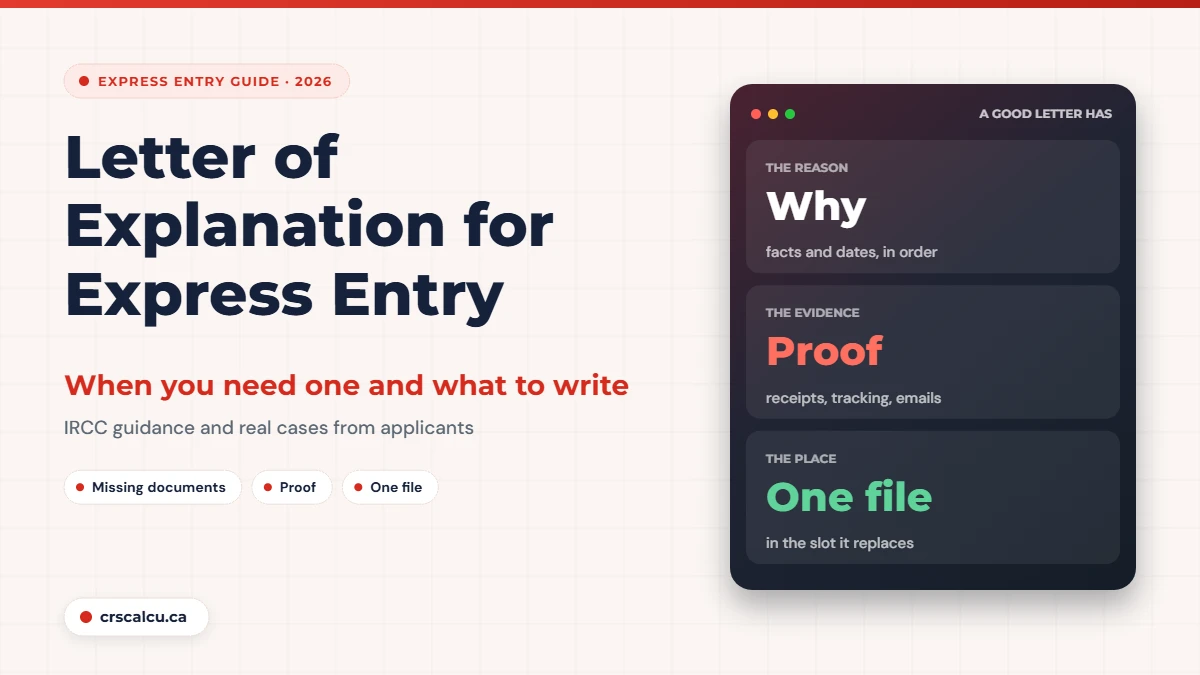
A letter of explanation for Express Entry is a short note you upload with your application to explain something an officer would otherwise have to guess: a document you cannot get, one that is delayed, or one that does not quite match the rest of your file. IRCC’s own instruction for a missing document is to write a letter that explains why you cannot get it or why it is taking longer, attach proof, and upload both in its place.
It is not a form. There is no template from IRCC. That freedom is why people get stuck on it.
We read IRCC’s current guidance and forum threads from 2017 to 2024 where applicants asked what to explain, how much to say, and where on earth the upload field went. The rules are below, with the cases that show them in use.
Quick answer: the letter of explanation
Write one when a required document is missing, late or different from what the checklist expects. Say what the document is, why you cannot provide it as asked, and what you are sending instead. Attach proof such as receipts or emails. For an online application, IRCC says to combine the letter and proof into one file and upload it where the missing document goes. A letter does not guarantee acceptance. The officer decides.
Key takeaways
What a Letter of Explanation for Express Entry Is For
An Express Entry application is decided on paper. After an invitation you get a document checklist, you upload what it asks for, and an officer reviews the file. If something is absent or odd, the officer has two choices: ask you, which costs weeks, or decide on what is there.
The first check is for completeness. IRCC’s page on what happens after you apply states it plainly: if your application is not complete, it is rejected and your processing fees are refunded. A letter in the right place is what turns an empty slot into an explained one.
Situation | Write a letter? | What to attach |
|---|---|---|
A required document cannot be obtained | Yes | Proof of every attempt to get it |
A document is delayed past the 60 days | Yes | Request receipt, payment, tracking number |
Names or dates differ between documents | Yes | The documents that link the two versions |
A replacement certificate has a new number | Short note | The replacement itself |
Large recent deposit in your funds | Yes | Source of the money, such as a sale or gift record |
Everything matches the checklist | No | Nothing extra |
Our summary. The first two rows follow IRCC’s supporting documents guidance (modified April 23, 2026). The rest reflect common applicant practice.
What IRCC Says to Do
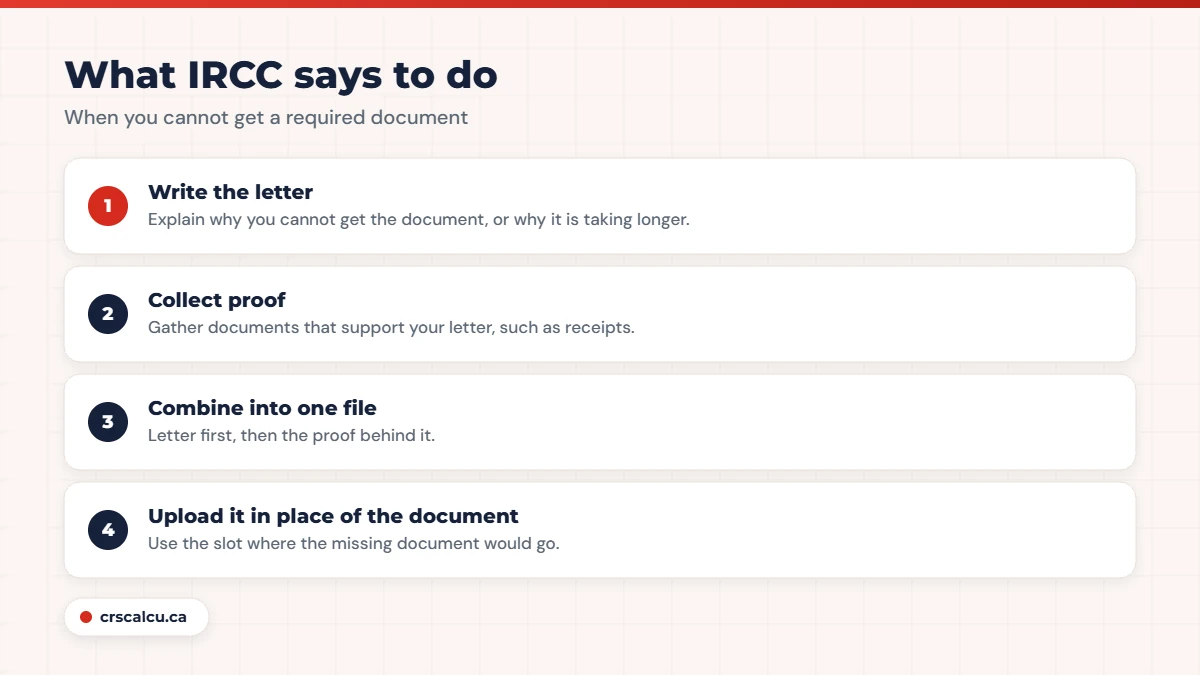
IRCC’s guidance on supporting documents gives three steps when you cannot get a required document. Write a letter that explains why you cannot get the document or why it is taking longer to get it. Collect any documents that support your letter, like receipts. Include your letter in your application.
For online applications there is one more instruction: combine your letter and documents into one file and upload it where the missing document goes.
The rules are stricter for one document. For a police certificate, IRCC says the letter must detail all the efforts you took to get it, with proof such as payment receipts, delivery notices or tracking numbers, official explanations of the delay, or a description of the situation in your country that prevents you from getting one. Our guide to the police certificate for Express Entry covers that in full.
A letter is a request, not a pass
IRCC adds a warning that applies to every letter: sending a letter and proof of your efforts does not guarantee they will be accepted. Use a letter when you truly cannot provide something. Do not use one to skip a document you could get with more effort.
What the Officer Can Do Next
IRCC lists four things that can follow. The officer may contact you for more information, give you an extension, accept the application without the document, or make a final decision based on what you did provide.
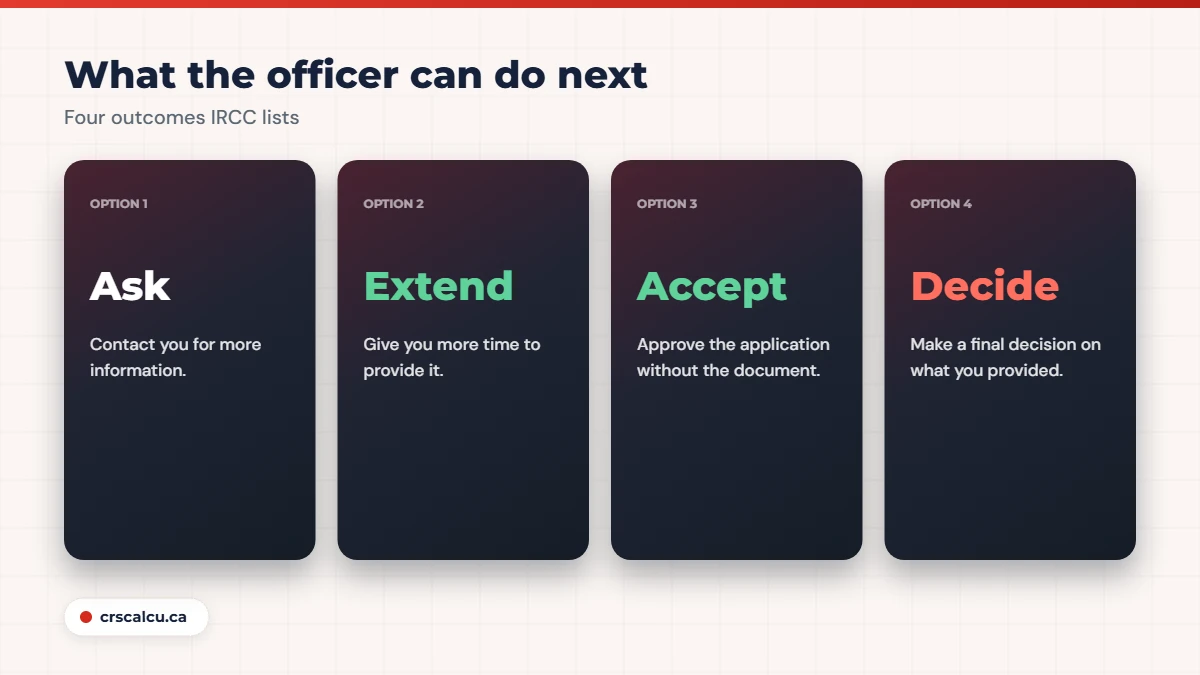
The help centre is frank about the downside. Without a required document, your application could be delayed, returned to you or refused. It also recognizes that some things are out of your hands, and names war and natural disasters as examples. An officer reads your letter and decides whether the application is complete without that document.
Real case: no letter, application returned
In February 2020, a Canadian Experience Class applicant could not get the required police certificate because their embassy refused to issue one. A different document was uploaded with no explanation, and the application was rejected as incomplete. Forum members pointed to the missing piece: a detailed letter and proof of each attempt.
How to Write the Letter
There is no official format. The letters that work, judging by years of forum reports, share a plain structure.
A structure that works
Write it the way you would explain it to a stranger with five minutes. No pleading, no life story. Officers read many files, and the fastest letter to approve is the one that answers the obvious question in the first paragraph.
What weakens a letter
Where to Upload It
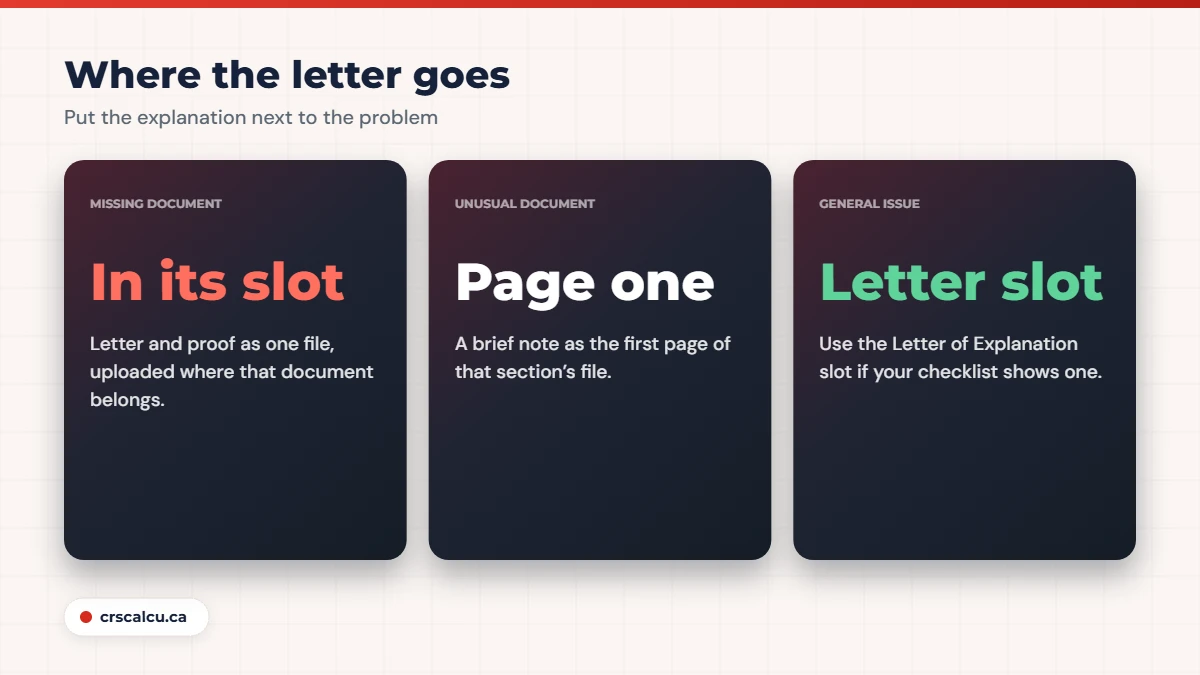
IRCC’s instruction is to put the combined file where the missing document goes. Applicants extend the same idea to other explanations.
Real case: one letter or many?
In August 2023, an applicant asked where to put explanations for large deposits in their bank statements, and whether to merge them with the statements. A member who had been through it replied in April 2024: they attached each explanation to the relevant section, in the same file as the required documents, and did that for every section.
Real case: replacement certificates and a name mismatch
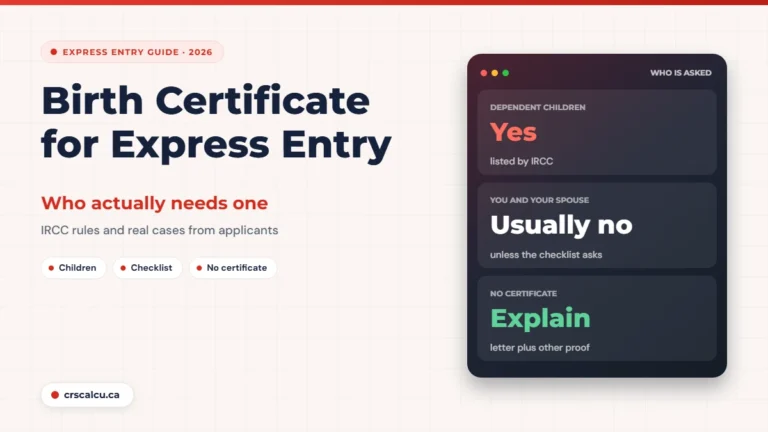
In October 2018, an invited applicant worried about a replacement birth certificate, a reissued marriage certificate with a new serial number, and a diploma showing a middle initial where another showed the full name. Members said they were overthinking it. Replacements are fine. The advice was a brief note as the first page of the relevant file.
The pattern is the same in both: put the explanation next to the thing it explains, as page one of that file. The officer looking at your proof of funds then sees the note about your proof of funds.
Real case: the upload field that vanished
In August 2017, an invited applicant found that the Letter of Explanation slot they had seen in their checklist was gone after they finished the forms. Clearing the browser cache brought it back, and they submitted three days later. Others reported the same glitch through 2020, and some fixed it by switching browsers.
If a general slot for a letter appears in your checklist, use it for anything that does not belong to a single document. If it does not appear, the section-by-section method covers you.
Explanations People Commonly Need
Issue | Core of the explanation | Proof |
|---|---|---|
Employer will not issue a full reference letter | What you asked for, who refused, what you provide instead | Emails, contract, pay records |
Company closed | When it closed and how you tried to reach former managers | Public record of closure, old documents |
Gap in personal history | What you were doing in those months | Nothing, or travel or study records |
Name spelled differently | That both spellings are you, and why | Documents that show both |
Certificate delayed | Date requested and expected date | Receipt and tracking |
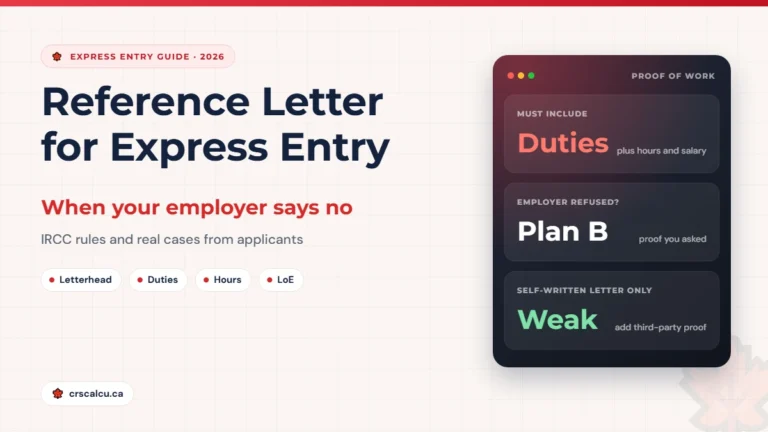
Examples drawn from applicant reports. Proof of work experience has its own rules. See our guide to the reference letter for Express Entry.
Real case: old letters for jobs with no points claimed
In April 2018, an invited applicant had listed past jobs for themselves and their spouse without claiming points for them. The old reference letters lacked duties, salary and hours, and new ones could not be obtained. Members noted that full proof matters most where points are claimed. A later poster who explained honestly reported approval within a month.
That case shows a letter doing its real job. It did not hide the weak documents. It told the officer what they were, why nothing better existed, and that no points depended on them.
Before You Upload
Final check
If the missing item is your medical exam or an ECA close to expiry, check those guides first. Some gaps cannot be fixed with a letter, and it is better to know before day 60.
Frequently Asked Questions
What is a letter of explanation in Express Entry?
It is a short letter you upload to explain a missing, delayed or unusual document. IRCC tells applicants who cannot get a required document to write a letter explaining why and to attach supporting proof.
Where do I upload a letter of explanation?
IRCC says to combine the letter and its supporting documents into one file and upload it where the missing document goes. Applicants also place explanations as the first page of the related section’s file.
Does a letter of explanation guarantee my application is accepted?
No. IRCC states that sending a letter and proof of your efforts does not guarantee acceptance. The officer decides whether the application is complete.
What happens if I skip a document without explaining?
The application can be found incomplete. IRCC says an incomplete Express Entry application is rejected and the processing fees are refunded.
How long should a letter of explanation be?
As short as the facts allow. One page is usually enough: what is missing, why, what you did, and what you attached.
Do I need a letter if my documents are complete?
No. If everything matches the checklist, an extra letter adds nothing. Write one only when an officer would otherwise be left with a question.
Not invited yet? Start with your score
See where your CRS score stands, so you know how soon these documents will matter.
Final Thoughts
A letter of explanation for Express Entry is a small document with a large job. It answers the officer’s question before the officer has to ask it, and it stops an empty upload slot from being read as an incomplete application.
Keep it to the facts, attach the proof, and put it where the problem is. Then keep copies. If the officer does write back, you will want to answer the same day.