Express Entry Guide · Updated October 2026
Co-op Work Experience in Express Entry: Why It Does Not Count for CEC and What It Is Still Good For (Real Cases)
Twelve months of real work at a real Canadian company, and the form says it counts for nothing. Here is the rule, the narrow exception, and how to make co-op pay off anyway.
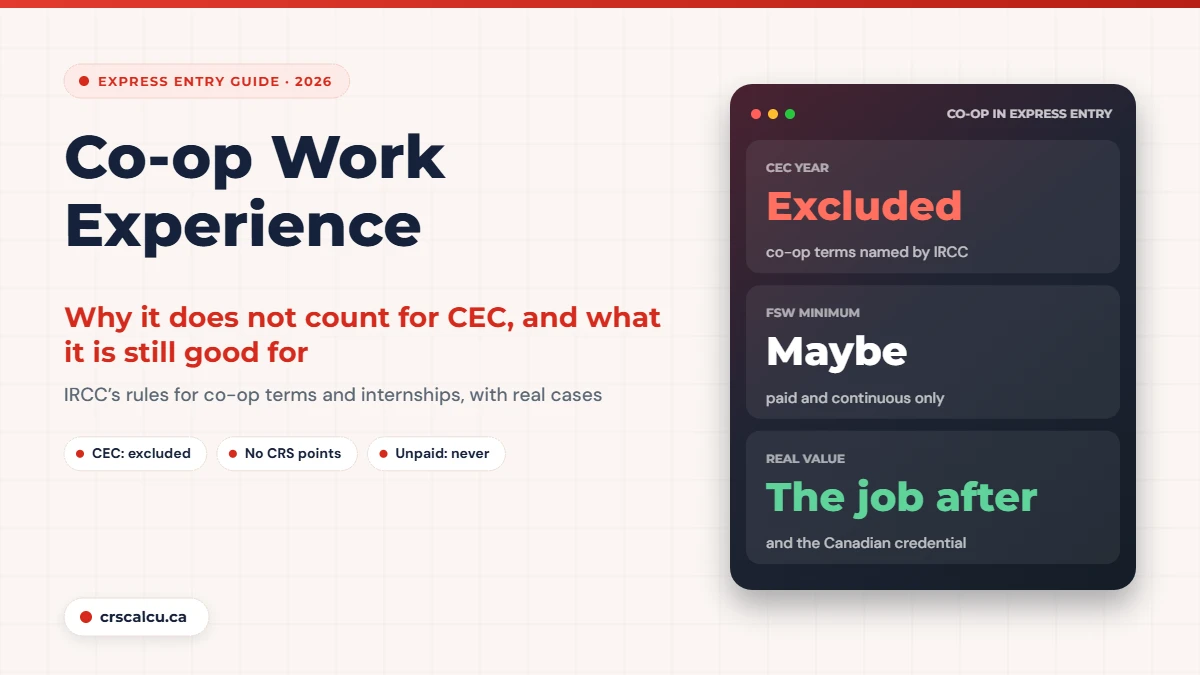
Co-op work experience is the hardest thing to explain to an international student in Canada. You were hired, trained and paid. You worked 40 hours a week for three terms. Your manager wants you back. And when you open an Express Entry profile after graduation, none of it moves your score.
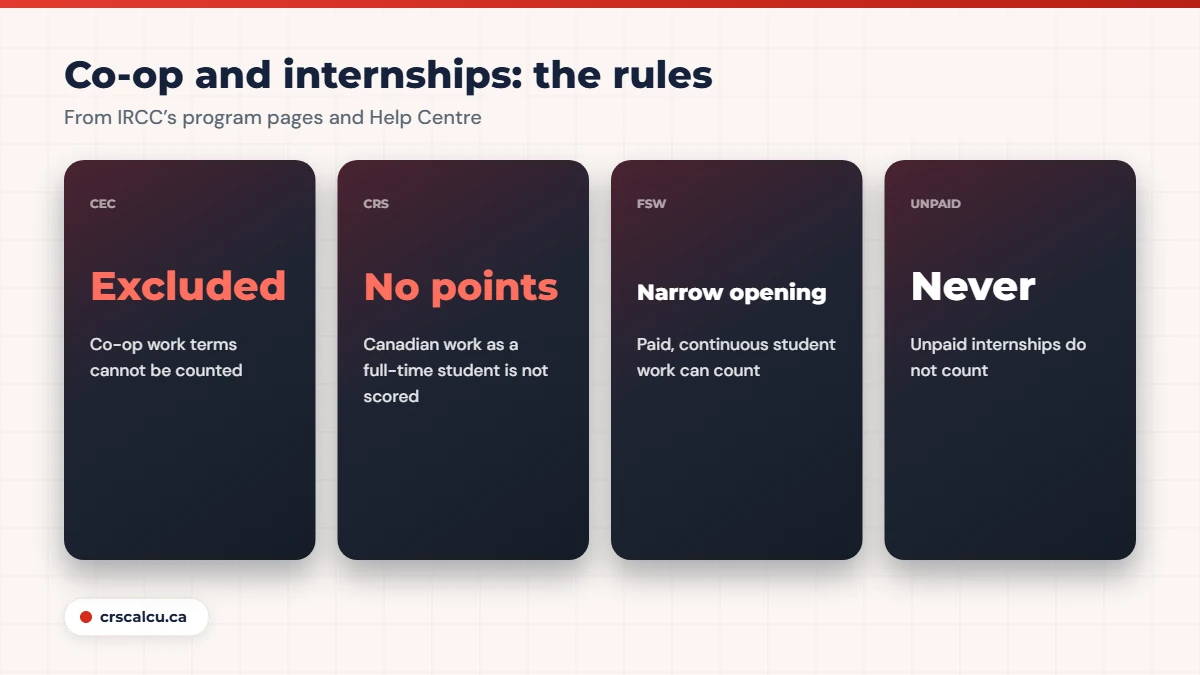
IRCC is unusually explicit about this. Co-op work terms are named on the Canadian Experience Class page as work you cannot count, and a Help Centre answer uses co-op as its example of experience that does not qualify. The reasoning is that co-op is part of your program of study, done while you are a full-time student.
We read those pages and the rules for the Federal Skilled Worker Program and the ranking system, along with four public forum threads from 2015 and 2016 where students asked the same question in different ways, including one where the answers disagreed. This post covers what the rule says, where there is a narrow opening, and what co-op is still worth.
Quick answer: does co-op work experience count for Express Entry?
Not for the Canadian Experience Class and not for Canadian work experience points. IRCC’s program page (modified September 24, 2026) lists co-op work terms among work you cannot count, and its Help Centre says experience gained while studying full time on a study permit, for example on co-op, does not count. Paid student work can count toward the Federal Skilled Worker Program minimum if it was continuous. Unpaid internships never count. For other jobs held while studying, see student work experience.
Key takeaways
What IRCC says about co-op work experience
There are three official statements, and they agree.
Source | What it says |
|---|---|
Canadian Experience Class page | You cannot count work done while a full-time student, or co-op work terms |
Help Centre, back in school | Work experience gained while studying full time on a study permit, for example on co-op, does not count |
Help Centre, student work | Student work does not count toward the Canadian Experience Class or Federal Skilled Trades minimum |
Help Centre, ranking | Canadian work experience gained while a full-time student does not count toward the ranking score |
Federal Skilled Worker Program page | Student work can count if it was paid by wages or commissions and was continuous |
Both program pages | Volunteer work and unpaid internships do not count |
Our summary of IRCC’s Canadian Experience Class and Federal Skilled Worker Program pages (modified September 24, 2026) and Help Centre answers (modified April 17 and September 1, 2026).
Notice that the exclusion is not about the quality of the job or the employer. A co-op term at a bank and a co-op term at a start-up are treated the same. What matters is that you were a full-time student and the work was part of your program.
Why it does not help with the Canadian Experience Class
The Canadian Experience Class needs one year of skilled work in Canada, or 1,560 hours, in the three years before you apply. Co-op terms are excluded from that year by name. They also earn no points under the Canadian work experience heading of the ranking system, where one year is worth 40 points for a single applicant on IRCC’s criteria page.
Real case: three co-op terms adding up to twelve months (December 2016)
An international student had completed three co-op work terms, twelve months in total, while a full-time student, and asked whether they could be used for the Canadian Experience Class. The reply was direct: work done during full-time studies, co-op included, does not count under that program, and the student would need to build experience after graduating. The poster thanked the member. A later participant in the thread, who had worked during studies outside Canada, was told that foreign experience of that kind could be used under the Federal Skilled Worker Program.
Real case: co-op plus a current job (May 2016)
An IT worker with a job in Canada asked whether the co-op terms from their studies could be added to their profile alongside it. Members answered that employment during full-time study is not included in the calculation, and that work done as part of an official co-op program on student status does not qualify. They added that work done outside Canada while studying may count for the Federal Skilled Worker Program, though not for the Canadian Experience Class. The poster said the question was answered.
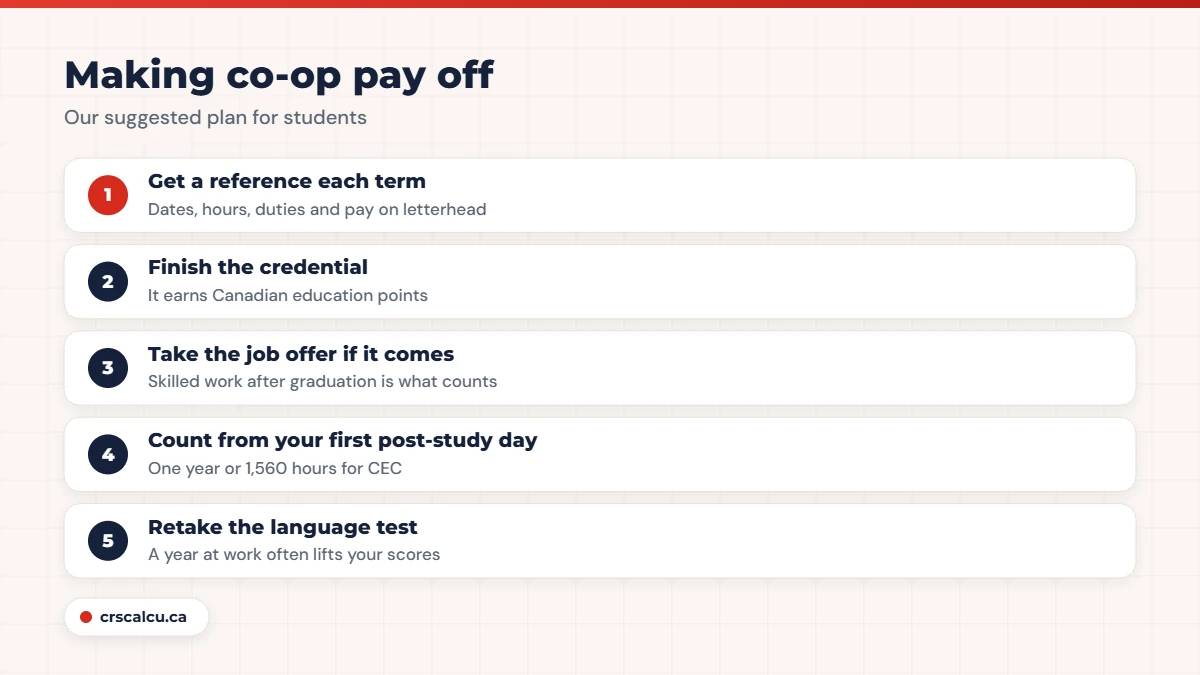
The practical consequence: your Canadian experience clock starts after you finish your program, when you begin skilled work on a post-graduation work permit. Our guide to the Canadian Experience Class covers that year.
The Federal Skilled Worker opening, and why it is narrow
IRCC’s Help Centre says student work experience gained while studying in Canada or abroad counts toward the Federal Skilled Worker minimum if it was paid, continuous and meets the other requirements. The program page asks for at least one year of continuous work, or 1,560 hours, in a skilled occupation that matches your primary occupation.
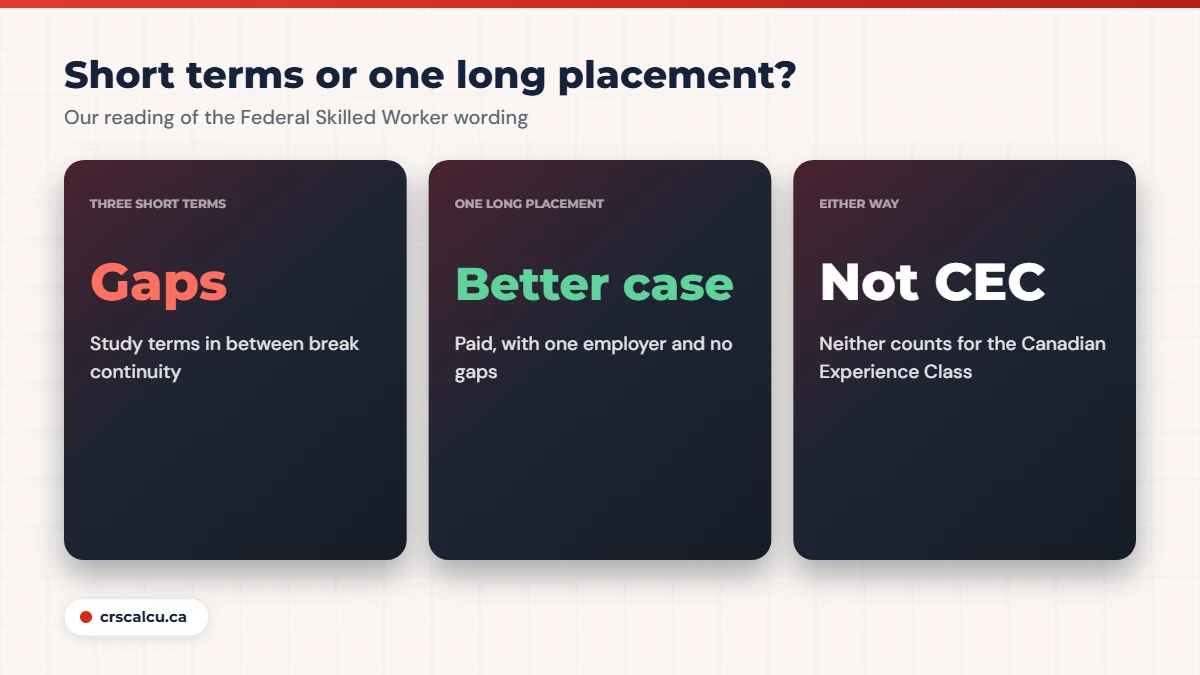
Our reading of how that applies to co-op: a single long placement stands a better chance than several short ones. Three four-month terms with study terms in between, or with different employers, have gaps, and the page’s wording for student work is “no gaps in employment”. A sixteen-month paid internship with one employer is a different animal.
Real case: a sixteen-month paid internship, and conflicting advice (January 2016)
A graduate with a Canadian degree and one year of work after graduation had a score of about 460 and wanted to add a sixteen-month, full-time, paid internship done during university. The first replies said work done as a student in Canada could not be counted for the Canadian Experience Class and was not foreign experience either. Later, an experienced member said they had been told more than once by immigration officials that paid internships done on a work permit do count toward the Federal Skilled Worker Program, like paid teaching assistant work. The poster was left unsure whether to claim it, and another member suggested looking at provincial programs. No outcome was reported.
That uncertainty is the honest state of things. The official text allows paid, continuous student work for one program’s minimum. It does not turn the same work into Canadian work experience points. If you would still be eligible and above the cut-off without the internship, the cautious choice is to list it in your history without relying on it.
Real case: summer internships claimed, then second thoughts (May 2015 to February 2016)
A graduate student asked whether full-time paid summer internships counted for the Federal Skilled Worker Program, since they were not taking classes in those months. One early reply suggested they could. A later, detailed answer said that work done in Canada while holding full-time student status does not count toward ranking points even in a term without courses, and that work inside Canada cannot be treated as foreign experience. Several readers became worried about profiles they had already submitted. One had received a provincial nomination after claiming work done during studies and did not know how the federal stage would treat it.
We could not confirm the “even in a term without courses” point on an official page. It is, however, the conservative reading, and the people in that thread who had claimed the work were the ones losing sleep.
Unpaid internships
This part has no grey area. Both program pages say counted work must be paid, by wages or commission, and that volunteer work and unpaid internships do not count. An unpaid placement still belongs in your history so that there are no gaps, and it can be worth a great deal as a route to a paid job. It is never work experience for Express Entry purposes.
What co-op is still good for
None of this makes co-op a waste. It simply pays off indirectly.
Where co-op helps your application
Ask for the letter while people remember you
Request a reference letter at the end of each work term, on letterhead, with dates, hours per week, duties and pay. You may not be able to claim the months, but if a later officer wants to understand your history, a letter written at the time is far better than one requested five years on.
How to enter co-op in your profile
Our suggested approach
Five mistakes with co-op work experience
Five mistakes from the rules and the threads
To see what your profile looks like without the co-op months, enter your post-graduation experience in the CRS calculator and compare the result with the latest draw cut-offs.
Frequently Asked Questions
Does co-op work experience count for Express Entry?
Not for the Canadian Experience Class and not for Canadian work experience points. IRCC lists co-op work terms among work you cannot count, because it is done while you are a full-time student.
Does a paid co-op count for the Federal Skilled Worker Program?
IRCC says student work can count toward that program’s minimum if it was paid and continuous. Separate short work terms with gaps between them are unlikely to meet the continuity wording. A single long paid placement has a better case, and forum advice on it has been mixed.
Do unpaid internships count?
No. IRCC’s program pages say volunteer work and unpaid internships do not count.
Can I claim Canadian co-op as foreign work experience?
No. Foreign work experience is work done outside Canada. Forum members were clear that experience gained inside Canada cannot be entered as foreign.
When does my work start counting after graduation?
From when you are doing skilled work in Canada with authorization and are no longer a full-time student, typically on a post-graduation work permit. IRCC’s public pages do not define the exact changeover day, so keep your completion letter and permit dates.
Should I still list co-op in my Express Entry profile?
Yes. Your work and personal history should be complete. List each term and show that you were a full-time student at the time, so it is recorded without being counted.
See your score with the experience that counts
Leave out the co-op months, add your post-graduation work, and compare the result with recent cut-offs.
Final Thoughts
Co-op work experience is excluded from the Canadian Experience Class and from Canadian work experience points because it happens while you are a full-time student. The Federal Skilled Worker Program leaves a narrow opening for paid, continuous student work, and unpaid placements count nowhere. The real return on co-op is the job it leads to, the credential it belongs to and the reference it leaves behind.
If your eligibility or your score depends on a long paid internship done during your studies, or if you have already submitted a profile that counts co-op months, speak to a licensed consultant or lawyer before you accept an invitation. It is much easier to correct a profile than an application.