Express Entry Guide · Updated October 2026
Maintained Status and Express Entry: Does Work Count While Your Permit Extension Is Pending? (Real Cases)
Your permit has expired on paper and your application is in. You are still at your desk. Is that time legal, and will it count toward permanent residence?
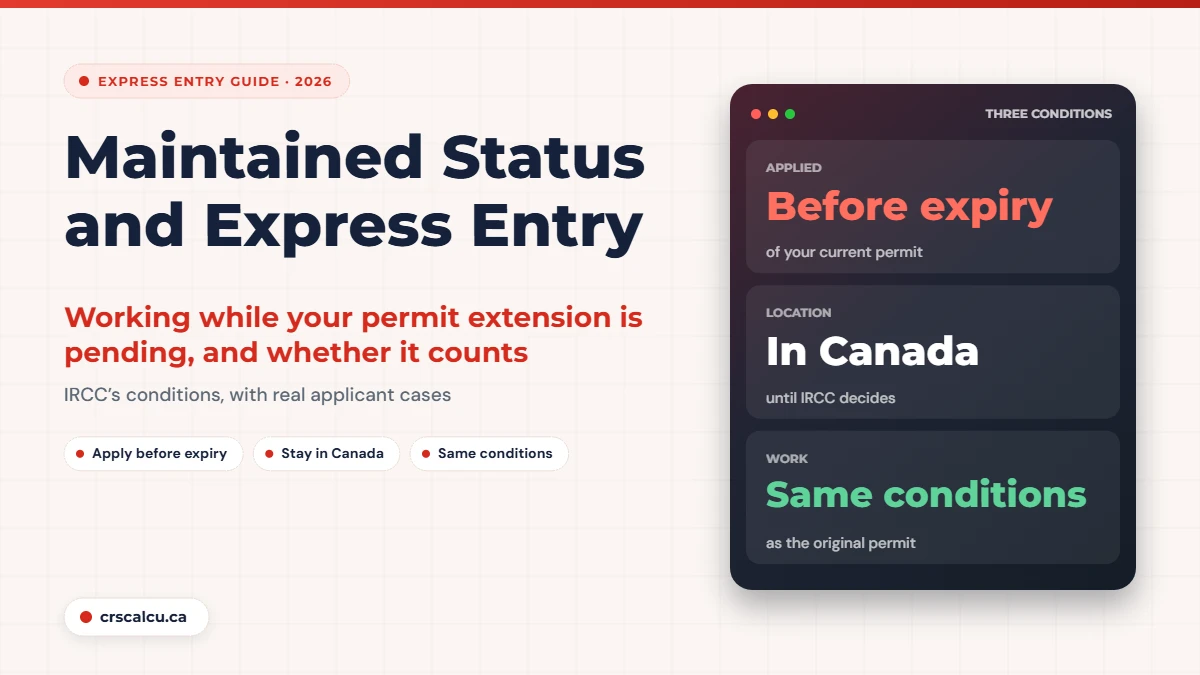
Maintained status is the stretch between the day your work or study permit expires and the day IRCC decides the application you filed to extend or change it. Older posts and many employers still call it implied status. For applicants building a year of Canadian experience, it is often a slice of several weeks or months sitting right in the middle of the period they need to count.
Two questions come up every time. Can I keep working? And does the work I do in that window count for Express Entry? IRCC answers the first one clearly. It does not answer the second in so many words, so you have to put two rules side by side.
We read IRCC’s page on expiring work permits, its Help Centre answer on working after a permit expires, the Canadian Experience Class requirements and the bridging open work permit page, along with three public forum threads from 2018 to 2021 where graduates and workers asked exactly this.
Quick answer: can I work on maintained status, and does it count?
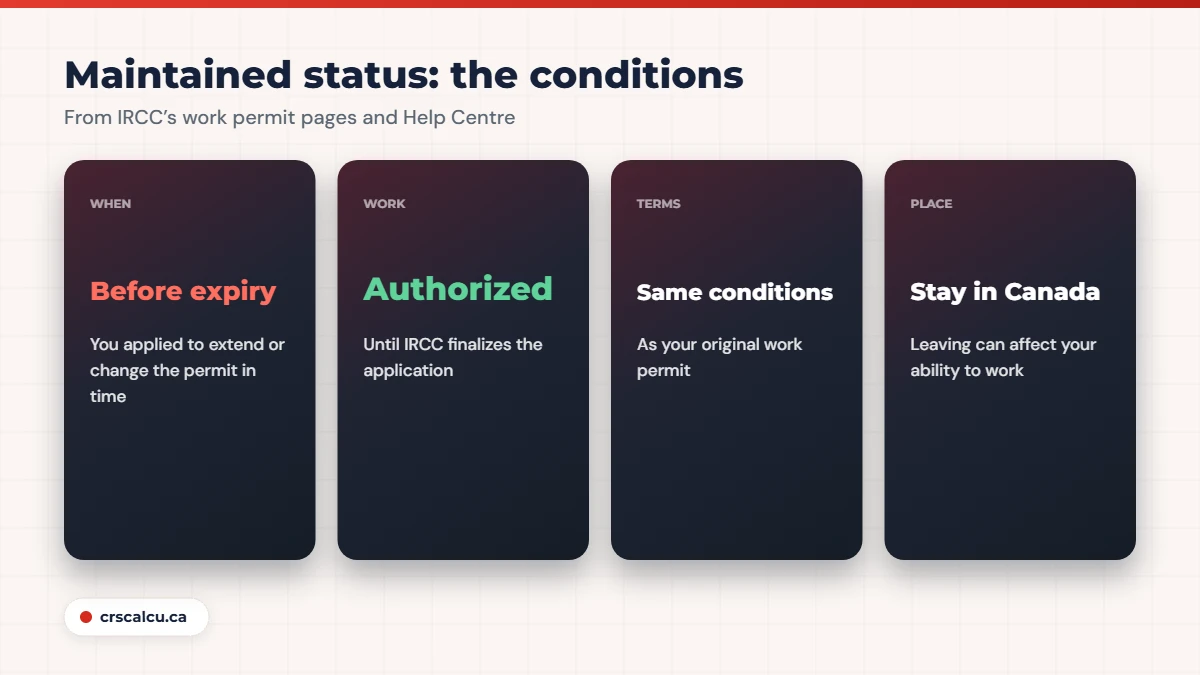
IRCC’s Help Centre (modified September 1, 2026) says that if you applied to extend or change your work permit before it expired, you have maintained your status and are authorized to work until the application is finalized, as long as you stay in Canada and work under the same conditions as your original permit. The Canadian Experience Class counts skilled work done in Canada while you had temporary resident status and were allowed to work. Put together, authorized work on maintained status is ordinary Canadian experience, and forum applicants were consistently told the same.
Key takeaways
What maintained status is
IRCC’s page “What to do if your work permit expires or is expiring” (modified July 17, 2026) describes it through its effect. If you apply to renew or change the conditions of your work permit before it expires, you are authorized to work without a permit until IRCC makes a decision on your application, as long as you stay in Canada, and you must work under the same conditions as your current permit.
The Help Centre says the same in one sentence and uses the term: if you applied before your work permit expired, you have maintained your status and are authorized to work until the application is finalized. “Implied status” was the earlier name for the same thing.
Question | What IRCC says |
|---|---|
When do I have it? | When you apply to extend or change your permit before it expires |
Can I keep working? | Yes, until IRCC finalizes the application |
On what terms? | The same conditions as your original work permit |
Employer-specific permit? | Keep working for the employer named on the original permit until a decision |
Can I leave Canada? | You must stay in Canada; leaving could affect your ability to work when you return |
How do I show my employer? | With the confirmation that you submitted your application |
Our summary of IRCC’s expiring work permit page (modified July 17, 2026) and Help Centre answer (modified September 1, 2026).
Does work on maintained status count for Express Entry?
IRCC does not have a line that says “work on maintained status counts”. It has two rules that meet.
The first is the one above: on maintained status you are authorized to work. The second is on the Canadian Experience Class page (modified September 24, 2026): the year of skilled work must be gained in Canada while you had temporary resident status, and you cannot count work done when you were not legally allowed to work in Canada. Work that is authorized, done in Canada, by someone whose status is maintained, falls on the right side of both.
IRCC’s bridging open work permit page points the same way. Among those who can apply, it lists people whose work permit has expired but who have maintained their worker status. The system treats maintained status as a continuation, not a gap.
Real case: study permit expired in March, permit arrived in September (July 2021)
A graduate had been working full-time in a skilled job since March 2020. Their study permit expired on March 30 and their post-graduation work permit was not issued until September. They asked whether the months in between counted toward the Canadian Experience Class. Members asked one thing: when did you apply? The answer was March 13, before the expiry. On that basis they said the hours counted, provided the applicant had been working within the conditions that applied to them. The poster thanked them and did not report further.
That case turned on a single date. Had the application gone in on April 2, the answer would have been different.
The graduate version: waiting for a post-graduation work permit
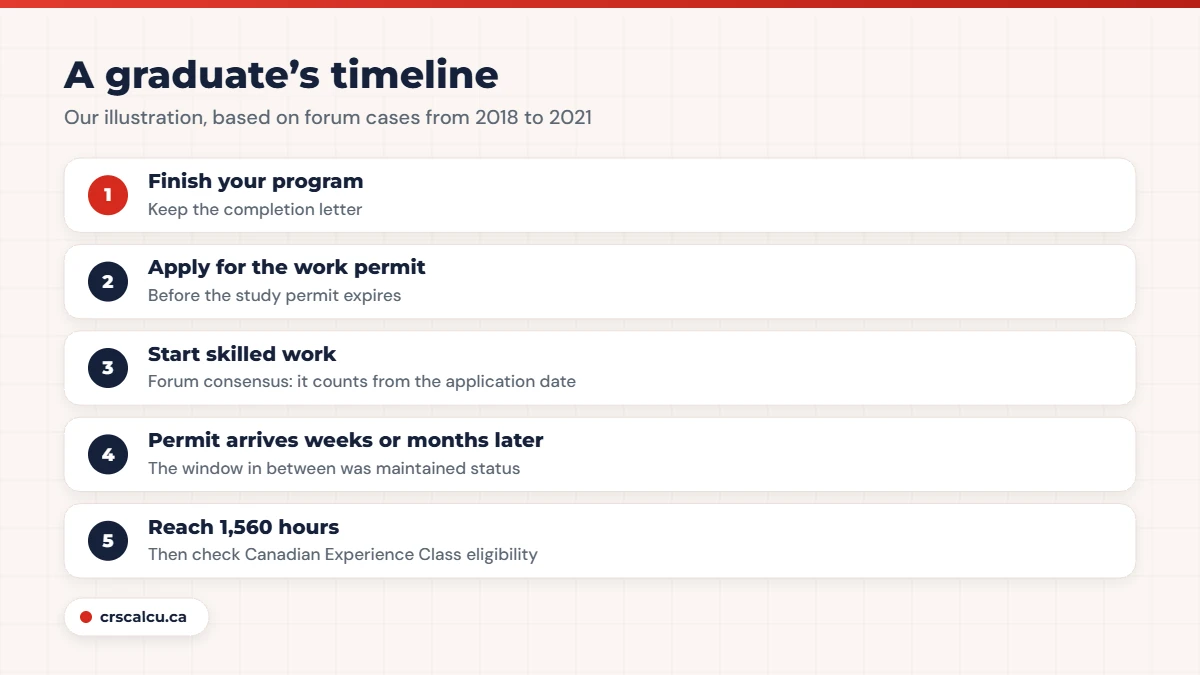
For international students the window opens the moment they finish their program. They apply for a post-graduation work permit, start a job, and wait.
Real case: started work the day after applying (August 2018)
A graduate finished on September 1, 2017, applied for a post-graduation work permit on September 3 and started a full-time skilled job on September 4. The permit was approved on November 2. They asked whether their year ran from September or from November. The first reply said from approval. Others corrected that, citing IRCC, and said work is authorized from the date the permit application was submitted, as long as you applied before starting. The thread settled on counting from the application date. No final outcome was posted.
Real case: “from when you applied”, not from when you finished (February 2021)
A graduate who waited two months for the permit document asked whether work in that period counted. A member said yes, once the application was in, and pointed to a public IRCC statement. In a 2024 follow-up another experienced member tightened the wording: count from the time you applied for the permit, not from the day you completed your program.
Our reading of those threads, and of IRCC’s exclusion of work done as a full-time student: start your count on the later of two dates, the day you were no longer a student and the day you submitted your permit application. Keep the completion letter and the submission confirmation, because together they prove the start date. Jobs you held before that point are covered in student work experience.
Our example: counting a year with a window in the middle
This is our own illustration, not a real applicant. A worker’s employer-specific permit expires on June 30. They apply to extend it on June 10, keep working for the same employer in the same job, and stay in Canada. The new permit is issued on October 15.
From July 1 to October 15 they were on maintained status. Because the application went in before the expiry and nothing about the job changed, that work was authorized. If they started the job on January 2, their year of experience is complete on January 1 of the following year, with the three and a half months of maintained status counted like any other. What they need in the file is the June 10 submission confirmation, so that an officer can see why work continued after June 30.
Change one fact and the picture changes. If the application had been submitted on July 5, there would be no maintained status, and the work after June 30 would not count.
What can break it
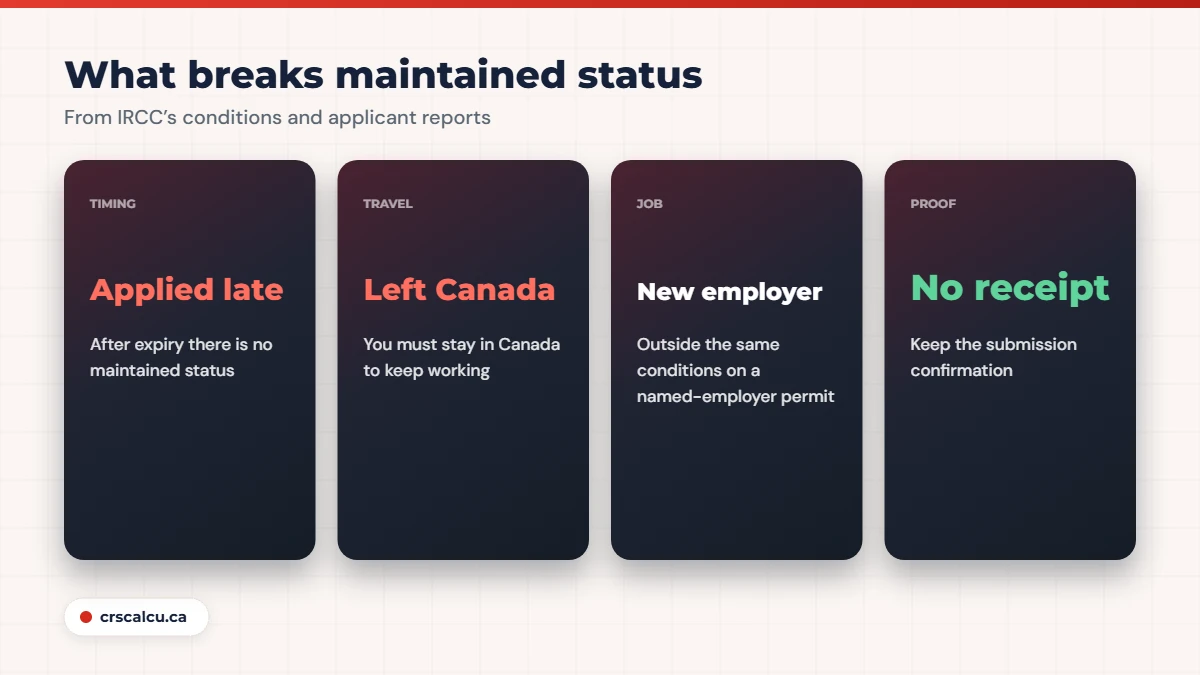
Maintained status is conditional, and each condition is a way to lose it.
Conditions that matter
The pages we read did not cover what happens after a refusal or during an application to restore status, so we will not guess at those rules here. What the Canadian Experience Class page does say is enough to be careful: work done when you were not legally allowed to work does not count.
One trip can cost you months
The most avoidable mistake in this window is a short trip abroad. Before you book anything while an extension is pending, read IRCC’s warning again: you must stay in Canada to keep working under maintained status. If the trip cannot wait, get advice first.
How to document the window
An officer reading your file later will see a permit that ended on one date and a new one that began months afterwards. Close that gap for them.
Keep these together
In your profile, the period is entered as normal work in Canada. The 1,560 hours are counted the usual way: see 1,560 hours for Express Entry.
Maintained status after you apply for permanent residence
The same idea matters at the other end of the process. If your work permit is running out while your permanent residence application is being processed, the bridging open work permit exists to cover the gap, and you need your acknowledgment of receipt to apply for it: see AOR in Express Entry. Apply before the current permit expires and you remain authorized to work while that application is decided. If your job changes during this time, tell IRCC through the IRCC web form.
Five mistakes people make on maintained status
Five mistakes from the rules and the threads
If the window counts, add it to your Canadian experience and run the numbers in the CRS calculator, then compare with the latest draw cut-offs.
Frequently Asked Questions
What is maintained status?
It is the period after your permit expires while IRCC is deciding an application you made, before the expiry, to extend or change it. IRCC says you are authorized to keep working until the application is finalized, under the same conditions, as long as you stay in Canada.
Is maintained status the same as implied status?
Yes. Implied status is the older term for the same situation, and many forum posts and employers still use it.
Does work on maintained status count for the Canadian Experience Class?
IRCC does not say so in one sentence, but work on maintained status is authorized, and the program counts skilled work done in Canada while you had status and were allowed to work. Forum applicants in 2018 and 2021 were told it counts.
From what date does work count after I graduate?
Forum consensus, citing IRCC, is from the date you submitted your post-graduation work permit application, once you had completed your program. Keep your completion letter and the submission confirmation.
Can I travel while on maintained status?
IRCC says you must stay in Canada to keep working under maintained status, and that leaving could affect your ability to work when you return.
Can I change jobs on maintained status?
You must work under the same conditions as your original permit. If it names an employer, IRCC says to keep working for that employer until a decision is made on your application.
Counted the window? Check your score
Add your authorized work to your Canadian experience and compare your points with recent Express Entry cut-offs.
Final Thoughts
Maintained status keeps you working while IRCC decides, and work done lawfully in that window is Canadian experience like any other. Everything depends on four facts: you applied before the permit expired, you stayed in Canada, you kept to the same conditions, and you can prove the dates.
If you applied after your permit expired, left Canada while an extension was pending, changed employers before a new permit was issued, or received a refusal, speak to a licensed consultant or lawyer before you count any of that time. Whether work was authorized is the kind of question an officer checks closely.