Express Entry Guide · Updated October 2026
Student Work Experience in Express Entry: Part-Time Jobs, TA Work and What Counts Where (Real Cases)
You worked 20 hours a week through a four-year degree. Whether that is worth anything in Express Entry depends on where you studied and which rule is asking.
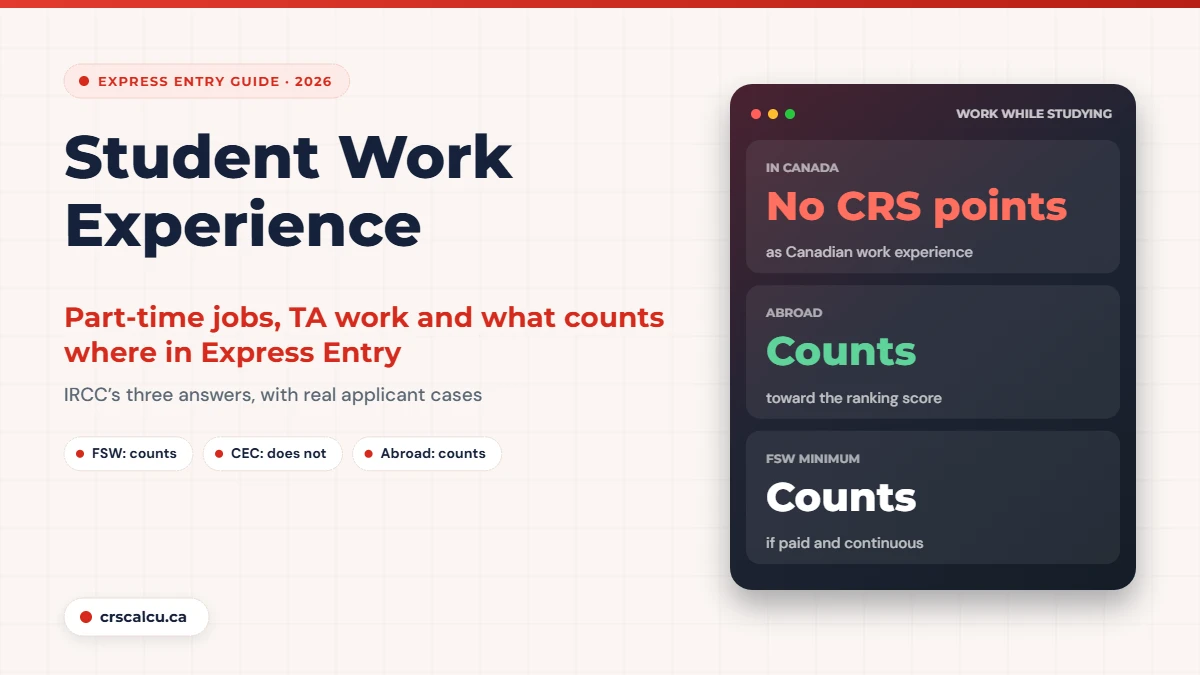
Student work experience is where international graduates most often overestimate their Express Entry profile. The job was real, it was skilled, the pay stubs exist. Then they read the fine print and find that a year as a teaching assistant during a master’s in Toronto counts for nothing, while a classmate’s part-time job during a degree in Manchester counts in full.
The rule is not arbitrary, but it is split across three places: the minimum requirements of each program, the points for Canadian work experience, and the points for foreign work experience. IRCC answers the question directly in one Help Centre entry, and most forum arguments would end faster if people read it first.
We read that Help Centre answer, IRCC’s pages for the Canadian Experience Class and the Federal Skilled Worker Program and the ranking criteria, along with four public forum threads from 2016 to 2018 in which students and graduates tried to work out what they could claim.
Quick answer: does student work experience count in Express Entry?
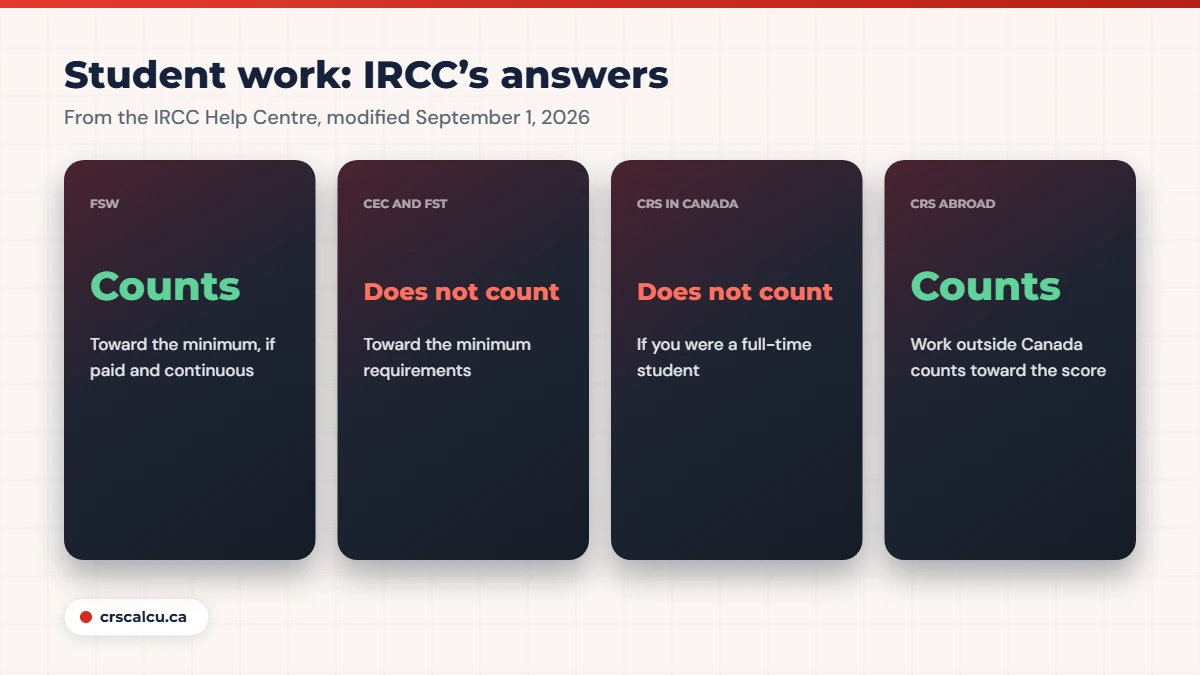
IRCC’s Help Centre (modified September 1, 2026) gives three answers. For the Federal Skilled Worker Program, work done while you were studying, in Canada or abroad, counts toward the minimum if it was paid, continuous and meets the other requirements. For the Canadian Experience Class and the Federal Skilled Trades Program, it does not count. For your ranking score, Canadian work done while you were a full-time student does not count, but work experience outside Canada does. The hours themselves are explained in 1,560 hours for Express Entry.
Key takeaways
What IRCC says about student work experience
The answer is in the Help Centre entry “Can I count student work experience toward the Express Entry work requirement?” Here it is as a table, alongside what the program pages add.
Where | Work while studying in Canada | Work while studying abroad |
|---|---|---|
Federal Skilled Worker minimum | Counts, if paid and continuous | Counts, if paid and continuous |
Canadian Experience Class minimum | Does not count | Not relevant: the program looks only at work in Canada |
Federal Skilled Trades minimum | Does not count | Does not count |
CRS: Canadian work experience points | Does not count if you were a full-time student | Not applicable |
CRS: foreign work experience | Not applicable | Counts toward the ranking score |
Our summary of the IRCC Help Centre answer on student work experience (modified September 1, 2026) and the program pages (modified September 24, 2026).
The Canadian Experience Class page repeats the exclusion in its own list: you cannot count work done while you were a full-time student, and it names co-op work terms separately. The Federal Skilled Worker Program page says student work can count if it was paid by wages or commissions and was continuous, with no gaps in employment.
Studying in Canada: why the campus job earns no CRS points
For most international students in Canada, this is the line that matters. The ranking system awards points for Canadian work experience: 40 points for one year if you have no spouse or partner on the application, rising to 80 for five years or more, according to IRCC’s criteria page (modified June 22, 2026). Work done in Canada while you were a full-time student is left out of that count.
Real case: four years as a teaching and research assistant (February 2016)
A poster asked on behalf of a friend who was doing a PhD in Canada after a master’s there, and who had worked part-time as a research and teaching assistant for four years. Could those jobs be added up to a year of full-time experience? The first replies said no, citing the rule that work done while enrolled in full-time study is excluded. Others pointed out that the Federal Skilled Worker Program accepts paid, continuous work, including part-time equivalents. A later post settled the points question: under the ranking system, Canadian work is not counted if you were studying full-time while doing it. No outcome was reported.
That thread shows the two-gate problem clearly. The assistantships might help someone meet the Federal Skilled Worker minimum. They would not add Canadian work experience points, and they would not open the Canadian Experience Class.
What does count is what you do after you finish. Skilled work on a post-graduation work permit is ordinary Canadian experience, and one year of it is the usual route into the Canadian Experience Class. Your studies are not wasted either: a Canadian credential earns its own points, which we cover in Canadian education points.
Studying abroad: where a part-time job can count in full
Outside Canada the picture reverses. The Help Centre says work experience outside Canada counts toward the score used to rank your profile, and the Federal Skilled Worker Program accepts student work toward its minimum. The work still has to be skilled, paid and long enough.
Real case: 20 hours a week for four years on a student visa (February 2017)
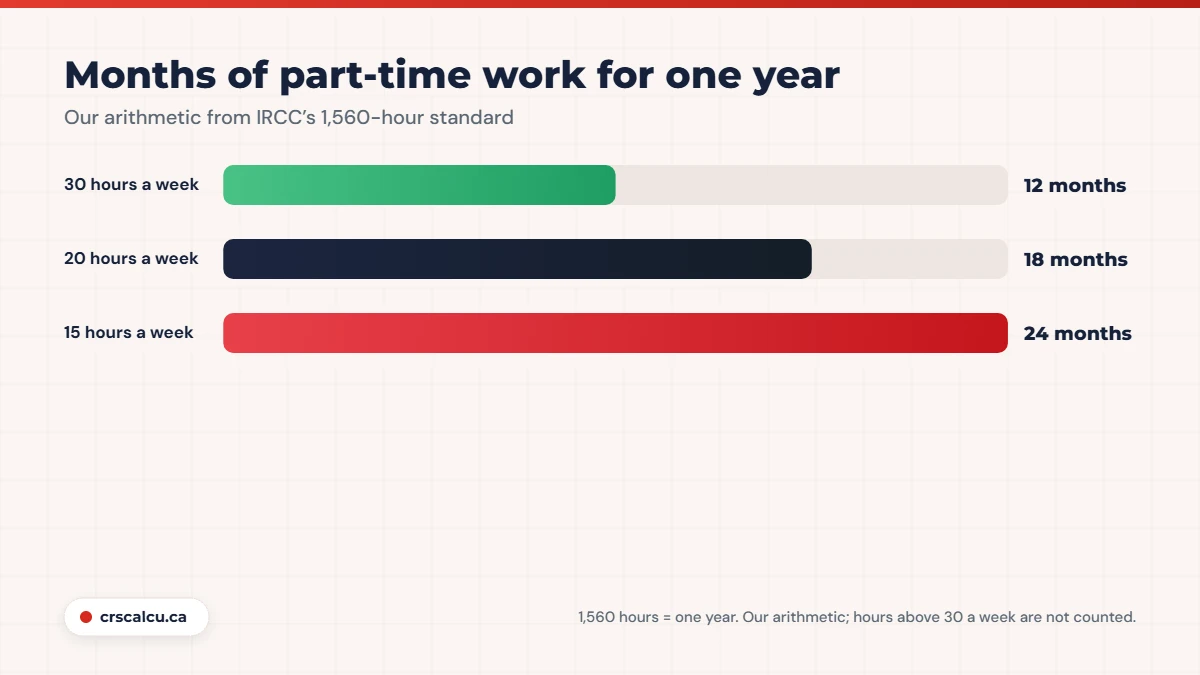
An applicant had studied in the United Kingdom on a student visa and worked 20 hours a week for more than four years in a skilled occupation. They asked whether it qualified. Members drew the distinction between Canada and elsewhere: work in Canada on a study permit does not count for the Canadian Experience Class, but foreign experience is treated differently, and for the Federal Skilled Worker Program it generally counts whether or not you were studying. They listed the conditions: continuous, paid, and enough hours, with 20 hours a week needing at least a year and a half to equal one full-time year. No final outcome was reported.
Their arithmetic is right. IRCC’s standard is 1,560 hours for one year, based on 30 hours a week. At 20 hours a week that takes 78 weeks, or about 18 months. At 15 hours a week it takes two years. Four years at 20 hours a week comes to roughly 2.7 full-time years. Our foreign work experience guide explains how those years turn into points.
Real case: “do part-time jobs get fewer points?” (August 2018)
A poster assumed part-time work earned reduced points and asked whether part-time work as a full-time student could be used at all. The reply corrected both ideas. Part-time and full-time work earn the same points once the hours add up to the full-time equivalent; the member’s example was 15 hours a week for 24 months equalling one year. But work done in Canada as a full-time student does not count for the Canadian Experience Class. Later posts, in 2021, confirmed that part-time skilled work during studies outside Canada can count for the Federal Skilled Worker Program.
What “full-time student” means for timing
The exclusion is tied to being a full-time student at the time of the work. That raises questions at the edges: the summer between two years of a degree, the weeks after your last exam, a job you kept after switching to part-time study.
IRCC’s public pages do not define those edges, and forum advice conflicts. In one 2015 thread a member said that work done in Canada while you hold full-time student status does not count even in a term when you take no courses. We could not confirm that on an official page. The safe reading is the narrow one: claim Canadian work as Canadian experience only from the point where you had finished your program and held a work permit. If a stretch of work sits in a grey area, explain it in a letter of explanation and do not let your eligibility depend on it.
One official answer does help with a common worry. The Help Centre entry about going back to school (modified April 17, 2026) says that if you graduated, earned one year of skilled work experience and then returned to studies, you can still apply under the Canadian Experience Class, as long as that year falls within the three years before you apply. Becoming a student again does not cancel work you did when you were not one.
Our example: one graduate, three kinds of work
Here is how the rules sort a fairly typical history. This is our own illustration, not a real applicant.
Our example: what counts and what does not
So the same person has one year of foreign experience, one year of Canadian experience, and two years of work that is recorded but not scored. Knowing that in advance is what lets you plan the post-graduation year properly.
How to enter student work in your profile
Our suggested approach
A job can be listed without being claimed
People worry that listing a campus job will look like an attempt to claim it. It is the opposite. Leaving a job out of your history creates an unexplained period. Listing it, with your student status shown, is simply accurate, and the system leaves it out of the Canadian experience total.
Five mistakes with student work experience
Five mistakes from the rules and the threads

Once you know which periods count, enter them in the CRS calculator and compare the result with the latest draw cut-offs. For many graduates the realistic plan is a year of full-time skilled work after graduation, with foreign experience and language scores doing the rest.
Frequently Asked Questions
Does student work experience count for Express Entry?
For the Federal Skilled Worker Program it counts toward the minimum if it was paid and continuous. For the Canadian Experience Class and Federal Skilled Trades Program it does not. For ranking points, Canadian work done while a full-time student does not count, but work outside Canada does.
Do I get CRS points for a part-time job I had while studying in Canada?
No. IRCC’s Help Centre says Canadian work experience gained while you were a full-time student does not count toward your Comprehensive Ranking System score.
Does work during my studies outside Canada count?
IRCC says work experience outside Canada counts toward the score used to rank your profile, and the Federal Skilled Worker Program accepts paid, continuous student work. It must be skilled and add up to enough hours.
How many months of part-time work equal one year?
One year is 1,560 hours. At 20 hours a week that is about 18 months, and at 15 hours a week it is 24 months. Hours above 30 a week are not counted.
Do teaching or research assistant jobs count?
In Canada, if you were a full-time student at the time, they do not count toward the Canadian Experience Class or Canadian work experience points. They may help meet the Federal Skilled Worker minimum if paid and continuous.
I worked for a year, then went back to school. Can I still use that year?
Yes. IRCC’s Help Centre says you can apply under the Canadian Experience Class if you gained at least one year of skilled work in Canada within the three years before you apply, even if you are now studying again.
See what your experience is really worth
Enter only the work that counts and compare your score with recent Express Entry cut-offs.
Final Thoughts
Student work experience follows one pattern: Canada is strict and abroad is generous. Work in Canada while you were a full-time student does not build Canadian experience for the Canadian Experience Class or for ranking points. Skilled, paid work during studies outside Canada can count in full once the hours add up. And under the Federal Skilled Worker Program, student work can help meet the minimum in either place.
If your profile only reaches the cut-off by counting a period when you were also studying, or if your study and work dates overlap in ways the form does not handle well, speak to a licensed consultant or lawyer before you submit. Claimed points that do not hold up are far more costly than a lower score.