Express Entry Guide · Updated October 2026
Lost Job After ITA: What a Layoff Does to Your Express Entry Application (Real Cases)
A layoff in the middle of a permanent residence file feels like the end of it. Usually it is not. Here is what actually depends on the job.
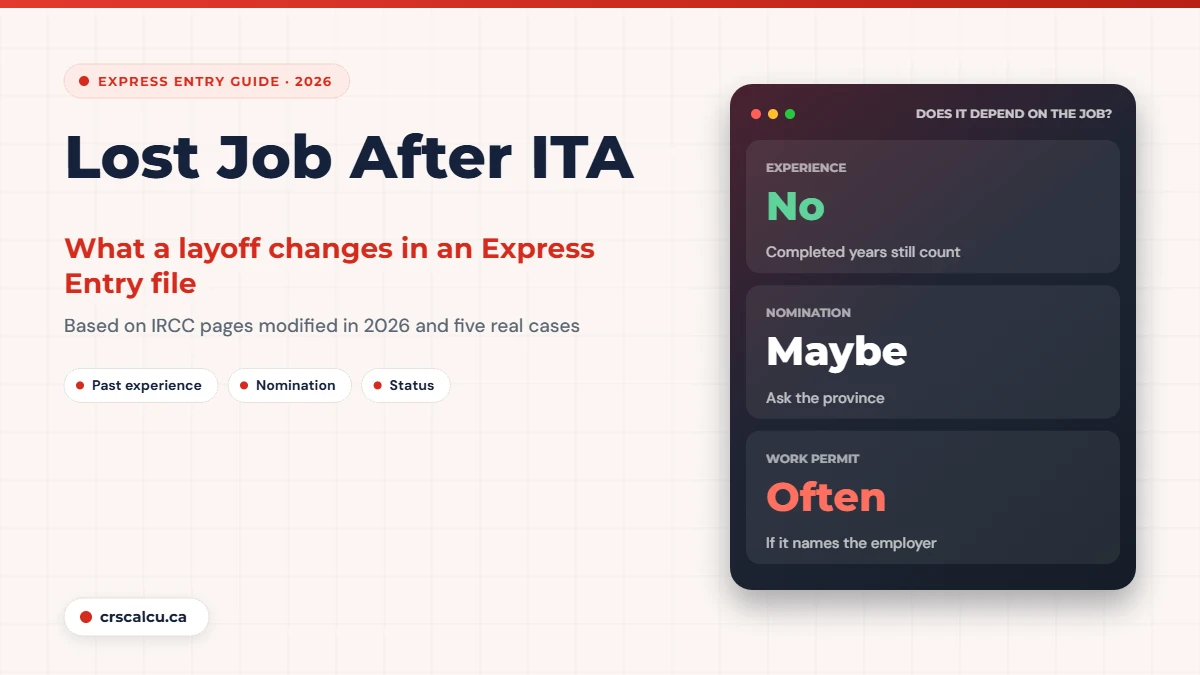
Searching “lost job after ITA” late at night is a rough way to spend an evening. Whether the layoff came on invitation day or a few weeks after you submitted, the first thing to know is that Express Entry mostly rewards what you have already done. Experience you built before the layoff is still yours. The invitation was not a promise from your employer, and a termination letter does not cancel it.
New rules, November 3, 2026: From November 3, 2026, job offers in high-wage occupations earn CRS points again, and an officer checks that every offer is genuine. IRCC pauses rounds for up to two weeks while it recalculates profiles. Check your score under the new rules · IRCC details
The second thing to know is that a few things really do hang on the job: a provincial nomination that was granted because of it, a Federal Skilled Trades application that relies on the offer, a settlement funds exemption, and above all your right to stay and work in Canada if your permit names that employer.
We read IRCC’s pages on invitations, applications, updates, job offers and work permits (all modified in 2026), plus five public forum threads from 2015 to 2024 written by people who were laid off or dismissed mid-process. This is general information, not legal or employment advice.
Quick answer: does losing your job after an ITA end your application?
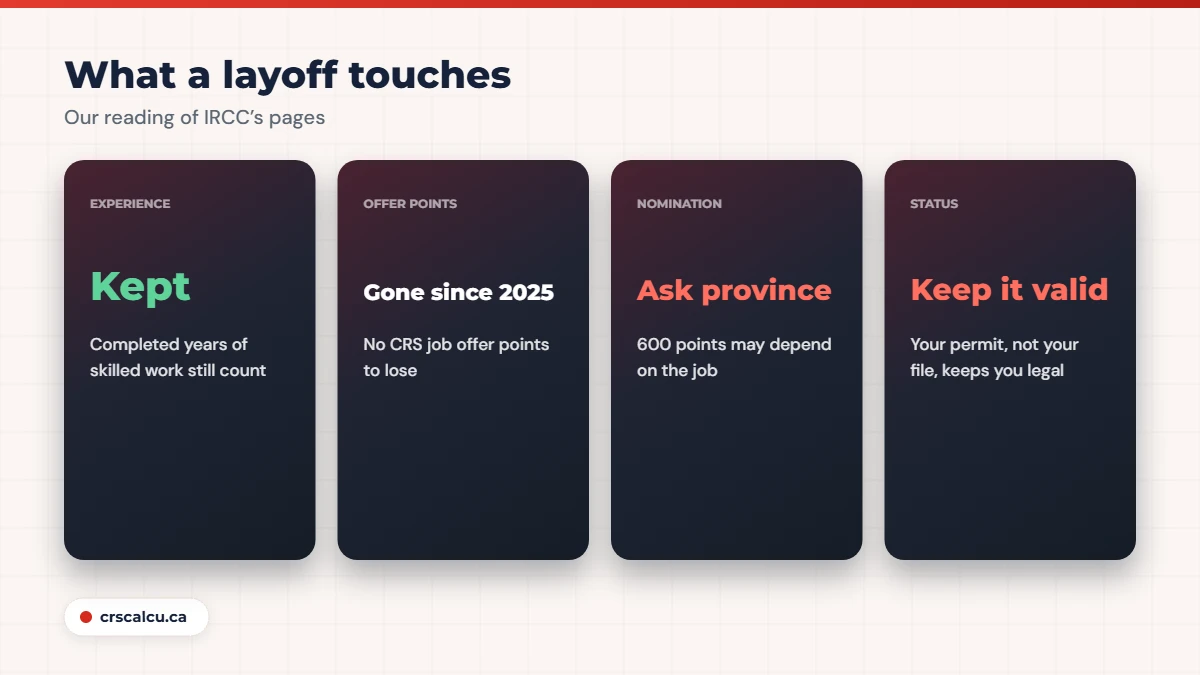
Not by itself. Canadian Experience Class and Federal Skilled Worker eligibility rest on past experience, and the old job offer points were removed from the CRS on March 25, 2025, so a layoff no longer strips 50 or 200 points the way it did in older forum threads; as of November 3, 2026, it matters only if your score included points for a high-wage job offer. What you must do is re-check anything the job was supporting, keep your temporary status valid, show true dates on the form, and tell IRCC after you apply if the change affects your eligibility. Start by re-running your number in our CRS calculator.
Key takeaways
Lost job after ITA: what actually depends on the job
Sort your situation into two piles. In the first pile are things the layoff cannot touch. In the second are things it can.
Item | Depends on the current job? | Why |
|---|---|---|
Canadian work experience points | No | Counted in completed years of past work |
Canadian Experience Class eligibility | No | One year of skilled work in Canada in the last 3 years; no job offer needed |
CRS job offer points | Possibly | Only a valid offer in a high-wage occupation earns 50, 70 or 100 points (as of November 3, 2026) |
Federal Skilled Trades eligibility | Possibly | Needs a valid job offer or a certificate of qualification |
Provincial nomination (600 points) | Possibly | Each province sets its own conditions |
Settlement funds exemption | Yes | Requires a valid job offer and authorization to work |
Your status and right to work in Canada | Often | An employer-specific permit names the employer |
Our summary of IRCC’s CRS criteria, eligibility and job offer pages (all modified June 22, 2026). The middle column is our reading.
IRCC’s job offer page says that, as of November 3, 2026, you don’t need an LMIA for a job offer to qualify, that an LMIA gives no extra CRS points or priority, that offers may be for an existing or a new position and with any employer, and that you don’t need a job offer to be eligible for the Canadian Experience Class. The CRS criteria page counts Canadian work experience in years: 40 points for one year, 53 for two and 64 for three, for a candidate without a spouse. Those years are in the past. A layoff today does not reach back and remove them.
Why the old forum threads sound more frightening
Search for this topic and you will find a decade of threads where losing a job meant losing points. They were right at the time. Read them as history, and for what they show about how IRCC handles a change.
Real case: 539 points, laid off after applying (May 2019)
A Canadian Experience Class applicant whose application was acknowledged on January 4, 2019 was laid off that February from a job that had been supported by a labour market assessment. They told IRCC straight away, applied for a bridging open work permit and found a new offer. IRCC then sent a letter raising concerns about the job offer they had claimed, with seven days to reply. Forum replies pointed out that the class itself needs no job offer; the issue was the 50 points claimed for it under the rules of the day. Their score was 539, so even without those points it was 489, well above the 449 cut-off of their round. One reply doubted they had qualified for the bridging permit when they applied, since their permit ran to September 2019. The applicant planned a detailed reply with documents. No final outcome was reported.
Two lessons survive the rule change. IRCC does look at whether a claim made in the profile was still true, and it may ask with a short deadline. And the test the replies applied, whether you still meet the lowest score of your round without the lost element, is the same one IRCC’s respond-to-invitation page describes today.
Real case: pandemic layoff with offer points (April 2020)
An applicant with 478 points, 50 of them for arranged employment, had an acknowledgment of receipt from March 2020 when their employer proposed a temporary layoff so staff could claim benefits. They feared losing the points and the application. Replies urged them to keep the offer demonstrably alive: stay on reduced pay if possible, or get the employer to confirm in writing that they would be rehired. In June 2020 another applicant wrote that their employer had been closed temporarily, that they too had claimed the offer points, and that they were approved with no request for updated documents. A third expected to be back at work before a decision.
Those points no longer exist, so the specific fear in that thread has gone. What remains useful is the instinct to get things in writing from the employer while they are still answering your emails.
If it happens before you submit
You have 60 days from the invitation, and IRCC’s respond-to-invitation page (modified June 22, 2026) says to re-calculate your score if your situation changes and to decline if it falls below the lowest score invited in your round. For most people who lost a job, the score does not move. Check anyway, then check eligibility.
The first week after a layoff (our suggested order)
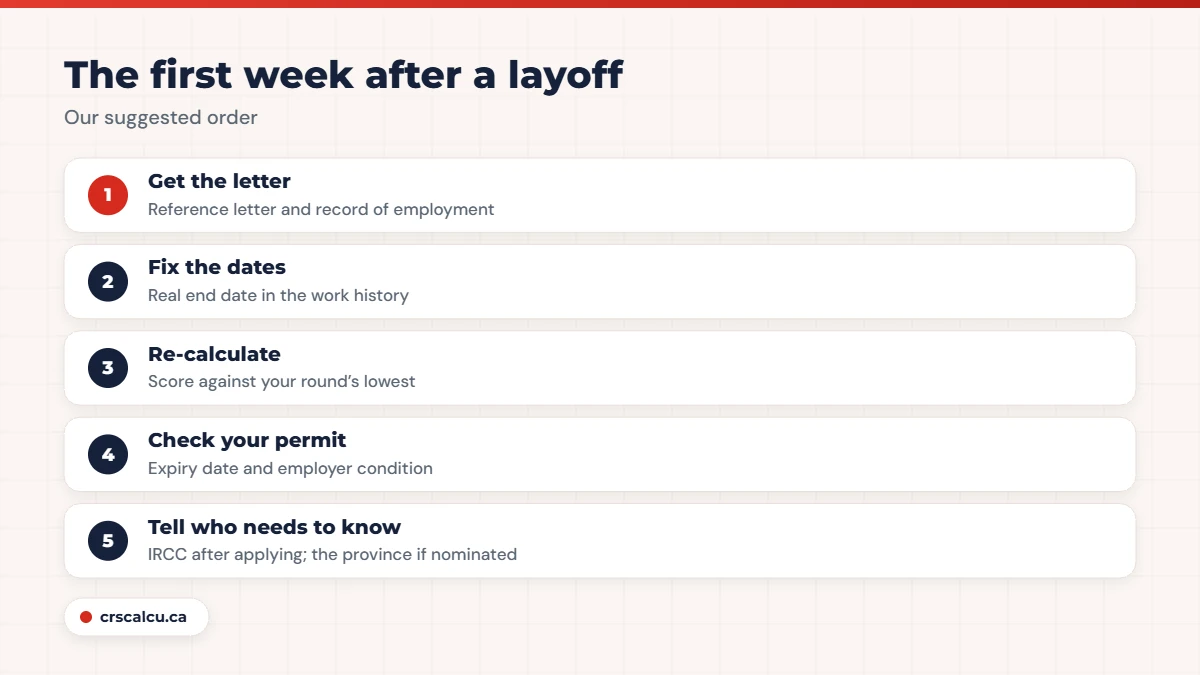
The reference letter is urgent in a way nothing else on that list is. A company that is cutting staff may not have a human resources team in a month. Our post on the reference letter for Express Entry lists what it must contain, and job change after ITA covers how the work history should read.
If you were relying on the job to skip settlement funds, that changes too. IRCC’s Federal Skilled Worker page says you must show funds unless you are authorized to work in Canada and have a valid job offer. See the amounts in our proof of funds post. And if the numbers no longer work, declining an ITA returns you to the pool without a penalty.
If it happens after you submit
IRCC’s Update your application page (modified September 3, 2026) says that after applying you must report changes to your job, education or language results that affect your eligibility, using the web form, with proof.
Real case: “please inform us about any change” (February 2015)
In the first weeks of Express Entry, an applicant working on an employer-supported permit asked whether losing the job after applying would sink the file. Early replies assumed the worst. The poster then found the wording in their acknowledgment letter, which asked applicants to report changes in circumstances such as the loss of a job offer, and noted that it did not say the application would be cancelled. Later replies drew the line this way: a job loss matters when the job supplied the points that got you invited, because the score is recalculated; where it did not, it should not affect the outcome; and not reporting it at all is what creates a misrepresentation problem. No outcome was reported.
That reasoning has aged well. IRCC’s create-profile page (modified September 24, 2026) warns that false information or missing details can lead to refusal, a finding of inadmissibility and a five-year bar. A layoff is not your fault. Hiding it would be your decision.
What to send if you report a job loss (forum practice, not an IRCC list)
Provincial nominees: the 600 points to protect
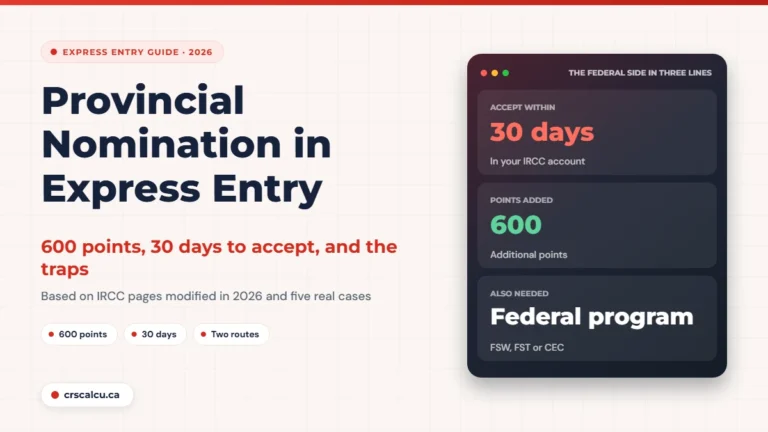
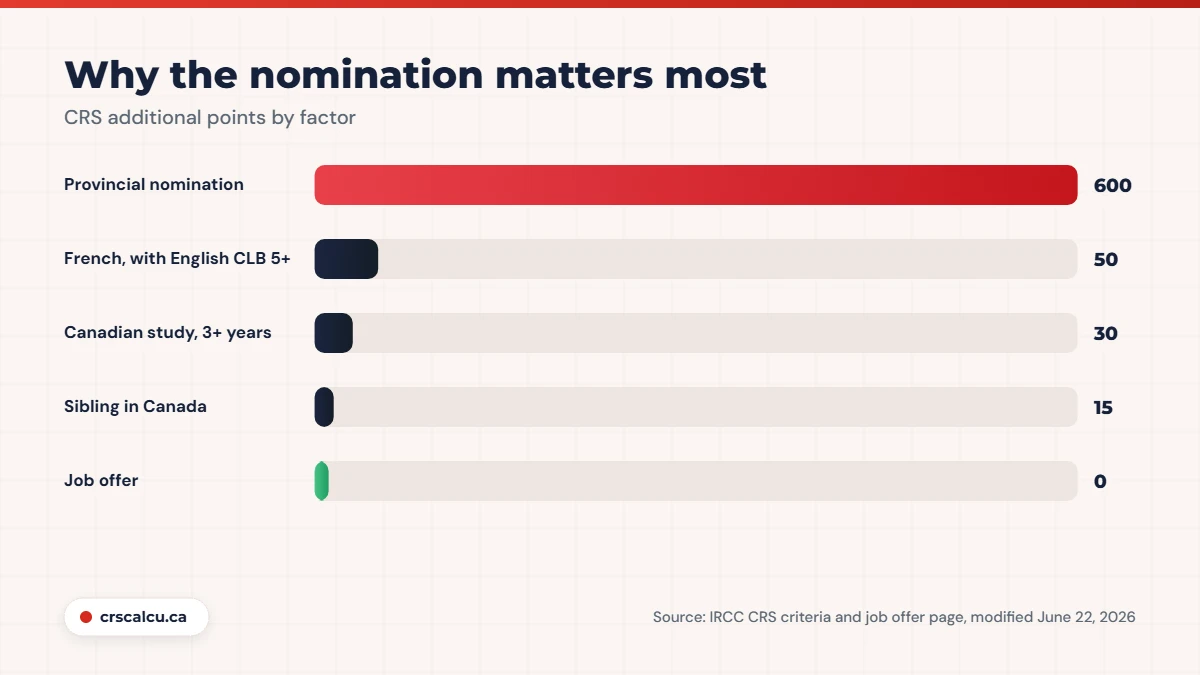
A nomination adds 600 points on the CRS criteria page, more than every other additional factor combined. IRCC’s application page lists a lost provincial nomination as a change that can lower your score and lead to refusal with no refund. Whether a layoff costs you the nomination is the province’s call, not IRCC’s.
Real case: dismissed just before applying, nomination intact (May 2022)
A nominee in a British Columbia tech stream, nominated on the strength of a job offer but without an employer restriction on the nomination, was terminated just before submitting the permanent residence application and had leads on similar jobs. They asked whether to apply at once or wait. A senior member later stressed that every change has to be reported to the province through its post-nomination system, and that silence risks the nomination being revoked. In 2024 another nominee in the same position reported what happened to them: they told the province, got a general acknowledgment, found a new job after three months and received their confirmation of permanent residence.
Real case: terminated on a closed permit, Alberta nominee (March 2024)
A worker on an employer-specific permit, with a provincial nominee application already acknowledged, was let go. Replies said to tell the provincial office immediately, and that not doing so would be misrepresentation. One reply said nominees are usually given about 90 days to find another job while the file keeps moving; another noted that a bridging open work permit may be available if the nomination certificate carries no employment restriction, and that outcomes differ by province. No outcome was reported, and people were still asking the same question in 2025.
The 90-day figure is a forum claim. We did not check it against the province’s own rules, and you should not plan around it without doing so. If you are comparing provincial options after a layoff, our BC PNP and Alberta calculators show how each system weighs a job.
Your status in Canada is the urgent part
An application for permanent residence does not give you status. IRCC’s Help Centre (modified April 17, 2026) says you can stay in Canada while waiting as long as you maintain legal status, and that keeping it valid is your responsibility.
If your permit is open, a layoff does not change your right to work elsewhere. If it names the employer, it does not let you start with a different one. IRCC’s bridging open work permit page (modified June 23, 2026) sets conditions that include being the principal applicant on a permanent residence application that has passed the completeness check, and holding valid status or being eligible to restore it. People who are laid off before that point have fewer choices; our guide to TR to PR pathways lists them, and leaving Canada during Express Entry covers what happens if you go home to wait.
Lost job after ITA: five mistakes to avoid
Avoid these
What IRCC does not say
We did not find an IRCC page that says a job loss with no effect on eligibility must be reported, that sets a time limit for finding new work, or that explains how each province treats a nominee who is laid off. Look at the latest draw cut-offs alongside your recalculated score, and treat any forum timeline as one person’s experience.
Frequently Asked Questions
Lost job after ITA but before submitting: should I still apply?
If your experience is complete, your score still meets the lowest score of your round and you still qualify for your program, nothing on IRCC’s pages stops you. Put the real end date on the job and re-check funds and status first.
Will I lose CRS points for being unemployed?
There is no CRS factor for being currently employed. As of November 3, 2026, job offer points apply only to a valid offer in a high-wage occupation, so you lose them only if your score included such an offer. Canadian work experience points are based on completed years.
Do I need a job to be eligible for the Canadian Experience Class?
No. IRCC’s job offer page says you do not need a job offer for the Canadian Experience Class. You need one year of skilled work in Canada in the last three years and the required language level.
Do I have to tell IRCC I was laid off after applying?
IRCC’s update page says to report job changes that affect your eligibility. For other cases it is silent. In the threads we read, people who reported it early were in a better position when IRCC asked questions.
What happens to my provincial nomination?
That depends on the province and on whether the nomination was tied to the employer. Tell the province. A lost nomination removes 600 points, and IRCC lists it as a change that can lead to refusal.
Can I get an open work permit because I was laid off?
A layoff does not create one. A bridging open work permit has its own conditions, including an application that has passed the completeness check and valid status.
Re-run your score with the new end date
Confirm that your number and your program still hold before you submit or report.
Final Thoughts
For most people who end up searching “lost job after ITA”, the file survives because it was never built on the job. The work is to prove that: true dates, a reference letter, a recalculated score, and a clear note to IRCC or the province where one is required.
If your nomination, your eligibility or your right to stay in Canada depended on the employer, the timing matters and the rules differ by program. Speak to a licensed immigration consultant or an immigration lawyer in the first days, not the last.