Express Entry Guide · Updated October 2026
Soft Landing in Canada: Landing, Leaving Again and Keeping Your PR Status Safe (Real Cases)
Fly in, become a permanent resident at the airport, fly home to wrap up your life. It is common, it is legal, and it starts a five-year clock on day one.
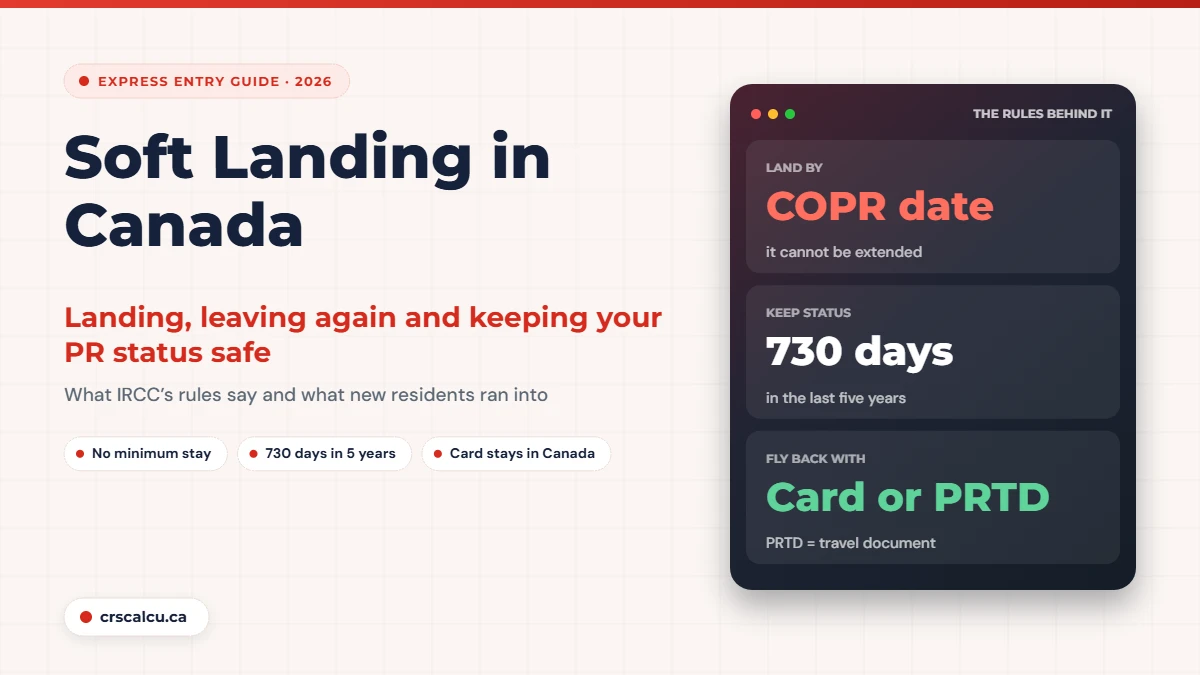
A soft landing in Canada is what applicants call a short first trip: you arrive before your Confirmation of Permanent Residence expires, complete the landing at the border, stay a few days or weeks, and go back to your home country to finish a job, sell a house or wait out a school year. Then you move for good later.
IRCC does not use the phrase and has no “soft landing” rules. What it has are the ordinary rules for every permanent resident, and those are enough to tell you what is safe: a deadline to land by, a residency obligation that begins the day you do, and some awkward logistics around a PR card that can only be mailed inside Canada.
We read IRCC’s pages on arriving as an approved Express Entry applicant, permanent resident status, PR cards and the travel document for returning without one, along with six public forum threads from 2017 to 2024 where people planned a soft landing or lived with the consequences of a long one.
Quick answer: is a soft landing in Canada allowed?
Nothing on IRCC’s pages requires you to stay for a set time after landing. Once the border officer confirms your status, you are a permanent resident and may leave. What you must do is meet the residency obligation: IRCC says you must be in Canada for at least 730 days during the last five years, and the days need not be continuous. You also need a way back in: without a valid PR card you need a travel document to return by plane, and cards are mailed only to Canadian addresses.
Key takeaways
What a soft landing in Canada is, in official terms
Strip away the nickname and a soft landing is two ordinary events close together: becoming a permanent resident at a port of entry, and then travelling abroad as a permanent resident.
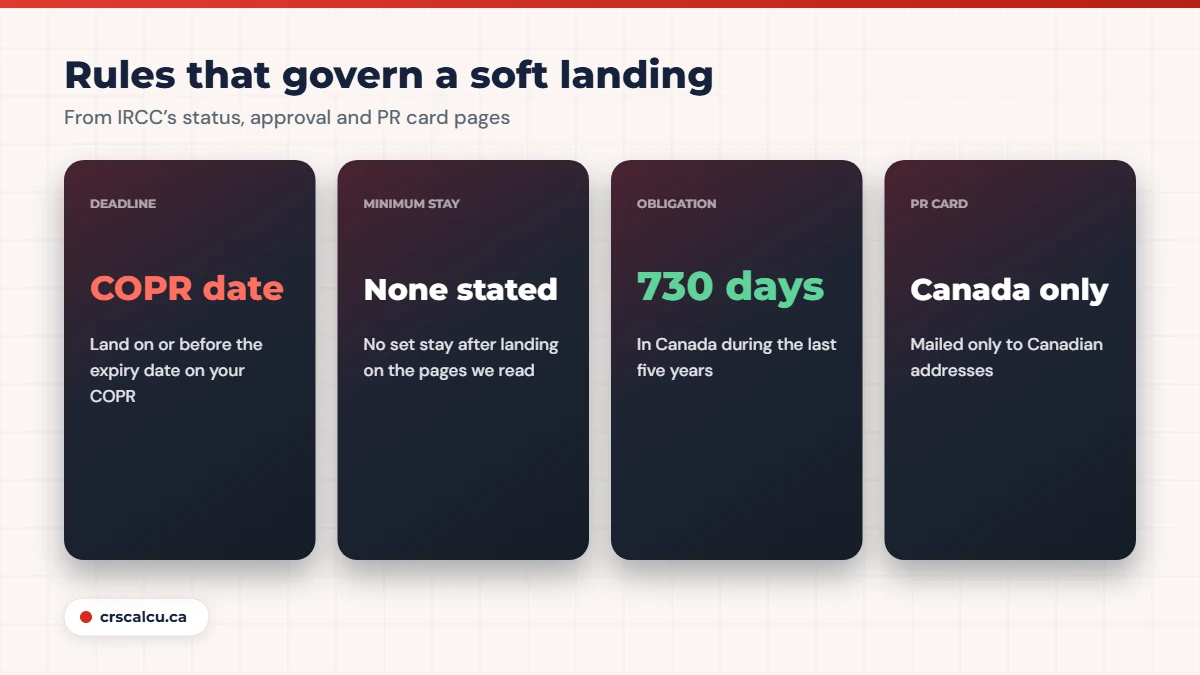
The first is described on IRCC’s page for approved Express Entry applicants outside Canada (modified June 22, 2026). You arrive with your passport, your Confirmation of Permanent Residence and your permanent resident visa if you have one, along with proof of funds. The officer makes sure you are entering on or before the expiry date on the COPR, checks that you are the person who was approved, and asks a few questions to make sure you are still eligible to immigrate. The officer then confirms the Canadian mailing address for your PR card.
The second is governed by IRCC’s page on permanent resident status (modified April 9, 2026). It says permanent residents can live, work or study anywhere in Canada, and sets out the one condition for keeping the status over time.
Question | What IRCC says | Page |
|---|---|---|
By when must I land? | On or before the expiry date on your COPR | If approved: outside Canada |
Can the COPR be extended? | No | If your application is approved |
Is there a minimum stay? | None stated on the pages we read | Not found |
What must I do to keep status? | Be in Canada at least 730 days during the last five years | Understand permanent resident status |
Must the days be continuous? | No | Same page |
Where is the PR card sent? | Only to Canadian addresses | Getting your PR card |
How do I fly back without a card? | With a permanent resident travel document | PR card and travel document pages |
Our summary of the IRCC pages listed under Sources, read on October 5, 2026.
The 730 days, and what “about three years” really means
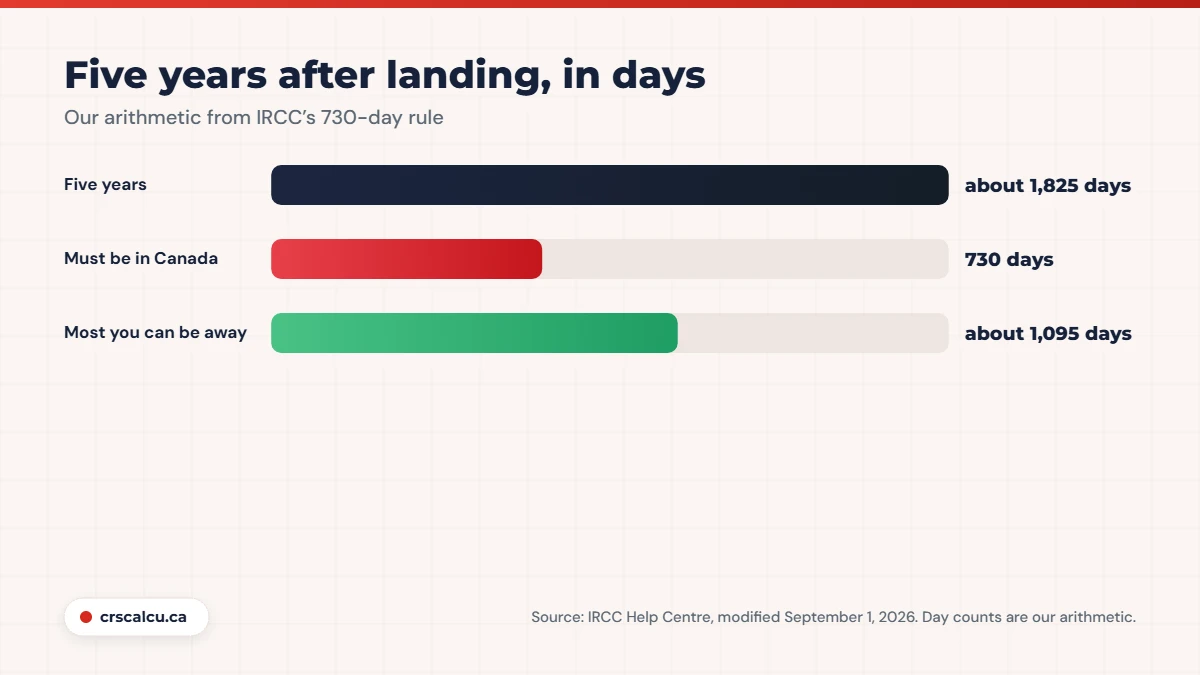
IRCC’s Help Centre (modified September 1, 2026) puts the rule in one sentence: to keep your permanent resident status, you must have been in Canada for at least 730 days during the last five years. The days do not need to be continuous, and some time abroad may count toward them in specific situations.
Our arithmetic: five years is about 1,825 days. Take away 730 and you have about 1,095, or roughly three years. That is where the forum rule of thumb comes from, that you can be away for up to three years after landing. It is true only in the narrowest sense. If you stay away for the full three years, you must then be in Canada for every remaining day of the five, with no holidays, no family emergencies and no work trips.
Real case: landed in March 2020, still abroad in late 2022 (November 2022)
A couple did a soft landing on March 6, 2020, returned to the United States, and received their PR cards. Nearly three years on they were still abroad, after a difficult pregnancy and the birth of a child. They planned to move in February 2023 and asked what would happen if they came a few months later instead. Members were blunt: nobody would stop them at the border, but arriving after three years away meant they could no longer reach 730 days, and an officer could report them. There is no extension. They also learned they could not sponsor their child while living outside Canada. No outcome was reported.
Life is the reason the three-year figure is dangerous. The couple in that thread did not plan to cut it close. Use our physical presence calculator to count your own days, and plan to move with a year or more to spare.
One protection is worth knowing. IRCC’s status page says that even if you do not meet the residency obligation, you remain a permanent resident until an official decision is made, and that status is lost only through a formal process. That is a safety net, not a plan.
How short can a soft landing in Canada be?
There is no official minimum, so this is applicant experience.
Real case: two or three months possible, then away again (June to December 2021)
A person whose COPR was about to expire could stay only two or three months after arriving and would need to leave several times in the first year. They worried this would break a rule. Early replies raised the residency obligation. Later ones were clearer: there are no soft landing rules, people regularly stay a few days and leave, and once you have landed you are free to travel, limited only by the 730 days. Members mentioned acquaintances who had landed by air in late 2021, stayed three or four days, and started their PR card process.
Real case: a three-week landing while working overseas (September 2017)
A new permanent resident working in Asia planned a three-week landing trip and realized the PR card would take longer than that. Members called short landings routine. Their practical advice was to book a return ticket, answer the officer’s questions honestly, and apply for a Social Insurance Number while in the country. For the card, they suggested a friend’s Canadian address, or else a travel document or a land crossing later. No outcome was reported.
The border officer does ask questions, and IRCC says their purpose is to confirm you are still eligible to immigrate. Answer truthfully, including about your plan to return later. We found nothing on IRCC’s pages that makes a short first stay a ground for refusing to land you.
The PR card problem
This is where soft landings go wrong in practice. The card is produced after you land and is mailed only to a Canadian address. IRCC’s card page says it sends the first card automatically if it has your Canadian mailing address and photo within 180 days. If you have already left, you are relying on someone else’s mailbox.
Forum members routinely suggest giving a friend’s address and having the friend forward the card. Be aware of what IRCC says on its portal page for people confirmed inside Canada: it does not mail PR cards to third-party addresses. We did not find the same sentence on the page for people landing at a border, where the officer simply confirms a Canadian mailing address, but it tells you how IRCC views the practice.
Real case: the card was “delivered”, and gone (June 2022)
After a soft landing, a new permanent resident learned that the carrier had recorded their PR card as delivered to a mailbox in Canada, but it was not there. They asked whether they could apply for a replacement from abroad and have a friend send it on. An experienced member said no: a replacement is applied for from inside Canada, and applying as though you were in Canada while living abroad is a false statement. The honest route was a travel document, applied for a few months before the real move. No outcome was reported.
Real case: how long to stay for the card (January 2024)
A family planning a July soft landing asked about affordable housing for a couple of months. A long-time member replied that the essentials, a Social Insurance Number and a bank account, can be done in a day, and that waiting for the card could mean budgeting up to six months, especially if the address changed. The poster asked about using a close friend’s address instead, and members agreed that was the practical answer. No final decision was reported.
Whichever way you go, tell IRCC promptly if the address changes. IRCC says you must report an address change within 180 days of arriving, using the IRCC web form.
Coming back
When you return to settle, you need to prove your status to the airline before it will board you. IRCC’s pages say that without a valid PR card you must apply for a permanent resident travel document to return, and that the document is for people outside Canada who plan to come back by airplane, boat, train or bus. That application is where your days in Canada are examined, so apply while you can still meet the 730 days.
Our suggested plan for a soft landing
Six mistakes people make with a soft landing
Six mistakes from the rules and the threads
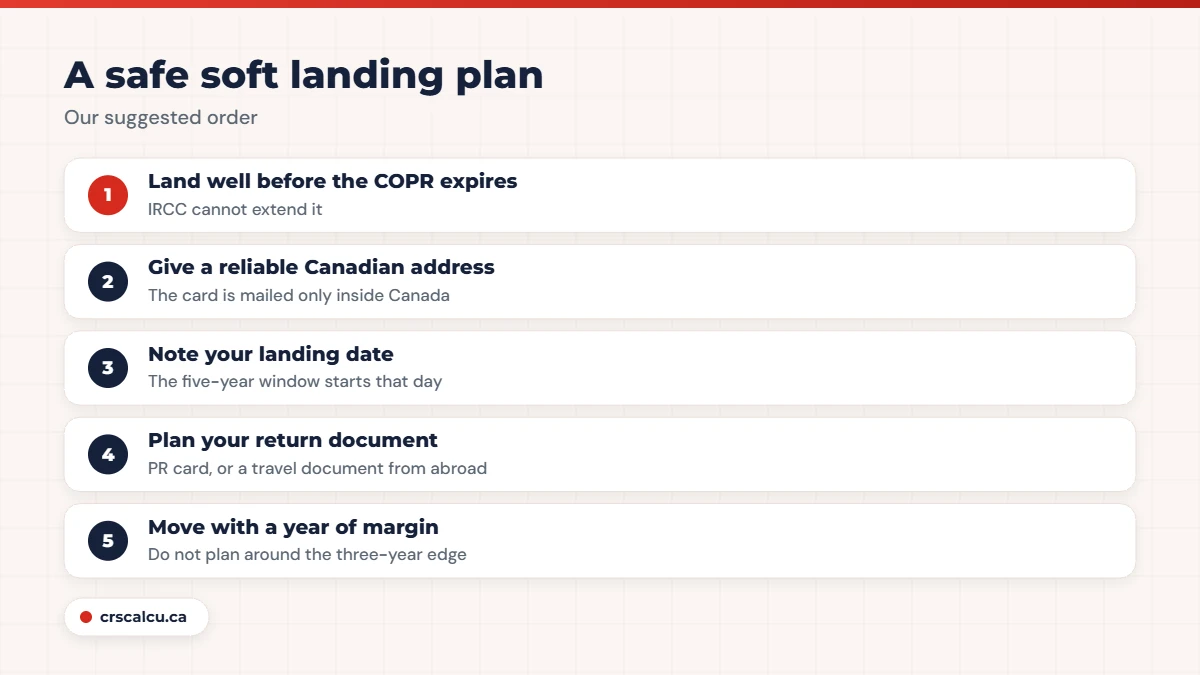
A soft landing only becomes a question once you have been approved. If you are still in the pool, the question is your score: check it with the CRS calculator against the latest draw cut-offs. If your reason for delaying the move is that your passport or other papers are not in order, fix those first.
Frequently Asked Questions
Is a soft landing in Canada legal?
IRCC’s pages set no minimum stay after landing. Once your status is confirmed at the border you are a permanent resident and can leave. You must then meet the residency obligation of at least 730 days in Canada in the last five years.
How long can I stay outside Canada after a soft landing?
By our arithmetic, about three years in the first five, because 730 days are needed. Using the full three years leaves no margin at all, so plan to return much sooner.
How many days do I need to stay for a soft landing?
There is no official number. Applicants on public forums described stays of three or four days, and others a few weeks. The practical question is whether you can receive your PR card.
Can my PR card be sent to me abroad?
No. IRCC mails PR cards only to Canadian addresses. Forum members often use a friend’s address, though IRCC’s portal page says it does not mail cards to third-party addresses.
How do I return to Canada without a PR card?
IRCC says you must apply for a permanent resident travel document to return by airplane, boat, train or bus. You apply from outside Canada.
Will I lose my status if I stay away too long?
Not automatically. IRCC says you remain a permanent resident until an official decision is made. But if you cannot show 730 days in the last five years, an officer can start that process when you apply for a travel document or arrive at the border.
Planning the move? Start with where you stand
A soft landing comes after approval. If you are still aiming for an invitation, check your points against recent cut-offs.
Final Thoughts
A soft landing in Canada is an ordinary landing followed by an ordinary trip abroad, and IRCC’s rules treat it that way. Land before your COPR expires, give an address that will still work in two months, and count your days from the first one. The three-year figure people quote is the outer edge of the rule, not a comfortable place to stand.
If you already know you will be away for more than two years, if your card has gone missing while you are abroad, or if you are close to the point where 730 days is no longer reachable, speak to a licensed consultant or lawyer before you apply for a travel document. That application is where your status gets examined.