Express Entry Guide · Updated October 2026
Leaving Canada During Express Entry: Trips, Moving Home and What to Tell IRCC (Real Cases)
A work permit that is running out, a family emergency, a holiday you booked months ago. Here is what leaving does, and does not do, to your profile or application.
Leaving Canada during Express Entry is rarely a free choice. A permit ends, a parent falls ill, an employer moves you, or you simply want to see your family after two years away. The fear is always the same: will stepping over the border undo the application?
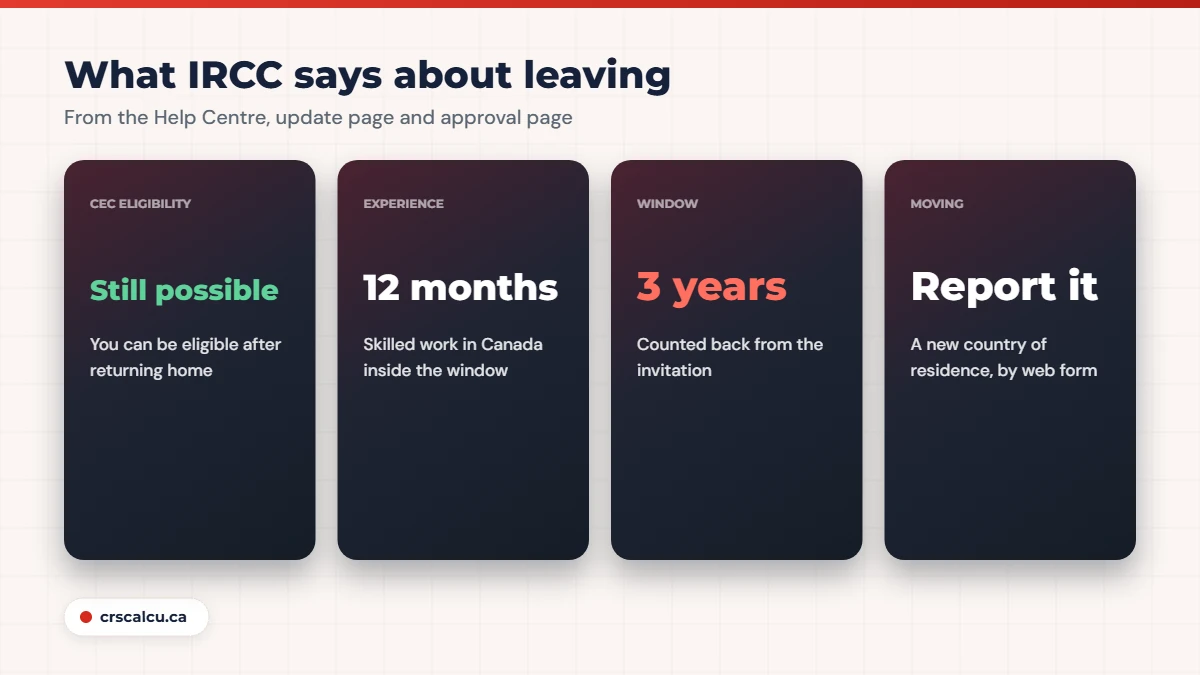
On the pages we read, IRCC does not say that it will. Canadian Experience Class eligibility is built on work you have already done, and the Help Centre says in so many words that you can still be eligible after returning to your country. What changes when you leave is practical: where your file is finalized, what you have to report, and whether you can get back in.
We read IRCC’s Help Centre, its update and approval pages and the eligibility rules (all modified in 2026), plus five public forum threads from 2017 to 2023. This is general information, not legal advice.
Quick answer: can you leave Canada while Express Entry is in progress?
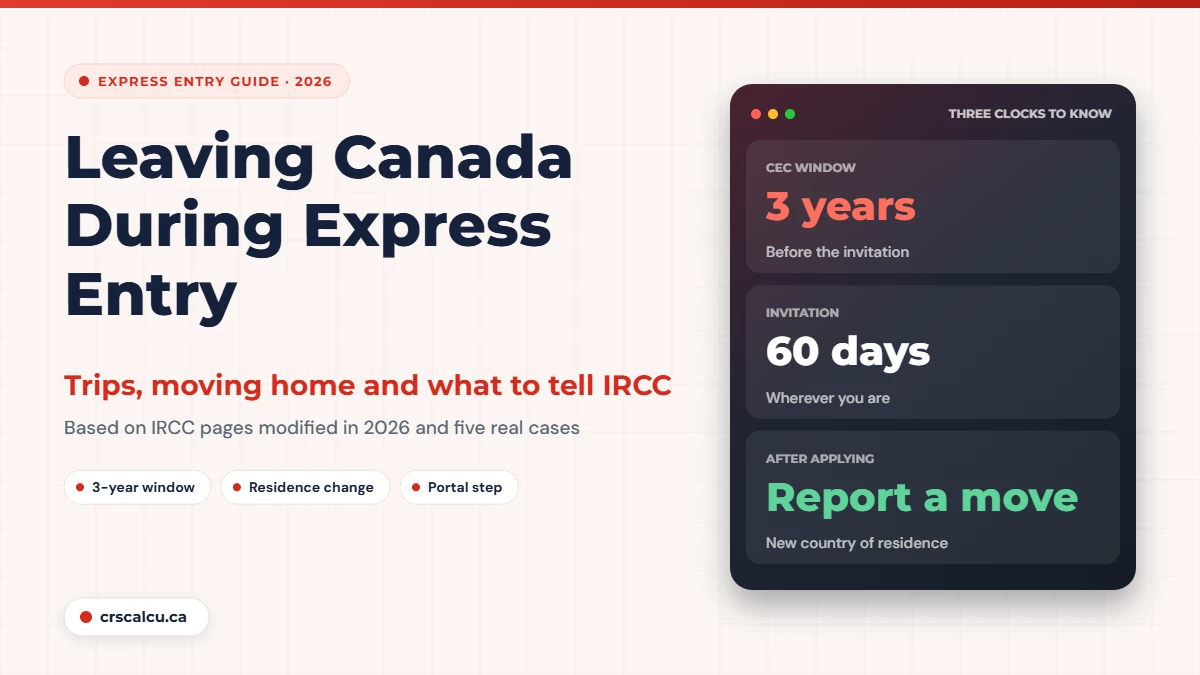
Yes. IRCC’s Help Centre (modified April 17, 2026) says you can still be eligible for the Canadian Experience Class after returning to your country, as long as you have at least 12 months of skilled work in Canada in the three years before you are invited. If you move, not just travel, IRCC’s Update your application page lists a change of country of residence as something you must report. The risks are a look-back window that keeps moving, a temporary status that may not let you back in, and an approval that arrives while you are abroad. Check your score in our CRS calculator before you go.
Key takeaways
Leaving Canada during Express Entry: what IRCC’s pages say
The most direct statement is a Help Centre answer to the question of whether you can still be eligible for the Canadian Experience Class if you have returned to your country. The answer (modified April 17, 2026) is yes, as long as you meet the requirements of the class, including at least 12 months of full-time work experience in Canada, or an equal amount of part-time, in the three years before you are invited to apply, in an occupation in TEER 0, 1, 2 or 3.
A second Help Centre answer (modified April 17, 2026) covers staying: you can remain in Canada while waiting for permanent residence as long as you maintain legal status, and you are responsible for keeping that temporary status valid. The Update your application page (modified September 3, 2026) lists a change of country of residence among the changes you must tell IRCC about. And the page on what happens when your application is approved (modified June 22, 2026) tells applicants in Canada to let IRCC know if they leave.
Put together: you are allowed to go, IRCC wants to know where you live, and nothing obliges you to stay except your own temporary status and your own timeline.
Leaving at each stage: pool, invitation, application
Stage | What IRCC says | What to watch |
|---|---|---|
Profile in the pool | CEC needs 12 months of Canadian skilled work in the 3 years before the invitation | The window keeps moving while you wait abroad |
Invited, not yet applied | Invitation valid 60 days; re-calculate if your situation changes | Documents and police certificates for where you now live |
Application submitted | Report a change of country of residence | Web form, new address, possible change of office |
Approved | Tell IRCC if you leave Canada | In-Canada portal versus a visa office abroad |
Our summary of IRCC Help Centre answers (modified April 17, 2026), the respond-to-invitation and approval pages (June 22, 2026) and Update your application (September 3, 2026). The third column is our reading.
In the pool: the three-year window
This is the part people underestimate. The Canadian Experience Class looks back three years from the invitation. Our example: you worked in Canada from July 1, 2024 to June 30, 2025, exactly 12 months, then went home. That year sits fully inside the three-year window only for invitations issued up to about the start of July 2027. After that, the earliest weeks start to drop out and you no longer have a full 12 months inside the window. That is our arithmetic, not an IRCC example, but it follows directly from the rule.
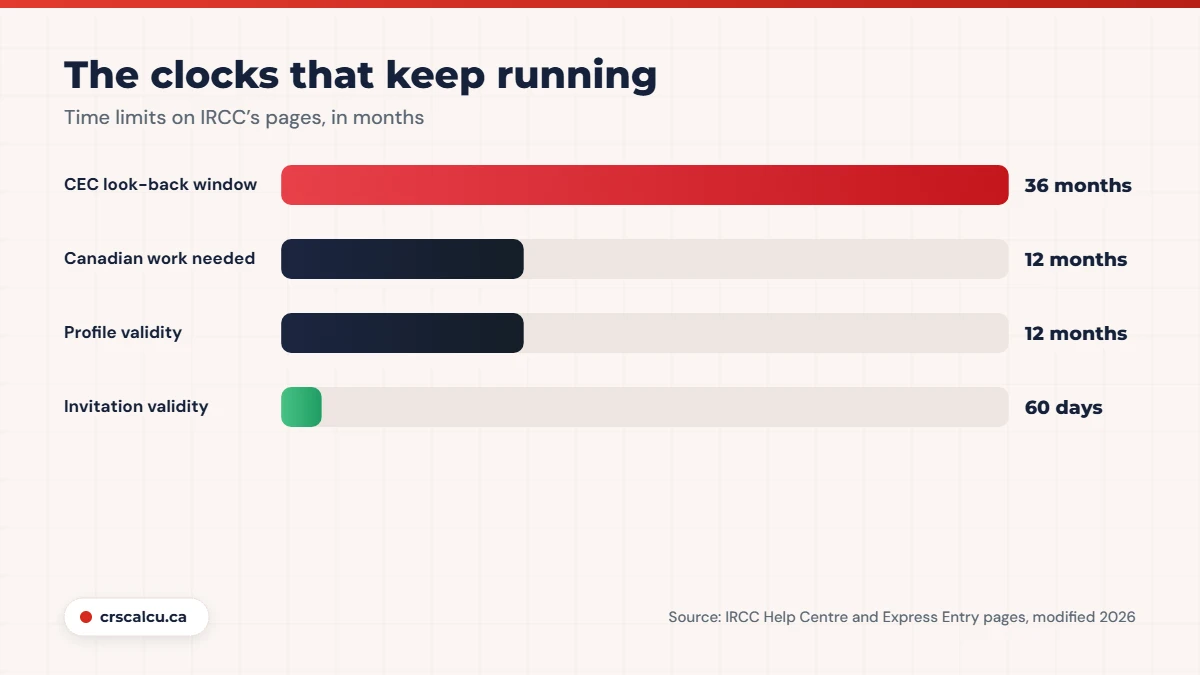
Meanwhile your profile has its own clock. IRCC’s page for candidates not invited says a profile expires after 12 months without an invitation, and you then need a new one. Work you do abroad after leaving does not add Canadian experience; the CRS criteria page defines Canadian work experience as working for a Canadian employer in Canada, and says remote work counts only if you were physically in Canada. Skilled work abroad may count as foreign experience instead; see foreign work experience in Express Entry and the Canadian Experience Class guide.
If the system assesses you under the Federal Skilled Worker Program instead, settlement funds come into play. IRCC’s program page says you must show funds unless you are authorized to work in Canada and have a valid job offer, and once you have left, that exemption is hard to rely on. Our proof of funds post has the amounts.
After the invitation
The 60 days run wherever you are. IRCC’s respond-to-invitation page says to re-calculate if your situation changes and to decline if you fall below the lowest score of your round; see declining an ITA. Leaving does not by itself change the score, but a job that ended when you left has to be shown with its real end date. We cover that in job change after ITA.
After you apply: trip or move?
IRCC’s update page speaks of a change of country of residence. It does not mention holidays. We did not find an IRCC page that asks applicants to report a short trip, and forum replies treat the two differently.
Real case: a vacation and work trips after applying (September 2022)
A Canadian Experience Class applicant with an acknowledgment of receipt dated August 19 wanted to take a vacation and some work trips while the file was in process, and worried about being abroad when the electronic confirmation of permanent residence arrived. Replies said travel during processing is allowed and that IRCC does not need to be told about a trip. They added a warning: before the confirmation is issued, IRCC emails for portal details and asks whether you are in Canada, and you have to be physically in Canada to complete that step. An applicant abroad at that moment either returns or asks for other arrangements, which can add months. No outcome was reported.
Real case: a month in, travelling south (May 2017)
Someone who had applied a month earlier planned a trip to the United States and held a work permit valid until August. A senior member said leaving would not harm the application, and that if you actually change your country of residence, the update IRCC needs is your new address. Another reply reminded them that getting back in depends on meeting the entry rules again: a valid passport and, where needed, a valid permit or visa. A later poster said they had gone back to their home country while waiting; as of June 2019 that case was still pending.
The second reply is the practical heart of it. Your application does not stop you leaving. Your documents decide whether you can return.
The dangerous version: leaving on maintained status
If your permit has expired and you are in Canada on maintained status, waiting for a decision on an extension, leaving is a different decision. IRCC’s Help Centre explains that maintained status lets you stay under the same conditions while the new application is decided, and that it applies while you remain in Canada. Step out, and you are relying on whatever visa or exemption gets you back in, without the right to keep working that maintained status gave you.
Check three documents before you book
Your passport, your permit and, if your nationality needs one, your visitor visa or electronic travel authorization. A valid permit does not by itself let you re-enter if the visa in your passport has expired. If any of the three will expire while you are away, sort that out first.
If your permit is close to its end and you are still waiting for an invitation, read our guide to TR to PR pathways before deciding to leave.
Moving home after you apply
A real move, with a new address in another country, is a reportable change. Forum experience fills in what tends to follow.
Real case: moving countries after the acknowledgment (March 2017)
An applicant with an acknowledgment of receipt had to move from the country where they were living back to their home country before the passport request. They asked whether the police certificates already submitted would stop being valid. Experienced replies said documents are assessed as of the acknowledgment date, so what was submitted should stand, but that nothing stops IRCC asking for a fresh certificate, so getting one early from a slow country is sensible. They also said the applicant had to report the new address and job to IRCC, and that a move can lead to the file being reassigned to another visa office, with a possible delay. No outcome was reported.
Real case: permit expiring, approval expected (September 2020)
An inland Canadian Experience Class applicant had a work permit and visa about to expire, biometrics still pending, and a trip abroad in a month from which they could not return without new documents. They asked what would happen if the approval came while they were away. An experienced reply explained the split: in Canada, the confirmation comes by email and landing is done virtually; outside Canada, you tell IRCC your new address by web form and the file moves to the visa office for that region, which the reply estimated at about four weeks. The poster phoned IRCC and was told the same. They then got a biometrics appointment and decided to wait for the confirmation before travelling.
The four-week figure is one member’s estimate. IRCC does not publish a transfer time.
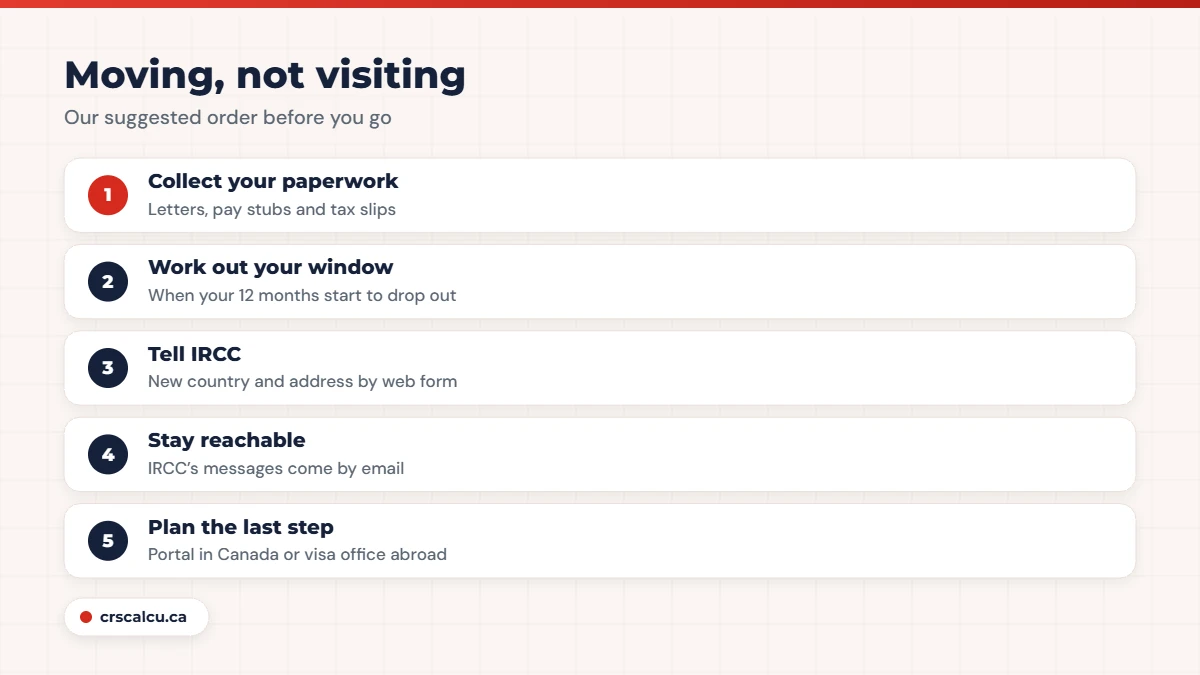
If you are moving, not visiting (our suggested order)
Approval while you are abroad
IRCC’s approval page (modified June 22, 2026) describes two endings. Applicants in Canada confirm their status through the online portal. Applicants outside Canada receive a confirmation of permanent residence to travel with, and the page says that document cannot be extended. The page also says to tell IRCC if you leave Canada, which is how the file gets routed the right way.
Real case: waiting on a decision with a valid permit (October 2023)
An applicant who had applied under the Canadian Experience Class in July 2023, with a work permit valid until August 2024 and a valid visitor visa, asked about travelling and about being approved while away. An experienced reply described two routes: for an absence of a month or two, tell IRCC when you will be back and the last step waits for your return; for a longer absence, ask for the file to be finished through a visa office, which takes longer. The same reply advised against long trips when a decision is close. Another poster said they had travelled twice during processing on valid documents with no trouble at the border, and had sent a web form before leaving. No outcome was reported.
Those two routes are forum descriptions of how it worked for them. They match the split on IRCC’s approval page, but IRCC does not set out the 30 to 60 day idea anywhere we could find.
Five mistakes people make when leaving Canada during Express Entry
Avoid these
What IRCC does not say
We did not find an IRCC page that defines how long an absence must be before it becomes a change of residence, that asks applicants to report short trips, or that gives a time for moving a file between offices. Keep an eye on the latest draw cut-offs if you are leaving while still in the pool, because the window is the thing that can close.
Frequently Asked Questions
Does leaving Canada during Express Entry cancel my Canadian Experience Class eligibility?
No. IRCC’s Help Centre says you can still be eligible after returning to your country if you have at least 12 months of skilled work in Canada in the three years before you are invited.
Do I have to tell IRCC about a short trip?
We found no IRCC page that asks for this. The Update your application page lists a change of country of residence. Forum replies say trips need not be reported, but that you should be reachable and able to return.
What if my permanent residence is approved while I am outside Canada?
IRCC’s approval page describes a portal process for applicants in Canada and a confirmation document for applicants abroad, and says to tell IRCC if you leave. In the cases we read, people either returned for the final step or asked for the file to be finished through a visa office.
Can I come back on my work permit after a trip?
A permit lets you work; entry also depends on a valid passport and, for many nationalities, a valid visa or electronic travel authorization. Check all three before leaving.
Will work I do abroad add to my Canadian experience?
No. The CRS criteria page defines Canadian work experience as work for a Canadian employer in Canada, and says remote work counts only if you were physically in Canada.
How long can I stay away before my Canadian experience stops counting?
There is no fixed absence limit. The rule is that 12 months of Canadian skilled work must fall within the three years before the invitation, so the answer depends on when you worked.
Check your score before you leave
See where you stand now, and what your profile looks like once your Canadian job has an end date.
Final Thoughts
Leaving Canada during Express Entry is allowed, and for many people it is unavoidable. What matters is knowing which clock applies to you: the three-year window if you are in the pool, the 60 days if you are invited, and the reporting duty and the portal step if you have applied.
If you are on maintained status, if your permit or visa will expire while you are away, or if a decision looks close, speak to a licensed immigration consultant or an immigration lawyer before you book anything.