Express Entry Guide · Updated October 2026
Move to Another Province After PR: Your Rights and the Nominee Question (Real Cases)
A better job two provinces away, family in another city, or a place you simply prefer. Here is what IRCC says, and where nominees need to be careful.
Whether you can move to another province after PR is one of the most argued questions on any immigration forum, and the arguments usually talk past each other. One side quotes the right of permanent residents to live anywhere. The other says a provincial nominee who leaves has lied. Both are describing something real.
For most Express Entry immigrants the answer is simple, because no province selected them. For provincial nominees there is a second layer: the nomination was given on the basis that you wanted to live in that province, and the question people worry about is whether that was true when you said it.
We read IRCC’s Help Centre answer on living outside your city of destination, its Provincial Nominee Program page and its permanent resident status page (all modified in 2026), plus five public forum threads from 2016 to 2023. This is general information, not legal advice.
Quick answer: can a permanent resident move to another province?
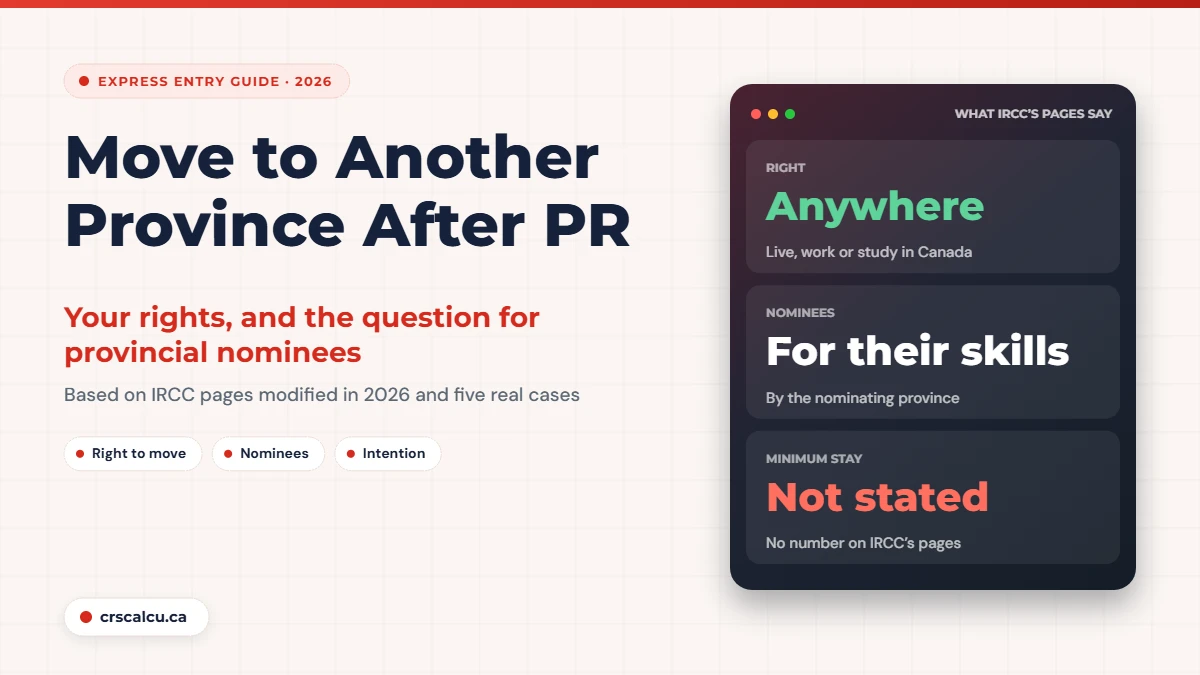
Yes. IRCC’s Help Centre (modified September 1, 2026) says that as a permanent resident you have the right to live, work or study anywhere in Canada, even somewhere other than the city of destination on your confirmation of permanent residence. It adds one sentence for people who came through the Provincial Nominee Program: the province that nominated you chose you to bring skills to that province. IRCC’s pages set no minimum time you must stay. The risk for nominees is about the honesty of the intention they declared, not about the move itself.
Key takeaways
What IRCC says about living somewhere else
The clearest official statement is a Help Centre answer to a new permanent resident asking whether they can live somewhere other than the city of destination on their confirmation of permanent residence. The answer (modified September 1, 2026) is that as a permanent resident you have the right to live, work or study anywhere in Canada.
The answer then turns to provincial nominees. If you became a permanent resident through the Provincial Nominee Program, it says, the province that nominated you chose you to bring skills to their province. It stops there. It does not say you must stay, for how long, or what happens if you do not.

Can you move to another province after PR through Express Entry?
If you were invited under the Federal Skilled Worker Program, the Canadian Experience Class or the Federal Skilled Trades Program with no nomination, no province chose you. The city on your confirmation is where you said you planned to go, and IRCC’s answer above covers you directly. One condition applies before you become a permanent resident, not after: IRCC’s Canadian Experience Class page says applicants must plan to live outside Quebec, because Quebec selects its own skilled workers.
How you became a permanent resident | What IRCC’s pages say | Our reading |
|---|---|---|
Express Entry, no nomination | Right to live, work or study anywhere in Canada | Free to move |
Express Entry with a provincial nomination | Same right; the province chose you to bring skills to that province | Free to move; your declared intention can be examined |
Any route | Keep your permanent resident status by being in Canada 730 days in every 5 years | Province does not matter for status |
Our summary of the IRCC Help Centre (modified September 1, 2026), the Provincial Nominee Program page (modified September 14, 2026) and the permanent resident status page (modified April 9, 2026). The third column is our reading.
Real case: landing city on the confirmation (January 2023)
A newly approved skilled worker noticed that their confirmation of permanent residence named one city while they wanted to land and settle in another, and asked whether that was a problem. Experienced members replied that applicants who are not provincial nominees can land and live anywhere in Canada, whatever city the document shows. The poster said the answers had helped and went ahead with their plans.
Provincial nominees: a right and an expectation
IRCC’s Provincial Nominee Program page (modified September 14, 2026) describes who the program is for: people who have the skills, education and work experience to contribute to the economy of a specific province or territory, who want to live in that province or territory, and who want to become permanent residents of Canada. Wanting to live there is part of the definition. IRCC’s Canadian Experience Class page (modified September 24, 2026) is firmer about where applicants plan to live: it says that if you are a provincial nominee, you must settle in the province or territory that nominated you.
So a nominee holds two things at once. As a permanent resident, the right to live anywhere. As a nominee, a statement on file that they wanted to live in the province that picked them. We explain how the nomination works on the federal side in provincial nomination in Express Entry.

The two fit together without contradiction if your intention was real and your plans later changed. They collide if you accepted the nomination already meaning to leave. IRCC’s create-profile page (modified September 24, 2026) warns that false information can lead to refusal, a finding of inadmissibility and a five-year bar. Forum members apply the same idea to intention: the question is whether what you declared was true when you declared it.
Real case: planning to leave as soon as the card arrives (November 2018)
A nominee of one province asked whether they could move to a city in another province once they had their PR card, since permanent residents are free to relocate. The first replies were blunt: taking a nomination while planning to leave is misrepresentation, and status could be at risk. Later replies were more measured. One quoted IRCC’s statement that a permanent resident has the right to live, work or study anywhere in Canada, and argued that intentions can change after landing; they described staying as a moral commitment more than a legal one. The thread ended without agreement, and the poster did not report what they did.
The disagreement in that thread is the honest state of things. What stands out is the timing: the poster was planning the move before they had even landed, which is precisely the situation the first replies were warning about.
When plans change after you land
Real case: ten months, then a better job elsewhere (January 2023)
A nominee had lived in the nominating province for about ten months before moving to another province for a better job. They had read about another nominee whose citizenship application was delayed for three years, with a letter questioning how little time they had spent in the province. Experienced members thought the risk in this case was low. One set out the logic: the issue is whether the statement about settling was truthful, and what matters is evidence of intent, not a fixed number of months; very short stays invite questions, longer ones do not. Another participant said they had moved provinces and later received their citizenship oath invitation with no difficulty.
Real case: two months in, a family crisis (August 2016)
A nominee who had landed two months earlier lost a parent, had a spouse in hospital and could not find work, and asked whether moving to another province would endanger their status or later citizenship. Several members said a permanent resident is free to move between provinces. One raised a practical point no one had asked about: the provincial health plan required a minimum number of days of residence each year, and leaving early could affect coverage for the hospital care already received. Another shared a letter from a provincial office warning that nominees who do not live and work in the province could have the nomination reviewed for misrepresentation. The poster did not say whether they moved.
Real case: one and a half years, and a signed declaration (May 2021)
Someone who had been selected by a province and lived there for a year and a half wanted to move and feared that a signed intention-to-reside statement would cost them citizenship. Replies said a move would not by itself lead to a citizenship refusal, that the right to move and to earn a living in any province is protected, that provincial selection and federal citizenship are separate matters, and that a declaration records your plans at the time you signed. They suggested keeping records of job searches and the new job. A moderator advised seeing a lawyer if the worry was serious. No negative outcome was reported.
None of these is a ruling, and none tells you what an officer would decide. Together they show how experienced members weigh it: what you intended when you applied, how long you stayed, why you left, and what you can show.
“How long do I have to stay?”
IRCC’s pages give no number. Not six months, not a year, not two.
Real case: the informal two-year idea (July 2017)
A long-running thread set out to answer this question for nominees. The opening post said that no waiting period exists in law, mentioned about two years as an informal expectation for showing you meant to settle, and advised anyone leaving sooner to keep evidence: applications for jobs in the province, rejections, and the reason for taking work elsewhere. When a later commenter claimed six months was mandatory, they were corrected: there is no legally required minimum. In March 2018 one user reported relocating after six months of documented job searching in the province without finding work.
Treat every figure you see as someone’s rule of thumb. Some provinces ask nominees to sign their own undertakings or to report after landing; those are provincial documents, and you should read your own.
Before you move: the practical list

Our suggested order
IRCC’s permanent resident status page (modified April 9, 2026) ties your status to being in Canada for at least 730 days in every five-year period. That count is national. Moving from one province to another does not touch it.
Five mistakes people make when they move to another province after PR
Avoid these
What IRCC does not say
The pages we read do not say whether or how a nominee’s move is reviewed, what a province can do after you have become a permanent resident, or how the question is treated in a citizenship application. Those are exactly the points on which forum members disagree, so we have reported the disagreement and not picked a side. If you are still choosing a route, compare programs in FSW vs CEC, check your score with the CRS calculator, and see the latest draw cut-offs. Our BC PNP and Alberta calculators cover two provincial systems.
Frequently Asked Questions
Can I move to another province after PR if I came through Express Entry without a nomination?
Yes. IRCC’s Help Centre says a permanent resident has the right to live, work or study anywhere in Canada, including somewhere other than the city of destination on the confirmation of permanent residence.
I am a provincial nominee. Am I allowed to move?
IRCC’s answer gives nominees the same right and adds that the province chose you to bring skills to that province. IRCC’s Express Entry program page also says nominees must settle in the province that nominated them, and the program is for people who want to live there. So the concern is whether your declared intention was true.
How long must a nominee stay in the province?
IRCC’s pages give no minimum. Forum members mention six months, a year or two years as rules of thumb, and others point out that none of these is in law.
Will moving provinces affect my PR status?
Status depends on being in Canada for at least 730 days in every five years. The province you live in is not part of that test.
Does the city on my confirmation of permanent residence matter?
IRCC’s Help Centre says you can live somewhere other than your city of destination.
Can I move to Quebec after becoming a permanent resident?
The Canadian Experience Class requires you to plan to live outside Quebec when you apply. After you are a permanent resident, IRCC’s statement is that you may live anywhere in Canada.
Still choosing a route?
See whether your score works without a nomination before tying your plans to one province.
Final Thoughts
You can move to another province after PR. For immigrants who were never nominated, that is the end of the question. For nominees it comes with an expectation that was part of the bargain, and with a duty to have been honest about your plans when you made them. Circumstances change, and the cases above show people moving for jobs and for family without consequences they reported.
If you are a nominee thinking of leaving within the first months, if a province has contacted you about it, or if you signed an undertaking you do not fully understand, speak to an immigration lawyer or a licensed consultant before you go.