Express Entry Guide · Updated October 2026
GCMS Notes for Express Entry: How to Order Them, What They Cost and What They Actually Show (Real Cases)
When the status page has said “in progress” for months, your file notes are the only way to see what the officer sees. Here is the official way to get them.
GCMS notes for Express Entry are the closest thing an applicant has to a look over the officer’s shoulder. GCMS is the Global Case Management System, the database IRCC uses to process applications. The “notes” are a printout of your record in it: what has been assessed, what is pending, and what officers wrote along the way.
You do not get them by asking nicely through your account. You get them by making a formal request under one of two federal laws, and which law you use decides whether it is free and whether you can apply from outside Canada. A surprising number of applicants pay a middleman for something they could request themselves.
We read IRCC’s pages on both kinds of request and its Help Centre answers on fees, eligibility and response times, along with seven public forum threads from 2016 to 2024. The official pages never use the phrase “GCMS notes”, so where we describe what the notes contain, that comes from applicants who received them.
Quick answer: how do I get GCMS notes for Express Entry?
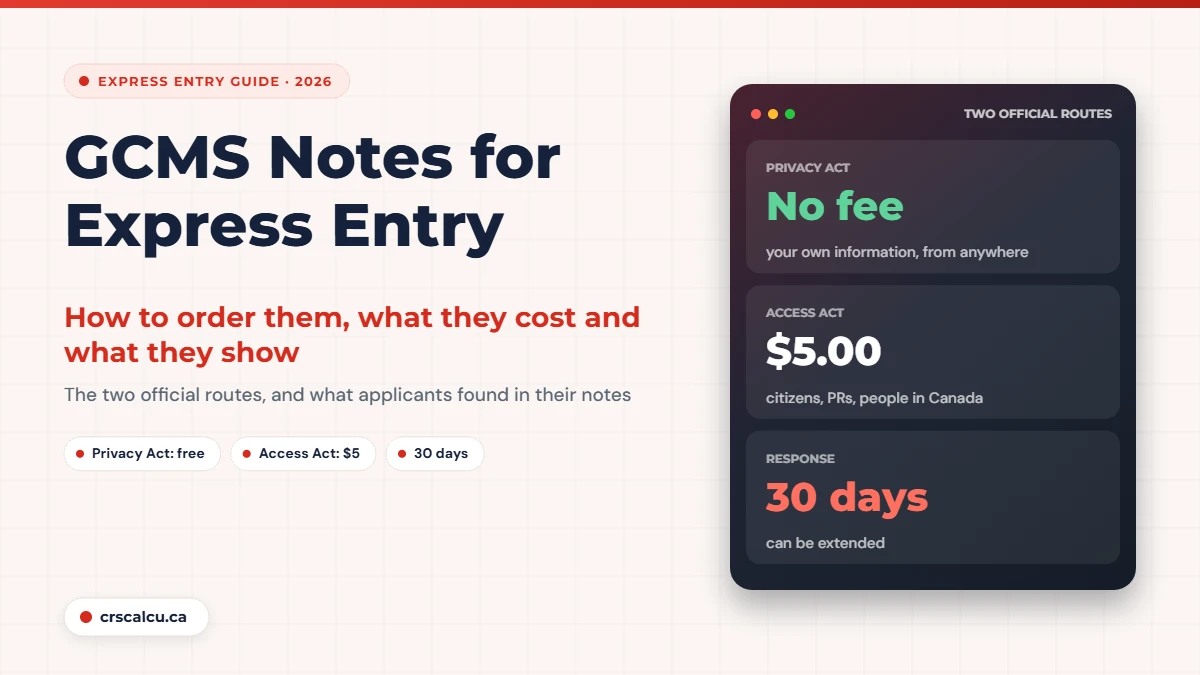
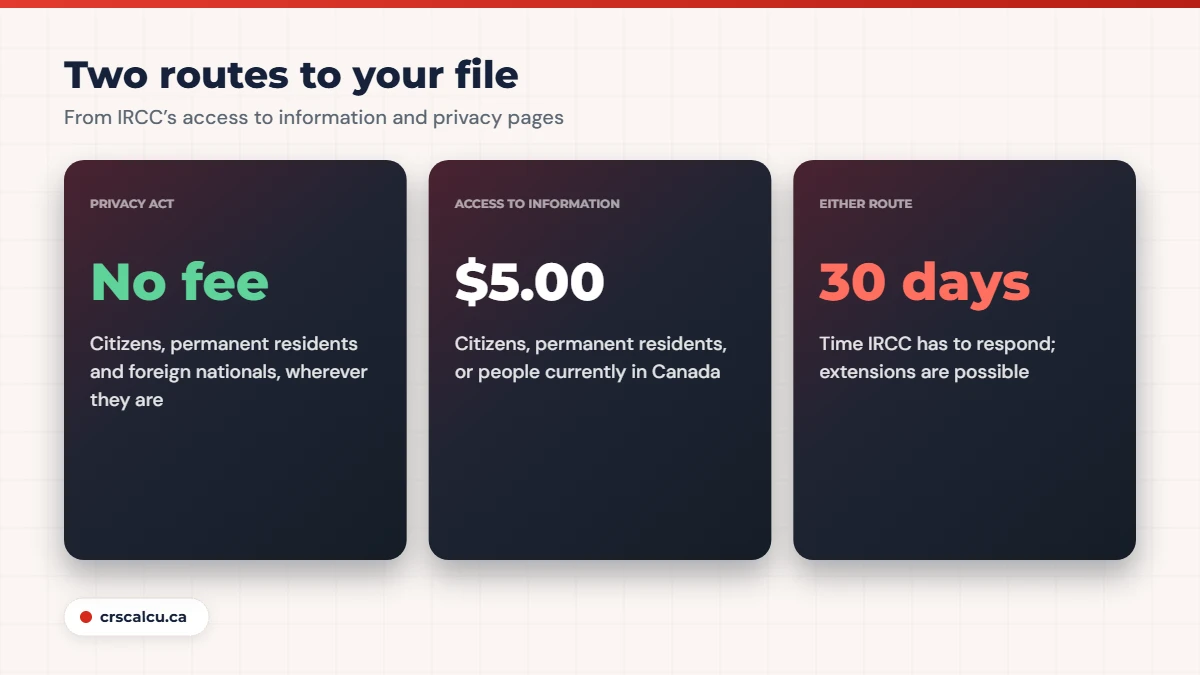
Request your own file from IRCC through the federal online access to information and privacy portal. Under the Privacy Act the request is free, and IRCC says citizens, permanent residents and foreign nationals can use it regardless of where they are. Under the Access to Information Act it costs $5 and you must be a citizen, a permanent resident or currently in Canada. IRCC has 30 days to respond, with possible extensions. Order them once you are well past the normal Express Entry processing time, not in week three.
Key takeaways
What GCMS notes are, and what IRCC calls them
“GCMS notes” is applicant shorthand. On IRCC’s pages the same thing is simply a request for records, or for your personal information, under the Access to Information Act or the Privacy Act. People also say “ATIP notes”, after the access to information and privacy office that handles the requests.
Real case: “ATIP or GCMS, which one should I order?” (November 2021)
An applicant facing delays asked whether to request ATIP or GCMS and what the pros and cons were. A member explained that they are not alternatives: one is the legal process, the other is the system the records come from. You ask for your GCMS notes by filing a request under the access and privacy laws through the official portal. The member added that a request under the Privacy Act avoids the $5 fee, that both routes return the same details, and that responses at that time were taking two months or more because of volume.
That thread clears up the most common confusion. There is one set of notes and two legal doors to it.
Two routes: Privacy Act or Access to Information Act
IRCC has a separate page for each route, and the differences matter most to applicants outside Canada.
Point | Privacy Act | Access to Information Act |
|---|---|---|
Who can request | Canadian citizens, permanent residents and foreign nationals, regardless of where they are located | Canadian citizens, permanent residents, or an individual or corporation currently in Canada |
What you can ask for | Your own personal information held by federal institutions | Records held by the department |
Fee | None | $5.00 per request |
How to submit | Online portal, or by mail with form IMM 5563 or a letter | Online portal, or by mail with form IMM 5563 or a letter and a $5 cheque |
Someone requesting for you | Needs your consent form IMM 5744 | Needs your consent form IMM 5744 |
Time to respond | 30 days, with possible extensions | 30 days, with possible extensions |
Our summary of IRCC’s pages on requests under the Privacy Act (modified April 24, 2018) and the Access to Information Act (modified May 19, 2023), and Help Centre answers modified September 1, 2026.
For years the standard forum advice was that applicants outside Canada had to find someone in Canada, or pay a service, to file on their behalf. That advice grew out of the Access to Information Act rule. IRCC’s Privacy Act page and its Help Centre answer “Who can make a request under the Privacy Act?” (modified September 1, 2026) both say foreign nationals can request their own personal information regardless of where they are located. If you are asking for your own file, that is the route to look at first.
Real case: a lookalike site asking $20 (December 2024)
An applicant wanting notes for a permanent residence application found two websites: a polished one asking $20, and the Government of Canada portal. They asked which was right. Every reply said to use the official portal and not the other site. Members described the steps as they knew them: choose IRCC, enter your details, pay $5, and wait about 30 days for an email. One said the notes usually run to eight pages or more, covering progress, completed stages, pending items and officer observations.
Paid services are not illegal, and some applicants use them for convenience. But the thing they sell is a request you are entitled to make yourself, for $5 or for nothing.
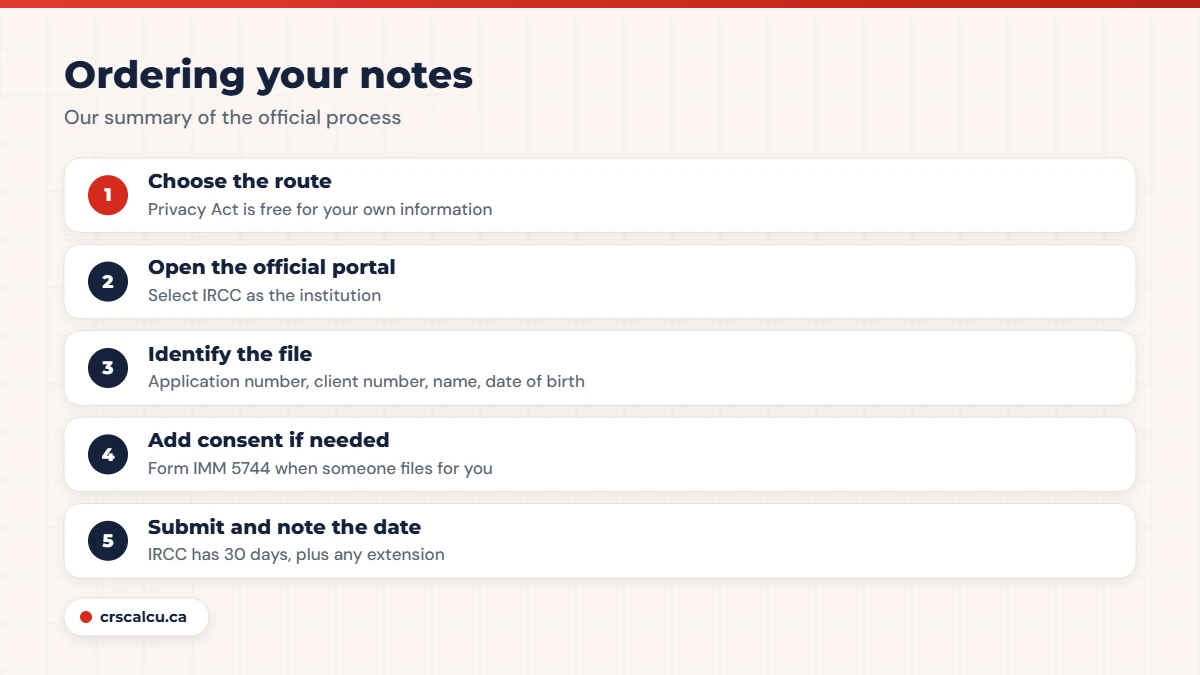
How to request your notes, step by step
Our summary of the official process
If you prefer paper, both IRCC pages say you can mail the request form IMM 5563, or a letter stating which act you are applying under, to IRCC’s access to information and privacy division in Ottawa.
How long it takes
The legal answer is on IRCC’s Help Centre (modified September 1, 2026): the department has 30 days to respond to a formal request under either act. That period can be extended, for example when a request involves many records or needs consultations, and for Privacy Act requests the extension can be up to a further 30 days. If you hear nothing within 30 days, the answer says you can contact the access to information and privacy division for a status update. IRCC’s Privacy Act page also warns that large increases in request volumes may affect its ability to meet the timelines.
Real case: 31 days for most, 70 and counting for one (January to April 2018)
A poster asked how long notes were taking after IRCC warned about a surge in requests. A member said agencies must respond within 30 days and that notes were arriving in about 31. Over the next weeks several people confirmed receiving theirs within that window, one for three separate requests. One applicant was the exception: they applied on February 9, sent a reminder a month later, and still had nothing in late April. Their request related to a refusal, and they wondered whether that was why.
Other threads put the wait at four to five weeks in 2018 and two months or more in 2021. Plan on a month and do not be surprised by two.
What GCMS notes for Express Entry show, according to applicants
Since IRCC’s pages do not describe the contents, this section is applicant experience. People who have received notes describe a summary of assessments, such as eligibility, medical, criminality and security, each with a status; a history of activities on the file; and officers’ written remarks.
Real case: “Passed – Candidate” and blank lines (April to June 2016)
An applicant received notes showing eligibility as passed with a “candidate” label and other requirements complete, with nothing yet beside security, medical and criminality. An experienced member read this as the file having cleared its first review, with the other assessments still to come. Another described their own notes moving through several statuses to “passed” about five months after submission. When the poster ordered notes again, nothing had changed between May and June.
Real case: notes revealed a hold the account never showed (October 2022)
A provincial nominee whose background check had been pending for months ordered their notes and learned the file had been on hold since May because of a biometrics problem. Nothing in the online account had mentioned it. Of all the cases we read, this is the one where the notes changed what the applicant could do next.
Two limits are worth knowing before you order. First, parts can be withheld. In a 2018 thread a member noted that information about background checks may be restricted and that those pages come back blank. Second, the labels are easy to misread. In a 2019 case an applicant took “security: not started” to mean they were in security screening, and a closer reading suggested they were not. We cover that stage in background check in Express Entry.
Notes are a snapshot
Your notes show the file on the day the request was processed. If an officer picks it up the following week, the notes will not say so. Ordering a new set every month mostly produces the same pages again, as the 2016 poster found.
When ordering GCMS notes for Express Entry is worth it
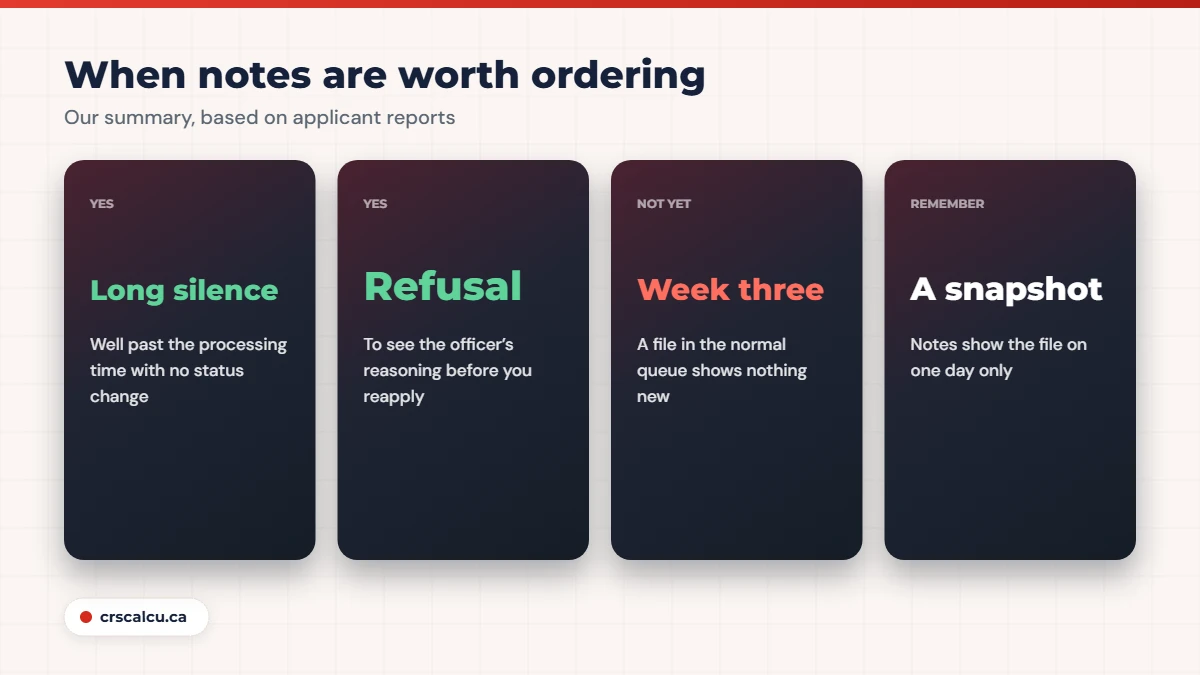
Order them if one of these is true
If you submitted last month and everything looks normal, notes will tell you only that the file is waiting its turn.
Five mistakes people make when ordering notes
Five mistakes from the threads and the rules
Notes describe an application that is already in process. If you are still working toward an invitation, they are not relevant yet: your next step is your score, which you can check with the CRS calculator against the latest draw cut-offs.
Frequently Asked Questions
How do I order GCMS notes for Express Entry?
Make a request to IRCC through the federal online access to information and privacy portal, asking for the electronic notes on your permanent residence application. Give your application number, client number, name and date of birth. You can also mail form IMM 5563.
How much do GCMS notes cost?
A request under the Privacy Act for your own personal information has no fee. A request under the Access to Information Act costs $5.00.
Can I order GCMS notes from outside Canada?
IRCC says foreign nationals can request their own personal information under the Privacy Act regardless of where they are located. The Access to Information Act route is limited to citizens, permanent residents and people currently in Canada.
How long do GCMS notes take?
IRCC has 30 days to respond, and the period can be extended. Applicants on public forums reported about 31 days in early 2018 and two months or more in 2021.
What do GCMS notes show?
According to applicants who received them: the status of each assessment, a history of activity on the file and officers’ remarks. Some parts, especially around background checks, may be withheld and appear blank.
Can my consultant or a friend request them for me?
Yes, with your consent. IRCC requires the Consent for an Access to Information and Personal Information Request form (IMM 5744) when someone makes a request on your behalf.
Not in process yet? Start with your score
File notes only exist once you have applied. Before that, the number that matters is your CRS score against recent cut-offs.
Final Thoughts
GCMS notes for Express Entry are worth ordering when a file has gone quiet for longer than it should. Use the official portal, pick the Privacy Act route if you are asking for your own information, give the file numbers, and allow a month or two. Read the result as a snapshot, with some pages possibly withheld.
If the notes show a concern you do not understand, a hold with no reason given, or an officer’s comment that questions something you declared, take them to a licensed consultant or lawyer before you write to IRCC. How you respond matters more than how fast.