Express Entry Guide · Updated October 2026
Education Category in Express Entry: Teachers, ECEs and Who Qualifies (Real Cases)
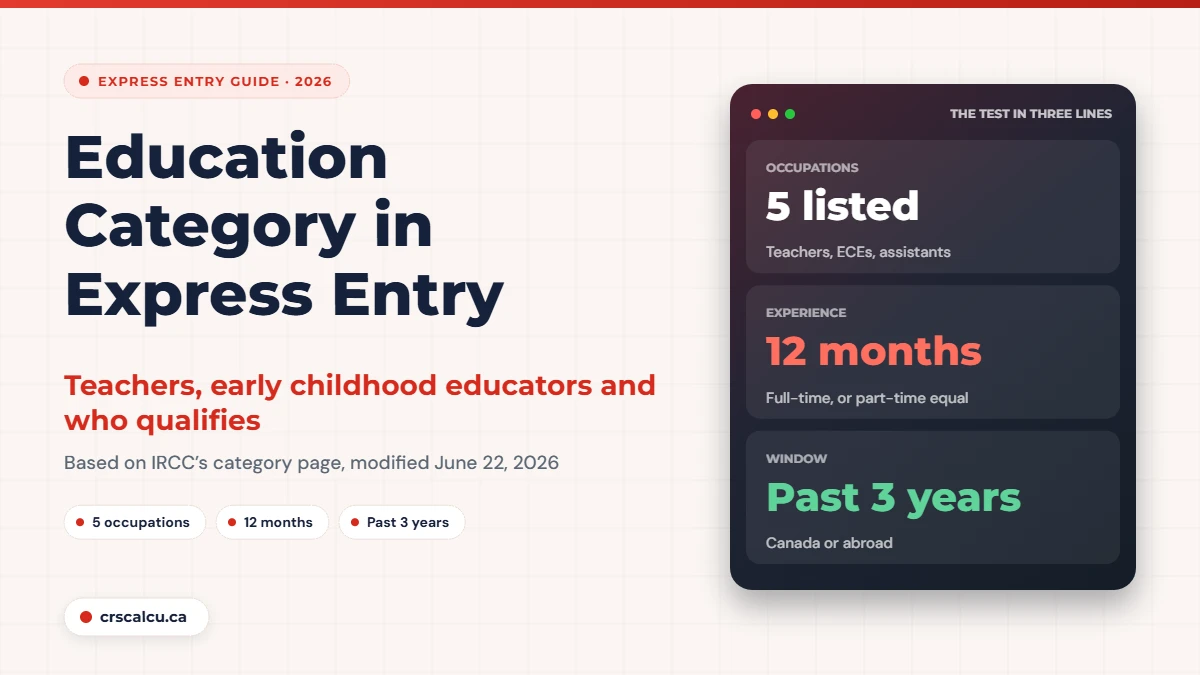
Teachers, early childhood educators and classroom assistants now have rounds of their own. The list is short and the test is specific.
The education category is one of the newer additions to Express Entry’s category-based selection, and the one that produces the most “does my job count?” questions. That is partly because the list is short, five occupations as we read it, and partly because education jobs come with titles that vary from one school board, daycare or charity to the next.
The test itself is the same as for the other occupation categories: recent experience in a listed occupation, on top of ordinary eligibility for an Express Entry program. What needs care is matching what you actually do to a code, counting part-time and term-time work properly, and not confusing a credential in education with experience in it.
We read IRCC’s category-based selection page (modified June 22, 2026), including the education occupations list, and five public forum threads from 2024 and 2025. This is general information, not legal or licensing advice.
Quick answer: who qualifies for the education category?
You qualify if you are eligible for an Express Entry program and have, within the past 3 years, at least 12 months of full-time work experience (or an equal amount of part-time) in one of the listed education occupations: secondary school teachers, elementary and kindergarten teachers, early childhood educators and assistants, instructors of persons with disabilities, or elementary and secondary school teacher assistants. A degree in education does not qualify you by itself; the test is work experience. Check your score with our CRS calculator.
Key takeaways
How the education category works
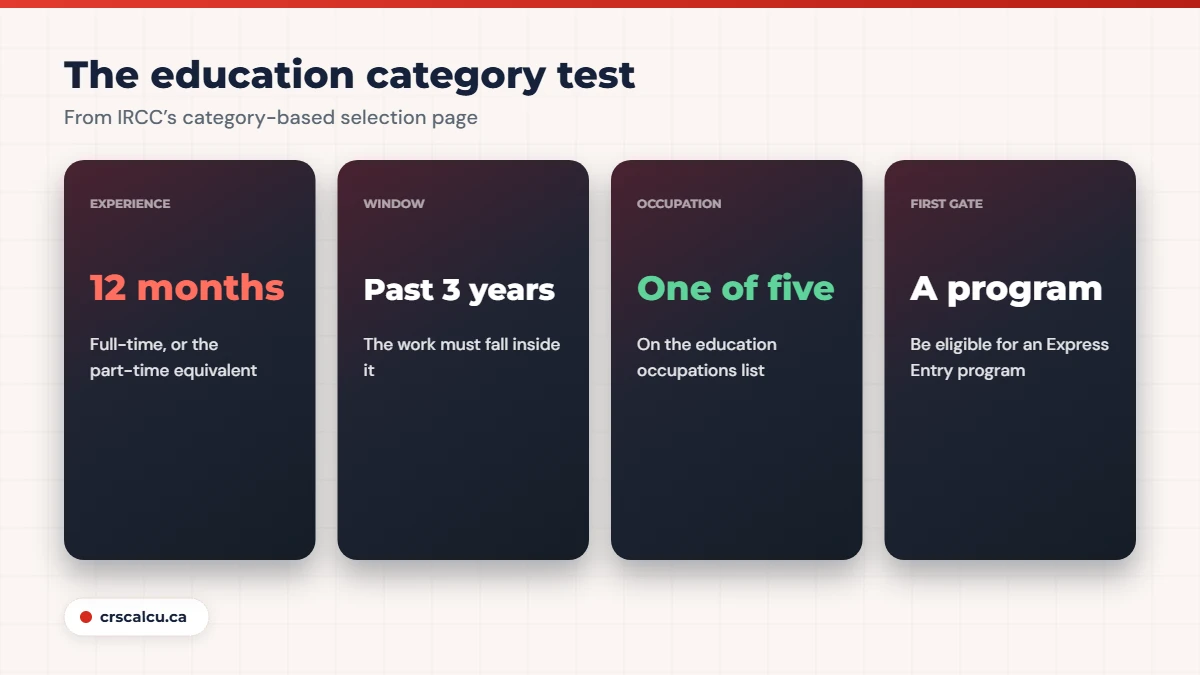
IRCC’s category-based selection page (modified June 22, 2026) describes rounds in which candidates who meet a category’s test are ranked against each other and the highest scores are invited. Two conditions apply to everyone. You must meet the minimum requirements of one of the three Express Entry programs. And you must meet the category’s own test, which for education occupations is at least 12 months of full-time work experience, or an equal amount of part-time experience, in a listed occupation, accumulated within the past 3 years.
There is no separate application. The system reads eligibility from the work history in your profile, so the codes you enter there are what count. Our overview is in category-based draws, and the same structure applies to the healthcare category and the trades category.
The five occupations in the education category
Occupation | NOC code | TEER |
|---|---|---|
Secondary school teachers | 41220 | 1 |
Elementary school and kindergarten teachers | 41221 | 1 |
Early childhood educators and assistants | 42202 | 2 |
Instructors of persons with disabilities | 42203 | 2 |
Elementary and secondary school teacher assistants | 43100 | 3 |
From IRCC’s category-based selection page (modified June 22, 2026). Check the live list; categories have been revised before.
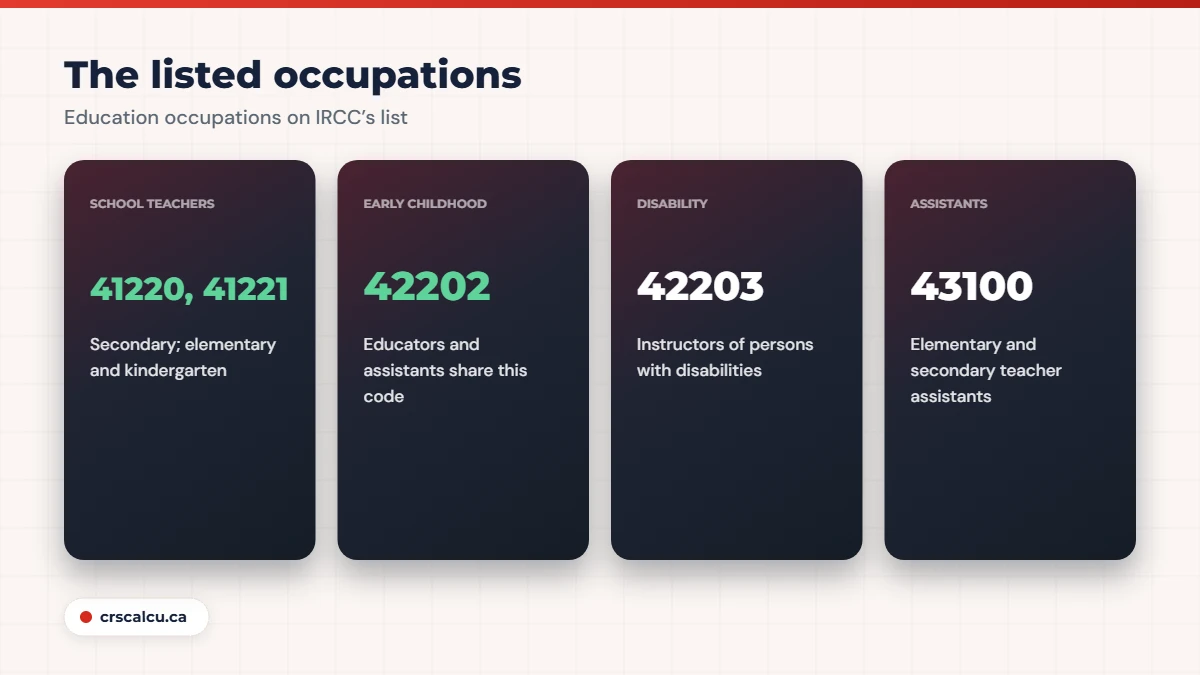
That is the whole list as we read it. University professors, college instructors, tutors, school administrators and education consultants are not on it. If your work is in one of those areas, a round for education occupations will not reach you, however closely your career is tied to teaching.
Two of the five deserve a note. Code 42202 covers both early childhood educators and their assistants, so an assistant in a licensed childcare setting can be in the same occupation as a fully qualified educator for this purpose. And code 43100, teacher assistants, is TEER 3, which still counts as skilled work for Express Entry.
Your code follows your duties
Job titles in education are unreliable. “Program assistant”, “learning support worker”, “classroom aide” and “facilitator” can each describe work that fits a listed code, or work that does not.
Real case: assisting an education program at a charity (May 2024)
A master’s graduate in education had a full-time job helping to run an educational program at a non-profit: supporting students, preparing classrooms, keeping records and organizing events. They asked which code and skill level applied. A senior member did not guess. They told the poster to look the duties up in the official occupation database and work it out from there. No answer on the code was recorded in the thread.
That reply is unsatisfying and correct. Nobody on a forum can assign your code from a job title. Read the lead statement and main duties of each candidate code and see which one describes most of what you do; our NOC and TEER finder helps, and wrong NOC code in Express Entry explains what is at stake if you choose a code because it is on a list.
Real case: skilled work before, a different job now (March 2024)
A candidate had a year and a half of experience in a TEER 2 job and was now working in a TEER 4 one, and asked whether they could still use Express Entry. A senior member said yes on the strength of the earlier experience, since TEER 4 work does not count either way, and added that the experience alone is not enough: the candidate also needs to fit a program, with language results and, for foreign education, a credential assessment. No outcome was reported.
For the education category this matters in a particular way. The listed experience does not have to be your current job, but it does have to sit inside the past 3 years. Someone who left a classroom two years ago for unrelated work still has a year of margin; someone who left four years ago has none.
Counting 12 months when the work is part-time or term-time
Education work is often part-time, split between employers, or paid only during the school year. IRCC’s page allows an equal amount of part-time experience in place of 12 full-time months, which in practice means counting hours. Our post on 1,560 hours shows the method.
Real case: part-time ECE assistant with an unrelated degree (October 2024)
Someone working part-time as an early childhood educator assistant in Ontario had been hired on the strength of two years of related experience and references; their own studies were in computer programming. They asked whether moving to full-time in the same role would let them qualify for permanent residence. Replies said it would come down to their score, pointed to the Canadian Experience Class and to provincial streams that have targeted early childhood roles, and suggested a credential assessment for their foreign education. The thread then drifted into provincial licensing. No outcome was reported.
Three things in that case are worth separating. An unrelated degree does not stop the work experience from counting; the category test is about the job. Part-time hours do count, pro rata. And for a candidate in Canada, a year of skilled Canadian work also opens the Canadian Experience Class, which is what makes the profile eligible in the first place; see FSW vs CEC.
Questions one poster asked, and what IRCC’s pages say
Real case: three questions with no replies (March 2025)
An early childhood assistant with exactly six months of Canadian experience and strong language results asked three things shortly after the education rounds began. Did five years of unrelated work at home count? Did an earlier job for a Canadian company, done while living abroad, count as Canadian experience? And what occupation code should they enter when their open work permit shows none? Nobody answered, and the poster asked again ten days later.
We can answer from the official pages. Unrelated foreign work does not help with the education category, which needs a listed occupation, but skilled foreign work can still count for program eligibility and for skill transferability points; see foreign work experience in Express Entry. Work for a Canadian company done from abroad is not Canadian work experience: the CRS criteria page (modified June 22, 2026) defines that as working for a Canadian employer in Canada. And the code comes from the duties of the job you did, not from the permit. An open work permit has no occupation on it because it lets you work in any job. As for the six months: the category asks for 12, so that poster had half of what was needed at the time of writing.
Licensing, credentials and Canadian study
Real case: an educator abroad planning ahead (February 2025)
A prospective applicant abroad, aiming to qualify as an early childhood educator, held a bachelor’s degree in another field and two childcare certifications. They asked how to get their education assessed, whether they needed a provincial licence first, and whether a job offer would help. Members told them to use the assessment service meant for immigration, said that provincial registration usually comes after arrival and is not needed to enter the pool, and pointed out that job offer points had just been removed from the points table. Another poster in the thread learned that a seven-month Canadian certificate in the field did not earn Canadian education points because it was too short.
The first and third points match what we have read on IRCC’s pages: an educational credential assessment has to be one issued for immigration purposes by a designated organization, and job offer points were removed from the CRS on March 25, 2025. On licensing, the category page we read sets a work experience test and does not mention registration; working in a regulated occupation in Canada is governed by the provinces, and this post does not cover that. On short programs, the CRS criteria page gives Canadian education points for credentials of one or two years, and of three years or more; see Canadian education points and study in Canada for CRS points.
A common misreading follows from the category’s name. An education degree does not put you in the education category. A physicist with a year of experience as a secondary school teacher qualifies. A graduate in education who has never held one of the five jobs does not.
Checking whether you qualify

Our suggested order
Documents to line up early
For foreign credentials, online degree and ECA covers a case where the assessment did not go as expected.
Five mistakes people make with the education category
Avoid these
What IRCC does not say
IRCC does not publish a schedule of education rounds or forecast their cut-offs. The category page does not address provincial licensing or registration. And it gives no way to have a job title checked against a code in advance; that judgment is yours to make and an officer’s to review.
Frequently Asked Questions
What is the education category in Express Entry?
It is one of IRCC’s category-based selection categories, called education occupations. Rounds for it invite eligible candidates with 12 months of recent experience in one of the listed occupations.
Which jobs are in it?
On the list we read: secondary school teachers (41220), elementary and kindergarten teachers (41221), early childhood educators and assistants (42202), instructors of persons with disabilities (42203) and elementary and secondary school teacher assistants (43100).
Do early childhood assistants qualify, or only educators?
Code 42202 covers early childhood educators and assistants together. Whether your job falls under it depends on your duties.
Does part-time work count?
Yes. IRCC’s page accepts an equal amount of part-time experience in place of 12 months of full-time work. Count the hours.
Do I need a teaching licence to be invited?
The category page sets a work experience test and does not mention licensing. Working in a regulated occupation in Canada is governed by provincial bodies.
Does my degree in education qualify me?
Not by itself. The category is based on work experience in a listed occupation, not on the field of your degree.
Check your score for an education round
Calculate your CRS and compare it with category cut-offs, not general ones.
Final Thoughts
The education category is small and exact: five occupations, 12 months, the past 3 years. If your real duties match one of the five and your profile is eligible in the ordinary way, the system will find you. If they do not, no title or degree will change that.
If your job sits between two codes, if your hours are split across employers, or if you are unsure whether your profile is eligible, a licensed immigration consultant or an immigration lawyer can review it with you.