Express Entry Guide · Updated October 2026
First PR Card in Canada: The 180-Day Rule, How Long It Takes and What to Do If It Never Arrives (Real Cases)
You do not apply for it, you cannot have it mailed abroad, and you need it to fly home from your first trip. Three facts that catch new permanent residents out.
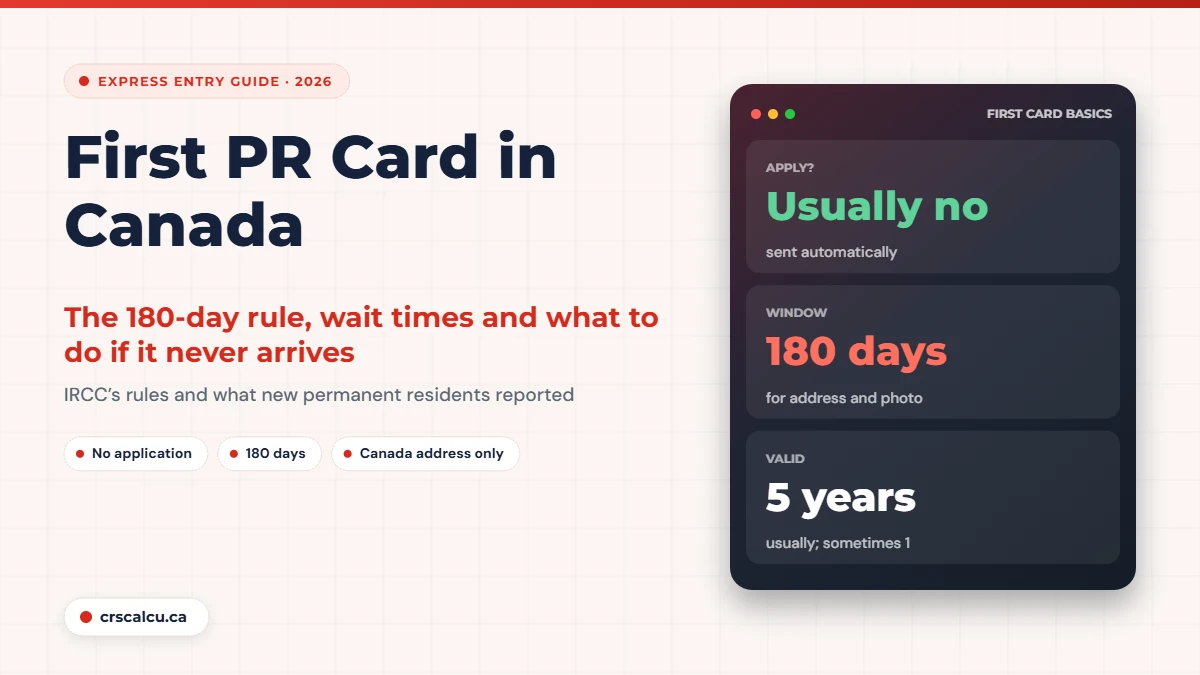
Your first PR card is the plastic proof of the status you just spent a year earning. Most people never fill in a form for it. IRCC’s page says it sends the first card automatically, as long as it has your Canadian mailing address and a photo within a set window after you become a permanent resident.
That sounds simple, and for most people it is. The trouble starts in the gaps: you landed and left again, the envelope went to an old address, the card was delivered and vanished from a shared mailbox, or you booked a trip abroad before it arrived. Each of those has a specific official answer, and a couple of them have traps.
We read IRCC’s pages on getting a PR card, receiving it, the travel document for people without one and permanent resident status, along with six public forum threads from 2018 to 2024 about cards that were late, lost or needed in a hurry.
Quick answer: how do I get my first PR card?
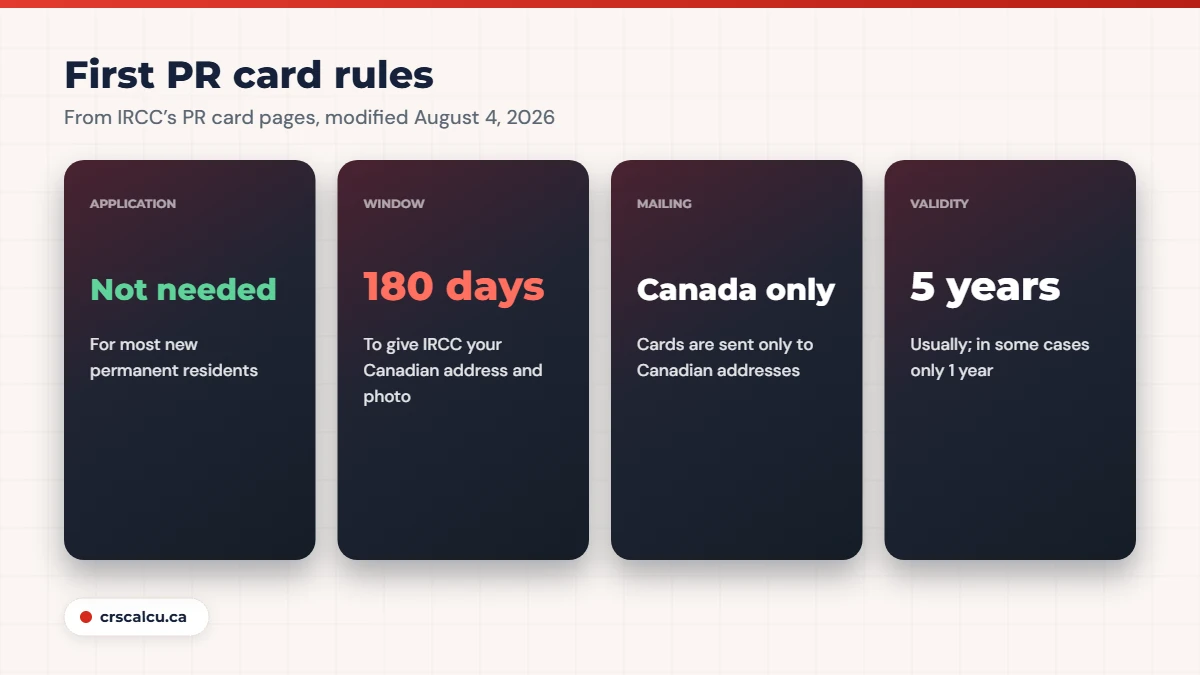
IRCC’s page (modified August 4, 2026) says most people do not need to apply for their first PR card. IRCC sends it automatically if you give your Canadian mailing address and photo within 180 days of becoming a permanent resident: to the border officer if you land at a port of entry, or through the permanent residence portal if you were confirmed in Canada. Cards are mailed only to Canadian addresses. A PR card is usually valid for five years.
Key takeaways
What IRCC says about the first PR card
The rules are spread over two pages: “Get, renew or replace a permanent resident card” and “Getting your PR card after you apply”, both modified August 4, 2026.
Question | What IRCC says |
|---|---|
Do I apply? | Most people do not need to apply for their first PR card |
What triggers it? | Giving your Canadian mailing address and photo within 180 days of becoming a permanent resident |
Landed at a border or airport? | Give the details to the border officer, or submit them online |
Confirmed in Canada? | Upload both through the Permanent Residence Portal |
Where is it sent? | Only to Canadian addresses |
How long is it valid? | Usually 5 years; in some cases only 1 year |
What if I miss the 180 days? | You have to apply for the card |
Our summary of IRCC’s PR card pages (modified August 4, 2026), read on October 5, 2026.
IRCC’s page for people arriving from outside Canada adds one detail: at the border, the officer confirms the Canadian mailing address where the card will be sent, and if you change your address within 180 days of arriving, you must tell IRCC using its web form.
The 180-day rule
This is the rule that decides whether your card is automatic and free of paperwork, or an application. The clock starts on the day you become a permanent resident: the day you land, or the date on your e-COPR.
For people confirmed in Canada the address and photo are part of the portal, so the rule looks after itself. It bites people who land from abroad without a Canadian address, promise to send one later, and then get busy. If you land and do not yet have somewhere to live, sort out an address you can rely on and send it in well inside the window. Our post on the IRCC web form explains how to report it.
The photo follows the same specifications as other permanent resident photos. We list IRCC’s numbers in the digital photo guide.
How long the first PR card takes
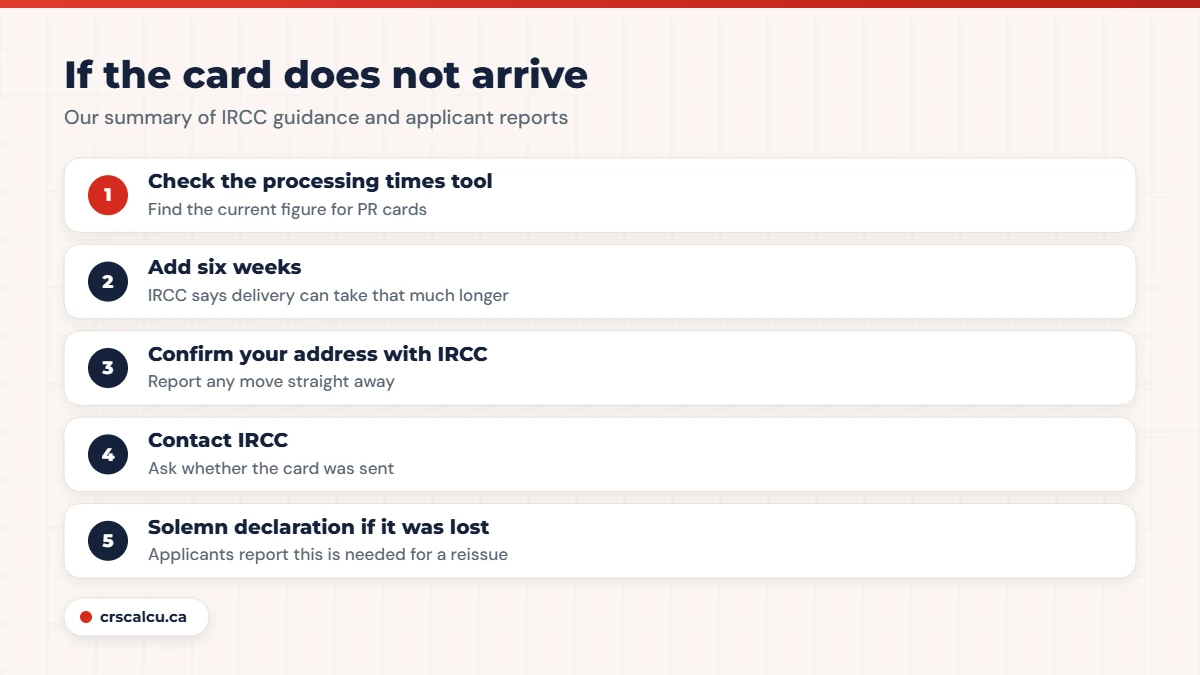
IRCC’s pages do not give a fixed number for a first card. The “after you apply” page says it can take an additional six weeks beyond the current processing time to receive it, and points you to the processing times tool for the current figure. Applicants have recorded their own waits.
Real case: about three weeks after the e-COPR (June to July 2021)
Two applicants confirmed through the portal in June 2021 posted their dates. Each received the e-COPR a few days after getting portal credentials on June 15, and each had the PR card in the mail roughly three weeks later, on July 5 and July 8. One had been warned by a lawyer to expect four to five months.
Real case: needed to travel, waited instead (August to December 2023)
An applicant received their e-COPR in June 2023 and still had no card in August, when an urgent trip outside North America came up. Members said they could leave without proof of status but would need a travel document to come back, and suggested waiting if possible. The applicant decided to wait. They later reported that the card arrived within three months of the e-COPR, and that people around them had waited anywhere from three weeks to two months.
So three weeks to three months is the range in these reports, with the processing times tool as the official reference.
If the card does not arrive
IRCC’s guidance is to wait before acting: up to six weeks beyond the normal processing time. After that, the route applicants describe is to contact IRCC and, where a card was sent and not received, to file a solemn declaration so it can be reissued. IRCC’s page says that if there is a mistake on a card you receive, you may be able to get it reissued.
Real case: delivered to the mailbox, according to the carrier (February 2018)
A couple who had just landed found six weeks later that their cards were lost in the mail. They had since left Canada and asked whether replacements could be requested from abroad and sent to a friend. Members replied that IRCC will not send cards outside Canada, that showing a non-Canadian residential address may mean the card is held for pick-up in person, and that only the cardholder can collect it. One who had been through it advised calling IRCC, waiting the six weeks, then sending a solemn declaration. No final outcome was reported.
Real case: family got theirs, one card missing for a year (March 2022 to February 2023)
A new permanent resident had no card twelve months after approval, although the rest of the family had theirs. A solemn declaration had been filed and nothing had moved. In February 2023 they reported what broke the logjam: they filed an access to information request about the file, and the card was issued about 30 days later.
Real case: four months, no card, no replies (February 2024)
An applicant who landed in mid-October 2023 still had no card in February and had heard nothing back from a web form or emails. Members helped them link the card file to their online account using their client number and family name, and said plenty of cards are sent and never received. For those, they said, a solemn declaration is required and reissuing takes three to four months. The poster managed to link the file and saw the status change, but was still waiting, and was by then outside Canada.
Two of these three people had left Canada while the card was outstanding. That is the common thread in lost-card stories.
Travelling before the card arrives
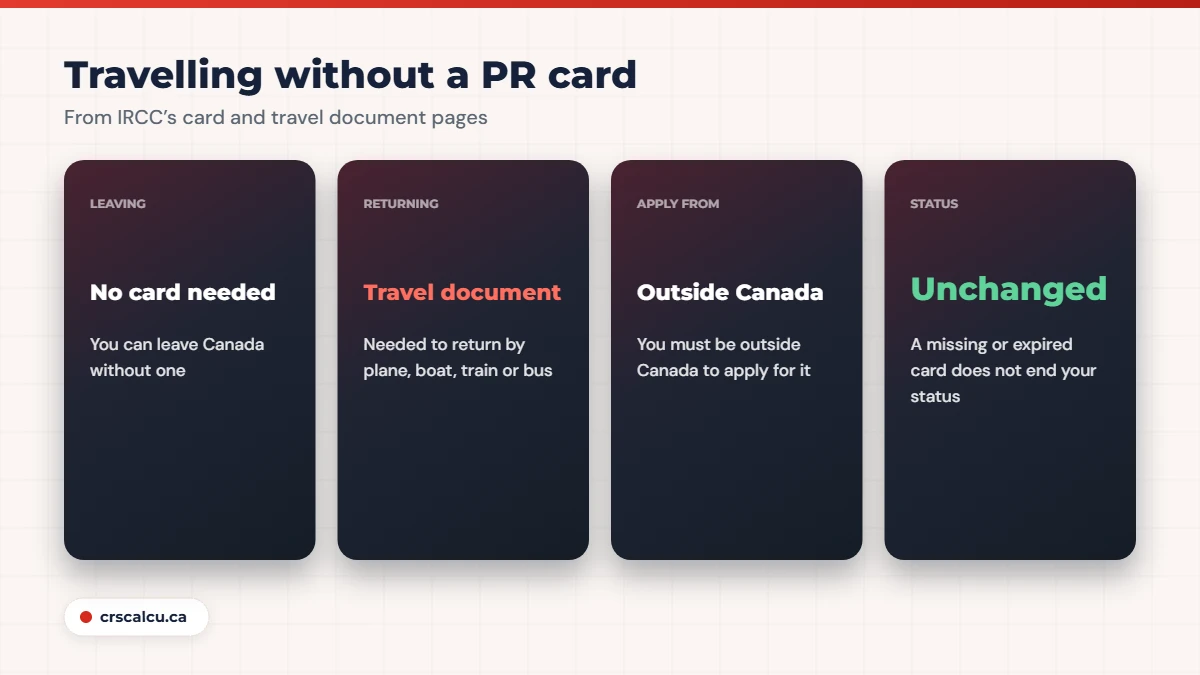
IRCC’s card page states the rule: if you do not have a valid PR card, you must apply for a permanent resident travel document to return to Canada. The travel document page (modified August 21, 2025) lists who can apply: someone who has permanent resident status, has no valid PR card, is outside Canada, and plans to return by airplane, boat, train or bus.
Private vehicles are not in that list. Applicants on forums consistently report re-entering at a land border by car with their passport and COPR, and one member in the 2022 thread above did exactly that to visit family in the United States. We did not find an IRCC page that sets this out, so treat it as applicant experience and carry every document you have.
Your options if you must travel first
Do not say you are in Canada when you are not
In a 2022 thread, someone who had left after landing asked about requesting a replacement card and having a friend forward it. An experienced member pointed out that applying as if you were in Canada while living abroad is a false statement, with the consequences that follow. If you are outside Canada without a card, the travel document is the honest route.
Does a missing or expired card affect your status?
No. IRCC’s page on permanent resident status (modified April 9, 2026) says an expired PR card does not mean you have lost your status. You lose status only through a formal process: an officer’s decision after an inquiry or a travel document appeal, a voluntary renunciation, a removal order, or by becoming a citizen.
What does matter is the residency obligation. The same page says you must be in Canada for at least 730 days during the last five years to keep your status, and that the days do not need to be continuous. You can count yours with our physical presence calculator. The card is evidence of status. It is not the status itself, and neither is its expiry date.
Six mistakes new permanent residents make with the card
Six mistakes from the rules and the threads
After you land or get your e-COPR
If you are not at this stage yet, the card is the last item on a long list that begins with an invitation. See where your points stand with the CRS calculator and the latest draw cut-offs.
Frequently Asked Questions
Do I need to apply for my first PR card?
Usually not. IRCC says most people do not need to apply, and that it sends the first PR card automatically if you give your Canadian mailing address and photo within 180 days of becoming a permanent resident.
How long does the first PR card take?
IRCC says it can take an additional six weeks beyond the current processing time shown in its tool. Applicants on public forums reported about three weeks in 2021 and up to three months in 2023.
Can my first PR card be mailed outside Canada?
No. IRCC sends PR cards only to Canadian addresses.
Can I travel before my PR card arrives?
You can leave, but IRCC says that without a valid PR card you must apply for a permanent resident travel document to return to Canada by airplane, boat, train or bus.
What if my PR card never arrives?
Wait up to six weeks beyond the normal processing time, then contact IRCC. Applicants report that when a card was sent and not received, a solemn declaration is needed before it is reissued, and that reissuing took three to four months.
Do I lose my status if my PR card expires or is lost?
No. IRCC says an expired card does not mean you have lost permanent resident status. Status depends on meeting the residency obligation of at least 730 days in Canada in the last five years.
The card comes last. The score comes first
If you are still working toward an invitation, check your points against recent Express Entry cut-offs.
Final Thoughts
Your first PR card is meant to be the easy part: give IRCC a Canadian address and a photo within 180 days, stay reachable at that address, and wait. Nearly every problem in the threads came from leaving Canada, or moving, before the envelope arrived.
If you have to travel urgently without a card, if the card has been missing for months, or if you have spent long periods outside Canada since landing, speak to a licensed consultant or lawyer before you apply for anything. The travel document application looks at your time in Canada, and it is better to know where you stand before you file it.