Express Entry Guide · Updated October 2026
Study in Canada for CRS Points: Is the Study Route Worth It? (Real Cases)
A Canadian credential adds points. So does the work that follows it. Whether the total beats what you lose in time, money and age is arithmetic you can do first.
The idea of study in Canada for CRS points is simple and widely sold: enrol in a one-year program, get a work permit afterwards, work for a year, and come out with a score that clears the cut-off. Each step in that chain is real. Each also has a condition attached, and the conditions are where plans fail.
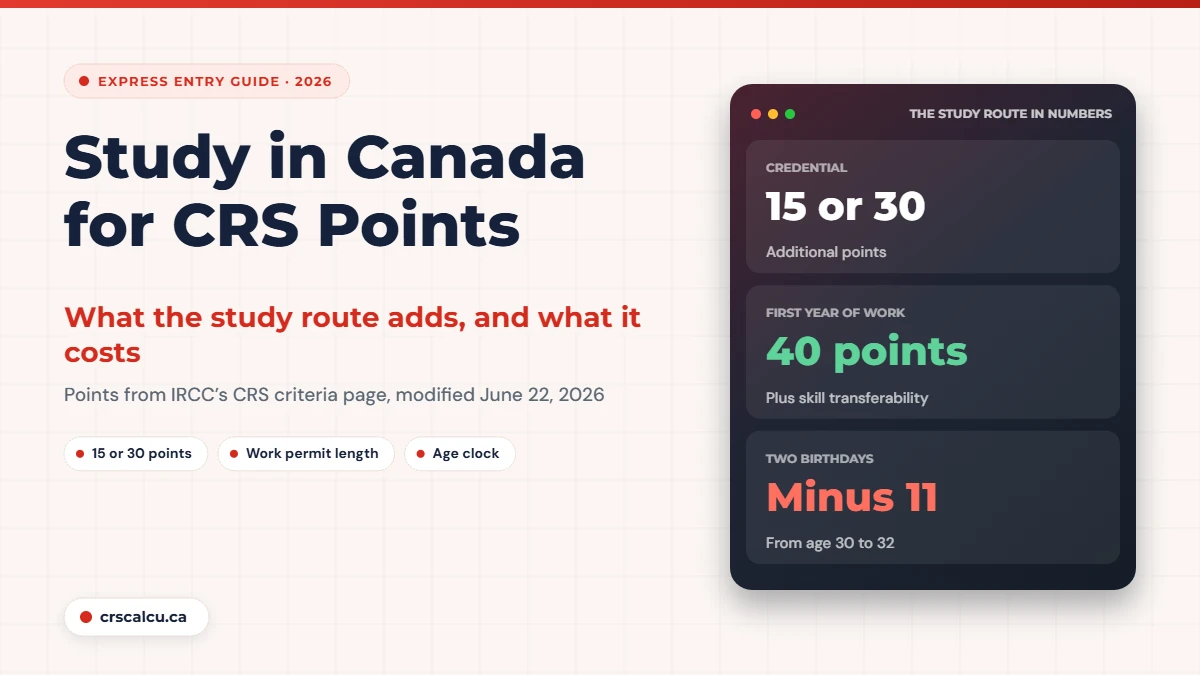
The credential itself is worth 15 or 30 additional points. The bigger prize is the year of Canadian work that follows, which adds core points and unlocks skill transferability. To get it you need a work permit long enough to hold a skilled job for twelve full months, and the length of that permit depends on the program you chose before you ever arrived.
We took the points from IRCC’s CRS criteria page and the work permit rules from IRCC’s post-graduation work permit pages (all modified in 2026), and read five public forum threads from 2017 to 2023. Figures marked “our arithmetic” are ours. This is general information, not legal or financial advice.
Quick answer: does studying in Canada raise your CRS score?
Yes, in two stages. A Canadian credential of one or two years adds 15 additional points, and one of three years or more adds 30. The larger gain comes afterwards, from Canadian work experience: 40 core points for the first year, without a spouse, plus skill transferability. But work done while you are a full-time student does not count toward the Canadian Experience Class, and a program of 8 months to under 2 years gives a work permit only as long as the program. Run both versions of your plan in our CRS calculator.
Key takeaways
What the CRS actually pays for
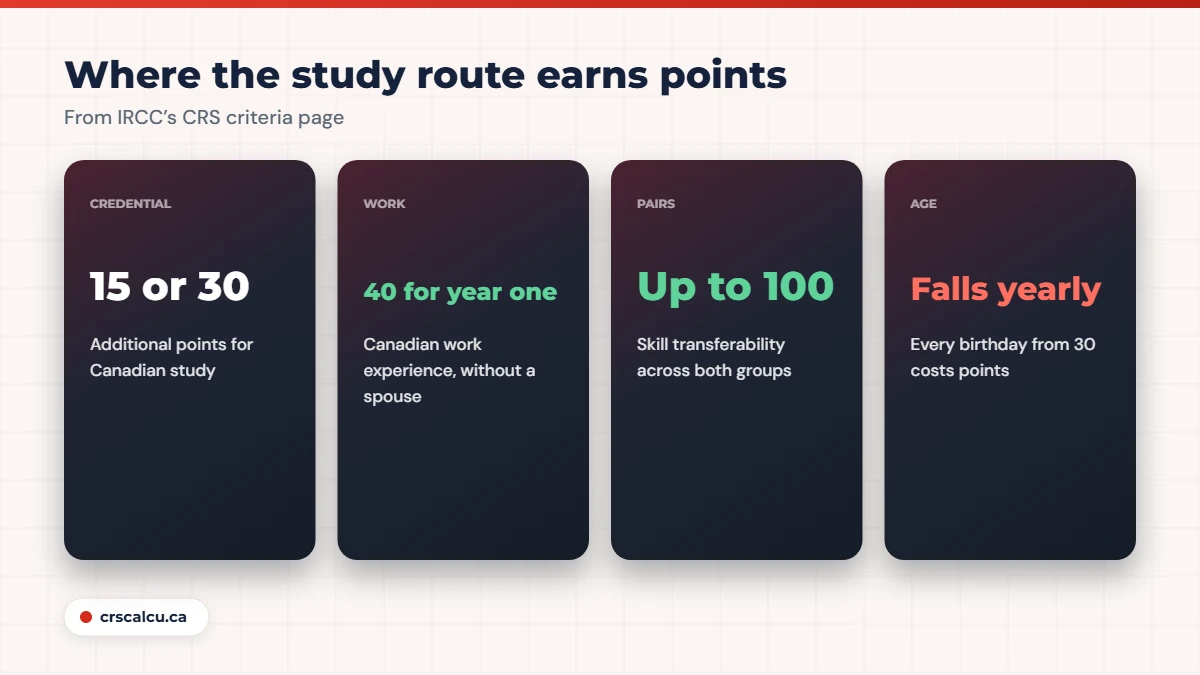
IRCC’s CRS criteria page (modified June 22, 2026) rewards the study route in four places, and it helps to see them separately.
Source | Points | Condition |
|---|---|---|
Canadian credential, 1 or 2 years | 15 additional | Completed post-secondary study in Canada |
Canadian credential, 3 years or more | 30 additional | Completed post-secondary study in Canada |
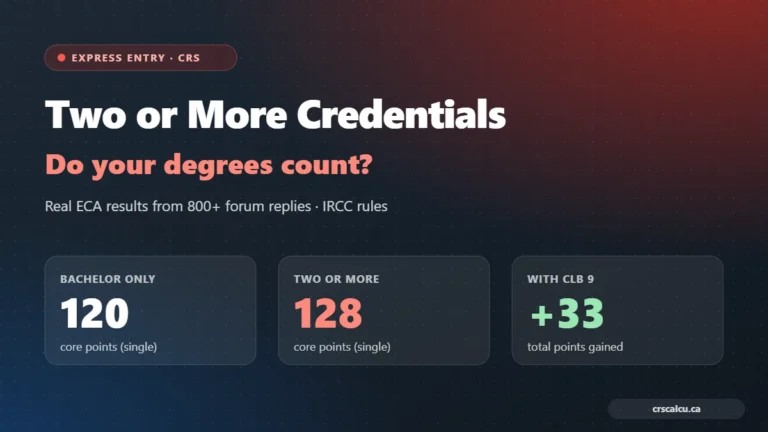
A second credential | Education line rises, for example 120 to 128 | Two or more credentials, one of three years or more |
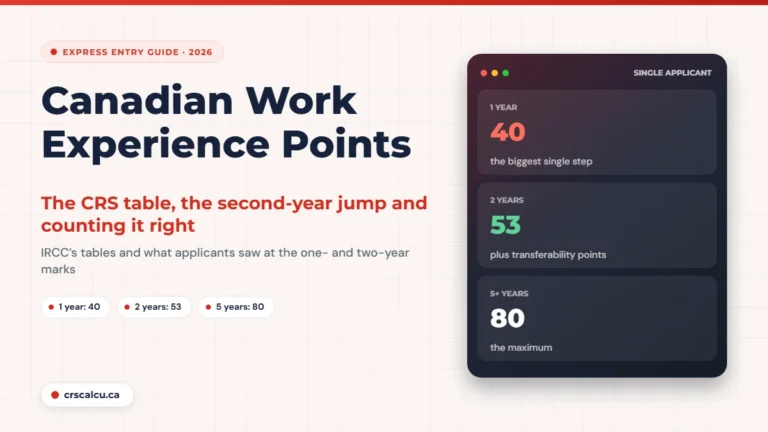
Canadian work experience | 40 / 53 / 64 core points for 1 / 2 / 3 years | Skilled work in Canada after your studies |
Skill transferability | Up to 50 per group, 100 in total | Education or foreign work paired with Canadian work or language |
Points from IRCC’s CRS criteria page (modified June 22, 2026), for a candidate without a spouse.
The first two rows are what the brochures quote. The last two are what usually decide the outcome. We go through the credential rules in Canadian education points and two or more credentials.
Study in Canada for CRS points: the arithmetic
Take a made-up candidate: 30 years old, single, a foreign bachelor’s degree, CLB 9 in all four abilities and three years of foreign skilled work. Today that is 105 for age, 120 for education and 124 for language, plus 25 and 50 from the two transferability pairs: 424.
Now the study route. A one-year Canadian program, then one year of skilled work in Canada. At the end the candidate is 32.
Line | Today, age 30 | After study and 1 year of work, age 32 |
|---|---|---|
Age | 105 | 94 |
Education | 120 | 128 |
First language, CLB 9 | 124 | 124 |
Canadian work experience | 0 | 40 |
Skill transferability | 75 | 100 |
Canadian study | 0 | 15 |
Total | 424 | 501 |
Our arithmetic using IRCC’s CRS criteria page (modified June 22, 2026). It assumes the second credential is recognized, a full 12 months of skilled work after graduating, and unchanged language results that are still valid.
That is 77 points gained over two years, after giving back 11 to age. It is a real gain. Now compare the alternative that costs far less: the same candidate, staying at home, reaching NCLC 7 in French. That adds 50 additional points and 12 as a second language, for 486, with no tuition and no birthday penalty if it is done within the year.
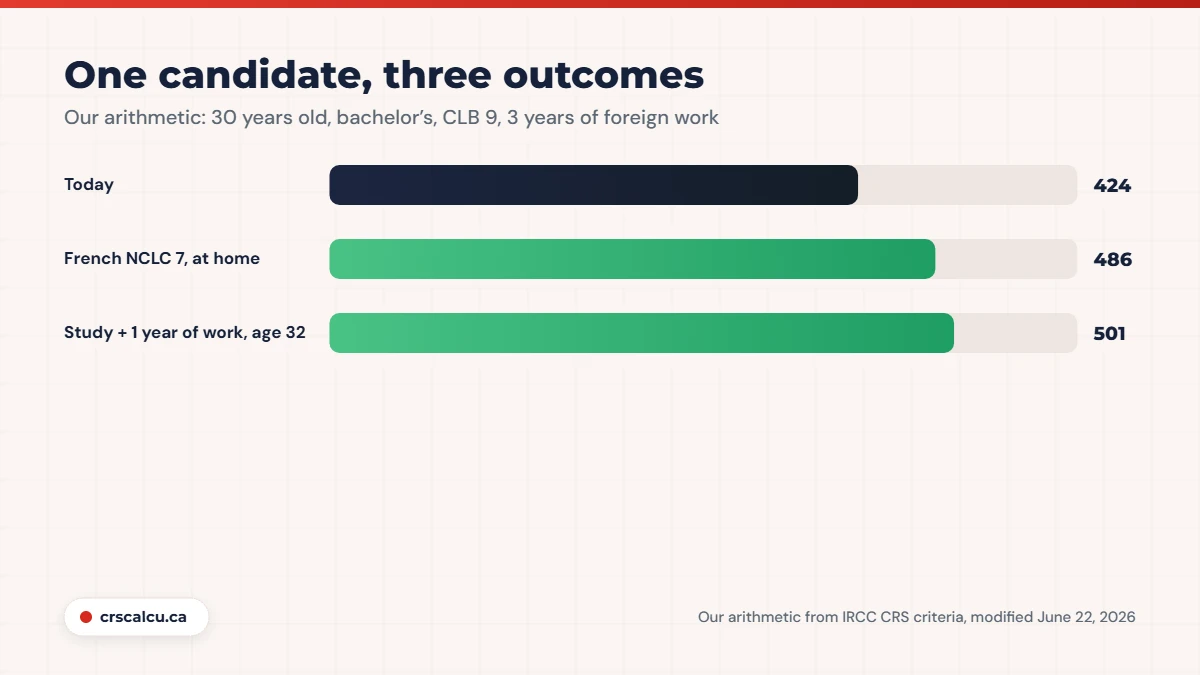
Neither number is a promise of an invitation. Compare both with the latest draw cut-offs, and see the other levers in improve CRS score. The study route also gives things French does not: eligibility for the Canadian Experience Class, a Canadian employer on your record, and a foothold in a province. Whether those are worth the tuition is your call. The point is to make it with the figures in front of you.
The work permit decides whether the plan works
Everything after graduation depends on the post-graduation work permit. IRCC’s page about it (modified March 9, 2026) sets the length. For a program of at least 8 months and under 2 years, the permit may be valid for up to the same length as the program. For a program of 2 years or more, it may be valid for 3 years. Since February 15, 2024, graduates of a master’s program of at least 8 months can apply for a 3-year permit even if the program was shorter than 2 years. If you complete more than one eligible program, each at least 8 months long, the lengths may be combined. The permit is never issued beyond the validity of your passport, and you cannot get a second one after an earlier program.
The eligibility page (modified June 24, 2026) adds conditions that did not exist a few years ago. University degree graduates must show CLB 7 in English or French, and graduates of college programs CLB 5. Graduates of non-degree programs whose study permit was applied for on or after November 1, 2024 must have studied in an eligible field. The program must be at least 8 months long, and you must apply within 180 days of confirmation that you completed it.
Real case: one year of study plus a one-year permit (July 2017)
A poster asked whether anyone had actually obtained permanent residence through one year of study followed by a one-year work permit. No one came forward with a success story. What they got was the arithmetic of the calendar: if you spend two months finding a job, a twelve-month permit leaves ten months of work, and the Canadian experience points need a full year. Experienced members advised choosing a program that leads to at least a two-year permit, and reminded the poster that graduates compete in the same pool on the same score as everyone else. Some mentioned provincial streams that accept less experience.
Real case: an eight-month permit (September 2023)
Someone on a tight budget was considering a diploma that would lead to an eight-month work permit and asked whether that would help at all. Replies were direct: additional points for Canadian work need a year of experience, so eight months is not enough. They recommended a program giving at least a one-year permit, and preferably two, to leave time to find skilled work. One commenter described planning their own studies so as to end up with a three-year permit.
Both threads describe the same trap. A permit equal to the program length leaves no room for a job search, a slow start or a gap between contracts. Count the hours as well as the months; our post on 1,560 hours shows how.
Work during your studies does not fill the gap
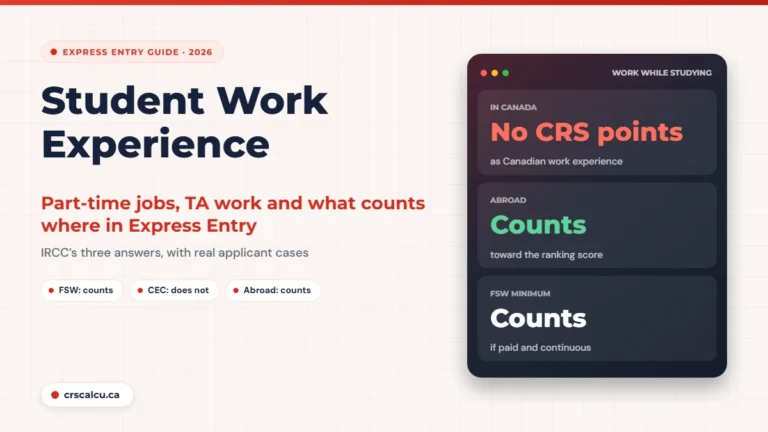
Many students work part-time and assume it counts. IRCC’s Canadian Experience Class page (modified September 24, 2026) says you cannot count work done while you were a full-time student, or co-op terms. So the clock on qualifying Canadian experience starts after you finish, on the post-graduation permit. Student work can count for the Federal Skilled Worker minimum if it meets that program’s rules; we compare the two in FSW vs CEC.
One-year master’s programs: the rule that changed
Real case: a one-year master’s at 397 points (February 2020)
A candidate with 397 points and more than five years of foreign banking experience had an offer for a one-year master’s program and asked whether it would be treated as a full master’s degree for points. An experienced member said it would count for the score, but warned that at the time it would lead to only a one-year work permit. Others suggested adding a short course near the end to lengthen the permit, and pointed to the difficulty of finding related work in a crowded job market. The poster planned to defer the start from May to September 2020 and did not report further.
The permit warning in that thread is out of date. IRCC’s page now says master’s graduates can apply for a three-year permit when the program was at least 8 months long, effective February 15, 2024. That removes the tightest constraint for master’s students. It does not change it for certificates and diplomas.
Real case: a one-year certificate, then a second (July 2022)
A student planning a one-year postgraduate certificate in marketing expected a one-year work permit and a projected score of 511, and asked whether that was a workable route. Experienced members listed the risks: the job has to start almost immediately and run without a break, the field is competitive, the occupation was not one provinces were targeting, and the projected score might not be enough later. One summed it up as having no margin for a single lost day. The poster decided to take a second certificate to lengthen the permit and gain time.
Stacking two programs is consistent with IRCC’s wording that the lengths of more than one eligible program may be combined. It also doubles the tuition and adds a year of age. For newer study permits, check the field of study rule before relying on a certificate.
The age clock runs through all of it
A candidate without a spouse has 110 age points from 20 to 29, 105 at 30, 99 at 31, 94 at 32 and 88 at 33. Two years of study and work costs 11 points for anyone who starts between the ages of 29 and 38, and more after that.
Real case: turning 30 (February 2020)
A candidate born in March 1991 asked whether they would keep the 110 points for ages 20 to 29 after turning 30 in March 2021. Replies confirmed that the points drop on the birthday while the profile is in the pool. One member added that the score is no longer recalculated for birthdays after you have applied. The poster concluded that they needed to act before turning 30.
For how a birthday is treated between an invitation and an application, see CRS score dropped after ITA.
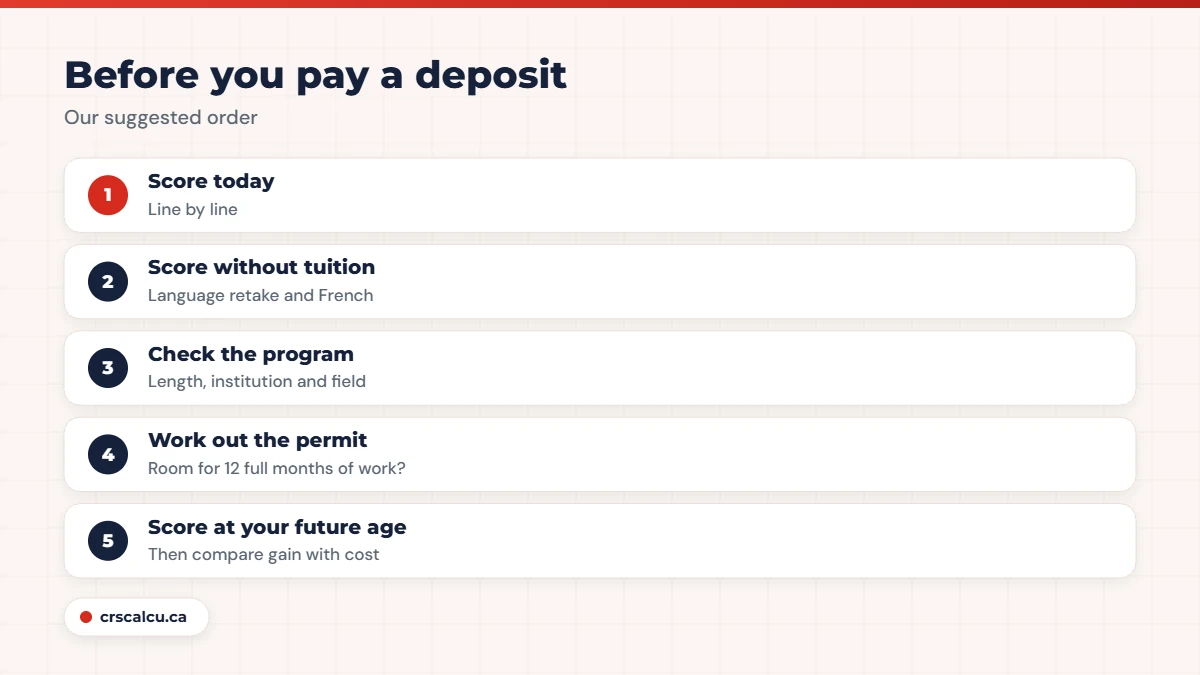
Before you pay a deposit (our suggested order)
If you are already in Canada on a permit, our guide to TR to PR pathways sets out the options alongside Express Entry.
Study in Canada for CRS points: five mistakes to avoid
Avoid these
What IRCC does not say
IRCC does not say that studying in Canada leads to permanent residence, and its pages make no promise that a graduate will be invited. It does not publish how many graduates complete a year of skilled work within their permit. The forum threads we read contained plenty of warnings and, on the one-year route, no documented success.
Frequently Asked Questions
Is it worth it to study in Canada for CRS points alone?
For the credential points alone, rarely: they are 15 or 30. The route makes sense when it also delivers a year or more of skilled Canadian work, and when that total beats cheaper options such as a language retake or French.
How many CRS points does a Canadian diploma add?
A credential of one or two years adds 15 additional points and one of three years or more adds 30. A second credential can also raise the education line and skill transferability.
How long is the work permit after a one-year program?
IRCC says a permit for a program of 8 months to under 2 years may be valid for up to the same length as the program. Master’s graduates can apply for 3 years if the program was at least 8 months.
Does part-time work while studying count?
Not for the Canadian Experience Class. IRCC’s page excludes work done while you were a full-time student and co-op terms.
Can I do two programs to get a longer permit?
IRCC says you may be able to get a permit that combines the lengths of more than one eligible program, each at least 8 months long. You can only ever get one post-graduation work permit.
Do I lose age points while I study?
Yes, if you are 30 or older, or turn 30 during the plan. Age points fall on each birthday while you are in the pool or before you enter it.
Price your plan in points first
Enter your details as they are now, then as they would be at the end of the study route, and compare.
Final Thoughts
To study in Canada for CRS points can work, and for a master’s student with a three-year permit ahead of them the odds are better than they were. For a one-year certificate with a one-year permit, the plan has no slack, and the people who have tried it say so. Do the arithmetic at your future age, check the permit rules for your exact program, and compare with what you could gain without moving.
A study permit and a work permit have their own rules, which change often. Speak to a licensed immigration consultant or an immigration lawyer before you commit money to a program for immigration reasons.