Express Entry Guide · Updated October 2026
Express Entry and Quebec: Applying When You Live or Work in Quebec (Real Cases)
Your job is in Montreal, your experience is Canadian, and the program says you must plan to live somewhere else. Here is how that works in practice.
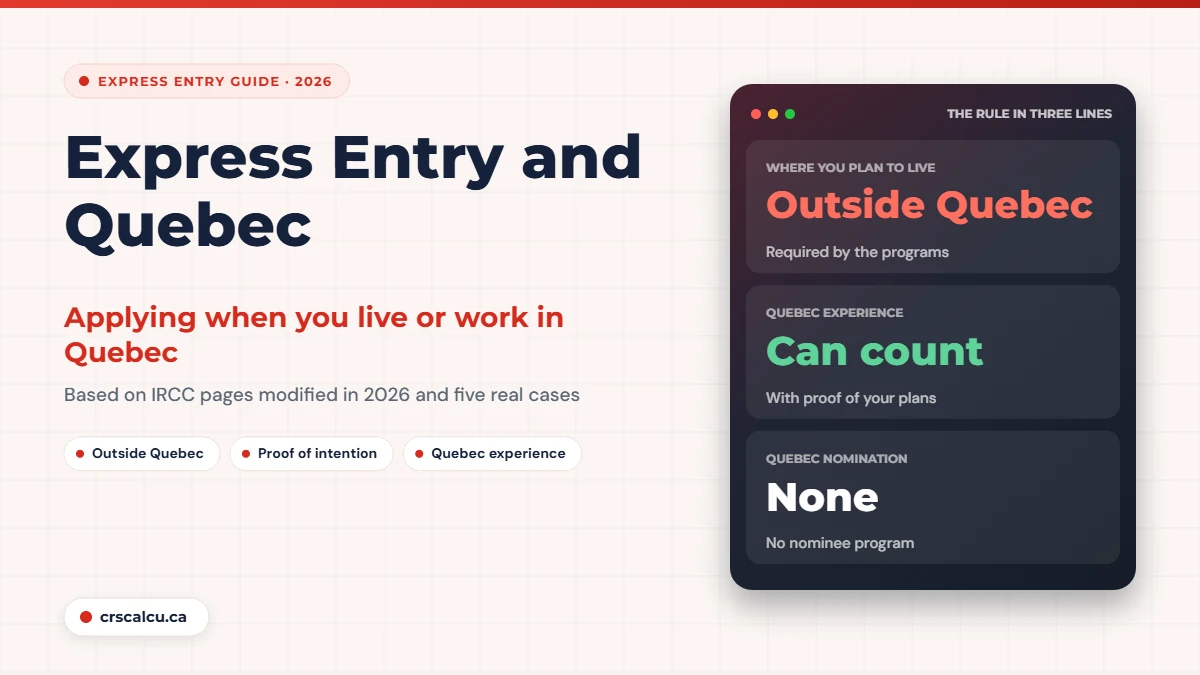
Express Entry and Quebec do not mix the way people expect. Quebec chooses its own skilled workers under its own system, so the federal Express Entry programs are for people who plan to live in any other province or territory. That would be simple if nobody in Quebec wanted to use Express Entry. Thousands do, because their work experience is in Montreal or Gatineau and their plans lie elsewhere.
IRCC allows it, on one condition that sounds mild and is not: you have to prove you do not plan to settle in Quebec. The forum threads on this are among the most anxious we read, because the proof is requested late, with a short deadline, and a letter saying “I intend to move” has not been enough.
We read IRCC’s Canadian Experience Class and Federal Skilled Worker pages (both modified September 24, 2026) and the provincial nominee eligibility page, plus five public forum threads from 2018 to 2023. This is general information, not legal advice.
Quick answer: can you use Express Entry if you live in Quebec?
Yes, if you genuinely plan to live outside Quebec. IRCC’s program pages say you must plan to live outside the province of Quebec, because Quebec selects its own skilled workers. They also say you can count work experience gained while living in Quebec, as long as you can prove you do not plan to settle there. IRCC does not list what proof it accepts. In the cases we read, applicants living in Quebec were asked for evidence during processing, and a statement of intent alone was not treated as enough. Check your score first with our CRS calculator.
Key takeaways
Express Entry and Quebec: the rule in IRCC’s words
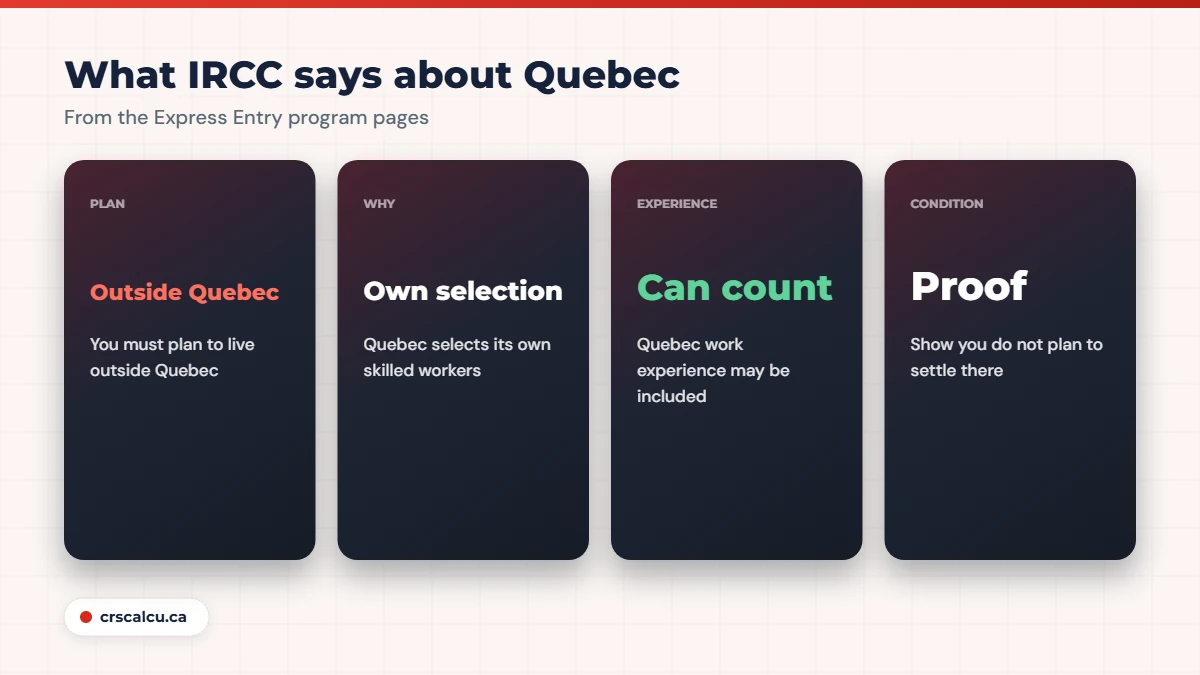
Both the Canadian Experience Class page and the Federal Skilled Worker page (modified September 24, 2026) have a section on where you can live in Canada. It says you must plan to live outside the province of Quebec, and explains that Quebec selects its own skilled workers. Anyone who plans to settle in Quebec is pointed to Quebec’s own program.
The same section deals with experience. The Federal Skilled Worker page says you can count work experience gained while living in Quebec, as long as you can prove you do not plan to settle there. The Canadian Experience Class page says you may include Quebec work experience and must include proof that you do not plan to settle there.
Two related facts complete the picture. IRCC’s provincial nominee eligibility page (modified May 21, 2026) says Quebec does not have a provincial nominee program. And the program pages add that a provincial nominee must settle in the province or territory that nominated them.
Your situation | What IRCC’s pages say | Our reading |
|---|---|---|
Live and work in Quebec, plan to move elsewhere | Quebec experience can count, with proof you do not plan to settle there | Eligible; the proof is the hard part |
Live and work in Quebec, plan to stay | You must plan to live outside Quebec | Express Entry is the wrong program |
Live elsewhere, past work in Quebec | Quebec experience can count | Eligible; your current address helps |
Live abroad, plan to settle in Quebec | Quebec selects its own skilled workers | Apply to Quebec’s program |
Our summary of IRCC’s Canadian Experience Class and Federal Skilled Worker pages (modified September 24, 2026). The third column is our reading.
Is Quebec work experience really Canadian experience?
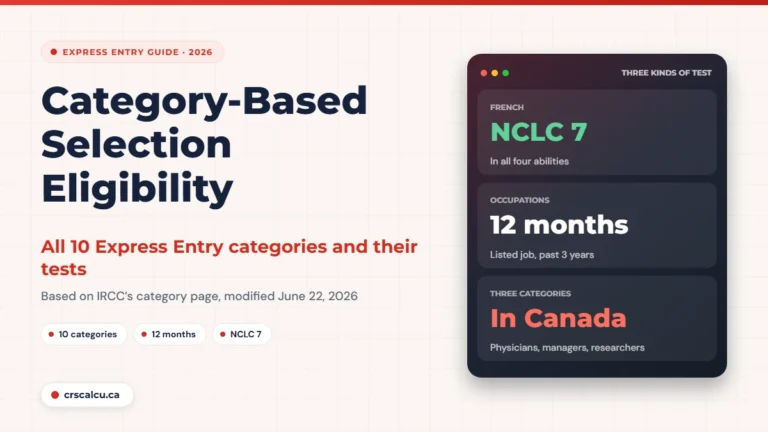
Yes. Quebec is in Canada, and nothing on the CRS criteria page (modified June 22, 2026) treats it differently: Canadian work experience is work for a Canadian employer in Canada. A year of skilled work in Montreal earns the same 40 core points, without a spouse, as a year in Toronto, and it can meet the Canadian Experience Class requirement. French, which many people in Quebec have, is rewarded as well: NCLC 7 in all four abilities adds 25 or 50 additional points and qualifies for French category rounds. See category-based draws and improve CRS score.
So a Quebec-based candidate can have a strong score. What they carry in addition is a question an Ontario-based candidate is never asked.
What proof of intention looks like
IRCC’s pages require proof and do not say what it should be. Everything below comes from forum experience.
Real case: a Montreal job after studying in Ontario (January 2018)
An applicant had studied for two years in Ontario, then taken a job in Montreal from January 2017 on an open work permit. With a year of experience they were invited under the Canadian Experience Class and asked whether to include a letter stating they intended to live outside Quebec, given that their job searches in Ontario had not yet succeeded. One experienced member said the letter was not strictly required at submission but that proof would probably be requested during processing. Another, who had personally received a fairness letter on this point, warned that officers can give as little as seven days to respond and that the evidence has to be solid: sworn statements, employer letters and supporting documents. A lease in the destination province and correspondence with a realtor were suggested. No outcome was reported.
Real case: “this letter is not enough” (September 2019 to February 2021)
A worker in Montreal with a permit expiring in January 2020 applied under the Canadian Experience Class and included a letter saying they would not stay in Quebec and were looking for work in other provinces. An experienced member told them plainly that, judging by other cases on the forum, a letter would not be enough, that a fairness letter was likely, and that the answer was to find a job outside Quebec and move. In February 2020 the poster reported having found work in another province. By February 2021 several other applicants in the thread had received fairness letters asking for stronger evidence; those with job offers elsewhere, or who had moved and could show a lease and new provincial identification, were told that was the kind of proof that counts.
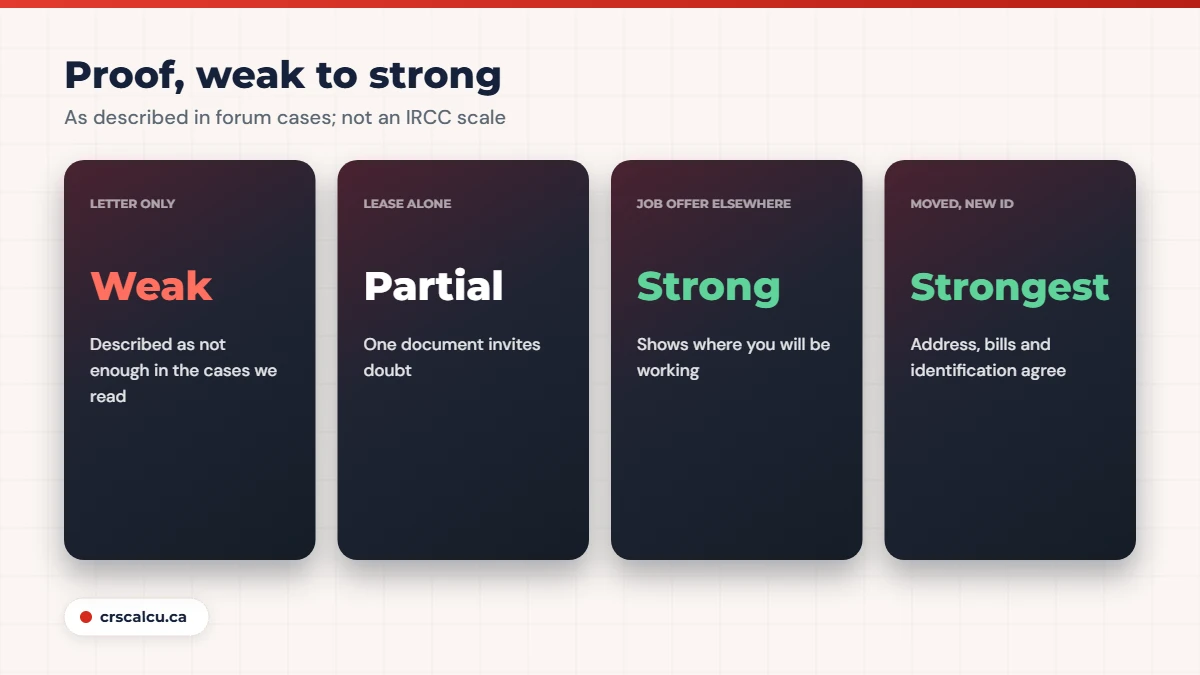
Evidence people in these threads used (forum experience, not an IRCC list)
One reply in a 2023 thread made a point worth repeating: anyone can sign a lease without living there, so a single document invites doubt. Several documents that tell the same story are stronger than one.
When your family is anchored in Quebec
Intention is judged for the household, not just the applicant.
Real case: spouse studying in Quebec until 2026 (November 2023)
A worker in Quebec planned to apply under the Canadian Experience Class after a year of experience. Their spouse was enrolled at a Quebec university until 2026, after which the couple meant to leave the province. Experienced members stressed that this is a federal program with Quebec excluded, so the applicant has to show they will be living elsewhere, and listed the usual documents. One cited a 2016 court decision in which an application had been refused where a spouse had continuing commitments in Quebec, since that raised doubt about whether the applicant would really leave. Another respondent said their own file had spent a year in eligibility review because all their experience was in Quebec, and was approved after they supplied an address in another province, utility bills and licensing applications there.
We did not read the court decision, so take it as reported. The reasoning is easy to follow all the same: a spouse with two more years of study in Quebec is evidence about where the family will be living, whatever a letter says.
Working in Quebec for an employer based elsewhere
Real case: Toronto employer, Montreal workplace (August 2020)
A candidate living in Quebec, employed by a company headquartered in Toronto and working in Montreal on what they described as a temporary assignment, asked whether anyone based in Quebec had succeeded through Express Entry. Replies repeated that Quebec runs its own selection and that the applicant needs to show they will live in another province. Suggestions included a lease outside Quebec, evidence of job searching there, and a written explanation of why they were leaving. One participant described their own approach: living on a lease in Ottawa while working remotely and searching for work locally, and said friends in similar positions had been approved. The poster said they would look at relocating.
An employer headquartered outside Quebec may help explain a plan to leave. It does not replace evidence that you will.
Moving to Quebec after you apply
Real case: a Montreal job offer mid-application (September 2018)
An applicant whose Canadian Experience Class file was already in process, with the medical passed, received a job offer in Montreal and asked whether accepting it would hurt the application. One member thought it would matter little, since people’s plans change, and that updating the address would do. Another warned of serious consequences: Quebec is outside the federal programs, and the applicant should stay resident elsewhere unless they could show the job was short-term with a plan to return. Two later posters said they were in the same position. Nobody reported an outcome.
The two replies cannot both be right, and IRCC’s pages do not settle it. What the pages do say is that you must plan to live outside Quebec, and that after you apply you must report changes such as a new job that affects your eligibility or a change of address. Moving to Quebec while the file is open creates exactly the question the rule exists to ask. For how job moves are reported, see job change after ITA.
After you become a permanent resident the position is different. IRCC’s Help Centre says a permanent resident has the right to live, work or study anywhere in Canada. We cover that, and what it means for intention declared earlier, in move to another province after PR.
Building your case before you are asked
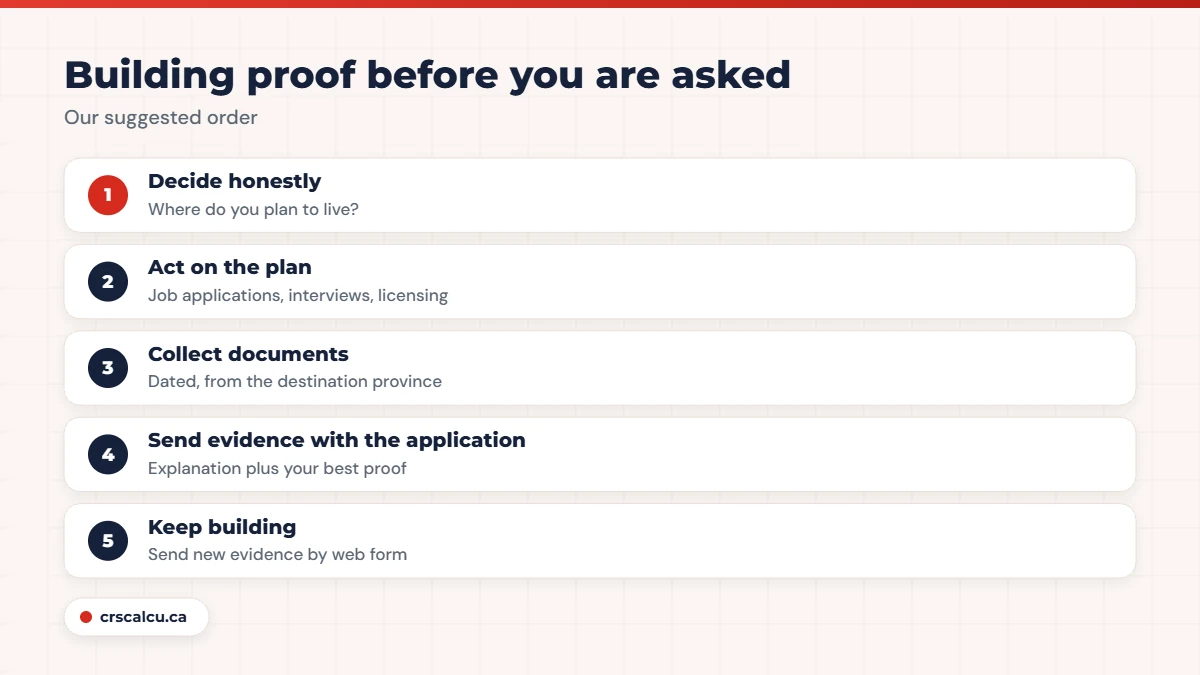
Our suggested order
If your score would benefit from a provincial route, remember that it cannot be Quebec through Express Entry; see provincial nomination in Express Entry and compare the federal programs in FSW vs CEC.
Five mistakes people make with Express Entry and Quebec
Avoid these
What IRCC does not say
IRCC’s pages do not list acceptable proof, do not say at what stage it will be requested, and do not say how long after landing an intention to live elsewhere should hold. They do not address applicants who move to Quebec while an application is in process. Compare your score with the latest draw cut-offs before investing in a move you would not otherwise make.
Frequently Asked Questions
Do Express Entry and Quebec work together at all?
Only in one direction. You can use Quebec work experience in an Express Entry application, but you must plan to live outside Quebec. Quebec selects its own skilled workers through its own program.
Does work experience in Quebec count for the Canadian Experience Class?
Yes. IRCC’s page says you may include work experience gained in Quebec, and that you must include proof that you do not plan to settle there.
What proof does IRCC accept that I will leave Quebec?
IRCC does not publish a list. In forum cases, applicants used job offers, leases, bills, provincial identification and licensing applications in another province. A letter of intent by itself was described as not enough.
Can Quebec nominate me through Express Entry?
No. IRCC’s provincial nominee eligibility page says Quebec does not have a provincial nominee program.
Can I move to Quebec after I become a permanent resident?
IRCC’s Help Centre says a permanent resident has the right to live, work or study anywhere in Canada. The intention you declared in your application still has to have been true when you made it.
Will I be asked for proof if I already live outside Quebec?
The requirement to prove you do not plan to settle in Quebec is attached to counting Quebec work experience. Living and working in another province when you apply is itself evidence of where you plan to live.
Check your score before you plan a move
Quebec work experience and French both count. See what your profile is worth.
Final Thoughts
Express Entry and Quebec can work together for someone whose experience is in Quebec and whose future is not. The rule is short, the proof is on you, and the people who came through it had more than a letter: they had a job, a lease or a new address somewhere else by the time an officer asked.
If your family is settled in Quebec, if you have received a procedural fairness letter, or if you are weighing a Quebec job while a federal application is open, speak to an immigration lawyer or a licensed consultant straight away.