Express Entry Guide · Updated October 2026
Bridging Open Work Permit for Express Entry: Who Qualifies, When to Apply (Real Cases)
It keeps you working while your permanent residence application is decided. It is also narrower than its reputation, and the timing is unforgiving.
The bridging open work permit exists for one situation: you have applied for permanent residence, your current work permit is about to end, and the decision has not arrived. It bridges that gap, and because it is an open permit, it does not tie you to one employer while you wait.
People get into trouble with it in two ways. Some assume it is available earlier than it is, while they are still in the pool or have only just been invited. Others leave it so late that their status has already lapsed, and discover that the rules about maintained status and restoration decide whether they may keep working.
We read IRCC’s bridging open work permit page (modified June 23, 2026) and its Help Centre answers on expiring permits (modified in 2026), plus five public forum threads from 2018 to 2024. This is general information, not legal advice.
Quick answer: who can get a bridging open work permit?
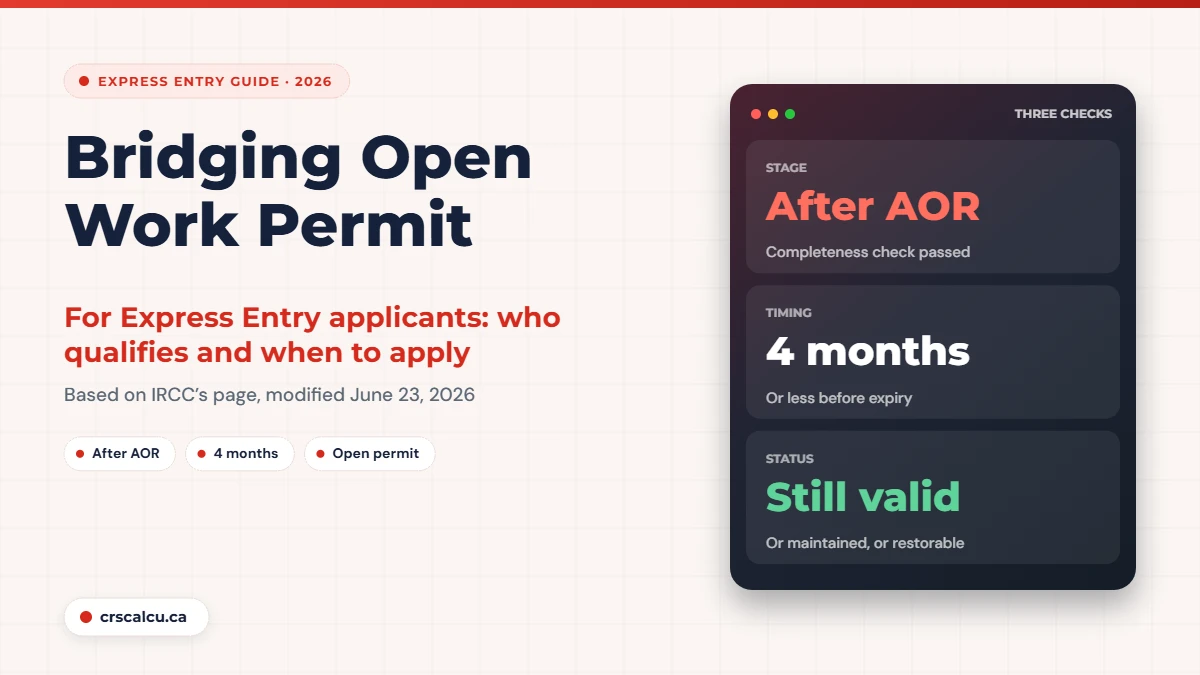
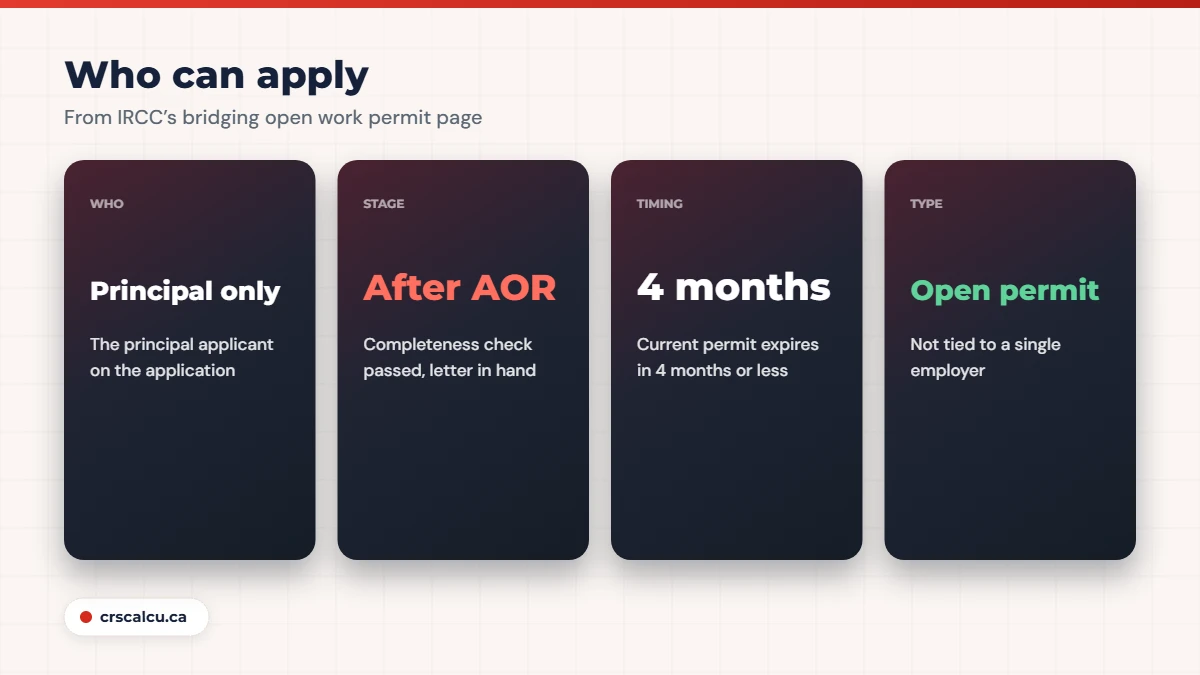
For Express Entry, you must be the principal applicant on a permanent residence application that is complete, has passed the completeness check and has an acknowledgement of receipt letter. You must be living in Canada, and either hold a valid work permit, be on maintained status as a worker, or be eligible to restore your status. IRCC’s Help Centre adds that your current permit should expire within four months or less. An invitation alone is not enough, and a profile in the pool is not enough. If you are still waiting for an invitation, start with our CRS calculator.
Key takeaways
What the bridging open work permit is for
IRCC’s page (modified June 23, 2026) describes a work permit for people who have applied for permanent residence under certain programs and whose current permit is running out. The Express Entry programs are on the list: the Federal Skilled Worker Program, the Canadian Experience Class and the Federal Skilled Trades Program. So is the Provincial Nominee Program, whether or not the nomination went through Express Entry.
It is an open work permit. On the application you select “Open work permit” as the type, and you pay both the work permit processing fee and the open work permit holder fee. IRCC says that in most cases you must apply online.
Six rules for a bridging open work permit
Rule | What IRCC’s pages say | Where people slip |
|---|---|---|
1. Who applies | You must be the principal applicant on the permanent residence application | A spouse on the application cannot apply for one in their own name |
2. Where you live | In Canada, intending to live outside Quebec, when you apply | Applying from abroad |
3. Status | Valid status and a valid work permit; or maintained status as a worker; or eligible to restore status | Status that has lapsed beyond repair |
4. Stage | Complete application submitted and completeness check passed, with the acknowledgement of receipt letter | Applying after the invitation but before applying for permanent residence |
5. Timing | Current permit expires in four months or less | Applying too early |
6. Nominees | No employment restrictions as a condition of the nomination | A nomination tied to one employer |
Our summary of IRCC’s bridging open work permit page (modified June 23, 2026) and the Help Centre answer on renewing a post-graduation work permit (modified September 1, 2026). The third column is ours.
Rule 4 is the one that catches people
The permit is tied to a permanent residence application that exists and has been checked. Three earlier stages do not qualify: being in the pool, holding an invitation, and having submitted an application that has not yet passed the completeness check.
Real case: status lost, 510 points, no application yet (March 2023)
A worker’s permit had expired in November 2022. They had applied to extend it, and the extension was refused on March 20, 2023. Now inside the 90-day restoration period, with 510 points, they had stopped working and asked whether they could apply for a bridging permit. A moderator set out the rule: you are eligible only once you have been invited, submitted the permanent residence application and received the acknowledgement of receipt. The poster asked whether restoring status and applying for the bridging permit could be done together after that point; the moderator said yes, if the requirements were met, and added that work done since the November expiry would not count as experience.
That case shows both sides of the rule. Without an application for permanent residence, a strong score is worth nothing for this permit. With one, IRCC’s third status option, being eligible to restore your status, can still apply. Our post on a PGWP expiring before an invitation covers what to do in the earlier stage.
Rule 3: valid status, maintained status or restoration
IRCC gives three status situations. The first is the simple one: your temporary status and work permit are both still valid. The second is maintained status: your permit has expired, but you applied to extend it before it did, so you may stay and keep working under the same conditions while that application is decided. The third is restoration: your status has lapsed, and you are within the period in which you can apply to restore it.

The difference between the second and third matters for work. IRCC’s Help Centre says a person on maintained status can keep working under the conditions of the old permit while they remain in Canada. A person who needs restoration must stop working until status is restored, and has 90 days after expiry to apply.
Real case: on maintained status from a different application (April 2024)
An applicant invited in a category round had a work permit that expired in mid-March. They had applied to extend it before it expired, so they were on maintained status, and they planned to apply for a bridging permit. They asked whether they could keep working if the extension was refused. Experienced members said no: maintained status lasts only as long as the application that created it is pending. If the extension were refused, they would be out of status and would have to stop working at once, and a bridging permit application made in the meantime would not carry the old status forward. No outcome was reported.
That reading is the forum’s, and it follows from how maintained status works: it belongs to a particular pending application. If you are relying on it, know which application it comes from.
Real case: applied four days before expiry (February 2024)
An applicant waiting on a permanent residence decision applied for a bridging permit only four days before their work permit was due to expire, after extra family forms had delayed their file. They worried about their status, about proving to their employer that they could keep working, and about a possible layoff. One member said that without a decision before the expiry date they would have to stop working. A more experienced member corrected this: an application made before the permit expires, even days before, gives maintained status. In the end the question did not arise. The poster reported that the bridging permit was approved one day after they applied.
One-day approval is not something to count on. What the case shows is that applying before the expiry date, even late, is very different from applying after it.
When to apply
IRCC’s Help Centre puts the window at four months or less before your current permit expires. Our example: with a permit expiring on June 30, the window opens around March 1. To use it, you need the acknowledgement of receipt by then, which means the invitation, the 60 days to apply and the completeness check all have to be behind you.
Real case: how long is it valid, and when should I apply? (January 2023)
A graduate with a permit expiring on April 30, 2023 asked whether a bridging permit is always valid for one year, whether it runs from approval or from the end of the old permit, and when to apply to get the longest one. A reply said the permit can be longer than a year and runs from the date it is approved. Members suggested applying about 90 days before expiry, since processing was then taking six to seven months, and noted that the acknowledgement of receipt has to be in hand first. No outcome was reported. A later poster in February 2024 received the same advice.
IRCC’s page, as we read it, does not state how long the permit is valid, so the “longer than a year” in that reply is forum experience. The processing time quoted is from 2023.
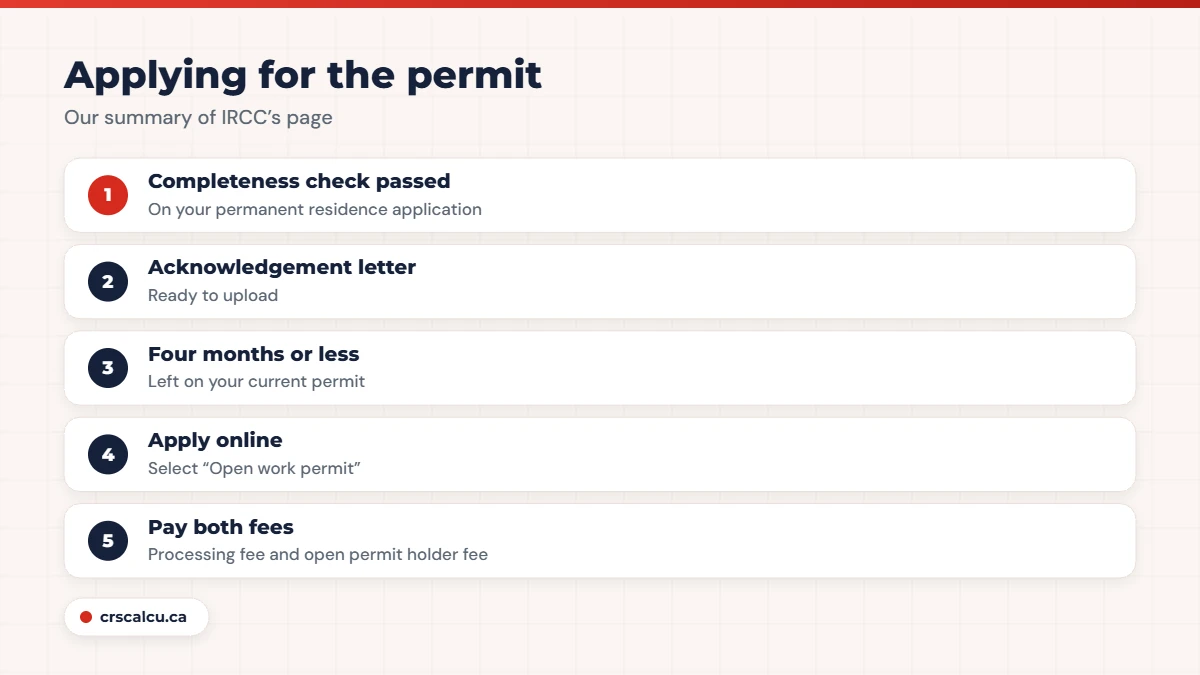
Applying (our summary of IRCC’s page)
Provincial nominees
Nominees are eligible on one extra condition: IRCC’s page says there must be no employment restrictions as a condition of the nomination. A nomination that requires you to work for a named employer does not fit an open permit.
Real case: refused for a “missing” nomination letter (December 2018)
A nominee applied for a bridging permit on September 27, 2018, five days after applying for permanent residence, and was refused on the ground that the nomination letter had not been provided, although they said they had attached it. Their post-graduation work permit was due to expire on January 11, 2019. Forum members advised writing to IRCC through the web form to ask for the decision to be looked at again, not attempting a formal appeal, and mentioned a Member of Parliament’s office or an employer-supported permit as fallbacks. The applicant sent an urgent web form. No outcome was reported.
Whatever happened in that file, the practical lesson is to label uploads clearly and to keep proof of what was submitted. For how nominations work, see provincial nomination in Express Entry; for nominees who lose the job behind a nomination, lost job after ITA.
Living in Quebec, or leaving Canada
For Express Entry applicants, IRCC’s page says you must live in Canada and intend to live outside Quebec at the time you apply for the bridging permit. That lines up with the Express Entry rule on Quebec, which we cover in Express Entry and Quebec. It also means the permit is not available to someone who has already left the country to wait; see leaving Canada during Express Entry.
Six mistakes people make with a bridging open work permit
Avoid these
What IRCC does not say
The page we read does not give the length of a bridging permit, a processing time, or what happens to the permit if the permanent residence application is refused. One forum reply quoted guidance that a valid bridging permit can be used until it expires even after a refusal; we could not confirm that on the page. It also does not cover family members. If your job changes while you wait, see job change after ITA; for routes other than Express Entry, see TR to PR pathways; and for round results, the latest draw cut-offs.
Frequently Asked Questions
When can I apply for a bridging open work permit?
After your permanent residence application has passed the completeness check and you have the acknowledgement of receipt, and when your current permit expires in four months or less.
Can I apply right after my invitation?
No. An invitation is not an application. IRCC requires a complete application for permanent residence that has passed the completeness check.
Can I keep working while I wait for the bridging permit?
If you applied before your current permit expired, IRCC’s rules on maintained status let you keep working under the same conditions while you stay in Canada. If your status had already lapsed, you must stop until it is restored.
Can my spouse apply for one?
Only the principal applicant on the permanent residence application can apply for a bridging open work permit. The page we read does not cover permits for family members.
I am a provincial nominee. Do I qualify?
Yes, if your nomination has no employment restrictions as a condition. A nomination tied to a specific employer does not qualify.
How long is a bridging open work permit valid?
IRCC’s page, as we read it, does not say. Forum members report permits of a year or more that run from the approval date.
Not invited yet?
The bridging permit starts with an application for permanent residence. See how close your score is.
Final Thoughts
A bridging open work permit solves one problem well: the gap between a work permit ending and a permanent residence decision arriving. It does not help before you have applied, and it works best when you apply inside the four-month window while your old permit is still valid.
If your status has already lapsed, if you are relying on maintained status from another application, or if your nomination has conditions, speak to a licensed immigration consultant or an immigration lawyer before you apply. For graduates still at the earlier stage, Express Entry for international students sets out the timeline.