Express Entry Guide · Updated October 2026
Certified Translation for Express Entry: Who Can Translate Your Documents (Real Cases)
You can speak the language perfectly and still not be allowed to translate your own marriage certificate. The rules on who translates, and what goes in the file, are stricter than most people expect. Here they are, with the cases that show the traps.
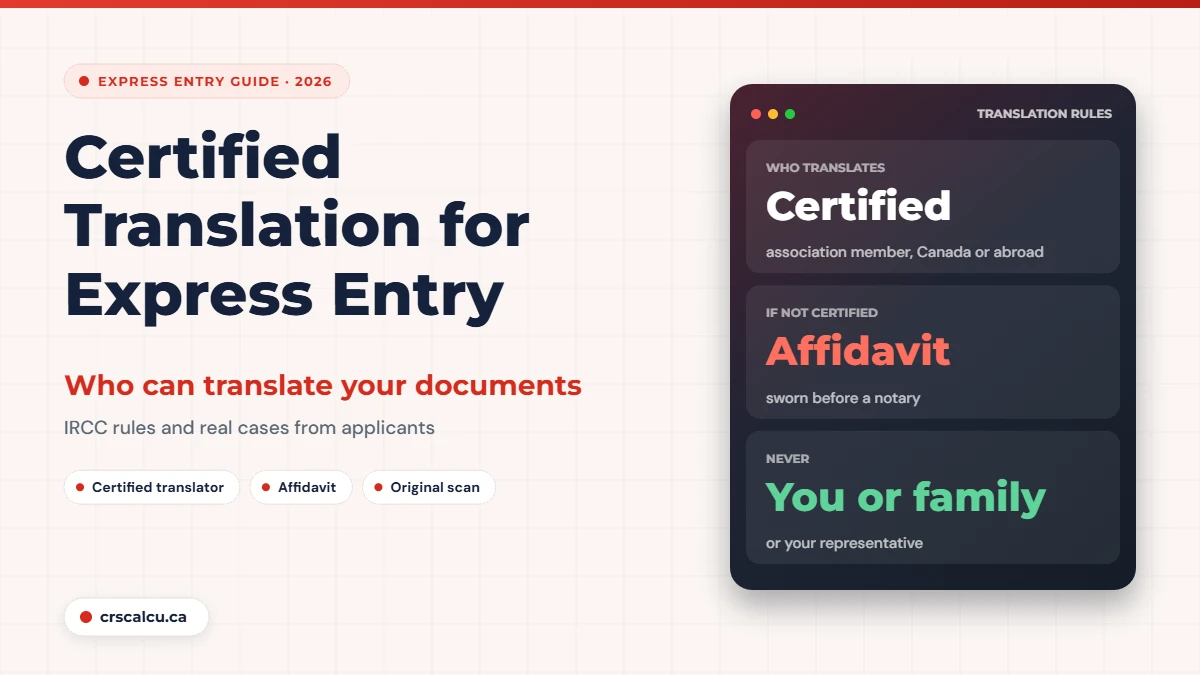
A certified translation for Express Entry is required for every supporting document that is not in English or French. IRCC accepts a translation done by a certified translator, meaning a member in good standing of a professional translation association in Canada or abroad. If the translator is not certified, the translation must come with an affidavit. Either way, you also upload a scan of the original document.
You cannot do it yourself. Neither can a family member, your representative or your consultant, even if they are a professional translator.
We took the rules from IRCC’s current Express Entry application page and read forum threads from 2019 to 2023 where applicants argued over affidavits, certified copies and translators outside Canada. This guide sets out what is settled and what people still get wrong.
Quick answer: translating documents for Express Entry
Any document not in English or French needs an English or French translation. Use a certified translator, a member in good standing of a professional translation association in Canada or abroad, whose stamp or seal shows a membership number. If that is not possible, the translator must swear an affidavit. Upload the translation together with a scan of the original. You, your family and your representative cannot translate.
Key takeaways
When You Need a Certified Translation for Express Entry
The rule is language-based, not country-based. If a supporting document is in English or French, upload it as it is. If it is in any other language, it needs a translation into English or French.
This applies to everything on your checklist: police certificates, birth and marriage certificates, bank letters, reference letters, degree certificates and transcripts. It also applies to small things. IRCC states that all stamps and seals that are not in English or French must also be translated.
Document | Translate? |
|---|---|
Certificate fully in another language | Yes, all of it |
Bilingual certificate with complete English or French text | No |
English document with a stamp or seal in another language | Yes, the stamp or seal |
Handwritten notes or annotations on a certificate | Yes |
Passport | Usually no, since most include English or French |
The stamp and seal rule is from IRCC’s Express Entry application page (modified June 22, 2026). The other rows apply the same rule to common cases.
Who Can Translate Your Documents
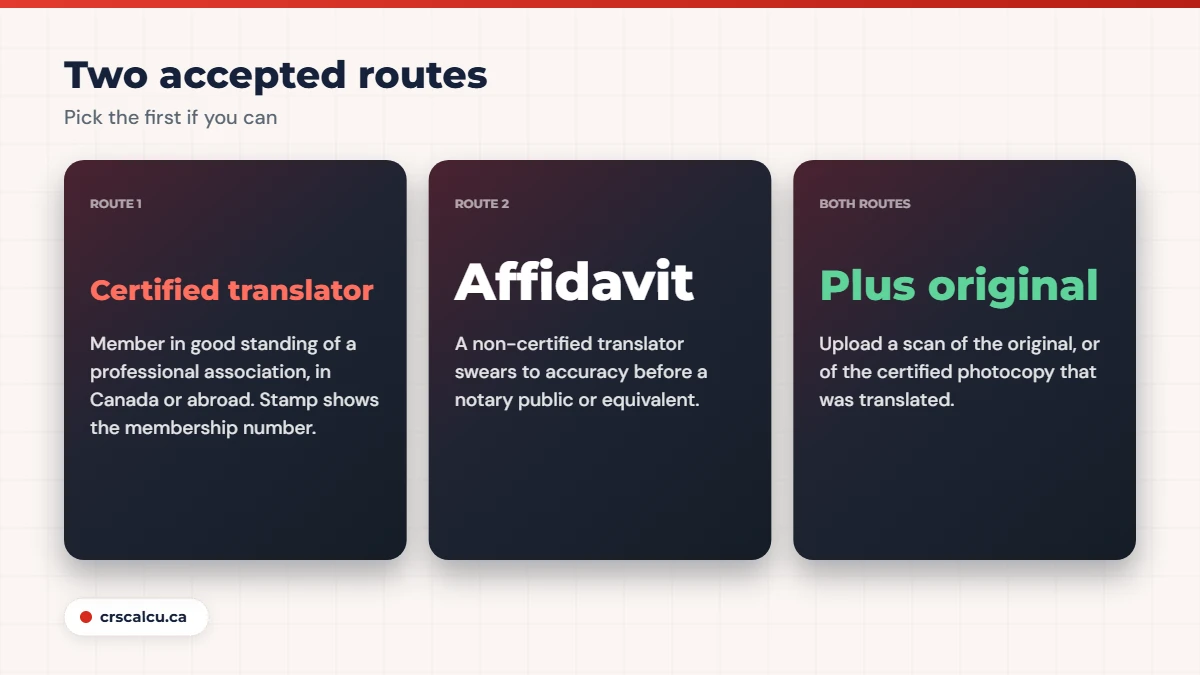
IRCC gives two acceptable routes.
Route 1: A Certified Translator
IRCC defines a certified translator as a member in good standing of a professional translation association in Canada or abroad. The certification must be confirmed by a seal or stamp that shows the translator’s membership number.
Two details are worth noting. The words in Canada or abroad mean a translator certified in your home country can qualify. And a translator who is still in the process of getting certified does not count. IRCC says so directly.
Route 2: An Affidavit
If the translation is not done by a certified translator, the person who did it must swear an affidavit. In it they state, under oath, that the translation is accurate and that they are fluent in both languages. Where the affidavit is sworn decides who can take it.
Where it is sworn | Who can take it |
|---|---|
In Canada | A notary public, a commissioner of oaths or a commissioner of taking affidavits |
Outside Canada | A notary public or the equivalent |
Source: IRCC, Apply for permanent residence through Express Entry.
Real case: affidavit when a certified translator was available
In May 2023, an applicant in Toronto worried about having submitted a notarized translation from a non-certified translator, when certified translators were easy to find. They pointed to guidance saying the affidavit route is for when a certified translator cannot do the work. The thread reached no verdict. The cautious reading is to use a certified translator whenever one exists for your language.
Who Cannot Translate
This is where well-meaning applicants go wrong. IRCC’s wording covers a lot of people: any family member, representative or consultant of the applicant, who may be a lawyer, notary or translator, is not permitted to translate documents.
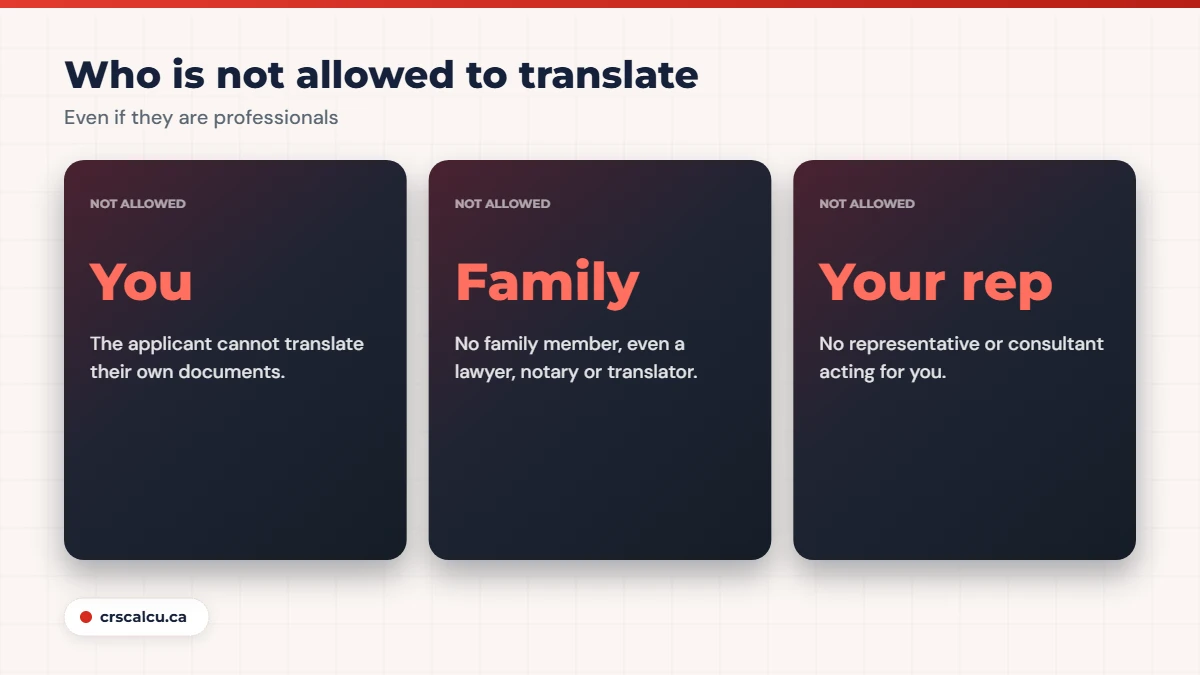
The same exclusion applies to the affidavit. It must not be taken by the applicant, or by any member of the applicant’s family, even if that person is a lawyer, notary or authorized translator.
Not acceptable
What Goes in the File
A translation never travels alone. IRCC asks for the English or French translation and a scan of the original document, or a scan of a certified photocopy of the original.
The certified photocopy part confused applicants for years.
Real case: when is a certified copy needed?
In November 2020, an applicant reported that IRCC had clarified its wording. Before, people read the rule as demanding a certified photocopy every time. The clarified text said you only need a scan of a certified photocopy if the translation was based on that photocopy. If the translator worked from your original, a plain scan of the original is what you upload.
So the question to ask is what the translator had in their hands. If they saw the original, scan the original. If you mailed them a certified copy because you could not part with the original, scan that certified copy.
IRCC defines a certified photocopy as a readable photocopy of an original, certified as a true copy by an authorized person. That person marks it with their name and signature, their position or title, the name of the original document, the date, and the phrase: I certify that this is a true copy of the original document.
Build each translated document as one file
Real case: translations uploaded without the originals
In January 2019, an applicant realized days after submitting that they had uploaded only the translations of two police certificates, a marriage certificate and two birth certificates. The originals were in Arabic and had been left out. Members urged them to send the originals through the IRCC web form immediately. They did, and were told the documents had been forwarded to the processing office.
Translators Outside Canada
Many applicants are abroad, or have documents from a country where no Canadian-certified translator works in that language.
Real case: does a foreign translator count?
In January 2021, a forum member asked whether a translator outside Canada could meet the definition of certified, since the wording then seemed to point to Canadian associations. The advice at the time was to add an affidavit to be safe. IRCC’s current page settles the main point: a certified translator is a member in good standing of a professional translation association in Canada or abroad.
That leaves one practical test. Can the translator show membership in a professional association, with a number on their stamp or seal? If yes, they fit Route 1. If your country has no such association, or the translator is not a member, use Route 2 and have the affidavit sworn before a notary public or the local equivalent.
Questions to ask a translator before you pay
How Translation Fits Your 60 Days
After an invitation you have 60 days. Translation is rarely the slowest step, but it comes last in a chain: first you get the document, then you translate it. A police certificate that arrives on day 50 leaves ten days for translation.
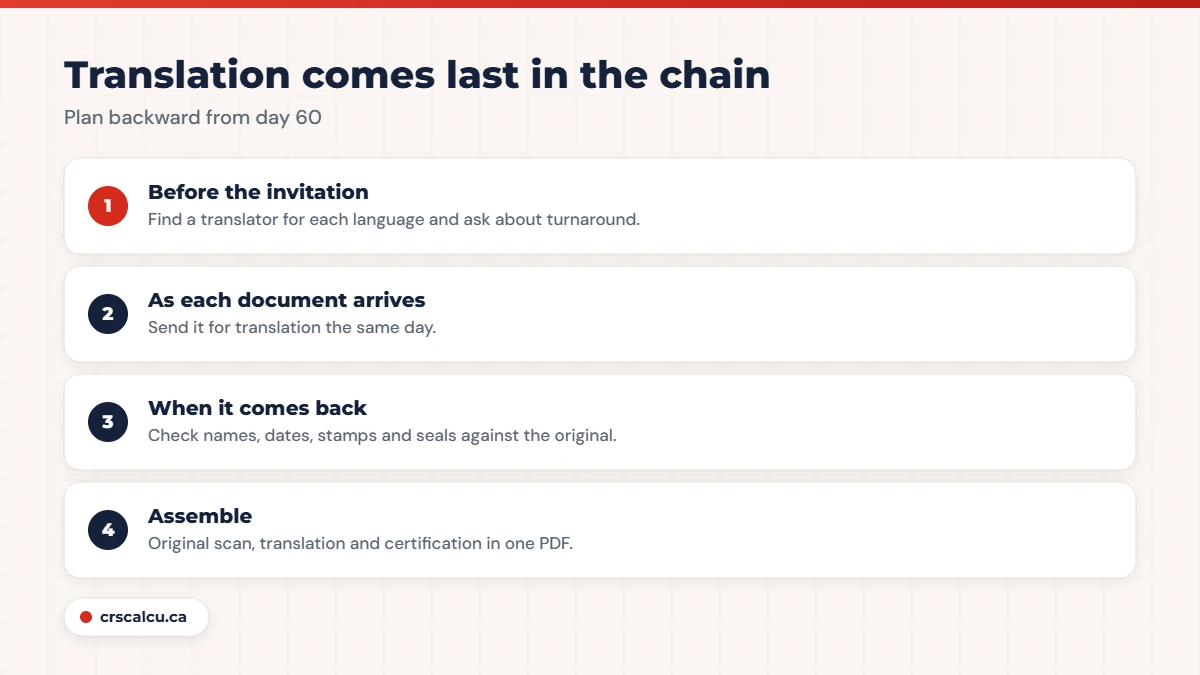
Order documents in other languages first, and line up a translator before the invitation so you are not searching on day 45. Our Express Entry document checklist lays out the whole sequence. The police certificate and birth certificate guides cover the two documents that most often need translating.
If a translation cannot be finished in time, do not upload a rough version and hope. Explain the delay. See how to write a letter of explanation for Express Entry.
Frequently Asked Questions
Do I need to translate my documents for Express Entry?
Yes, if they are not in English or French. Each needs an English or French translation and a scan of the original document or of a certified photocopy.
Can I translate my own documents for Express Entry?
No. IRCC does not permit the applicant, family members, representatives or consultants to translate, even if they are professional translators.
Does the translator have to be in Canada?
No. IRCC defines a certified translator as a member in good standing of a professional translation association in Canada or abroad.
When is an affidavit needed for a translation?
When the translation is not done by a certified translator. The translator swears the affidavit before a notary public or equivalent, or in Canada before a commissioner of oaths.
Do I need a certified copy of the original?
Only if the translator worked from a certified photocopy. Applicants report IRCC clarified this in 2020. If the translation was based on the original, upload a scan of the original.
Do stamps and seals need to be translated?
Yes. IRCC states that all stamps and seals that are not in English or French must also be translated.
Check your score while the paperwork is in progress
See how your CRS score compares with the latest draw cutoffs.
Final Thoughts
A certified translation for Express Entry has three parts: the original, the translation and proof that a qualified, independent person did the work. Miss any one and the document may be treated as if it was never uploaded.
Choose a translator who belongs to a professional association, keep family and representatives out of it, and scan what the translator actually worked from. Then put all of it in one file.