Express Entry Guide · Updated October 2026
Foreign Degree CRS Points: What a Master’s, PhD or Professional Degree From Abroad Is Worth in Express Entry (Real Cases)
The education line of the score is the visible part. The larger reward for a master’s or doctorate sits one section lower, and it only appears if your assessment says the right thing.

A foreign degree is worth nothing in Express Entry until someone in Canada has said what it equals. That is the job of the educational credential assessment, the ECA. Once you have one, IRCC’s scoring table gives points for the Canadian equivalent it names, and for nothing else on your wall.
Most applicants know the headline numbers: so many points for a bachelor’s, a few more for a master’s, a few more again for a doctorate. Fewer notice that the steps are small on the main education line and large in the skill transferability section, where a master’s or doctorate doubles what a single bachelor’s degree can earn. That is where an assessment that comes back one level lower really hurts.
We read IRCC’s scoring criteria and its ECA page, and five public forum threads from 2017 to 2023 in which applicants found out that only their highest degree counted, that an unfinished degree did not, or that their master’s had been assessed as something else.
Quick answer: how many CRS points is a foreign degree worth?
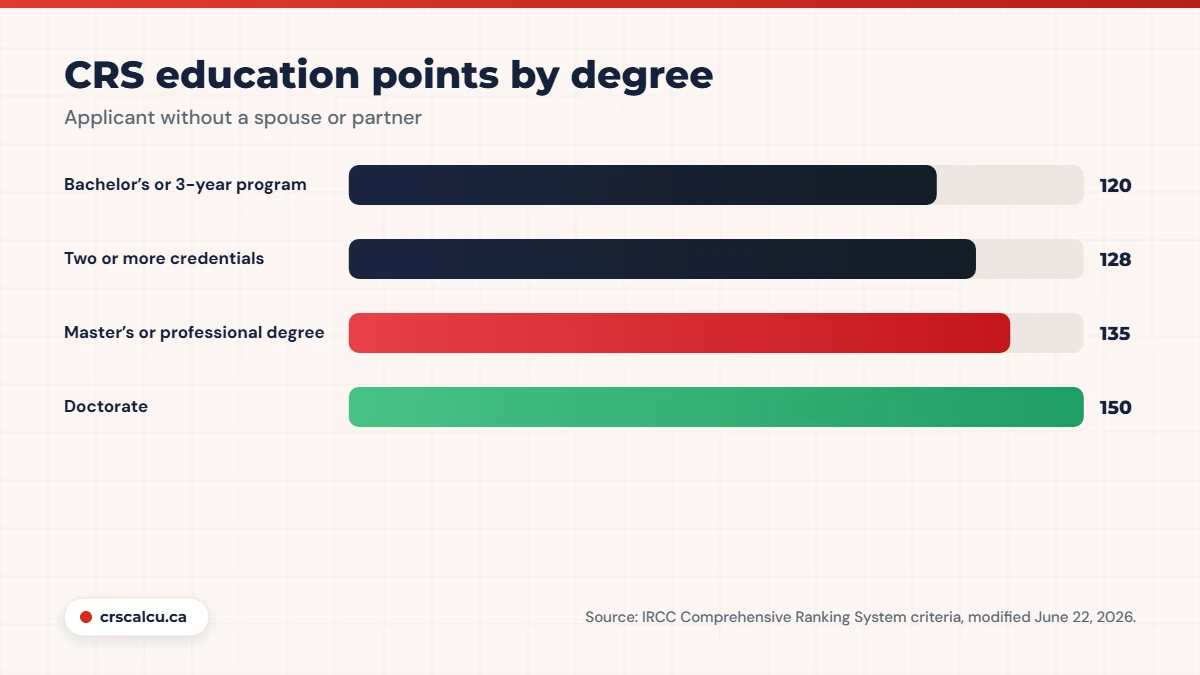
With a valid ECA, IRCC’s table (modified June 22, 2026) gives a single applicant 120 points for a bachelor’s degree or three-year program, 128 for two or more credentials, 135 for a master’s or a listed professional degree, and 150 for a doctorate. Only your highest level is scored on that line. A master’s or doctorate can then earn up to 50 skill transferability points with strong language, against 25 for one bachelor’s degree. Three-year degrees are covered in three-year bachelor degree.
Key takeaways
What a foreign degree scores on the education line
IRCC’s criteria list education in steps. These are the ones that apply to university-level study, with the wording that matters.
Level, as IRCC describes it | With a spouse or partner | Without |
|---|---|---|
Bachelor’s degree, or a program of three or more years | 112 | 120 |
Two or more credentials, one of them three years or longer | 119 | 128 |
Master’s degree, or professional degree needed to practise in a licensed profession | 126 | 135 |
Doctoral level university degree (PhD) | 140 | 150 |
From IRCC’s Comprehensive Ranking System criteria (modified June 22, 2026).
The professional degree line has a note attached. IRCC says the degree program must have been in medicine, veterinary medicine, dentistry, optometry, law, chiropractic medicine or pharmacy. An engineering or accounting qualification is not a “professional degree” in this sense, however professional it is.
Only the highest level counts
The line is a ladder, not a sum. You stand on one rung.
Real case: “why no points for my bachelor’s?” (April 2017)
An applicant with a bachelor’s and a master’s degree, both assessed, was puzzled that their profile showed points only for the master’s. Members explained that the system scores the highest level of education reached and does not add lower degrees on top. One then looked at the rest of the profile and pointed to the real constraint: a writing score of 6.5, half a band short of the level that would unlock more points. The advice was to retake the language test. Another member said they had needed several attempts to lift writing to 7.0 themselves.
Real case: assess the bachelor’s too, or only the master’s? (August 2017)
A candidate already in the pool had only their master’s assessed and asked whether the bachelor’s needed assessing as well. Early replies disagreed. The thread then worked it out: a second assessment helps only if the master’s is rated below master’s level, in which case two credentials together could reach the two-or-more line. The poster checked and found their master’s, from a university in the United Kingdom, was assessed as a master’s degree. They concluded that nothing more was needed.
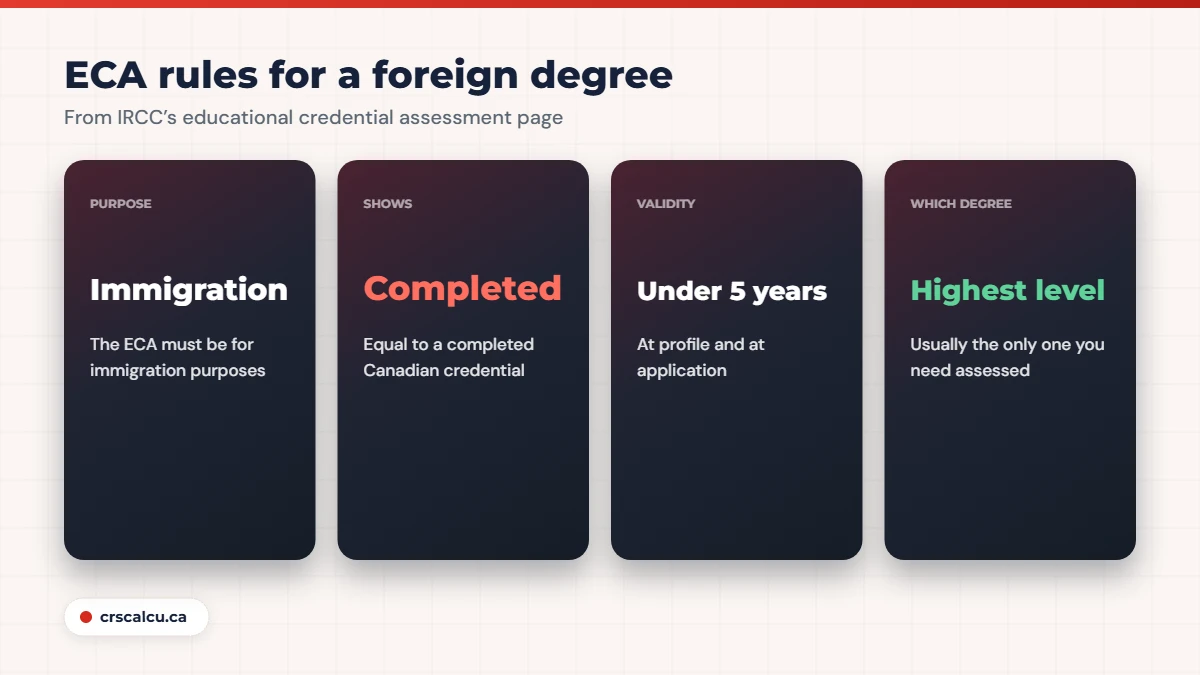
IRCC’s ECA page says the same in official terms: you usually only need an assessment for your highest level of education, and you assess more than one credential when you want the two-or-more line. The details are in two or more credentials.
The larger reward: skill transferability
Below the core factors, the criteria award skill transferability points for combinations. Two of them involve education: education with language, and education with Canadian work experience. The table treats a single post-secondary credential differently from a master’s, a doctorate or two credentials.
Your education | CLB 7 or more, some under 9 | CLB 9 or more in all four |
|---|---|---|
One post-secondary credential of one year or longer | 13 | 25 |
Two or more credentials, a master’s, a professional degree or a doctorate | 25 | 50 |
From IRCC’s criteria (modified June 22, 2026). The same two rows apply with Canadian work experience in place of language: 13 or 25 points for one year, and 25 or 50 for two years or more. The education combinations together are capped at 50 points, and skill transferability at 100 overall.
Our arithmetic for a single applicant with CLB 9 in every ability: a bachelor’s degree gives 120 + 25, or 145 points. A master’s gives 135 + 50, or 185. A doctorate gives 150 + 50, or 200. The step from bachelor’s to master’s is 15 points on the education line and 40 once transferability is counted.

That 40-point figure is not ours alone. In a 2015 thread, an applicant whose MBA was assessed at bachelor’s level said it had cost them about 40 points. This is where the number comes from.
Language is not the only key to those points. The same table rewards education combined with Canadian work experience. In our own illustration, a single applicant with a master’s degree, one year of skilled work in Canada and CLB 8 in every ability earns 25 points for education with language and 25 for education with Canadian experience: 50 in all, which is the most the education combinations can give together. With one bachelor’s degree the same person would have 13 and 13, or 26. The education combinations are capped at 50 between them and the whole section at 100, so a higher degree pays off most for people who also have language or Canadian experience to pair with it.
When the assessment comes back lower
The equivalency on your ECA is not guaranteed to match the name of your degree.
Real case: an engineering degree and an MBA assessed as two bachelor’s degrees (April 2017)
An applicant submitted a Bachelor of Engineering and an MBA. The report described them as two four-year bachelor’s degrees, without a master’s. Their score came out at 401 where they had expected 408. Members said assessments follow Canadian standards, which can differ from the title of the original degree, and that course load and program structure play a part. They suggested asking the organization why the MBA was rated that way, and otherwise going ahead with the profile. Others in the thread had seen master’s degrees from some countries assessed as bachelor’s degrees or postgraduate diplomas.
Their numbers check out against the table: two credentials score 128 and a master’s 135, a difference of 7 on the education line. Two or more credentials and a master’s share a row in the transferability table, so nothing else changed. The outcome that costs 40 points is the other one, where a master’s is assessed as a single bachelor’s degree with no second credential beside it.
Real case: a master’s with no bachelor’s degree (November 2023)
An applicant with more than five years of work experience held an MBA from a university in the United Kingdom but had never completed a bachelor’s degree. They asked whether that was a problem. Members answered that it depends entirely on how the master’s is assessed: if the report says master’s degree, the points are for a master’s. Only the highest level needs assessing, so the missing bachelor’s is not an obstacle in itself. No outcome was posted.
Degrees in progress
Real case: one year into a two-year master’s (September 2017)
A student halfway through a two-year master’s asked whether they could claim master’s points before graduating. They were told to list the program as current study and that an assessment is only issued for completed degrees and diplomas, so the points would have to wait. One member suggested that, in the meantime, a spouse with a stronger profile could be the principal applicant.
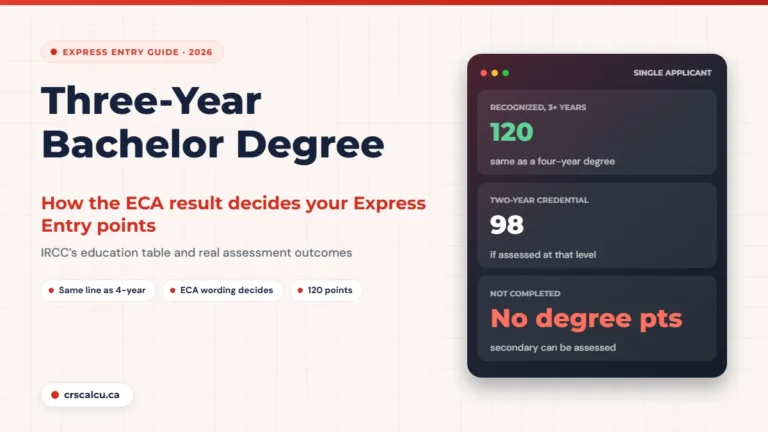
IRCC’s wording supports this: the ECA must show a credential equal to a completed Canadian one. Until then your highest completed level is what counts. You can update a profile in the pool once the new assessment arrives.
Your spouse’s degree
If your spouse or partner is coming with you, their education earns points too, on a much smaller scale. IRCC’s table gives 8 points for a bachelor’s degree or three-year program, 9 for two or more credentials, and 10 for a master’s, professional degree or doctorate. They need their own ECA for a foreign degree. Whether that is worth the fee depends on how close you are to a cut-off; see non-accompanying spouse for how the two scoring grids compare.
Getting the assessment right
Our suggested order
Model both outcomes before you pay for a second assessment
If your master’s might come back at bachelor’s level, work out your score both ways in the CRS calculator: master’s alone, and two credentials. If the second gets you to 128 and the transferability tier you need, assessing the bachelor’s as well is cheap insurance. If the master’s is recognized as a master’s, the second report adds nothing.
Five mistakes people make with a foreign degree
Five mistakes from the rules and the threads
When your report arrives, enter the level it states in the CRS calculator and compare your total with the latest draw cut-offs. If language is what holds back the transferability points, see minimum CLB for Express Entry.
Frequently Asked Questions
How many CRS points do I get for a foreign degree?
With a valid ECA, a single applicant gets 120 points for a bachelor’s degree or three-year program, 128 for two or more credentials, 135 for a master’s or listed professional degree, and 150 for a doctorate. With a spouse the figures are 112, 119, 126 and 140.
Do I get points for both my bachelor’s and my master’s?
No. The education line scores only your highest level. A second credential matters only for the two-or-more line, which sits below a master’s.
Do I need an ECA for a foreign degree?
Yes, to get points for education completed outside Canada, and to meet the education requirement of the Federal Skilled Worker Program. Canadian degrees do not need one.
What counts as a professional degree?
IRCC says the program must have been in medicine, veterinary medicine, dentistry, optometry, law, chiropractic medicine or pharmacy, and be needed to practise in a licensed profession.
My master’s was assessed as a bachelor’s degree. What can I do?
Enter what the report states. In a 2017 forum case, members suggested asking the organization why, and noted that two assessed credentials can reach the two-or-more line. Model both outcomes before paying for another assessment.
Can I claim points for a degree I am still studying for?
No. An ECA shows a completed credential. Forum members were told that only completed degrees and diplomas are assessed, so the points come after graduation.
Have your ECA? See the full effect on your score
Enter the level on your report, including language, and compare your total with recent Express Entry cut-offs.
Final Thoughts
A foreign degree is scored by what your ECA says it equals in Canada. The education line counts your highest level only, with modest steps between bachelor’s, master’s and doctorate. The bigger difference is in skill transferability, where a master’s, a doctorate or two credentials can earn twice what one bachelor’s degree does, provided your language or Canadian experience is strong enough to unlock it.
If your degree has been assessed lower than its title, if you studied in a system that combines degrees, or if your invitation depends on a credential you have not yet completed, speak to a licensed consultant or lawyer before you set your profile. Enter only what the report supports.