Express Entry Guide · Updated October 2026
Three-Year Bachelor Degree in Express Entry: How the ECA Result Decides Your Points (Real Cases)
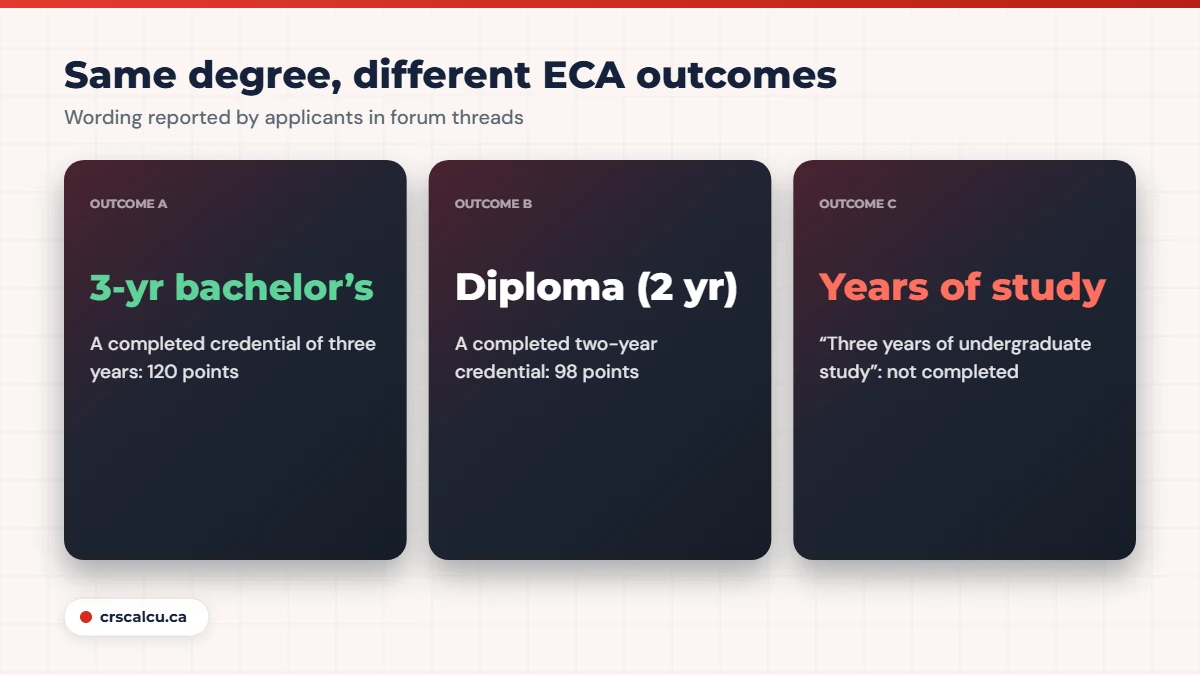
The same three-year degree has come back from an assessment as a bachelor’s degree for one graduate and as “three years of undergraduate study” for another. The wording decides the points.
A three-year bachelor degree is the standard first degree in much of the world: India, the United Kingdom, Australia, most of Europe, large parts of Africa. In Canada a bachelor’s degree usually takes four years. That one-year difference is behind one of the most common worries in Express Entry: will my degree count as a degree?
The answer does not come from IRCC. It comes from the organization that assesses your credential, in a report called an educational credential assessment, or ECA. IRCC’s scoring table then gives points according to what that report says. The good news is that the table itself is generous to three-year programs. The risk is in how the report is worded.
We read IRCC’s page on educational credential assessments, the education table in the ranking criteria and a Help Centre answer on multiple credentials, along with five public forum threads from 2015 to 2025 in which graduates posted the exact wording of their assessment and what it did to their score.
Quick answer: does a three-year bachelor degree get full points in Express Entry?
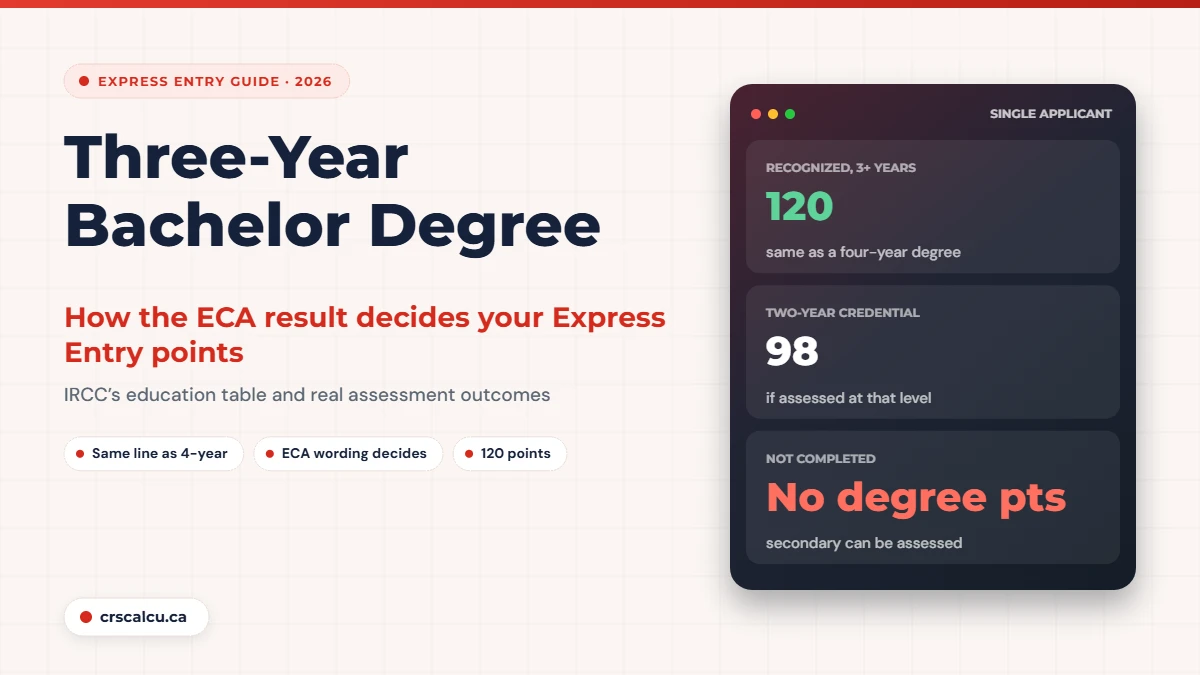
It can. IRCC’s scoring table (modified June 22, 2026) has one line for a bachelor’s degree or a program of three or more years: 120 points for a single applicant, 112 with a spouse or partner. A three-year credential that your ECA recognizes as a completed Canadian credential fits that line. The problem arises when the report says something less, such as years of study without a completed credential. IRCC says the ECA must show your education is equal to a completed Canadian credential. For timing, see ECA validity.
Key takeaways
How Express Entry scores a three-year bachelor degree
Start with the scoring table, because it is friendlier than most people expect. IRCC’s criteria list education levels in steps, and the step that matters here groups two things together.
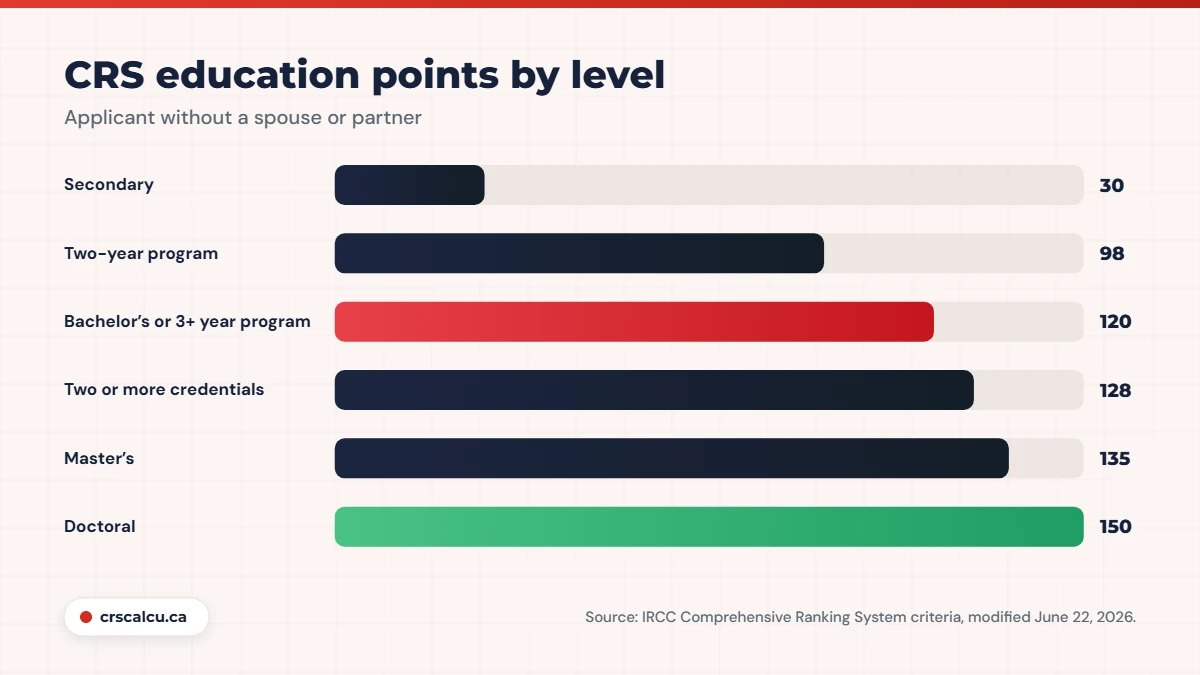
Level of education | With a spouse or partner | Without |
|---|---|---|
Secondary school diploma | 28 | 30 |
One-year post-secondary program | 84 | 90 |
Two-year post-secondary program | 91 | 98 |
Bachelor’s degree, or a program of three or more years | 112 | 120 |
Two or more credentials, one of them three years or longer | 119 | 128 |
Master’s degree or professional degree | 126 | 135 |
Doctoral degree | 140 | 150 |
From IRCC’s Comprehensive Ranking System criteria (modified June 22, 2026).
Read the fourth row again. A four-year bachelor’s degree and a three-year program earn the same points. For ranking, there is no penalty for the missing year, as long as the credential is recognized as a completed post-secondary credential of three years or more.
Why the ECA wording is everything
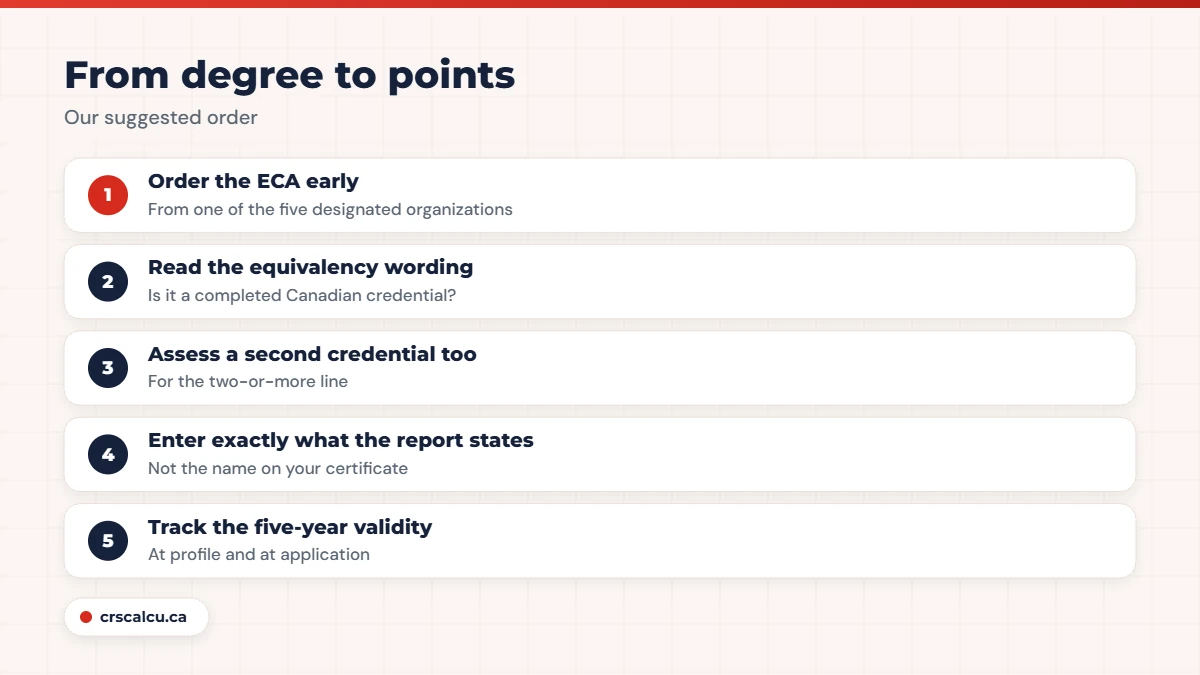
You only get those points for foreign education if you have an assessment. IRCC’s ECA page (modified June 22, 2026) says the report must be issued for immigration purposes by a designated organization, must be less than five years old when you complete your profile and when you apply, and must show that your foreign credential is equal to a completed Canadian secondary or post-secondary credential.
“Completed” is the word to watch. The assessing organizations describe outcomes in their own phrases, and those phrases fall into two groups.
If the report says something like | Our reading for a single applicant |
|---|---|
Bachelor’s degree (four years) | Bachelor’s line: 120 points |
Bachelor’s degree (three years) | Same line: 120 points |
Diploma (three years) | Three-year program: 120 points |
Diploma (two years) | Two-year program: 98 points |
Three years of undergraduate study | Not a completed credential: no post-secondary points on that report |
Our reading of IRCC’s education table against wording reported by applicants. The phrases are examples from forum threads, not IRCC terms. Enter exactly what your own report states.
Real case: “three years of undergraduate study” (June 2017)
A graduate with a three-year Bachelor of Science from an Indian university had it assessed and received the result “three years of undergraduate study”, not a bachelor’s degree. Members traced the reason to the assessing organization’s policy at the time, which gave full recognition to Indian three-year degrees only from institutions with a top national accreditation grade; this university was graded lower. They explained that the result would not earn degree-level points, and advised approaching a different designated organization for a second assessment. The poster accepted that advice.
Two cautions about that thread. The policy described is the organization’s own, as members quoted it in 2017, and such policies are revised. And the suggestion that another organization might reach a different result is a forum view, not a rule. What the case does show is that two holders of “a three-year BSc” can get different outcomes depending on the institution.
Our example: what the wording is worth
This is our own illustration, using IRCC’s tables for a single applicant with CLB 9 in every language ability. If the report recognizes the three-year degree as a completed credential, the education line gives 120 points, and the skill transferability section adds 25 for a post-secondary credential combined with strong language: 145 points that depend on the degree.
If the same degree comes back as years of study without a completed credential, and the applicant falls back on an assessed secondary diploma, the education line gives 30 points and the transferability points for education are not available, because they need a post-secondary credential. That is a gap of 115 points between two versions of the same person. It is the reason to read the equivalency line of your report before you read anything else, and to find out early which way your institution is treated.
Which organization assesses it
IRCC’s page lists five designated organizations for general credentials: Comparative Education Service at the University of Toronto, International Credential Assessment Service of Canada, World Education Services, International Qualifications Assessment Service, and International Credential Evaluation Service at the British Columbia Institute of Technology. Physicians, and pharmacists and architects who need a licence, go to their own professional bodies.
IRCC accepts a valid report from any of them and does not rank one above another. Whether they would assess a particular three-year degree differently is not something IRCC’s pages address.
Real case: a three-year degree plus an MBA (July 2015)
A graduate from India with a three-year bachelor’s degree and an MBA had both assessed. The first came back as a three-year undergraduate credential. The MBA came back as equivalent to a four-year Canadian bachelor’s degree, not a master’s, which cost them points they had been counting on. They asked whether another organization would be more generous. A moderator replied that the designated organizations work to similar standards, so a different result was unlikely, and added a practical point: credentials can only be claimed separately if the report assesses them separately.
That is the less-discussed side of a three-year degree. In some systems the first degree and the next one are assessed together, with the second treated as completing a bachelor’s level instead of adding a master’s. Our guide to two or more credentials explains how the higher lines of the table work.
Adding a second credential
If your three-year degree is recognized as a completed credential, another completed post-secondary credential can move you from 120 to 128 points. IRCC’s Help Centre (modified September 1, 2026) says that to get full points for two or more credentials, at least one must be from a program of three years or longer and you need a valid ECA for each. The order in which you completed them does not matter.
Real case: a diploma and a degree, assessed separately (July to November 2018)
An applicant held a three-year polytechnic diploma and a four-year bachelor’s degree from India. Only the degree had been assessed. Members said assessing the diploma as well would give the “two or more” level, and that it could be added to the existing file. In November 2018 the applicant posted the outcome: the diploma was assessed as a secondary school diploma plus a two-year diploma, and the degree as a four-year bachelor’s degree. Later posters confirmed receiving the two-or-more points with similar combinations.
Real case: a foreign bachelor’s and a one-year Canadian certificate (March 2025)
An applicant had an associate degree, a three-and-a-half-year engineering bachelor’s degree and a one-year Canadian postgraduate certificate. They asked which needed assessing. A member explained that the Canadian certificate needs no assessment but, at one year, cannot by itself reach the two-or-more level. With an ECA confirming the bachelor’s degree as equivalent, the two together would. No final result was posted.
A Canadian credential also earns separate additional points: see Canadian education points. If part of your study was online, read online degree ECA first.
If your degree is not recognized as completed
IRCC’s ECA page gives one fallback in its own words: if your post-secondary credential is not equal to a Canadian credential, you could get your secondary credential assessed. That secures the secondary-level points, 30 for a single applicant, and for the Federal Skilled Worker Program it meets the minimum education requirement.
Options applicants discussed
Enter what the report says, not what the diploma says
In the profile, choose the education level that matches the Canadian equivalency printed on your ECA. If your certificate says “Bachelor of Commerce” and the report says “diploma (two years)”, the report governs. Claiming the higher level is a classic source of lost invitations and worse: see misrepresentation in Express Entry.
Five mistakes with a three-year degree
Five mistakes from the rules and the threads
Once you have the report, put the level it states into the CRS calculator and compare your total with the latest draw cut-offs. If you qualify through the Federal Skilled Worker Program, check the education factor on our FSW points calculator as well.
Frequently Asked Questions
Does a three-year bachelor degree count as a bachelor’s degree in Express Entry?
For points, IRCC’s table gives the same score to a bachelor’s degree and to a program of three or more years: 120 for a single applicant. It counts if your ECA shows it is equal to a completed Canadian credential of that length.
How many CRS points is a three-year degree worth?
If recognized as a completed credential of three years or more: 120 points without a spouse or partner, 112 with. If assessed as a two-year credential: 98 or 91.
What if my ECA says “three years of undergraduate study”?
That wording describes study, not a completed credential. In a 2017 forum case, members said it would not earn degree-level points. IRCC says the ECA must show a credential equal to a completed Canadian one, and that you can have your secondary credential assessed if the post-secondary one is not equal.
Will a different ECA organization give a better result?
There is no official answer. Forum members have suggested trying another designated organization; a moderator in 2015 thought the standards were similar. IRCC accepts a valid report from any of the five.
Can I get two-or-more-credentials points with a three-year degree?
Yes, if you have a second completed post-secondary credential and a valid ECA for each. IRCC requires that at least one credential be from a program of three years or longer.
Do I need to assess every degree I have?
IRCC says you usually assess only your highest level. Assess more than one if you want points for two or more credentials.
Got your ECA result? See what it scores
Enter the level printed on your report and compare your total with recent Express Entry cut-offs.
Final Thoughts
A three-year bachelor degree is not a handicap in the Express Entry scoring table. It sits on the same line as a four-year degree. Everything depends on the assessment recognizing it as a completed credential, and that has varied with the institution and the way later degrees are counted. Get the ECA early, read its wording carefully, and enter exactly that.
If your report came back lower than you expected and your eligibility or invitation depends on it, speak to a licensed consultant or lawyer before you choose a second assessment or a different route. And never enter a level the report does not support.