Express Entry Guide · Updated October 2026
Principal Applicant in Express Entry: How Couples Should Choose (Real Cases)
Two people, one application, and only one of you carries the score. Here is how the points split between a principal applicant and a partner, with real numbers.
Choosing the principal applicant in Express Entry is the biggest points decision a couple makes, and many couples make it by default: whoever started the research, or whoever earns more, ends up at the top of the profile. The Comprehensive Ranking System does not care about either of those things.
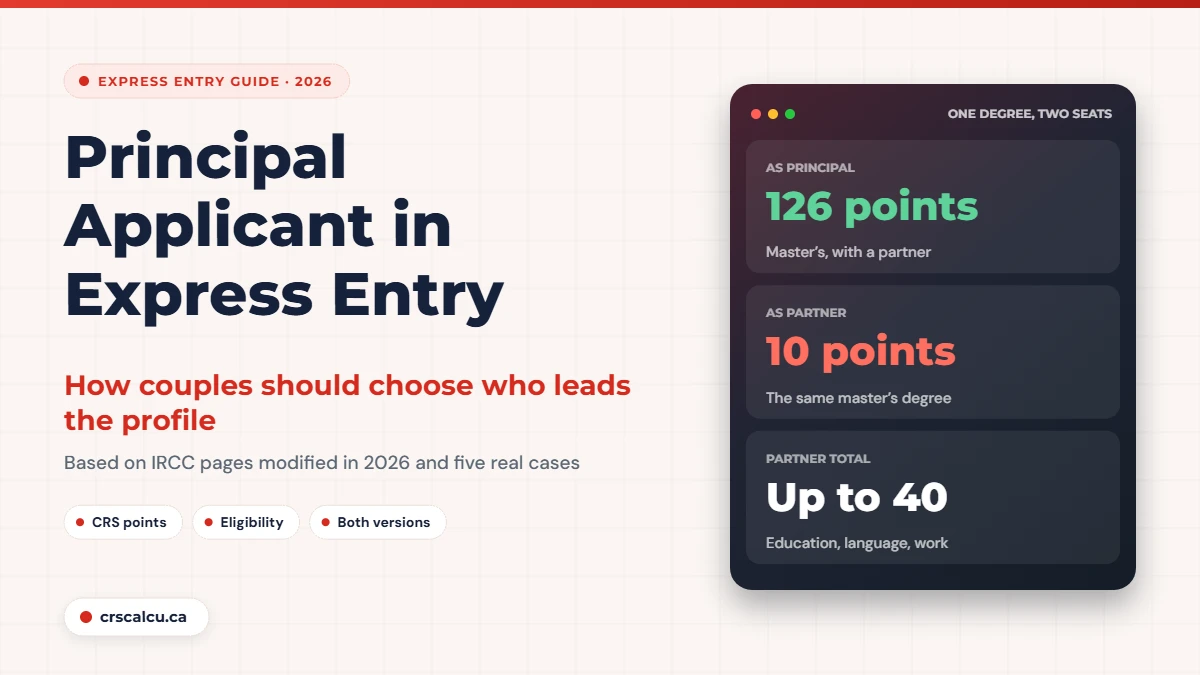
What it cares about is age, education, language scores and skilled work, and it weighs them very differently depending on which seat a person is sitting in. The same master’s degree is worth 126 points for a principal applicant with a partner, and 10 points for the partner. That gap is the whole story.
We read IRCC’s CRS criteria, its eligibility and application pages and three Help Centre answers (all modified in 2026), plus five public forum threads from 2017 to 2019 where couples compared their two possible scores. This is general information, not legal advice.
Quick answer: who should be the principal applicant?
Usually the partner whose own age, language results, education and skilled work produce the higher CRS score when placed in the principal seat, as long as that person also meets the eligibility rules of an Express Entry program by themselves. IRCC does not choose for you and does not publish a rule on it. Run the numbers both ways in our CRS calculator, because the difference between the two versions was 54 and 55 points in two of the cases we read. Both partners become permanent residents on the same application either way.
Key takeaways
What the principal applicant in Express Entry actually carries
IRCC’s CRS criteria page (modified June 22, 2026) splits the score into parts. The core factors (age, education, official languages and Canadian work experience) are scored for the principal applicant. A second block gives points for the spouse or common-law partner’s education, language and Canadian work experience. Skill transferability and the additional points (a sibling in Canada, French, Canadian study, a provincial nomination) are built on the principal applicant’s details.

Qualification | As principal (with a partner) | As the partner |
|---|---|---|
Age 29 | 100 | 0 |
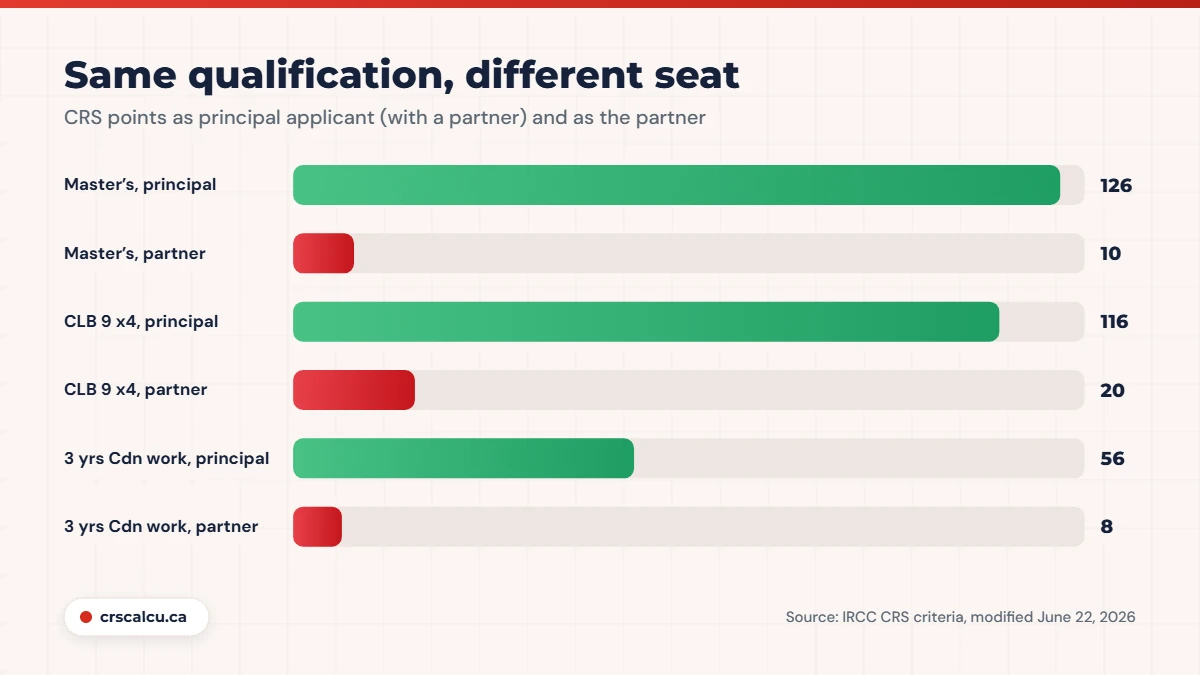
Master’s degree | 126 | 10 |
First language, CLB 9 in all four abilities | 116 | 20 |
Canadian work experience, 3 years | 56 | 8 |
Foreign work experience, 3 years | Counts for skill transferability | 0 |
Points from IRCC’s CRS criteria page (modified June 22, 2026). The language rows are four abilities at 29 points each for a principal applicant and 5 each for a partner; that multiplication is ours.
Read down the right-hand column. A partner’s whole contribution is capped at 40: up to 10 for education, up to 20 for language and up to 10 for Canadian work. A partner’s age earns nothing. A partner’s foreign work experience earns nothing. So the person with the stronger combination of youth, test scores and skilled work should usually be in the left-hand column, where those things are counted in full.
Who should be the principal applicant: run both versions
There is no shortcut that beats doing the arithmetic twice. Here is a made-up couple, scored with IRCC’s tables.
Line | Partner A leads | Partner B leads |
|---|---|---|
Age (A is 33, B is 28) | 80 | 100 |
Education (A master’s, B bachelor’s) | 126 | 112 |
First language (A CLB 9, B CLB 7) | 116 | 64 |
Partner’s education and language | 20 | 30 |
Skill transferability | 100 | 38 |
Total | 442 | 344 |
Our arithmetic using IRCC’s CRS criteria (modified June 22, 2026). Both partners have three years of foreign skilled work and no Canadian work. This is an illustration, not a real applicant.
Partner B is five years younger and wins the age line by 20 points. Partner A still comes out 98 points ahead, because CLB 9 unlocks far more than CLB 7 does: more core language points, and the top band of skill transferability for both education and foreign work. If Partner B retook the language test and reached CLB 9, the picture would change again. That is why the choice is not permanent until you are invited; it is worth redoing whenever one of you gets a new test result, a birthday or another year of work.
Real case: 414 one way, 468 the other (April 2018)
A couple worked out their score with each spouse in the lead. One version gave 414 and the other 468, a difference of 54. The poster asked whether both would get permanent residence together, whether the non-lead spouse could travel separately, and whether any work permit would be needed afterwards. An experienced reply said to go with the higher-scoring spouse as principal, that both spouses become permanent residents on a joint application, that the first landing has to be with or after the principal applicant, and that no separate work permit is needed once permanent residence is granted. No final outcome was reported.
Real case: 415 against 470 with similar careers (March 2018)
A poster’s own score was 415 and the spouse’s was 470. Their education and work history were similar; the gap came from age and language results. The poster wondered whether being the secondary applicant would limit their right to work or the timing of their arrival. Replies explained that the lead seat matters for scoring, that the principal applicant is the one who has to document work experience with reference letters, and that after landing both spouses hold the same status. The poster decided not to build a second profile and to let the spouse lead.
The landing point in those replies (that a partner cannot land before the principal applicant) is forum advice. It is widely repeated, but we did not read it on an IRCC page for this post, so treat it as something to confirm before you book flights.
A higher score is not enough: the principal must be eligible
The score ranks you. Eligibility gets you into the pool at all, and it is judged on the principal applicant. IRCC’s eligibility page (modified June 22, 2026) sets the minimums for each program.
Program | Skilled work | Language | Other |
|---|---|---|---|
Canadian Experience Class | 1 year in Canada in the last 3 years, TEER 0 to 3 | CLB 7 for TEER 0 or 1; CLB 5 for TEER 2 or 3 | No education requirement |
Federal Skilled Worker | 1 year continuous in the last 10 years | CLB 7 | Secondary education and 67 points on the selection grid |
Federal Skilled Trades | 2 years in the last 5 years | CLB 5 speaking and listening; CLB 4 reading and writing | Job offer or certificate of qualification |
Our summary of IRCC’s Express Entry eligibility page (modified June 22, 2026).
This is where a paper comparison can mislead. A partner might produce the higher number in a calculator and still fail the entry test: no full year of continuous skilled work, a language score one band short of CLB 7, or experience in an occupation that is not in TEER 0 to 3. Check the lead candidate’s occupation in our NOC and TEER finder, convert test results with the CLB calculator, and if you are relying on the Federal Skilled Worker route, test the 67 points in the FSW points calculator.
The principal applicant is also the one whose work history has to be proven. The reply in the March 2018 case put it plainly: the lead documents the experience. If one partner’s former employers will not issue letters, that weighs on the choice. Our post on the reference letter for Express Entry explains what the letters need to show.
Category-based rounds can change the answer
IRCC’s category-based selection page (modified June 22, 2026) says candidates in occupation categories need at least 12 months of work in a listed occupation within the past three years, and candidates in the French category need NCLC 7 in all four abilities. Our reading: those tests apply to the person the profile belongs to, so a partner with a lower general score but an eligible occupation or strong French may still be the better lead. See category-based draws and compare with the latest draw cut-offs.
Changing your mind: there is no “switch” button
Couples often pick a lead, wait in the pool for months, and then one partner’s new language result flips the comparison. What then?
IRCC’s Help Centre (modified September 1, 2026) says you may only have one profile at a time, and that creating more than one will not give you a better chance of being invited. We did not find any IRCC page describing a way to swap the principal applicant inside an existing profile. The forum answer is that the other partner builds a profile in their own name.
Real case: an agent’s fee to “switch” (January 2019)
A couple working through an agent had a score of 390. After the other spouse got better language results, making that spouse the lead would raise the score to 430, and the agent wanted an extra fee for the change. One experienced reply said there is no such thing as switching the principal applicant: a new profile has to be set up. The same reply pointed out that creating a profile costs nothing and that IRCC only charges when the application is submitted after an invitation. Another reply thought the agent was overcharging; a third said extra work could fairly cost extra, and that the couple could do it themselves if they preferred. No outcome was reported.
The government-fee part of that reply matches what we read. IRCC’s fee list (modified September 21, 2026) shows a $990 processing fee and a $600 right of permanent residence fee at the application stage; there is no fee listed for creating a profile.
Real case: should each of us make a profile? (July 2017)
A poster asked whether both spouses could each create a profile and list the other as a dependant. Several replies called it unnecessary: work out which spouse has the stronger score and go ahead with that one as principal. One reply added that when a couple applies together, both receive the same permanent resident status, with the same right to work and the same health coverage, so the lead seat only matters until landing. No outcome for the original poster was reported.
Real case: a second profile while the first was active (July 2018)
One spouse already had a profile listing the other as accompanying. The second spouse, who had the higher score, asked whether they could create a profile of their own. A senior member answered that nothing prevented it. A couple who had done the same said it was fine as long as each profile listed the other as accompanying, and that the second profile should be withdrawn as soon as either was invited. Another reply objected that two profiles from one household compete for a limited number of invitations. The poster said the answer was clear. No outcome was reported.
Note what IRCC’s one-profile rule does and does not say. The Help Centre answer we read is written to “you”, one candidate. It does not address spouses each holding a profile, and we did not find an IRCC page that does. If you are considering it, get advice first, and make sure both profiles tell the same truth about the family.
How to choose, step by step
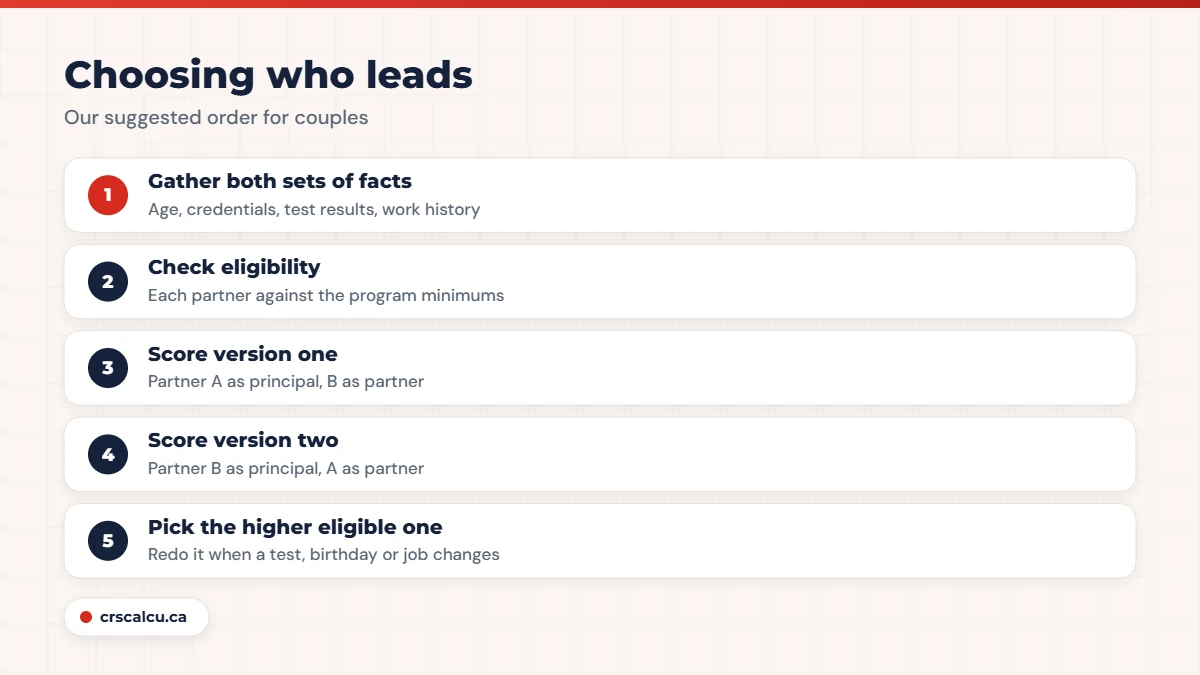
Our suggested order
What the non-lead partner still has to do
If your partner is not coming, or is already a Canadian citizen or permanent resident, the scoring changes again: the CRS criteria page says you are scored as if you had no partner. We cover that in our post on a non-accompanying spouse, and the definition questions in common-law partner in Express Entry.
Five mistakes when choosing the principal applicant in Express Entry
Avoid these
What IRCC does not say
We did not find an IRCC page that tells couples which partner should lead, that describes swapping the principal applicant in an existing profile, or that addresses both spouses holding a profile at once. The pages we read define the points, the eligibility rules and the one-profile limit, and leave the choice to you.
Frequently Asked Questions
Who should be the principal applicant in Express Entry, me or my spouse?
Usually the partner with the higher CRS score in the principal seat who also meets a program’s minimum requirements personally. Score both versions; IRCC does not publish a rule on which partner should lead.
Does the principal applicant get more rights after landing?
Forum replies we read say both partners hold the same permanent resident status once they land, and that the lead seat matters for scoring and for the first landing. We did not find an IRCC page that ranks the two after landing.
How many points can my partner add?
Up to 40 on the CRS criteria page: up to 10 for education, up to 20 for first official language and up to 10 for Canadian work experience. A partner earns no points for age or foreign work.
Can we change the principal applicant after creating a profile?
We found no IRCC option to swap the lead inside a profile. Forum replies say the other partner creates a profile in their own name. IRCC’s Help Centre says you may only have one profile at a time.
Does my partner need a language test?
Only to earn the partner language points, which are based on CLB levels from an approved test. The principal applicant needs valid results to be eligible at all.
Do we both become permanent residents at the same time?
A partner who is included as accompanying is processed on the same application. In the cases we read, replies said both spouses become permanent residents on a joint application.
Score both versions in two minutes
Enter the details once with each partner in the lead and compare the totals side by side.
Final Thoughts
The right principal applicant in Express Entry is the one the arithmetic and the eligibility rules point to, not the one who happened to open the account. For most couples the answer becomes obvious once both versions are on paper, and for some it changes after a single language test.
If the two versions are close, if one partner’s work history is hard to document, or if you are thinking about a second profile, speak to a licensed immigration consultant or an immigration lawyer before you commit.