Express Entry Guide · Updated October 2026
Married After ITA? What Happens to Your CRS Score and Express Entry Application (Real Cases)
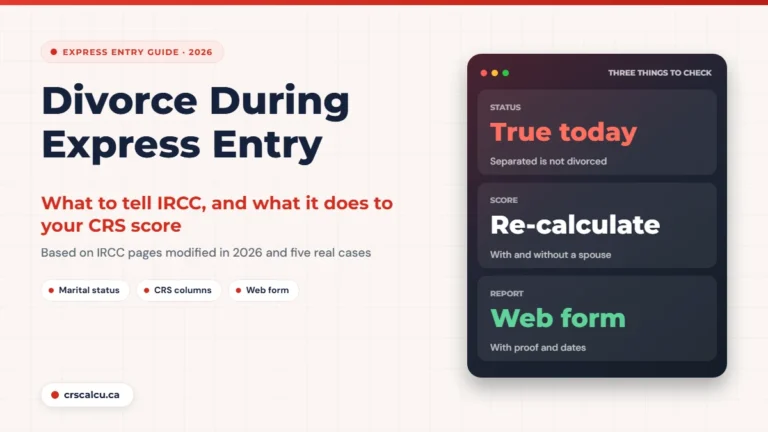
A wedding in the middle of your Express Entry process is not a disaster. But the date you marry decides whether your score is recalculated, and hiding it is the one mistake you cannot undo.
You got your Invitation to Apply (ITA). You also have a wedding date. Now you are wondering if getting married after ITA will sink your application.
You are not alone. This question fills pages on a large Canadian immigration forum, and it shows up on Quora every few months. We read those threads, posted between 2017 and 2020, along with newer questions from 2025 and 2026.
The honest answer depends on one thing: did you marry before or after you submitted your application for permanent residence? This guide walks through each window, with the real numbers people shared.
Quick answer: what happens if you get married after ITA
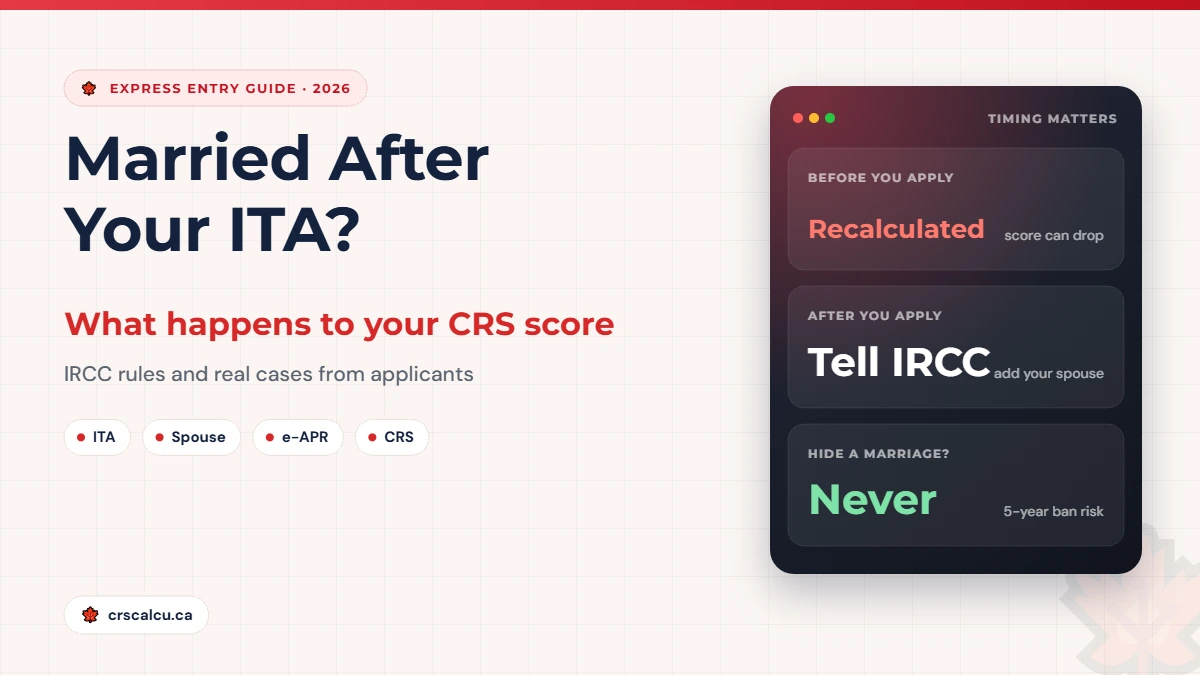
If you marry after the ITA but before you submit your application, you must apply as married and your CRS score is recalculated with your spouse. If the new score is below the cutoff of your round, IRCC encourages you to decline. If you marry after you submit, members report the score is not recalculated, but you must tell IRCC and add your spouse. In every case, never hide the marriage.
Key takeaways
Married After ITA: The Three Windows
If you get married after ITA, think of your process as three windows. The rules change as you move from one to the next.
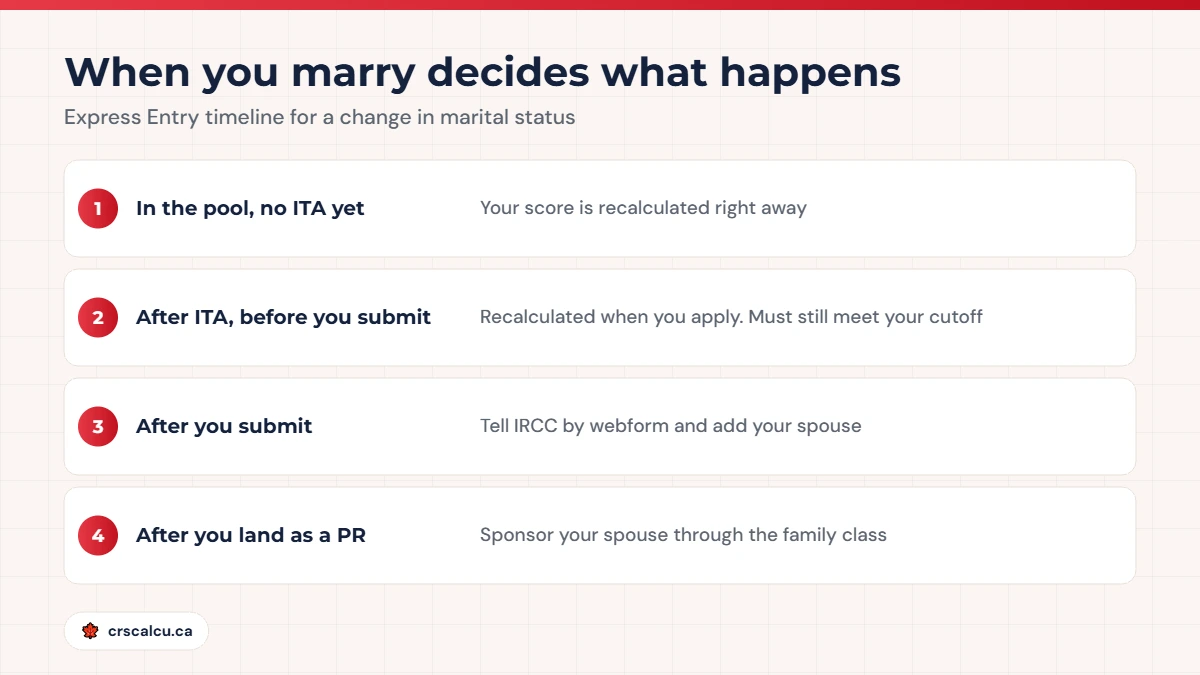
When you marry | Is your CRS recalculated? | What you do |
|---|---|---|
In the pool, before any ITA | Yes, right away | Update your profile |
After ITA, before you submit | Yes, at submission | Apply as married, or decline |
After you submit, before PR | Members report no | Tell IRCC by webform, add spouse |
After you land as a PR | No | Sponsor your spouse later |
Based on IRCC program instructions and member reports. The third row is what applicants reported, not an official IRCC statement.
IRCC’s program instructions on the ITA explain the second window. Your profile locks when you are invited. If your situation changes, the addition of a spouse can raise or lower your score. Candidates are encouraged to decline if the recalculated score falls below the lowest-ranked person in their round.
An engagement changes nothing. You are single until the wedding day or until you have lived together for 12 months as common-law partners.
Why Your Score Can Drop When You Add a Spouse
To see what being married after ITA does to your score, start with the core table. The CRS has two versions of it. A single applicant can get up to 500 core points. A married applicant can get up to 460, and the spouse can add up to 40 through education, language and Canadian work.
So if your new husband or wife has no language test and no assessed degree, you lose points and get nothing back. That is where the drop comes from.
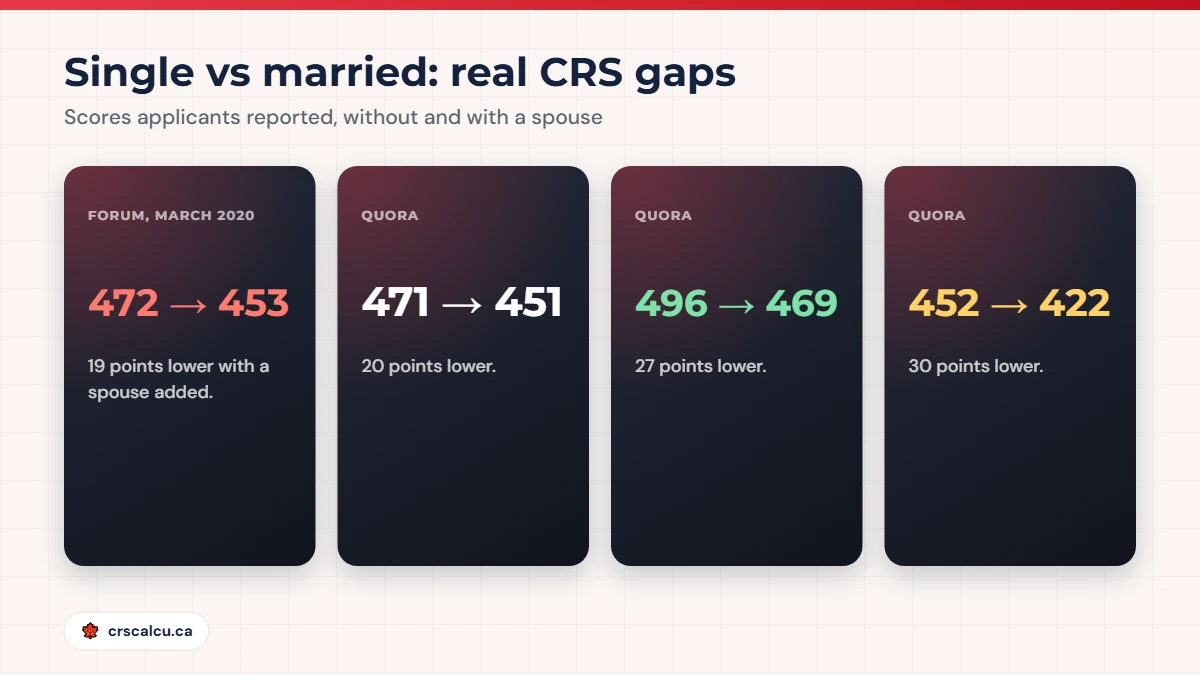
Real case: 472 single, 453 married
In March 2020, an applicant held an ITA with 472 points. The cutoff was 471. With a spouse added, the score would fall to 453. They were told that scores are not recalculated after the application goes in. They submitted as single, which was true at the time, and married about seven and a half months later. They added the spouse a month after the wedding. Approval came 10 days after that, and both became permanent residents.
The same gap shows up on Quora. One person had 471 alone and 451 with a spouse. Another had 496 alone and 469 with a husband. A third had 452 against 422. A drop of 20 to 30 points is normal for people married after ITA when the spouse adds nothing. Our spouse points guide shows how to win some of those points back.
Tip: run both versions before the wedding
Open our CRS calculator and enter your profile twice: once as single and once with your partner’s real details. Now you know the number you are dealing with.
If You Marry Before You Submit the Application
For anyone married after ITA, this is the risky window. Unlike a birthday after the invitation, a wedding is not forgiven. Once you are married, you cannot apply as single. Your marital status has to be true on the day you submit.
Real case: ITA in March, wedding on April 29
In April 2017, an applicant had an ITA from March and a wedding set for April 29. They had not submitted yet. The replies gave two clean options. Submit a complete application before the wedding, then add the spouse later. Or marry first, accept that the score is recalculated, and decline if it falls under the cutoff.
Real case: deadline June 20, wedding in May
In April 2018, another member was invited at the end of March and planned to marry in April or May. Their deadline was June 20. They were told the same thing: submitting before the marriage keeps the score as it is. They also asked if the spouse had to be added within six weeks. The answer was that a spouse can be added up to the day you land.
Your honest options in this window
A provincial nomination changes the math. In December 2019, a member was invited on November 27 with 1,041 points, including 600 from Ontario, and married on December 6. A spouse could never pull that score under the cutoff. The advice was to email the province about the change and keep that email as proof.
If You Marry After You Submit
If you are married after ITA and after submitting, this window is calmer. In August 2018, an applicant married after getting the acknowledgement of receipt. Members told them the score would not change and the spouse did not need a language test or an ECA.
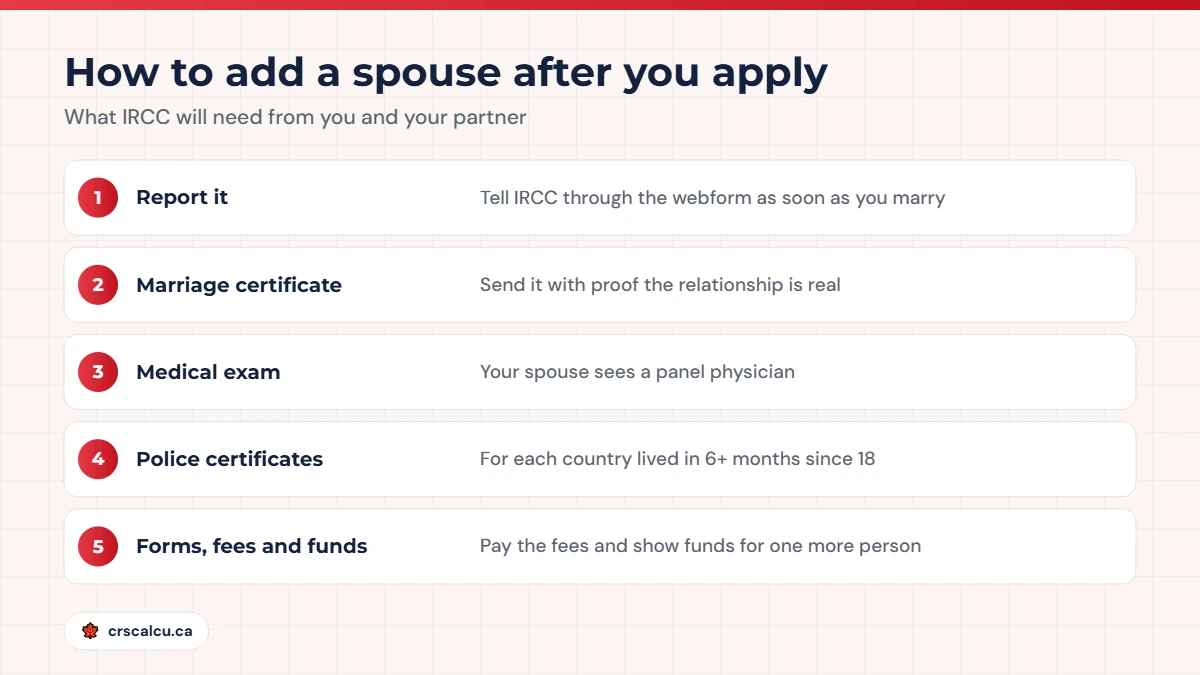
What you do need is speed and paperwork. Tell IRCC through the webform as soon as the marriage is official. Then be ready to send what they ask for.
How to add a spouse after you apply
See the current amounts in our proof of funds guide. Expect some extra processing time. One poster was approved 10 days after adding a spouse, but that is the lucky end of the range.
Accompanying or Non-Accompanying?
Married after ITA or before it, you must declare your spouse either way. What you choose is whether they get PR with you now.
If your spouse is truly not coming, you are scored as a single person. That sounds like an easy fix, and it is the reason many people ask about it. But it has to be real. One Quora user had 496 alone and 469 with her husband, and both were already living in Canada, he on a work permit tied to hers. It is very hard to say that spouse is not coming.
Warning: declare your spouse even if they stay behind
A non-accompanying spouse still has to be listed and should still do the medical exam. If you leave a spouse off your application, section R117(9)(d) blocks you from sponsoring them later. Hiding a marriage can also bring a five-year ban for misrepresentation.
We explain the trade-offs in detail in our guide to the non-accompanying spouse option.
After Approval: Married Before or After You Land
Some people are not married after ITA at all. They are approved, hold a confirmation of permanent residence, and marry before they travel. You must tell IRCC before you land. Do not land as “single” when you are married. Several forum members asked if it is “safer” to marry after landing. The replies said there is no safety difference, only a time difference.
If you marry after you become a permanent resident, you sponsor your spouse through the family class. It works, but it is a separate application and it takes months. Adding a spouse to an open Express Entry file is usually faster.
Mistakes real applicants made
Frequently Asked Questions
Will my CRS score drop if I get married after ITA?
It can. If you marry before you submit your application, the score is recalculated with your spouse. It may go up or down, depending on your spouse’s education, language test and Canadian work.
Can I submit my application as single and marry later?
Yes, if you are truly single on the day you submit. After the wedding, you must tell IRCC and add your spouse.
Does my new spouse need IELTS or an ECA?
No. A language test and an ECA are only needed if you want CRS points for your spouse. They do need a medical exam and police certificates.
What if my score falls below the cutoff after adding my spouse?
IRCC encourages candidates to decline the ITA in that case. You go back into the pool and can be invited again.
How do I tell IRCC that I got married after applying?
Use the IRCC webform. Send the marriage certificate and say whether your spouse is accompanying you.
Can I leave my spouse off the application and sponsor them later?
No. You must declare your spouse. A spouse who was not declared and examined cannot be sponsored later under R117(9)(d).
Does getting engaged change my marital status?
No. You are single until you marry, or until you have lived with a partner for 12 months in a common-law relationship.
I have a provincial nomination. Does marriage affect it?
Usually not. The 600 points keep you far above the cutoff. Tell the province about the change and keep proof of that message.
Check your score both ways before the wedding
Run our free calculator once as single and once with your partner. You will see the exact gap in seconds.
Final Thoughts
Getting married after ITA is a timing question, not a crisis. Before you submit, the new score has to hold up. After you submit, you report the marriage and add your spouse.
Whatever the dates look like, tell the truth about them. Every bad outcome we read started with someone trying to hide a wedding.