Express Entry Guide · Updated October 2026
Divorce During Express Entry: What to Tell IRCC and When (Real Cases)
Separated, divorcing or already divorced while your profile or application is open? Here is what IRCC’s own pages say, and what five real cases looked like.
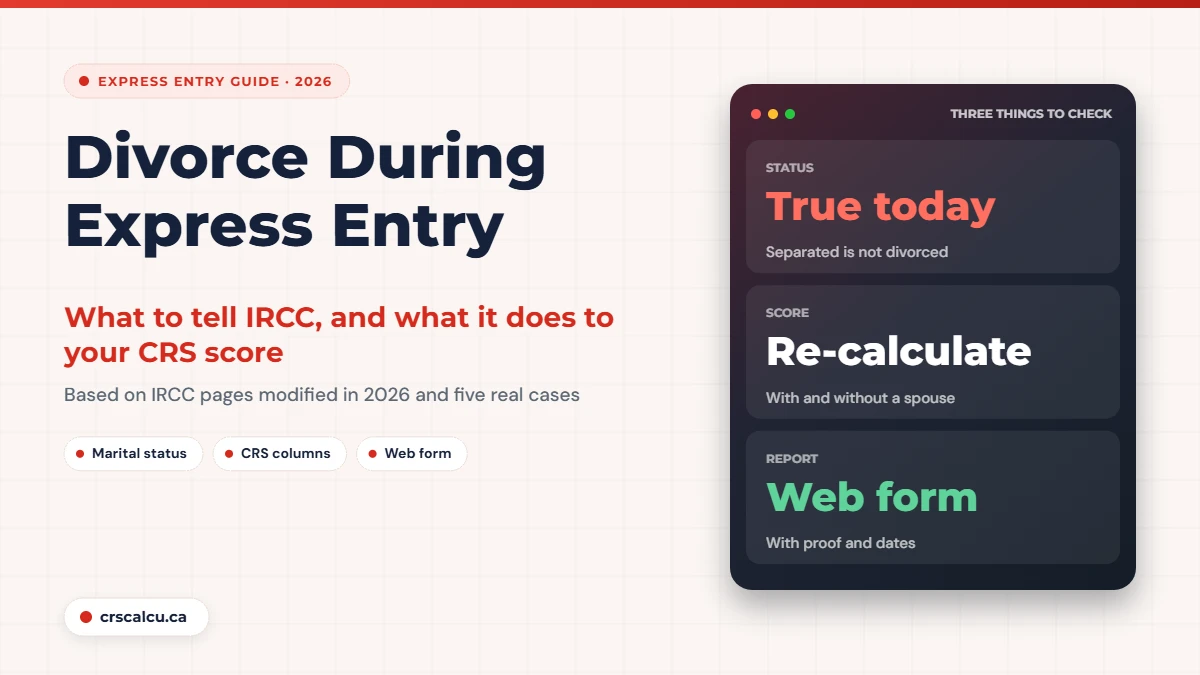
A divorce during Express Entry is one of those changes nobody plans for, and it lands on top of a process that already has deadlines. The immigration question is narrower than the personal one: what is your marital status today, who is still part of your file, and has IRCC been told.
The answers depend on where you are. In the pool, you edit your profile. After an invitation, you re-check your score before you apply. After you submit, you report the change with proof. At every stage the word you pick (married, legally separated or divorced) has a specific meaning to IRCC, and people in the threads we read often mixed them up.
We read IRCC’s pages on profiles, invitations, applications and updates (all modified in 2026), plus five public forum threads from 2018 to 2023 written by people whose marriage broke down mid-process. This is general information. It is not legal advice, and it does not cover family law in your country.
Quick answer: what happens if you divorce during Express Entry?
You have to tell IRCC. Its application guide says to inform it immediately of any change in marital status, and its update page lists marriage, separation and divorce among the changes to report. In the pool, you update the profile and your score is recalculated. After you apply, you use the web form and attach proof. A spouse you are separated from but still legally married to is still a family member, and IRCC says family members need a medical exam even if they are not coming. To see what the change does to your points, run both versions in our CRS calculator.
Key takeaways
Divorce during Express Entry: what IRCC’s wording says
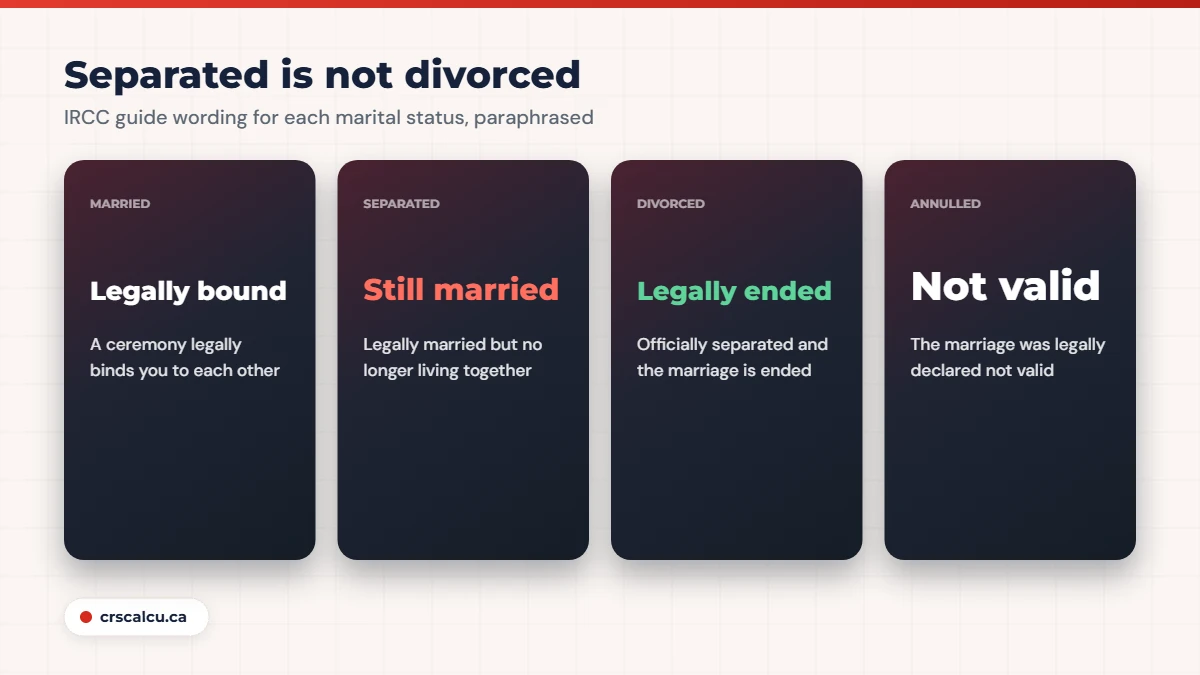
Start with the definitions. Most of the confusion in the threads we read comes from people using “separated” and “divorced” as if they meant the same thing. IRCC’s application guides define each marital status in a single line. The Express Entry pages we read do not spell each status out, so we take the wording from Guide 0118 (modified April 23, 2026), one of IRCC’s permanent residence guides, which carries the department’s standard list.
Status | What the guide says (paraphrased) | Our reading |
|---|---|---|
Married | You and your spouse had a ceremony that legally binds you | Stays true on paper until the marriage is legally ended |
Legally separated | Still legally married, but no longer living with your spouse | The marriage exists; you live apart |
Divorced | Officially separated and the marriage has been legally ended | A court or authority has finished it |
Annulled marriage | The marriage has been legally declared not valid | A separate status, not the same as divorced |
Our summary of the marital status definitions in IRCC’s Guide 0118 (modified April 23, 2026). The third column is our reading, not IRCC text.
Two things follow. First, moving out does not make you divorced. If you live apart and no court has ended the marriage, the status that matches IRCC’s wording is legally separated. Second, the same guide tells applicants to inform IRCC immediately of any change in marital status or family composition, and its examples include separation and divorce by name. There is no grace period in that sentence, and it does not say “once the divorce is final”.
The guide adds a line that matters more than it first appears: any family member who has not been examined before you become a permanent resident can never be sponsored by you in the future. Keep it in mind when you read the cases below, because two of them turn on exactly that.
Separated or divorced: which one are you today?
Pick the status that is true on the day you fill in the form, not the one you expect to have in three months. A divorce that has been filed but not granted is still a marriage. A couple who have agreed to end things but still share a home may not fit “legally separated” as IRCC words it, because that wording turns on no longer living together.
Documents follow the status. IRCC’s page on applying for permanent residence through Express Entry (modified June 22, 2026) lists a marriage certificate if you declared “married”, and a divorce certificate and legal separation agreement if you declared “divorced”. We did not find an IRCC list of proof for someone who is separated with no court papers yet. That gap is where the forum questions pile up.
Real case: separated, divorce stuck, application already in (June 2021)
An applicant whose file had been acknowledged in October 2020 wanted to take a spouse off the application. The couple had been long-distance for more than two years and had never lived together, and travel restrictions had stalled the divorce. An experienced reply said a separated spouse could be switched from accompanying to non-accompanying without a divorce order, but that removing the spouse completely would need a divorce order or court filings showing the divorce had started. The same reply warned that every message to IRCC had to describe the real situation, because a made-up reason could be treated as misrepresentation. The applicant drafted a web form message along those lines. No final outcome was reported; a later poster in a similar position said they had sent court papers three months earlier and had heard nothing yet.
That reply draws a line we saw repeated in other threads: showing a separated spouse as not coming is one request, and taking a spouse off the file is another. It is a forum member’s view, not an IRCC quote, and we could not find an IRCC page that states it in those words.
Where you are in the process changes what you do
Stage | What IRCC says | What to do |
|---|---|---|
Profile in the pool | Keep your profile up to date; a submitted profile can be changed | Change your family information, then check the new score |
Invited, not yet applied | The invitation is valid for 60 days; re-calculate if your situation changes | Re-run your score before you apply |
Application submitted | Report marriage, separation or divorce | Send the web form with proof and dates |
Approved, not yet landed | Inform IRCC immediately of any change in marital status | Report before you become a permanent resident |
Our summary of IRCC’s create-profile page (modified September 24, 2026), respond-to-invitation page (June 22, 2026), Update your application page (September 3, 2026) and Guide 0118 (April 23, 2026).
In the pool
IRCC’s Help Centre says a submitted, eligible profile can still be updated. Marital status is one of the fields that can look locked, because it was carried over from the first questionnaire. The Help Centre answer on greyed-out fields says to use the “Modify Family Information” button at the top of the profile page, make the change and select “Update Information”. The create-profile page (modified September 24, 2026) says you must keep the profile up to date, and that an update does not change the date and time used for the tie-breaker.
Once the status changes, the system scores you again. Whether that helps or hurts depends on what your spouse was adding, which we work through below.
After an invitation, before you apply
IRCC’s respond-to-invitation page (modified June 22, 2026) says the invitation is valid for 60 days only, and that if your situation changes you should re-calculate your score. If the new score is below the lowest score invited in your round, the page says you should decline. Declining puts you back in the pool and does not affect later invitations; we cover that choice in declining an ITA. Sixty days is not long when a marriage is ending, so do the arithmetic in the first week, not the last.
Real case: invited through a nomination, marriage failing (May 2023)
A candidate invited in April 2023 after a provincial nomination had married that January. By May the relationship had broken down and the spouse refused to do the medical exam or get a police certificate. The candidate had not claimed any spouse points, and the deadline to apply was June 12. Replies suggested speaking to a family lawyer at home about how long a divorce would take, and preparing sworn statements and separation papers to show the marriage had ended. By early June the spouse had filed for divorce, with a first hearing set for mid-June. The candidate planned to apply before that hearing with a notarized affidavit, and was uneasy about uploading a court petition that contained allegations. No final outcome was reported.
After you submit
This is the stage with the clearest rule. IRCC’s Update your application page (modified September 3, 2026) lists the changes you must report, and marriage, separation and divorce are on it, next to a new child and a change in the country where you live. The route is the IRCC web form, and the page tells you to include proof.
What a split does to your CRS score
The Comprehensive Ranking System has two columns for the core factors: one for candidates with a spouse or common-law partner and one for candidates without. The CRS criteria page (modified June 22, 2026) also says that if your spouse or partner is not coming with you to Canada, or is a Canadian citizen or permanent resident, you earn points as if you did not have one. So the column you are in can change with the marriage, and it can also change with who is accompanying you.
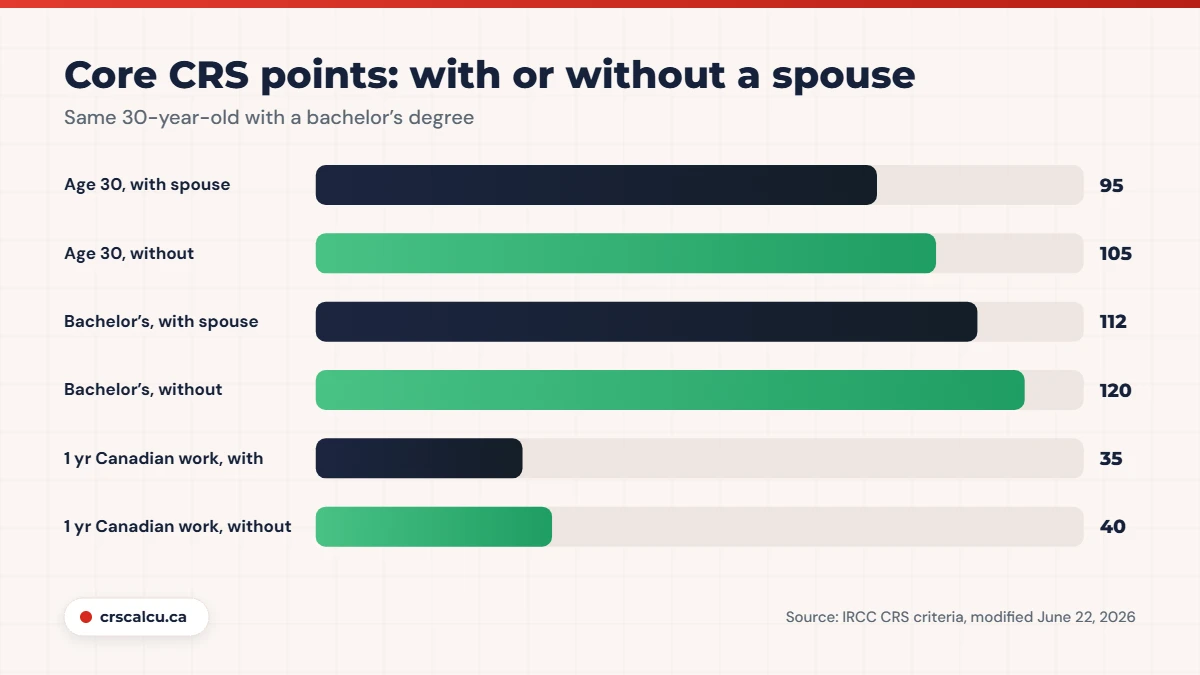
Factor | With a spouse | Without a spouse |
|---|---|---|
Age 30 | 95 | 105 |
Bachelor’s degree | 112 | 120 |
First language, CLB 9 in all four abilities | 116 | 124 |
Canadian work experience, 1 year | 35 | 40 |
Spouse factors (education, language, Canadian work) | Up to 40 | 0 |
Points from IRCC’s CRS criteria page (modified June 22, 2026). The language rows are four abilities at 29 or 31 points each; that multiplication is ours.
Our arithmetic, for one made-up profile: a 30-year-old with a bachelor’s degree, CLB 9 in all four abilities and one year of Canadian work has 358 core points with a spouse and 389 without one. That is a gap of 31. The spouse can then add back up to 40 points: up to 10 for education, up to 20 for language and up to 10 for Canadian work experience.
So the result goes both ways. If the spouse in our example had a master’s degree, CLB 9 or higher in every ability and five years of Canadian work, they were adding the full 40, and the candidate goes from 398 to 389 on becoming single. If the spouse had only secondary school (2 points), CLB 5 or 6 in each ability (4 points) and no Canadian work, they were adding 6, and the candidate goes from 364 to 389. Skill transferability and additional points use one table for everyone, so those lines do not move because of the column.
That is why “will a divorce raise my score” has no single answer. Put your own numbers in the CRS calculator twice, compare them with the latest draw cut-offs, and read our post on what CRS score you need before you decide anything about an invitation.
The spouse you are separated from is still a family member
Here is the part people least expect. IRCC’s Express Entry application page (modified June 22, 2026) says your family members must have a medical exam even if they are not coming with you. The Help Centre says the same about dependants who stay behind, and adds that a dependant who is inadmissible may make you inadmissible too. IRCC’s page on undeclared family members (modified September 11, 2026) says all family members must be declared, including those who are not coming.
If you are legally separated, you are, in IRCC’s own wording, still legally married. Our reading is that a separated spouse therefore still counts as a family member until the marriage is legally over, and the forum replies we read assume the same. That becomes a practical problem when the two of you are not on speaking terms and one of you needs the other to attend a medical exam.
Real case: living apart for a year, child involved (November 2019)
A candidate who had lived apart from a spouse for about a year, and had a young child, wanted to apply without the spouse, relying on a self-declared statement of separation. An agent had suggested leaving the child off the application to avoid custody questions and sponsoring the child later. After the invitation arrived, the spouse’s years of living in several other countries meant a long list of documents. An experienced reply warned that applying as legally separated with the spouse left out would mean the spouse could not be sponsored later, and that sponsoring a child afterwards would need either full legal custody or the other parent’s written consent. The reply pointed to filing for divorce as the clearest route, since IRCC might ask for proof that proceedings had begun. No outcome was reported.
Leaving a child off a file is the opposite of what IRCC’s pages tell you to do. Children stay your dependants whatever happens to the marriage, and the rules on declaring and examining them are the same ones that apply to a non-accompanying spouse. If a child arrives in the middle of all this, see our posts on being pregnant during Express Entry and on a baby born after ITA.
Real case: separated 13 months, exams already done (July 2023)
A work permit holder in Canada had a permanent residence application in process for three months, with medical exams and biometrics finished for both spouses. The couple had never lived together, had been apart for 13 months and had agreed to divorce, but the paperwork was not done. The applicant asked how to take the spouse off the file. A regular contributor called the non-accompanying route the easiest one: tell IRCC the relationship has ended and the divorce is not yet complete. The same reply noted that the spouse would still need a completed medical exam, and that proving a separation without a final divorce would be hard. No outcome was reported.
Do not invent a reason
IRCC’s create-profile page (modified September 24, 2026) warns that false information can lead to refusal, a finding of inadmissibility and a five-year bar on applying. Calling a marriage over when it is not, or still intact when it is not, both fall on the wrong side of that line. Describe what actually happened and when.
How to tell IRCC, and what to send
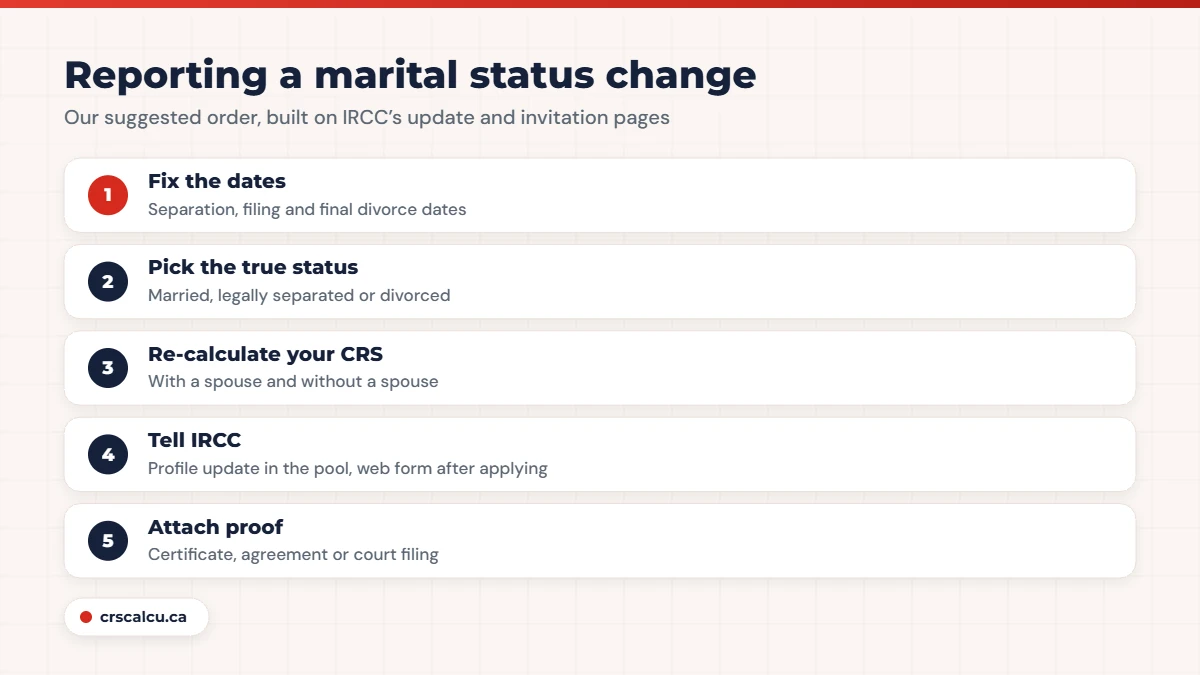
IRCC’s update page says to report the change and include proof, and it routes you to the web form. It does not publish a script. The order below is ours.
Our suggested order
Real case: marriage ending just before landing (November 2018)
A principal applicant who was waiting for the confirmation of permanent residence asked whether starting a divorce before landing would cause trouble or count as misrepresentation. Several experienced replies said the same thing: any change in marital status has to be reported to IRCC before landing, filing for divorce is itself something to report, and staying silent is what creates the misrepresentation risk. They added that the applicant would need to ask IRCC formally to take the spouse off the application. One reader said they had been through something similar months earlier and had gone ahead with the divorce while continuing alone. The original poster did not report an outcome.
Have these ready before you write to IRCC
Five mistakes people make with a divorce during Express Entry
Avoid these
What IRCC does not say
We looked for several things and did not find them on the pages we read. There is no published list of documents that prove a separation when there are no court papers. There is no stated length of time you must live apart before “legally separated” applies; one forum reply quoted a figure, but we could not confirm it on an IRCC page, so we have left it out. There is no service standard for how quickly a marital status update sent by web form is reflected in a file. And we did not find a statement on what happens to fees already paid for a spouse who is later taken off an application.
Where IRCC is silent, the forum replies fill the space with experience, and experience varies. Treat the cases above as examples of what people did and were told, not as rules.
Frequently Asked Questions
Do I have to report a divorce during Express Entry if my application is already submitted?
Yes. IRCC’s Update your application page (modified September 3, 2026) lists marriage, separation and divorce among the changes you must report after applying. You report through the IRCC web form and include proof.
I am separated but not divorced. Which marital status do I choose?
IRCC’s guide wording says you are legally separated if you are still legally married but no longer living with your spouse, and divorced only once the marriage has been legally ended. Choose the one that is true on the day you fill in the form.
Will my CRS score go up after a divorce?
It depends on what your spouse was adding. The “without a spouse” column gives more core points, but you lose up to 40 spouse points. In our example a strong spouse profile meant a drop of 9 points and a weak one meant a gain of 25. Run your own numbers both ways.
Does my separated spouse still need a medical exam?
IRCC says family members must have a medical exam even if they are not coming with you. A legally separated spouse is, in IRCC’s wording, still legally married to you. Our reading is that the requirement stays until the marriage is legally over, but IRCC does not publish a line on this exact case.
Can I remove my spouse from my application?
You can report the change and ask. Forum replies we read say IRCC expects a divorce order or proof that divorce has been filed before taking a spouse off a file, and that a separated spouse can be shown as non-accompanying in the meantime. We could not find an IRCC page that states this in those words.
What if we get back together after I reported the separation?
Then your marital status has changed again. IRCC’s guide asks to be told immediately of any change in marital status, so our reading is that a reconciliation that changes your status is reported the same way, with dates.
See your score both ways
Run your numbers with and without a spouse before you update your profile or answer an invitation.
Final Thoughts
Nothing on the IRCC pages we read says that a divorce during Express Entry ends a profile or an application by itself. What they say is that the change must be reported, that the status you pick has to be the true one, and that family members who are still legally yours must be declared and examined. The score can move in either direction, so check it before any deadline does the deciding for you.
If your spouse will not cooperate, if children are involved, or if you are days from an invitation deadline, speak to a licensed immigration consultant or an immigration lawyer, and to a family lawyer where the divorce is taking place. The cost of a short consultation is small next to a refused application.