Express Entry Guide · Updated October 2026
Personal History for Express Entry: Gaps, Unemployment and Addresses
The form wants every month of your adult life accounted for. Not just jobs. The months between them too. Here is how to fill it without gaps, what to call the awkward periods, and how it has to line up with your addresses and work history.
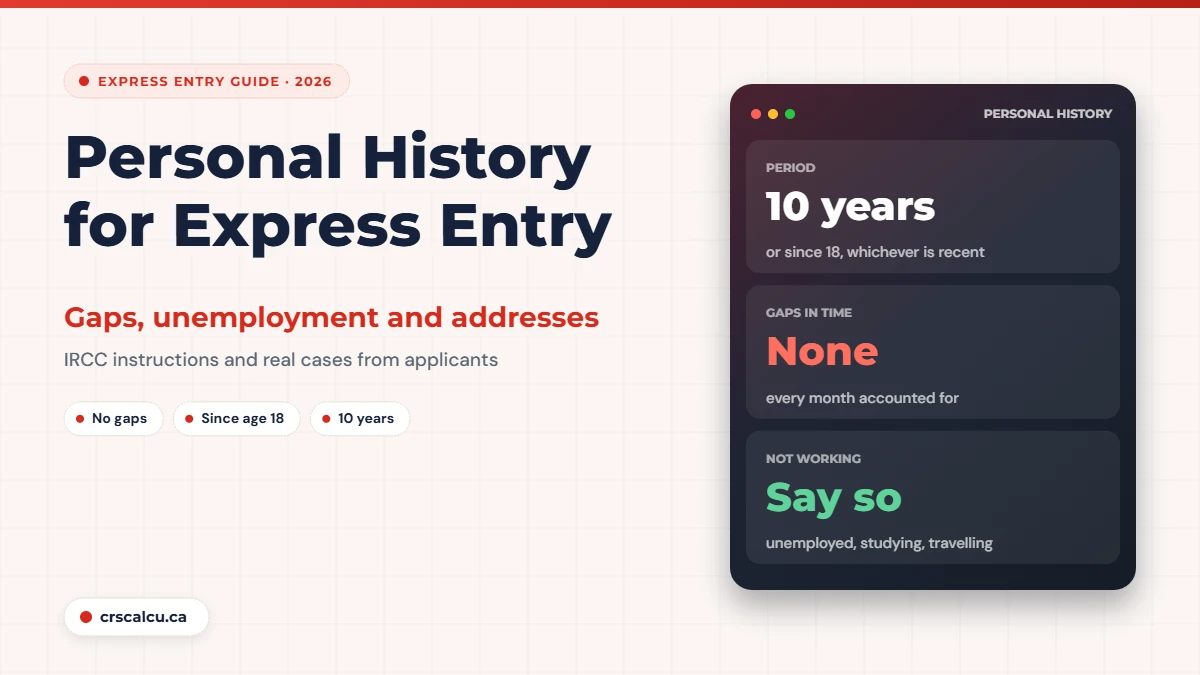
Personal history for Express Entry is the section of the permanent residence application where you account for what you were doing in every period since you turned 18, or over the past 10 years, whichever is most recent. IRCC’s instruction is direct: do not leave gaps in time. If you were not working, you say what you were doing instead, such as unemployed, studying or travelling.
It is not the same as work history. Work history is about the jobs that support your claim. Personal history is about your whole timeline, including the three weeks between two jobs and the year you spent at home with a child.
We went through IRCC’s background form instructions and forum threads from 2015 to 2024 where applicants got stuck on gaps, unemployment labels and which addresses to list. Here is what the rules require and how people handled the grey areas.
Quick answer: personal history
Cover every month since your 18th birthday or the last 10 years, whichever is more recent, with no gaps. For time not working, write what you were doing: unemployed, studying, travelling, retired and so on. List every address where you lived in the same period, with postal codes and no P.O. boxes. Make sure it agrees with your work history, travel history and police certificates.
Key takeaways
What Personal History for Express Entry Covers
After an invitation, the online application asks for background information that mirrors IRCC’s Schedule A form. IRCC’s instructions for that form set the period and the standard. The period is since the age of 18, or the past 10 years, whichever is most recent. The standard is that you do not leave gaps in time, and IRCC warns that processing will be delayed if you do not account for all periods.
Your age when applying | Start your history from |
|---|---|
24 | Your 18th birthday, 6 years ago |
28 | Your 18th birthday, 10 years ago |
35 | 10 years ago, when you were 25 |
45 | 10 years ago, when you were 35 |
Our examples of IRCC’s rule: since age 18 or the past 10 years, whichever is most recent.
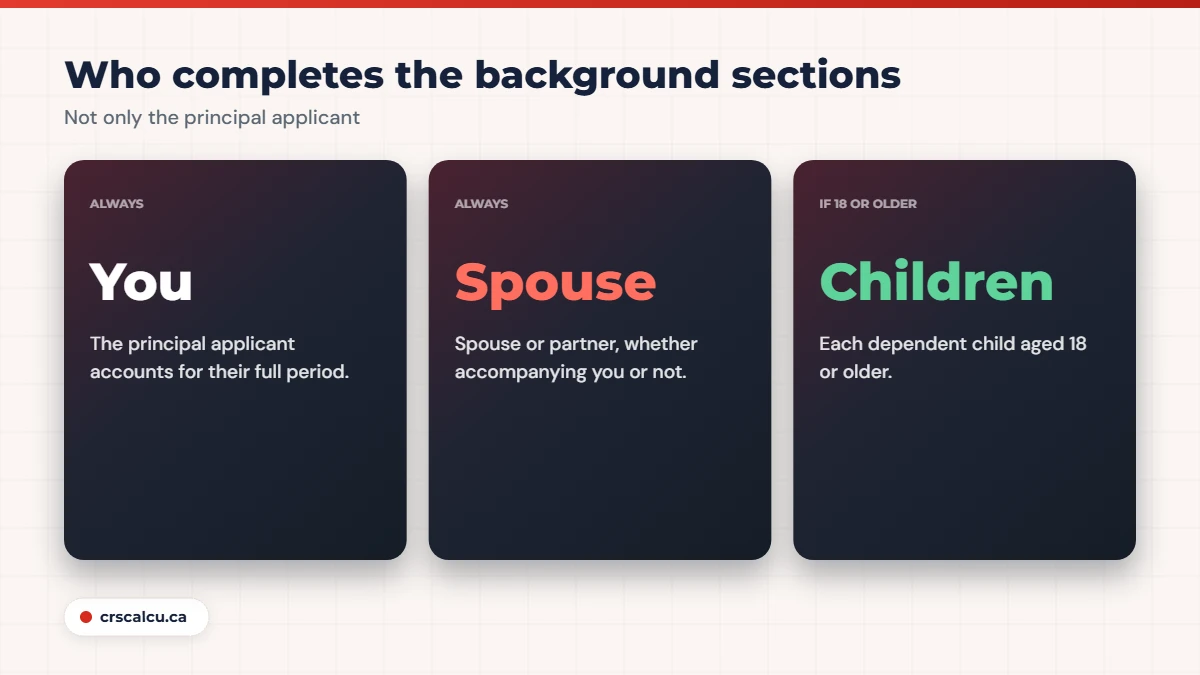
The instructions also say who must do this. It is not only the principal applicant. A spouse or common-law partner completes it whether or not they are coming to Canada, and so does every dependent child aged 18 or older.
Personal History Is Not Work History
Applicants mix these up constantly, because the same jobs appear in both.
Example: two sections that did not match
In June 2015, an invited applicant had listed only the jobs that earned points in the work history section, but every job, including short retail work, in personal history. They worried about the mismatch. Members explained the difference: work history is for the jobs that count toward your claim, and personal history is for everything, including travel and unemployment. The applicant chose to list all jobs in both.
Section | What goes in | Gaps allowed? |
|---|---|---|
Work history | Jobs, with the ones you claim points for fully documented | Yes, it is a list of jobs |
Personal history | Everything you did: work, study, unemployment, travel, caring for family | No |
Address history | Every place you lived, with postal code | No |
Travel history | Trips abroad in the last 10 years | It is a list of trips |
Personal and address rules are from IRCC’s Schedule A instructions (IMM 5669, modified June 26, 2025). The comparison is ours.
A job you list in personal history but not in work history is fine, as long as you are not claiming points for it. What must not happen is a job with points claimed that has different dates in the two places.
How to Record Unemployment and Other Gaps
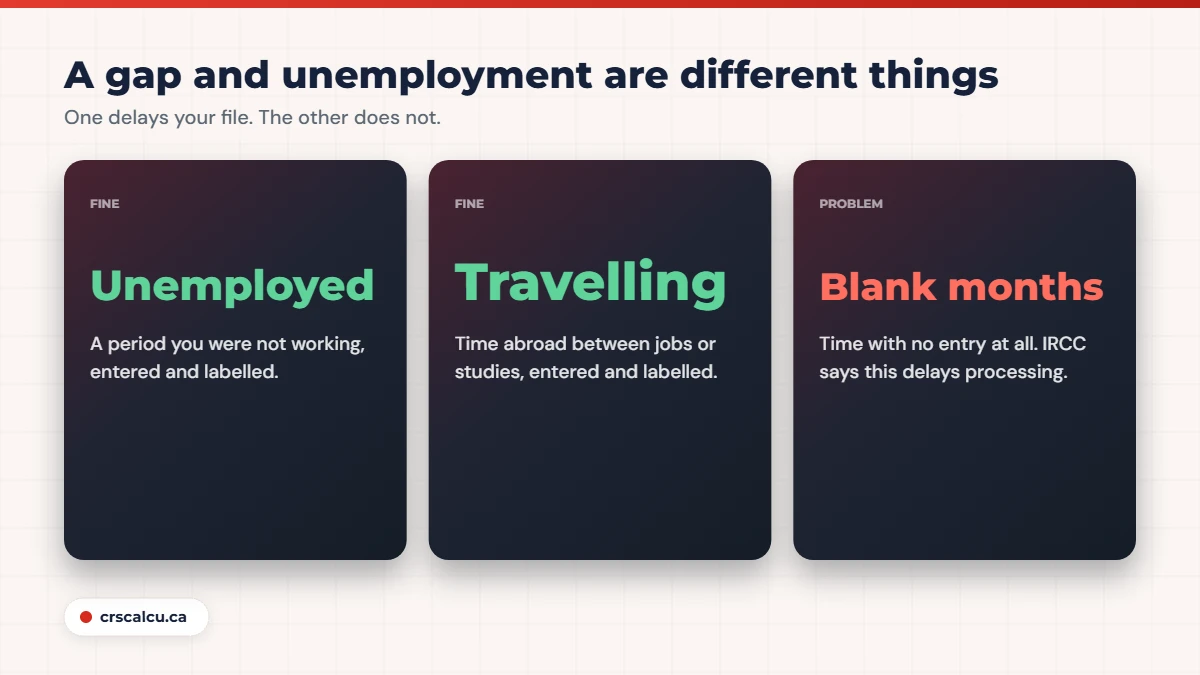
IRCC’s instructions give the vocabulary. If you were not working, state what you were doing, and the examples it lists are unemployed, studying, travelling, retired and in detention.
Example: what to type for unemployment
In August 2018, an invited applicant did not know what to enter for a jobless period, or what to put in the company name box, which assumed a job. An experienced member’s answer was plain: write unemployed as the activity and N/A for the company. A later poster in the same thread reported getting permanent residence after doing exactly that.
Short gaps count too.
Example: 24 days between jobs
In September 2022, an applicant asked whether to mention a 24 day stretch between two jobs in April 2022. Because the form works in months, the dates would look continuous either way. A member’s advice was to keep everything straight: if you were unemployed, say so.
What you were doing | How applicants entered it |
|---|---|
Between jobs, looking for work | Unemployed |
Full-time study | Studying, with the school name |
Raising a child or caring for a relative | Homemaker, or caring for family |
Long trip or backpacking | Travelling, with the countries |
Waiting for a visa or permit | Unemployed, awaiting permit |
Preparing for exams between degrees | Unemployed, preparing for studies |
Retired | Retired |
Labels drawn from IRCC’s examples and applicant reports. Use wording that is true for you.
Example: months of backpacking
In February 2015, in the first weeks of Express Entry, an applicant had long stretches of backpacking that fit none of the activity categories in the form. They phoned the immigration call centre twice. Others with the same problem ended up entering the period as unemployed and travelling, with not applicable for the employer, so that the timeline stayed continuous.
Nothing in these labels hurts you. Officers see unemployment, study breaks and parenting in every second file. What slows a file down is a month that is simply missing.
Address History: Where You Lived, Not Where You Slept
IRCC’s instruction is to enter the residential addresses where you have lived since your 18th birthday or the past 10 years, whichever is most recent, complete with the postal code. It adds: do not use P.O. box addresses.
The question applicants ask is what lived means.
Example: do hotels count?
In July 2019, a Canadian Experience Class applicant asked whether hotels from business trips and holidays belonged in address history. One member said address history means your normal residences. Another said to add every stay to be safe. A third drew the line at sustained stays: a weekend away is not an address, but a stay of 45 days or more is.
Example: a three week holiday
In January 2024, an applicant asked whether a three week trip home needed its own address entry. An experienced member said no. Think of address history as the places you lived, and put holidays in travel history. The member stressed the real rule for addresses: leave no gaps between one and the next.
So the working approach is this. Your home address stays your address while you take a normal holiday. A long stay somewhere else, where you really were living for months, gets its own entry. And the end date of one address should meet the start date of the next.
Address history checks
The Other Background Questions
The same form asks about three more things. IRCC’s instructions describe each.
Also on the background form
Answer these fully and plainly. A student union or a professional body is a membership. Compulsory national service is military service. Leaving them out because they seem routine creates an inconsistency that is harder to explain later than the fact itself.
Make the Sections Agree
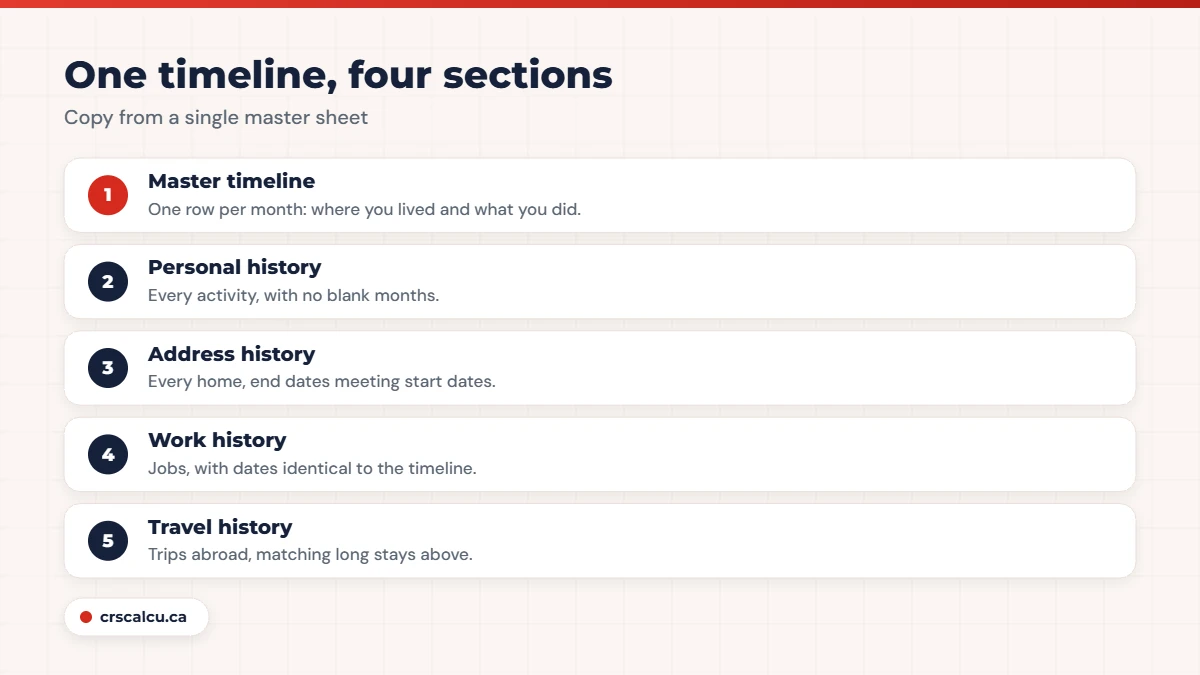
An officer reads your history as one story told four ways. The dates should tell the same story each time.
Mismatches that draw questions
If something cannot be made to fit, do not force it. Explain it. A short letter of explanation for Express Entry placed with the relevant document tells the officer you saw the issue too. Dates for claimed jobs must also match your reference letters.
A Method That Works
Build one master timeline first
Do this while you are still in the pool. When the invitation comes you have 60 days, and those days are better spent chasing documents than reconstructing 2017. The rest of the list is in our Express Entry document checklist.
Frequently Asked Questions
How far back does personal history go for Express Entry?
Since you turned 18, or the past 10 years, whichever is most recent.
Can I leave gaps in my personal history?
No. IRCC’s instructions say not to leave gaps in time, and that processing is delayed if you do not account for all periods.
How do I show unemployment in personal history?
Enter the period as unemployed. Applicants commonly write N/A where the form asks for a company name. IRCC lists unemployed, studying, travelling and retired as examples of what to write.
Is personal history the same as work history?
No. Work history lists your jobs. Personal history accounts for all of your time, including study, unemployment, travel and caring for family.
Do I list hotels and holidays in address history?
Address history is for places you lived. Normal holidays belong in travel history. Long stays where you were living elsewhere for months get their own address entry.
Does my spouse have to fill in personal history?
Yes. IRCC’s background form is completed by the principal applicant, the spouse or common-law partner whether accompanying or not, and dependent children aged 18 or older.
Check your score while you build your timeline
See how your CRS score compares with the latest cutoffs.
Final Thoughts
Personal history for Express Entry is a timeline with no missing months. That is the whole requirement. It does not judge how you spent the time. It only asks that you say.
Build one master timeline, label the quiet periods honestly, and copy from it into every section so the dates agree. A complete history is rarely questioned.