Express Entry Guide · Updated October 2026
Continuous Work Experience in Express Entry: What the Federal Skilled Worker Rule Means and Whether a Gap Breaks It (Real Cases)
A week between two jobs. A fortnight of notice period. A month of travel. Applicants ask whether any of these breaks the one year the Federal Skilled Worker Program asks for.
Continuous work experience is the phrase that keeps Federal Skilled Worker applicants awake. The program asks for at least one year of it, and the word “continuous” invites a question the official page does not answer directly: how small a break is still a break?
Before worrying about that, it helps to know how narrow the rule is. It applies to one program, to one year, and to one occupation. The rest of your work history can be as patchy as real careers usually are. It still counts for points. And if you qualify through Canadian experience instead, the requirement does not apply to you at all.
We read IRCC’s Federal Skilled Worker Program page and its comparison of the three programs, along with four public forum threads from 2017 to 2024 in which applicants with gaps of seven days, two weeks and several months asked whether they still qualified.
Quick answer: what counts as continuous work experience?
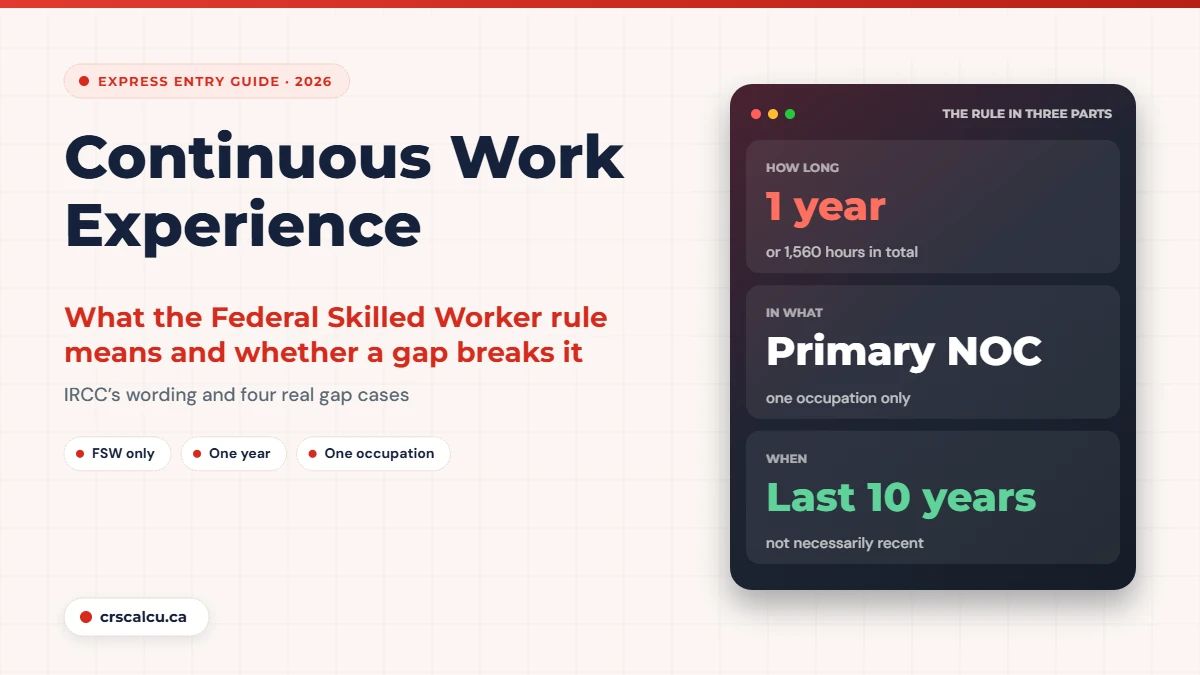
IRCC’s Federal Skilled Worker Program page (modified September 24, 2026) asks for at least 1 year of continuous work, or 1,560 hours in total at 30 hours a week, in the same occupation as your primary one, within the last ten years. Its program comparison puts it as “1 year continuous within the last 10 years”. The page does not say how long a gap must be to break continuity, and forum advice is that an officer decides. The safest case is one unbroken year, with one employer or with jobs that follow each other directly. The Canadian Experience Class has no continuity rule.
Key takeaways
What the rule says, and where it applies
IRCC lists what your skilled work experience must be for the Federal Skilled Worker Program. Among the conditions: in the same occupation as the job you want to use for your application, within the last ten years, paid, and at least one year of continuous work or 1,560 hours in total, at 30 hours a week. Hours above 30 a week are not counted.
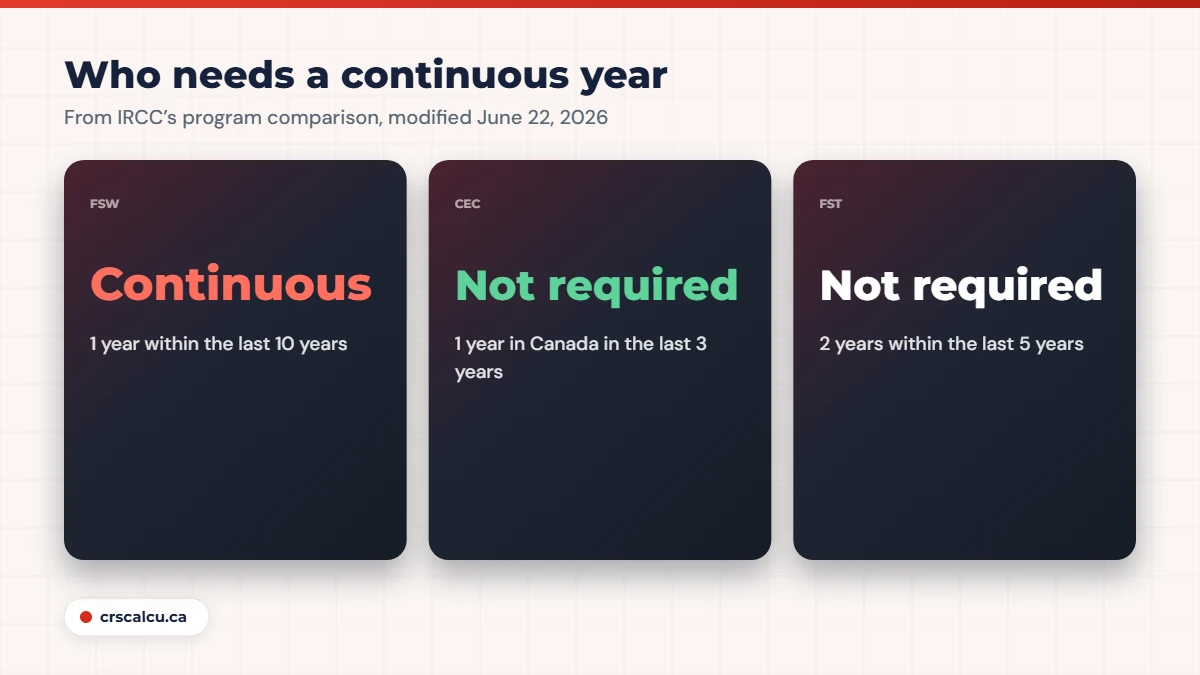
The comparison page shows how different the three programs are on this point.
Program | Amount | Continuity |
|---|---|---|
Federal Skilled Worker Program | 1 year within the last 10 years | Continuous |
Canadian Experience Class | 1 year in Canada in the last 3 years | Not stated as a requirement |
Federal Skilled Trades Program | 2 years within the last 5 years | Not stated as a requirement |
Our summary of IRCC’s “Express Entry: Who can apply” page (modified June 22, 2026).
Real case: “continuity is a requirement for FSW, not CEC” (October 2018)
Someone asked whether the one year of experience for the Canadian Experience Class and the Federal Skilled Worker Program has to be continuous. The first reply was unsure. The second said no for the Canadian Experience Class and listed that program’s conditions. A third put it in one line: continuity is a requirement for the Federal Skilled Worker Program, not for the Canadian Experience Class. Follow-up questions over the next two years confirmed that work for different employers can be combined for the Canadian program as long as the hours add up to 1,560.
If you have a year of skilled work in Canada, read Canadian work experience points instead. The rest of this post is for people relying on experience abroad.
One year only, and in one occupation
Two details shrink the problem further.
First, only one year has to be continuous. Once you have it, more experience raises your points whether or not it is joined up.
Second, the continuous year has to be in your primary occupation. A year made of six months as an analyst and six months as a manager is twelve months of work in two occupations, and neither half is a year. We explain how to choose in primary occupation.
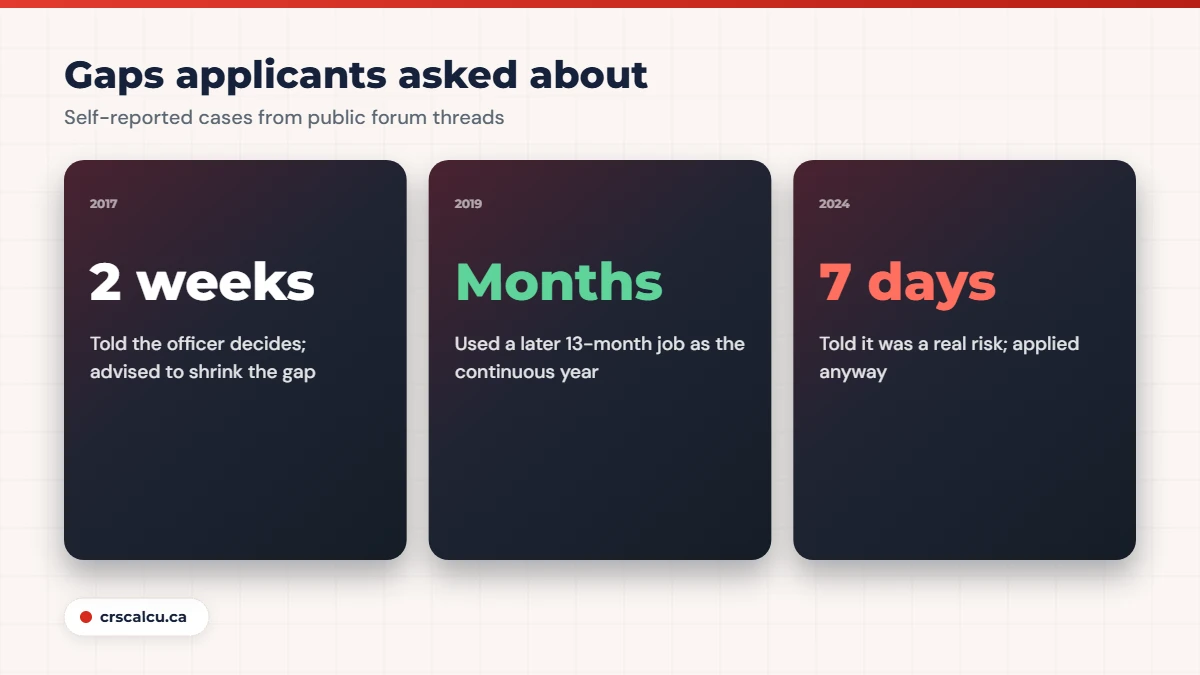
Real case: ten months, a gap, then thirteen months (June 2019)
An applicant had three jobs over three years: one of ten months, then a gap, one of thirteen months, and a current one. They asked whether the first job, which was under a year, could be claimed. A member explained that it would not help meet the eligibility requirement, but it could still be entered and would count for ranking points, and that the second job’s occupation could serve as primary. The applicant later reported that when their most recent year was recognized, their foreign experience points went from 25 to 50 and their score reached 451. A member added a caution that dates may be checked day by day at the application stage.
That case shows the two jobs the rule does and does not do. The thirteen-month position supplies the continuous year. The ten-month one adds to the total.
Does a small gap break it?
This is the question IRCC’s page leaves open. It says “continuous” and, for work done while studying, adds “no gaps in employment”. It does not give a number of days.
Real case: two weeks between jobs (November 2017)
An applicant with several jobs in the same occupation had a two-week gap between two of them and asked whether their experience still counted as continuous. The first reply was strict: continuous means continuous, not even a day. More experienced members disagreed in part. They said the decision rests with the officer and that people with minor breaks had been approved. As a practical fix, the applicant was advised to ask their current employer to extend their last day by two weeks to shrink the gap that mattered. A later exchange made the point that only one year needs to be continuous.
Real case: seven days while moving cities (February 2024)
An applicant working in the United States left a job in early November 2019, moved across the country and started a new one in the same occupation on November 18, seven days later. Neither job alone covered a year. They asked whether the week would disqualify them. Members answered that, technically, continuous means no gaps at all, that officers have discretion, and that it was a real risk. One added that the continuity rule matters only for the Federal Skilled Worker Program. The applicant decided to apply anyway and put their own chances at fifty-fifty. No outcome was posted.
Two threads, six years apart, with the same answer: nobody outside IRCC can promise that a gap of days is harmless, and nobody can show that it is always fatal. We found no official figure either way.
How to think about your own dates
This is our own way of sorting cases, from safest to riskiest. It is not an IRCC classification.
Our reading, from safest to riskiest
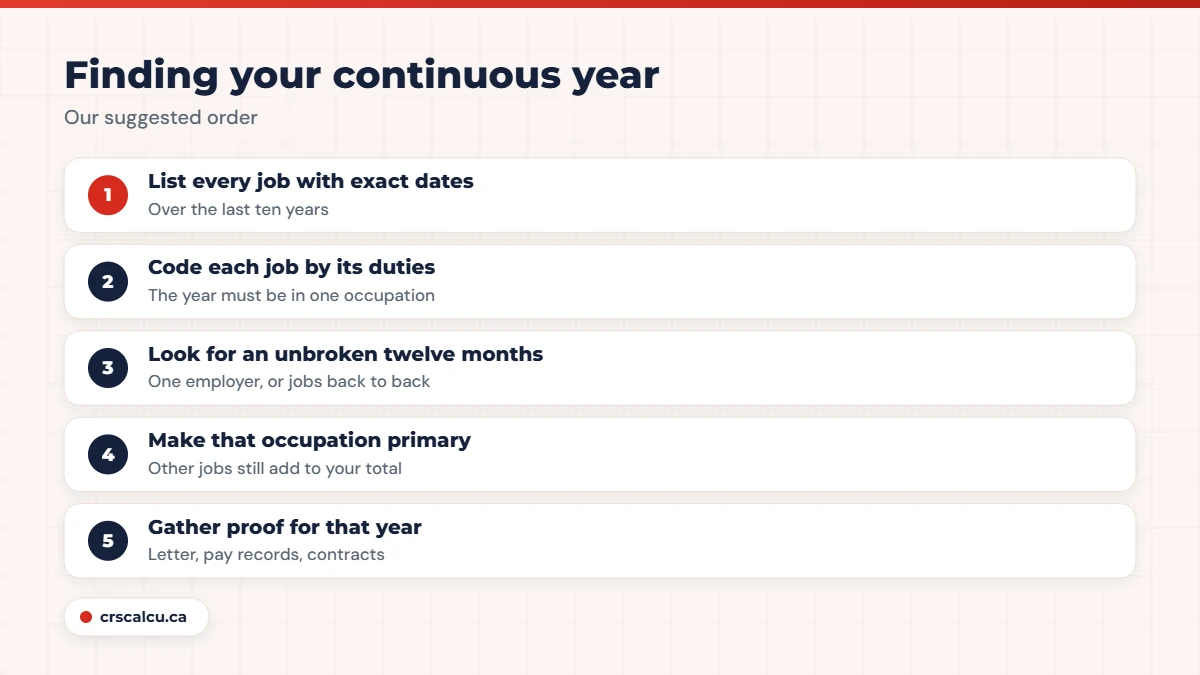
If you have a clear case anywhere in the last ten years, build your eligibility on that year and let the rest of your history add points. In the 2019 case above, that is exactly what the applicant did.
Look for your cleanest year, not your latest
The continuous year does not have to be your most recent work. It has to be within the last ten years and in your primary occupation. An unbroken eighteen months at a company you left four years ago may be a much safer foundation than two recent jobs with a week between them.
Our example: three applicants, same total, different answers
These are our own illustrations. Each person has twenty-four months of skilled work abroad in the last five years.
Our example
The lesson is that the total tells you about points and the shape tells you about eligibility. Check the shape first.
Part-time work and the 1,560 hours
IRCC gives the requirement two ways: one year of continuous work, or 1,560 hours in total. Part-time work reaches 1,560 hours over a longer period, for example two years at 15 hours a week. More than one part-time job can be combined. What you cannot do is finish early by working long weeks, because hours above 30 a week are not counted. The arithmetic is in 1,560 hours for Express Entry.
For part-time work the same continuity question arises over a longer stretch. A part-time job held without interruption for two years is the clean version.
Proving it
Whatever your dates are, the officer sees them through documents.
Documents that show an unbroken year
Enter the true dates. A gap that is disclosed is a question of judgment. A gap hidden by stretching an end date is a false statement, with the consequences described in misrepresentation in Express Entry. Your personal history will show the gap anyway, since it has to account for every month.
Five mistakes people make with the continuous year
Five mistakes from the rules and the threads
Once you know which year carries your eligibility, check the six selection factors in 67 points for Express Entry, then put your whole history into the CRS calculator and compare the total with the latest draw cut-offs.
Frequently Asked Questions
What is continuous work experience in Express Entry?
For the Federal Skilled Worker Program, IRCC asks for at least one year of continuous work, or 1,560 hours in total at 30 hours a week, in your primary occupation within the last ten years.
Does a gap of a few days between two jobs break continuity?
IRCC’s page does not give a number of days. Forum members say that strictly it means no gaps, and that the officer decides. In 2017 and 2024 threads, applicants with gaps of two weeks and seven days were told it was a risk.
Does all my work experience have to be continuous?
No. Only one year must be continuous for eligibility. Other skilled experience counts toward your total even with gaps.
Do I need continuous work experience for the Canadian Experience Class?
No. That program asks for one year of skilled work in Canada in the last three years, and work for different employers can be combined.
Can I combine two jobs to make one continuous year?
If they are in the same occupation and follow each other without a break, that is the strongest case. If there is a break, or the occupations differ, you are relying on an officer’s judgment or do not meet the rule.
Does annual leave or sick leave count as a gap?
Paid leave within a job is part of that employment. The concern in forum threads is breaks between jobs, not time off inside one.
Found your continuous year? See your score
Enter your full work history and compare your total with recent Express Entry cut-offs.
Final Thoughts
Continuous work experience is a narrow requirement that feels like a broad one. It asks the Federal Skilled Worker Program applicant for a single unbroken year in their primary occupation within the last ten years. IRCC does not say how small a gap is tolerated, and the only safe answer is a year with no gap at all. Everything else in your work history can have breaks and still earn points.
If your only route to a year runs across a gap between jobs, or your occupation changed partway through, speak to a licensed consultant or lawyer before you rely on it. They cannot promise an outcome either, but they can help you present the dates and choose the strongest year.