CRS Points Guide · Updated October 2026
French Points in Express Entry: Is Learning French Worth It for Your CRS Score? (Real Cases)
French can add more points than anything except a provincial nomination. It can also eat a year of your life for nothing if you stop one level short. Here is the honest math and how long it took real people.
“My CRS is 435. If I start French from zero, can it save me?” That question was asked on Quora years ago and people still ask it every week. The French points Express Entry offers are bigger today than when most of those old answers were written.
Some answers online still say French is worth 30 points. That was true before October 2020. Others say you can pick up the points in two or three months. Nobody in the threads we read managed that.
We went through forum posts from 2017 to 2025 where people shared their study time, their test scores and what happened next. This guide puts the numbers and the timelines together.
Quick answer: how many French points Express Entry gives
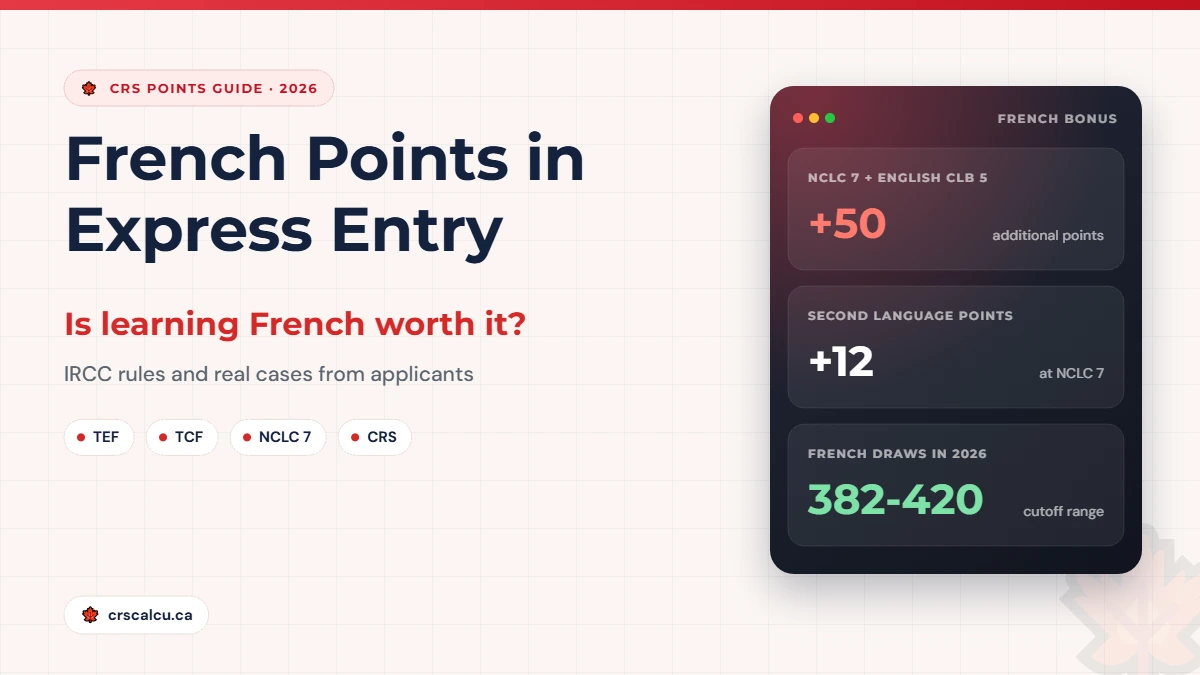
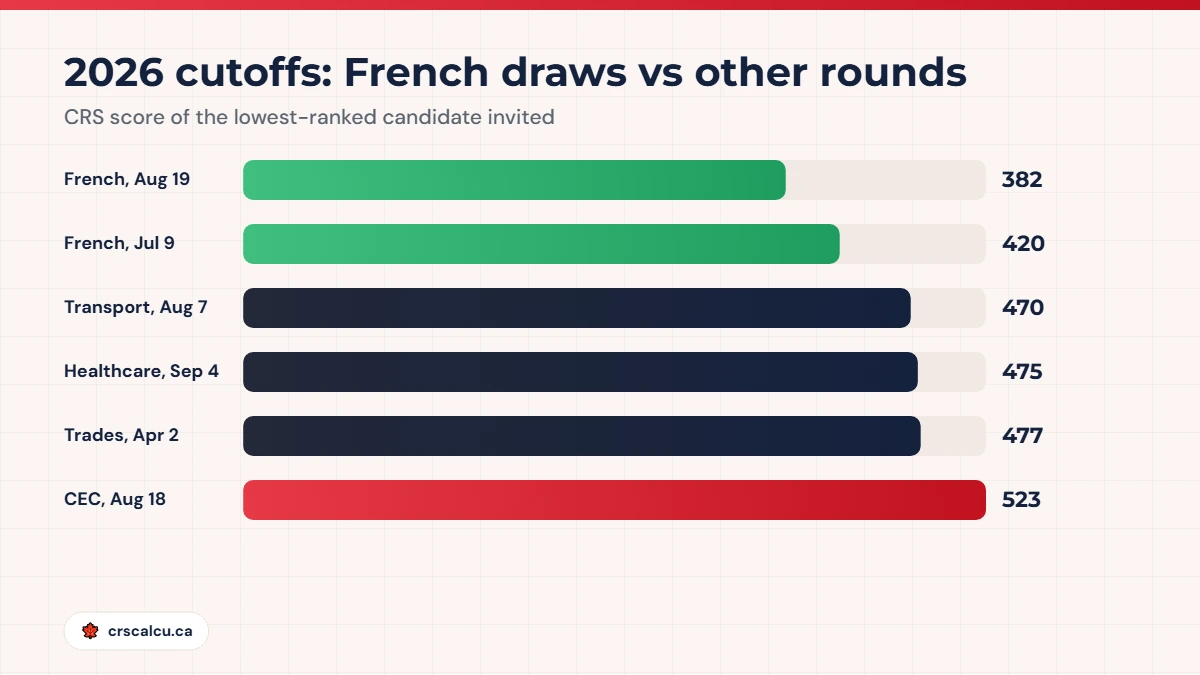
If you score NCLC 7 or higher in all four French skills and CLB 5 or higher in all four English skills, you get 50 additional points. With weaker or no English, you get 25. French as a second official language adds up to 24 more (12 at NCLC 7). NCLC 7 in all four also makes you eligible for French-language draws, which had cutoffs between 382 and 420 in mid-2026.
Key takeaways
French Points Express Entry: The Numbers
The French points Express Entry gives come from three separate places. Most calculators add them without explaining them, so here they are one by one. The values come from IRCC’s CRS criteria.
1. Additional points for French
Your French | Your English | Points |
|---|---|---|
NCLC 7 or higher in all four skills | CLB 4 or lower, or no English test | 25 |
NCLC 7 or higher in all four skills | CLB 5 or higher in all four skills | 50 |
Below NCLC 7 in any skill | Any | 0 |
Source: IRCC CRS criteria, additional points.
2. Second official language points
If English is your first official language, French is scored as your second. That is worth 1 point a skill at NCLC 5 or 6, 3 points at NCLC 7 or 8, and 6 points at NCLC 9 or higher. The maximum is 24 for a single applicant and 22 with a spouse.
French level in all four skills | Second language points | Additional points | Total |
|---|---|---|---|
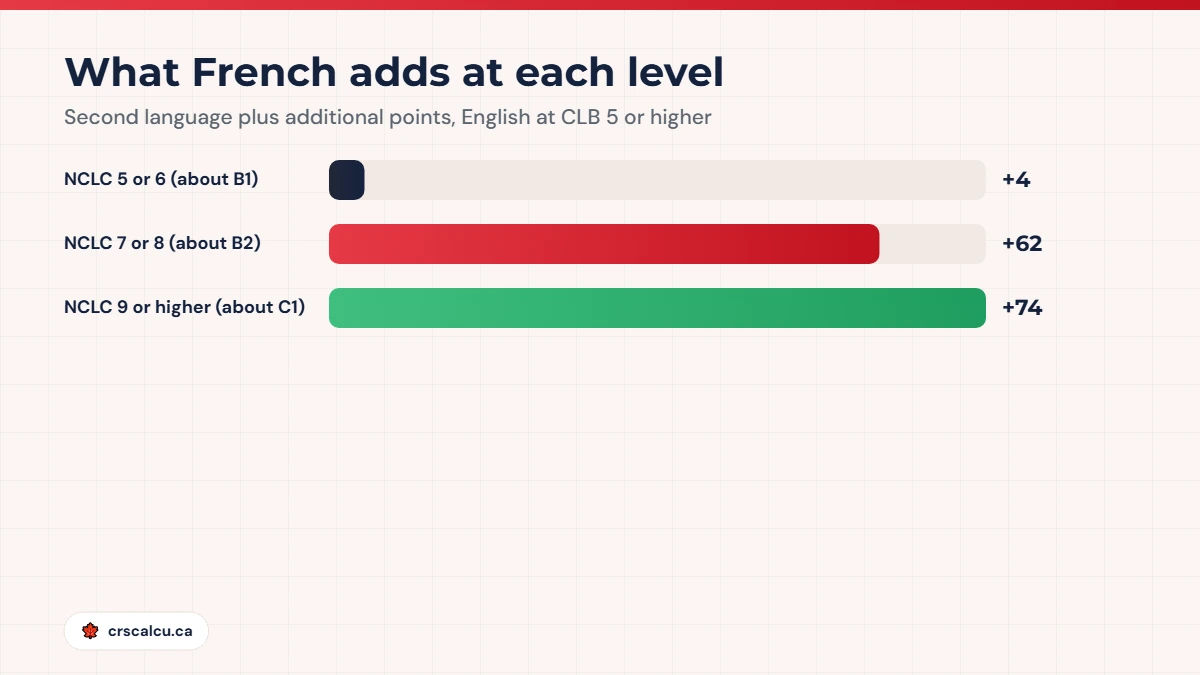
NCLC 5 or 6 (about B1) | 4 | 0 | 4 |
NCLC 7 or 8 (about B2) | 12 | 50 | 62 |
NCLC 9 or higher (about C1) | 24 | 50 | 74 |
Our calculation from the IRCC grid for a single applicant. CEFR levels are approximate.
See the cliff in the French points Express Entry table? B1 gives you 4 points. B2 gives you 62. An old Quora answer says a low level gets you “4 points in 4 to 6 months.” That part is still about right. It is the other 58 points that take the real work.
3. French-language draws
The third benefit goes beyond the French points Express Entry adds to your score. It is not points at all. With NCLC 7 in all four skills you can be invited in French-language proficiency rounds. In July and August 2026 those rounds invited 5,000 people each, with cutoffs of 420, 399, 391 and 382. Canadian Experience Class rounds in the same months needed 516 to 523. All rounds are on our latest draws page.
Real case: does French add points or put me in another draw?
In May 2024, a member with a score in the 490s and no French asked which it was. The replies: both. The points are added to your score, and the system also places you in French rounds automatically once your test results qualify. You do not choose one or the other.
How Long Does It Take to Reach NCLC 7 From Zero?
For French points Express Entry candidates all ask the same thing: how long? The forum answers are refreshingly blunt.
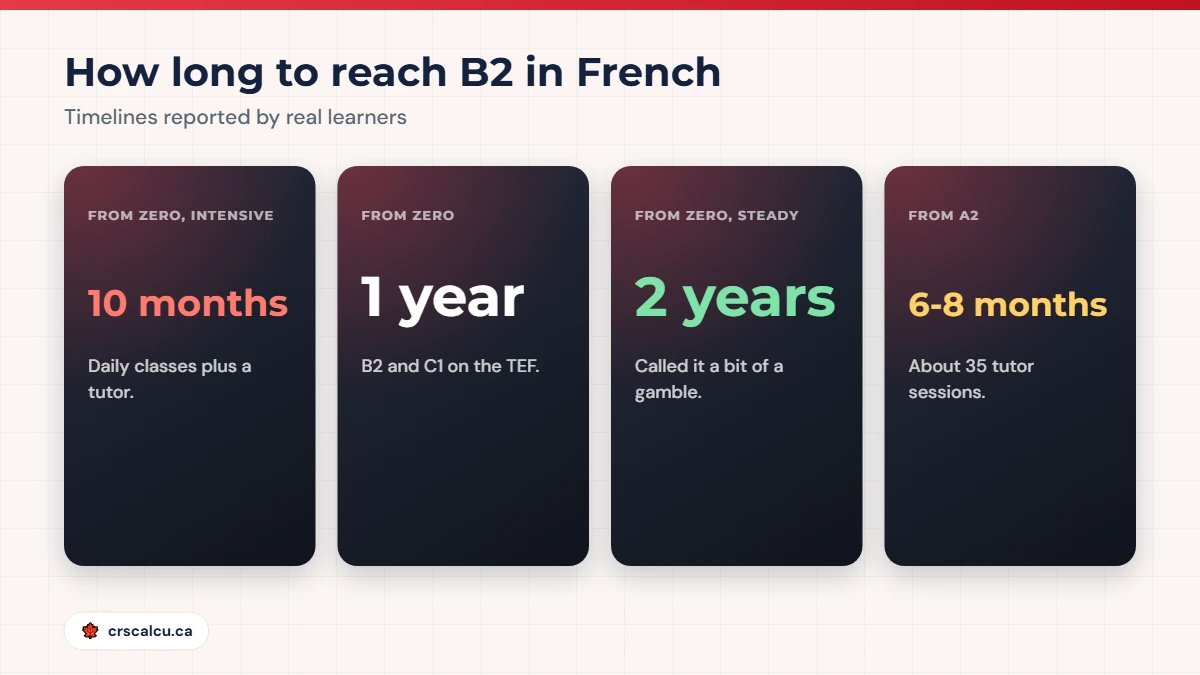
Starting point | Time to about B2 | How they studied |
|---|---|---|
Zero | About 10 months | Classes 3 hours a day, 4 days a week, plus daily tutoring; last 2 months only exam prep |
Zero | About 1 year | Reached B2 in two skills and C1 in two on the TEF |
Zero | About 2 years | Steady study; called it “a bit of a gamble” |
A2 from earlier classes | 6 to 8 months | About 35 half-hour tutor sessions, French video, practice tests |
Zero, 7 to 8 hours a day | About 10 months | Full plan every day; score went from 473 to 579 |
From forum threads (2017 to 2024) and stories shared with us. Your pace will differ.
In September 2017, a member with about 420 to 430 points wanted to learn French in two or three months. A French speaker doubted it. An experienced member said to expect at least a year of concentrated study. Someone who had done it in a year added a warning: unless you reach B2, the result barely moves your score.
Real case: beginner in January, passed in December
One member started from nothing in January 2020 and passed the TEF Canada on the first try about 10 months later. They admitted they were not serious for the first months and said steady effort from day one would have cut the time. What they used: an intensive beginner class, a private tutor, a second tutor only for the exam, podcasts, flashcards and a language exchange partner. Their advice was that writing and speaking need a real person to correct you.
Tip: all four skills, not your best three
In October 2021, a member posted TEF results with B1 in reading, listening and writing and A2 in speaking. The reply was short. You need NCLC 7 in every skill for the bonus. In December 2024, another had NCLC 5 in speaking and listening only and did not qualify for French draws. Plan your study around your weakest skill, because French points Express Entry rules reward all four or nothing.
TEF Canada or TCF Canada?
To claim French points Express Entry needs a result from one of two tests: TEF Canada or TCF Canada. Results are valid for two years. A DELF or DALF diploma is not accepted. In May 2019, a member who had just passed DELF B2 asked if they still needed the TEF. They did.
Real case: missed on TEF, got 50 points on TCF
In April 2021, a member who had studied French for three years shared both results. On the TEF Canada they scored C1 in speaking and listening but B1 in writing, so no bonus. On the TCF Canada they scored C1 in listening and reading and B2 in writing and speaking. That was enough for the 50 points. They found the TCF more practical, mostly because of how the reading section builds in difficulty.
That is one person’s experience, and both tests have changed their formats over the years. The useful lesson is this: if you miss by one skill on one test, the other test is worth a try before another six months of study.
Before you book a French test
You can convert TEF and TCF scores with our CLB calculator.
Is French Worth It for You?
Are the French points Express Entry offers worth a year of study? Sometimes yes, sometimes no. A Quora writer who immigrated in 2020 gave advice that still holds: finish squeezing your English first. It is usually faster to go from CLB 8 to CLB 9 than to learn a new language. Our CLB 9 vs CLB 10 guide shows what that jump is worth.
Your situation | Our view |
|---|---|
English below CLB 9 | Fix English first. It is faster and worth up to 82 points |
CLB 9 or 10, score 440 to 500, no Canadian work | French is likely your best path |
Score under 420 even after English | French draws make it realistic; a province may be faster |
Already B1 in French | Strong yes. You are months away, not years |
Work permit ends in under a year, starting from zero | Risky. Run French next to another plan |
Eligible for a healthcare, trades or transport draw | Check those cutoffs first |
A guide, not a promise. Cutoffs change with every draw.
After March 2025, when job offer points were removed, French became the main advice on the forums. In December 2024, a worker with 478 points was about to lose a 50-point job offer. Members told him to push his French to NCLC 7. See all current categories in our category-based draws guide.
The 2026 Risk: French Points May Change
One learner chasing French points Express Entry rewards called two years of study “a bit of a gamble” because the government can change the rules. In 2026 that worry has something concrete behind it.
IRCC published a consultation paper on Express Entry reforms. It explains that French additional points were introduced in 2017 and increased in 2020. It then says that since category-based selection began in 2023, those additional points “may no longer be necessary” to select French speakers. IRCC is assessing whether to remove or change them.
What that means today
Mistakes we saw in the threads
Frequently Asked Questions
How many CRS points do I get for French?
With NCLC 7 in all four French skills and CLB 5 in all four English skills, you get 50 additional points plus 12 second language points. That is 62 in total, or 74 at NCLC 9.
What French level do I need for Express Entry points?
NCLC 7 in speaking, listening, reading and writing for the additional points. That is roughly B2. Lower levels give only 1 point per skill.
How long does it take to learn French for Express Entry from zero?
People who shared their results needed about 10 months of intense study up to 2 years. Nobody in the threads we read did it in a few months.
Is TEF or TCF easier?
It depends on the person. One forum member missed the bonus on TEF Canada and got it on TCF Canada. Try a mock test of both.
Does DELF B2 count for Express Entry?
No. IRCC only accepts TEF Canada and TCF Canada results for Express Entry.
Do I need English if I have French?
Not to be eligible, but you get 50 additional points only with CLB 5 or higher in all four English skills. Without that, you get 25.
Will I be in French draws automatically?
Yes. Once valid results showing NCLC 7 in all four skills are in your profile, you are considered in French-language rounds.
Are French points being removed?
IRCC said in a 2026 consultation paper that it is assessing whether to remove or change them. As of October 2026 they are still in force.
See what French would do to your score
Add a French result to our free calculator and compare your score with recent French-language draw cutoffs.
Final Thoughts
The French points Express Entry gives are real, large and hard to earn. NCLC 7 in all four skills is the only level that pays, and it takes most beginners about a year of serious work.
If your English is maxed and your score is stuck, French is still the strongest move you control. Start with a level test, plan for a year, and keep one eye on IRCC’s review.