Express Entry Guide · Updated October 2026
Baby Born After ITA: How to Add a Newborn to Your Express Entry Application at Every Stage (Real Cases)
Immigration timelines and due dates rarely line up. If your baby arrives between the invitation and the landing, the application has to catch up. Here is how, stage by stage.
A baby born after ITA is one of the happiest complications an Express Entry application can have. It is also one that IRCC expects to hear about. A new child is a new family member, and every family member has to be declared, whether the application is still on your laptop, sitting in a processing queue, or already approved.
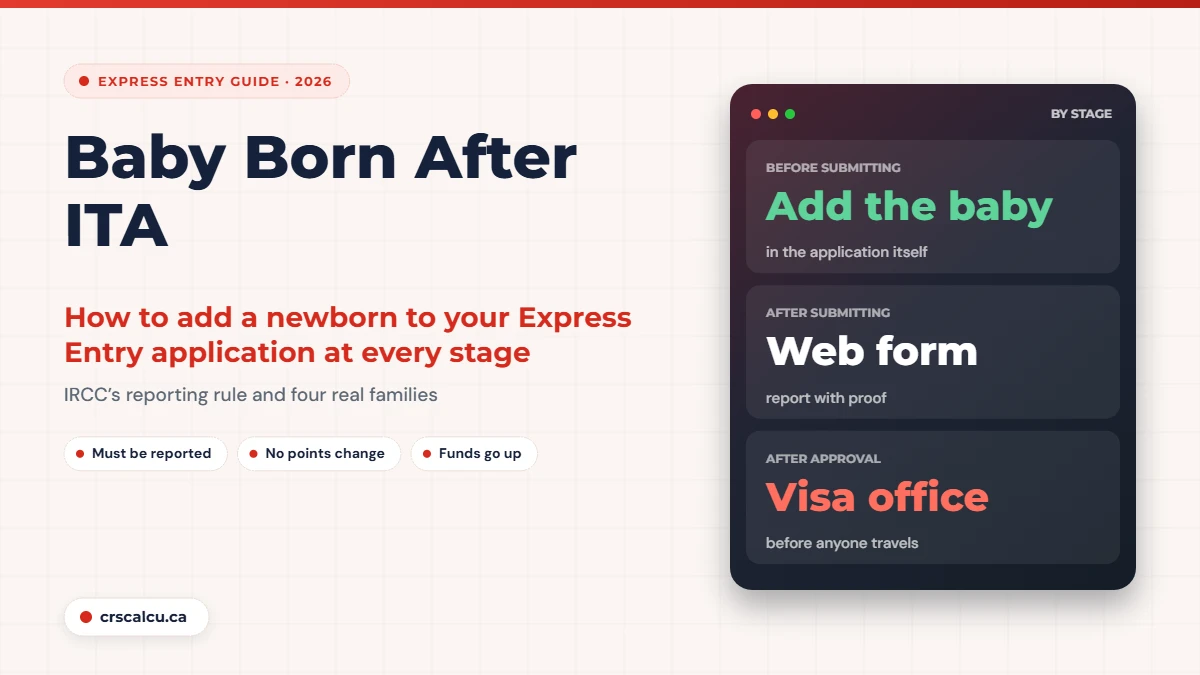
What you have to do depends on where the application is on the day the baby is born. Before you submit, you add the child to the forms. After you submit, you tell IRCC and send documents. After approval but before you land, the visa office has to issue papers for the baby too. The one thing you cannot do at any stage is say nothing.
We read IRCC’s pages on updating an application, dependent children, responding to an invitation and medical exams, along with four public forum threads from 2018 to 2022 from parents whose babies were born after the invitation, after the acknowledgment of receipt, and after the visa.
Quick answer: what do I do if my baby is born after ITA?
Tell IRCC, with proof. Its “Update your application” page (modified September 3, 2026) lists a new child (birth or adoption) among the changes you must report and says to include proof of any change. If you have not yet submitted, add the baby to the application itself. If you have submitted, report the birth through the IRCC web form and send what IRCC asks for. A new child does not change your points, but it raises the settlement funds you need and adds a fee. A baby born in Canada is normally a citizen and is listed, not added as an applicant.
Key takeaways
Baby born after ITA: why you must report it
Three official rules point the same way. The “Update your application” page lists a new child, by birth or adoption, among the changes applicants must report, and says IRCC needs up-to-date information to review and decide the application. The page on family members says you must declare all of them when you apply for permanent residence. And the dependent child page defines a child under 22 as a dependant.
There is also a practical reason. A child who is not declared and examined before you become a permanent resident generally cannot be sponsored by you later. For a baby born abroad, being added now is the simple route. We cover the general rules in dependent children in Express Entry.
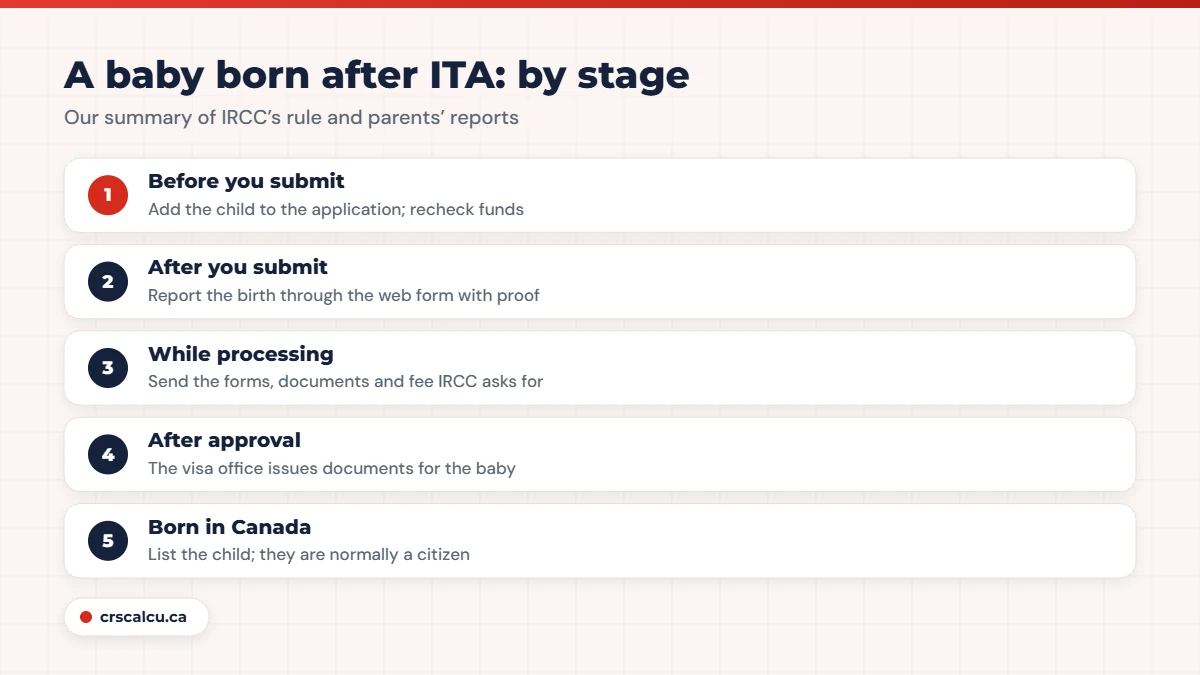
When the baby is born | What to do | Source |
|---|---|---|
After the invitation, before you submit | Add the child to the application; recheck funds and fees | Forum advice; IRCC’s invitation page on changes |
After you submit, before a decision | Report through the web form with proof | IRCC: Update your application |
After approval, before you land | Tell the visa office; the child needs their own documents | Forum case, 2018 to 2019 |
In Canada, at any stage | List the child as a family member; they are normally a citizen | Forum case, 2020 |
Our summary. The duty to report a new child is on IRCC’s “Update your application” page (modified September 3, 2026). The steps at each stage reflect what parents reported.
Stage one: baby born after ITA, before you submit
Your profile is locked once you are invited, so the baby cannot be added there. The application you fill in after the invitation is where family members are entered, and it should describe your family as it is on the day you submit.
Real case: invited, then a newborn before submitting (July 2018)
A candidate received an invitation and their baby was born before the application went in. They asked how to add the child. Members said the profile could not be changed at that point and that the child’s details belong in the permanent residence application, with a passport, birth certificate and medical exam, and with the settlement funds recalculated for the larger family. They told the applicant to explain the change in a letter. One suggested preparing the baby’s papers in the meantime, since requests for a child’s documents can come with a short deadline. A day later the applicant already had the passport and birth certificate.
IRCC’s page for invited candidates says that if your situation changes, you should recalculate your score before applying. Children carry no points, so a birth does not lower your score. What it changes is family size.
Before you submit with a newborn
If the baby’s passport cannot be issued before your 60 days run out, do not miss the deadline over it. Submit with proof that you applied and an explanation, as you would for any document that is on its way. See Express Entry ITA deadline.
Stage two: born after you submit
Once the application is with IRCC, you report the birth through the web form and wait for instructions.
Real case: born eight months after the acknowledgment (August 2021 to January 2022)
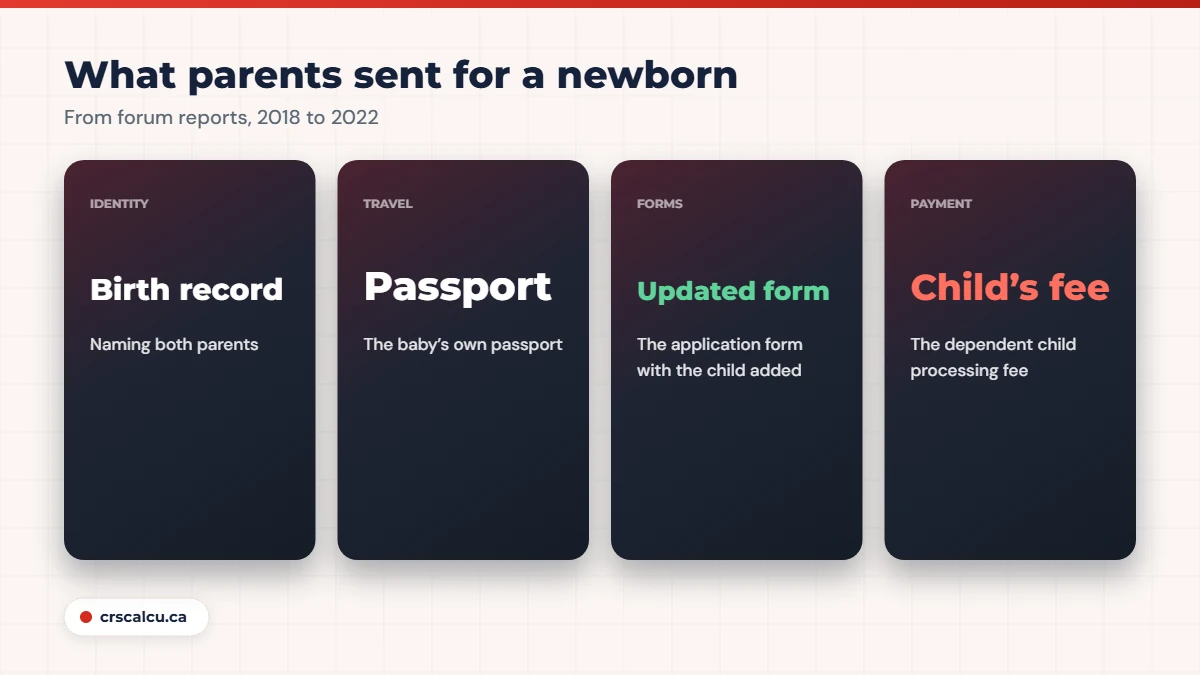
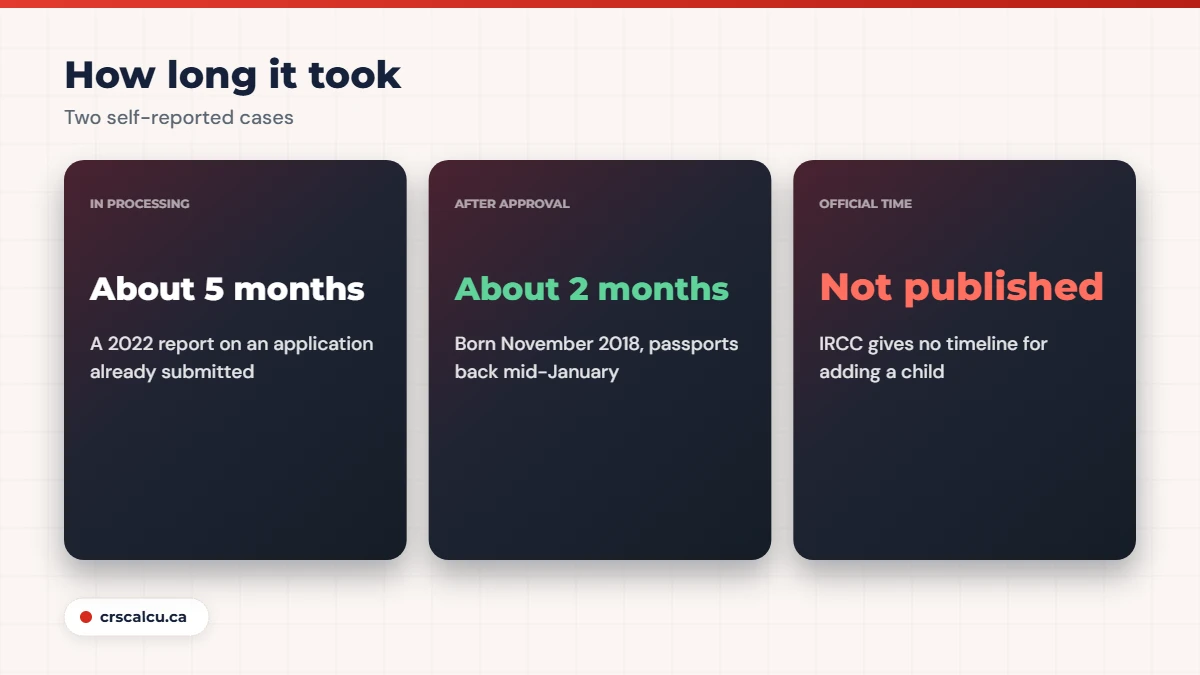
An applicant whose file had been acknowledged in November 2020 had a baby in July 2021 and asked IRCC how to add the child. The reply listed several application forms, the birth certificate, the passport, police certificates and proof of payment. That list puzzled parents, since a newborn has no police record. In January 2022 another applicant who had been through it described what they actually sent: the main application form updated with the child, the birth certificate, the baby’s passport, a letter of explanation and the receipt for the child’s processing fee. No biometric fee was needed. They said it took about five months for the file to move on.
Two points from that thread. IRCC’s first reply was a standard list, and parents should send what applies to a baby and explain what does not. And adding a child takes time, months in that case, during which the rest of the file may appear to stall. Keep an eye on the expiry of your own medical exam results while you wait.
Stage three: born after approval, before you land
This is the stage that frightens parents most, because the documents are already in hand and have an expiry date. IRCC says it cannot extend a COPR. A baby born now needs to be added and to receive their own confirmation before the family travels.
Real case: a second child due between visa and travel (October 2018 to April 2019)
A family had their visas and confirmations and planned to travel in January when they learned a second child would be born in November. The visa office asked for the passports and confirmations back, along with the new birth certificate and the baby’s passport. The parents feared the whole process would restart. A member who had done it listed what they sent: a cover letter, the dependant’s form, the fee receipt, the birth certificate, a passport copy, the baby’s medical results and updated proof of funds. In their case the child was added within three weeks of sending documents in November, passports were requested in December and returned in mid-January. The family landed in February and had their PR cards by early April. The deadline on their documents did not change.
So it can be done, and in that case it took about two months. It also meant sending approved passports back to the visa office. If you are pregnant when approval arrives, tell the visa office your due date and ask how they want to handle it. Our posts on the passport request and the Confirmation of Permanent Residence explain those documents.
Do not travel and land with an undeclared newborn waiting at home. Becoming a permanent resident without declaring the child is the situation the rules are written to prevent.
Medical exam, biometrics and other questions parents ask
A newborn does not escape the health check. IRCC’s Help Centre says all dependants must have a medical exam by an approved panel physician, and that applies to a baby added at any stage. Panel physicians examine infants routinely; ask the clinic what they need you to bring. Biometrics are different. IRCC collects fingerprints and a photo from applicants aged 14 to 79, so a baby is exempt, and the 2022 report above confirms no biometric fee was charged. Police certificates start at 18 and do not apply.
The same reporting rule covers adoption. IRCC’s wording is “a new child (birth or adoption)”, so a child who joins your family by adoption during processing is reported in the same way, with the adoption papers as proof. Adoption cases raise extra questions about when the adoption became final, and they are worth taking to a licensed adviser before you send anything.
If the baby is born in Canada
A child born in Canada is, in almost all cases, a Canadian citizen from birth. They do not need permanent residence and are not processed as an immigrant.
Real case: a citizen baby in a permanent residence application (June 2020)
Parents of a child born in Canada asked whether the child had to be included and paid for. A senior member said the child should be listed on the family information form, with the birth certificate as proof, and that no permanent residence fees are due for a citizen. Later posters reported that the online system showed the child as not accompanying, and were advised to upload the birth certificate and declare the child all the same.
You still report the birth, because your family composition has changed, and your settlement funds are calculated on family size if that requirement applies to you.
Five mistakes new parents make
Five mistakes from the rules and the threads
A new baby does not change your points. If you are still in the pool, the number to watch is the same as before: check it in the CRS calculator against the latest draw cut-offs.
Frequently Asked Questions
What do I do about a baby born after ITA?
You must tell IRCC. Before you submit, add the child to the application. After you submit, report the birth through the web form with proof. A new child does not change your points.
Does a new baby affect my CRS score?
No. Children do not earn or cost ranking points. A larger family does raise the settlement funds you must show, if that requirement applies to you.
What documents does IRCC want for a newborn?
Parents in forum threads sent an updated application form, the birth certificate, the baby’s passport, a letter of explanation and the receipt for the child’s processing fee, and a medical exam where requested. Follow the instructions IRCC sends you.
How long does it take to add a newborn?
IRCC does not publish a time. In one 2022 report it took about five months on an application in process. In a 2018 case after approval, the child was added within three weeks and the passports were back about two months after the birth.
My baby was born in Canada. Do I add them to the application?
List them as a family member with the birth certificate. A child born in Canada is normally a citizen, so no permanent residence fee is paid for them.
Can I land first and sponsor the baby later?
Do not. You must declare all family members, and a child who is not declared and examined before you become a permanent resident generally cannot be sponsored afterwards.
Family growing? Recheck the numbers
Your points do not change with a new baby, but your funds requirement does. See where your score stands against recent cut-offs.
Final Thoughts
A baby born after ITA has to be brought into the application, whatever stage it has reached. Before you submit, that means adding the child and rechecking funds. After you submit, it means a web form, documents and patience. After approval, it means working with the visa office before anyone travels. In the cases we read, families who reported promptly were delayed by weeks or months, and all of them got there.
If your baby is due close to your invitation deadline or to the expiry date on your confirmation, or if you have already travelled without declaring a child, speak to a licensed consultant or lawyer straight away. Timing is everything at those points, and the fix is much simpler before a deadline than after it.